Last Updated: March 27, 2026
Learning how to use chopsticks is one of the most rewarding small skills you can pick up as a home cook — it opens a door into the tactile, intimate way that much of Asia approaches a meal. We have taught countless students this technique in our kitchen, and we promise: with the right grip and twenty minutes of practice, you will wonder why you ever reached for a fork.
Key Takeaways
- The lower chopstick never moves — all motion comes from the upper one.
- Hold the chopsticks roughly two-thirds of the way from the tips, not at the very end.
- Chinese, Japanese, and Korean chopsticks each have a distinct shape designed for their cuisine.
- Several cultural taboos apply across East Asia — knowing them is as important as the grip itself.
- Start practicing with larger foods like broccoli florets before attempting slippery noodles.
Understanding the Basics: Two Sticks, One Job
The Fundamental Rule That Changes Everything
Before touching a pair of chopsticks, absorb this single truth: the lower chopstick is an anchor, not a moving part. It rests against your ring finger and the fleshy base of your thumb, and it stays there for the entire meal. Every motion — every pinch, every grip — comes entirely from the upper chopstick. This is the insight that most beginners miss, which is why so many people end up with sore hands and scattered rice.
Think of the lower chopstick as the fixed jaw of a pair of pliers. The upper chopstick is the moving jaw. Once you feel this distinction in your own hand, the whole system clicks into place. Everything else we teach you from here is just refining that single mechanical relationship.
This matters because chopsticks are not tongs. They are levers — and the ring finger acts as the fulcrum. Understanding this prevents the most common error: gripping both sticks and squeezing them together from the sides, which gives you almost no control and tires your hand in minutes.
Where to Hold the Chopsticks
Grip the chopsticks roughly one-third of the way from the top — or put another way, hold them about two-thirds of the way down from the tips. This is the sweet spot that almost no beginner finds intuitively. Hold too close to the tips and you lose leverage; hold too close to the top and you lose control over small foods.
A practical test: extend the chopsticks in front of you and open them as wide as you can with your fingers. You want a gap of roughly two to three centimetres — enough to grip a dumpling comfortably. If the gap is tiny, shift your hold slightly upward. If the sticks wobble like helicopter blades, move your hold slightly toward the tips.
The exact position shifts slightly depending on chopstick type and the dish you are eating. Noodle dishes allow a slightly higher grip; picking up individual edamame from a bowl calls for moving your fingers a touch closer to the tips. With experience, this adjustment becomes unconscious — like shifting your grip on a pen when switching between writing and sketching.
The Pencil Analogy — and Why It Works
Every chopstick teacher uses the pencil analogy, and we use it too — because it works. Pick up a pencil in your dominant hand. Notice exactly where it rests: the soft pad near the base of your index finger, supported underneath by your middle finger, with your thumb resting on the side to control direction. That is precisely how the upper chopstick should sit.
The pencil analogy also teaches you the right amount of tension. You hold a pencil firmly enough to write, but loosely enough that someone could pull it from your hand without a fight. Chopsticks demand that same relaxed authority. Death-grip tension is the enemy — it creates tremors in your tips, kills fine motor control, and cramps your hand before the main course arrives.
Once the upper chopstick is seated like a pencil, you simply lay the lower chopstick into the groove between the base of your thumb and the first joint of your ring finger. It rests there passively — no pinching, no gripping, just nestled in place by the natural contour of your hand.
Step-by-Step Chopstick Technique for Beginners
Step 1 — Position the Lower Chopstick
Hold your dominant hand out with your palm facing up. Place the first chopstick so it sits in the crook between your thumb and index finger — that fleshy web of skin. Let it rest on the first joint of your ring finger (the finger next to your pinky). The ring finger acts as a shelf. Your thumb will press lightly against the side of the chopstick to hold it steady. Do not curl your ring finger around it — just let the chopstick sit on top.
Now flip your hand over so your palm faces the table. The lower chopstick should stay in place through that rotation, held by the gentle pressure of your thumb and the ring finger shelf beneath it. If it falls, your ring finger is probably curled too tightly. Relax the whole hand and try again — the natural resting position of your fingers is usually all the grip the lower stick needs.
The lower chopstick tip should point at whatever you plan to eat. Keep both chopstick tips level — if one is dramatically higher than the other, your grip needs adjusting. Practice this position alone for thirty seconds before adding the second stick.
Step 2 — Add the Upper Chopstick
Now pick up the second chopstick and hold it exactly like a pencil — resting on the side of your middle finger, with your index finger resting along the top and your thumb pressing lightly on the side. Your index finger and middle finger will do most of the work. Your thumb provides the anchor point that lets those two fingers move freely.
The upper chopstick should sit closer to your fingertips than the lower one — it sits higher in your hand, above the lower stick, with a small gap between the two. When you look at your hand from the side, the two chopsticks should be roughly parallel, with the upper one sitting perhaps a centimetre above the lower one at the hold point.
Check your thumb: it should be bent slightly at the joint and pressing against both chopsticks from the side. The thumb does not push down — it stabilises from the side, like a wall that keeps the sticks from sliding left or right. If your thumb is straight and stiff, your grip will feel rigid and clumsy. Bend it, relax it, and feel the difference.
Step 3 — Practice the Opening and Closing Motion
With both chopsticks in position, practice opening and closing them without any food present. Push your index and middle fingers forward — this lowers the upper chopstick tip toward the lower one, closing the gap. Pull them back — this opens the gap. The lower chopstick should not move at all during this exercise. If it does, your ring finger is probably trying to join the action. Consciously keep it still.
Aim for a smooth, even opening and closing motion. The tips should meet cleanly when closed — if one crosses over the other like scissors, your grip alignment needs work. Adjust the position of the upper stick slightly until the tips meet flush. This alignment matters enormously when you are trying to pick up something small like a single soybean.
Do ten slow open-close repetitions. Then do ten more at a normal speed. You are training muscle memory here, not just understanding a concept. The hands need to feel this pattern before you add the complexity of actual food. This is the stage that separates people who ”get” chopsticks from those who struggle with them every time they sit down at a noodle bar.
Common Mistakes and How to Fix Them
Mistake 1 — Moving Both Sticks
This is by far the most common error we see. When both chopsticks move simultaneously, you end up with a scissors action that has almost no grip force — food pops out sideways or rolls away entirely. The fix is simple but requires conscious attention: press your ring finger firmly against the lower chopstick as a reminder that it is not supposed to move. Some teachers suggest putting a folded napkin between the lower chopstick and your ring finger as a tactile cue.
If you keep catching yourself moving both sticks, slow everything down. Eat deliberately. Speed will come with practice, but first you need the correct pattern locked in. Rushing the learning phase is what locks bad habits into muscle memory.
A useful drill: hold a chopstick in your non-dominant hand and tap the lower chopstick of your main grip every time it moves. This external feedback loop accelerates correction significantly. Within a single meal of mindful eating, most people eliminate this error.
Mistake 2 — Gripping Too Tightly
Tension is the enemy of fine motor control. When you grip chopsticks hard, you activate large muscle groups in the forearm that are built for power, not precision. The result is chopstick tips that shake visibly and cannot align accurately. The paradox of chopstick technique is that the more relaxed your grip, the more food you actually pick up.
A check we give beginners: at any point during your meal, can you feel the chopsticks? If you can feel pressure in your palm or along your ring finger, you are gripping too hard. The chopsticks should feel almost weightless in your hand — present but not demanding attention. Think of holding a small bird: firm enough that it cannot fly away, gentle enough that you do not hurt it.
If tension is persistent, take the chopsticks out of your hand, shake your wrist loose, and consciously relax your whole arm before re-gripping. Tension often starts in the shoulder and travels down. A relaxed shoulder leads to a relaxed hand.
Mistake 3 — Tips That Do Not Align
When the tips of your chopsticks are at different heights — one pointing up, one pointing down — you cannot pick up food cleanly. This misalignment usually comes from the upper chopstick sitting too far forward or too far back in your hand relative to the lower one. Both tips should meet at exactly the same point when you close them.
The quick fix: before eating, tap the tips of both chopsticks on the table together, like you are tapping a pen. This naturally aligns them at the same endpoint. Most experienced chopstick users do this automatically at the start of every meal — it is the chopstick equivalent of squaring a deck of cards.
If misalignment persists even after tapping, the problem is in your hold position. The upper chopstick needs to move slightly — either further toward your fingertips or back toward your palm — until both tips naturally meet at the same point when closed.
Types of Chopsticks: Chinese, Japanese, and Korean
Chinese Chopsticks — Longer and Blunt-Tipped
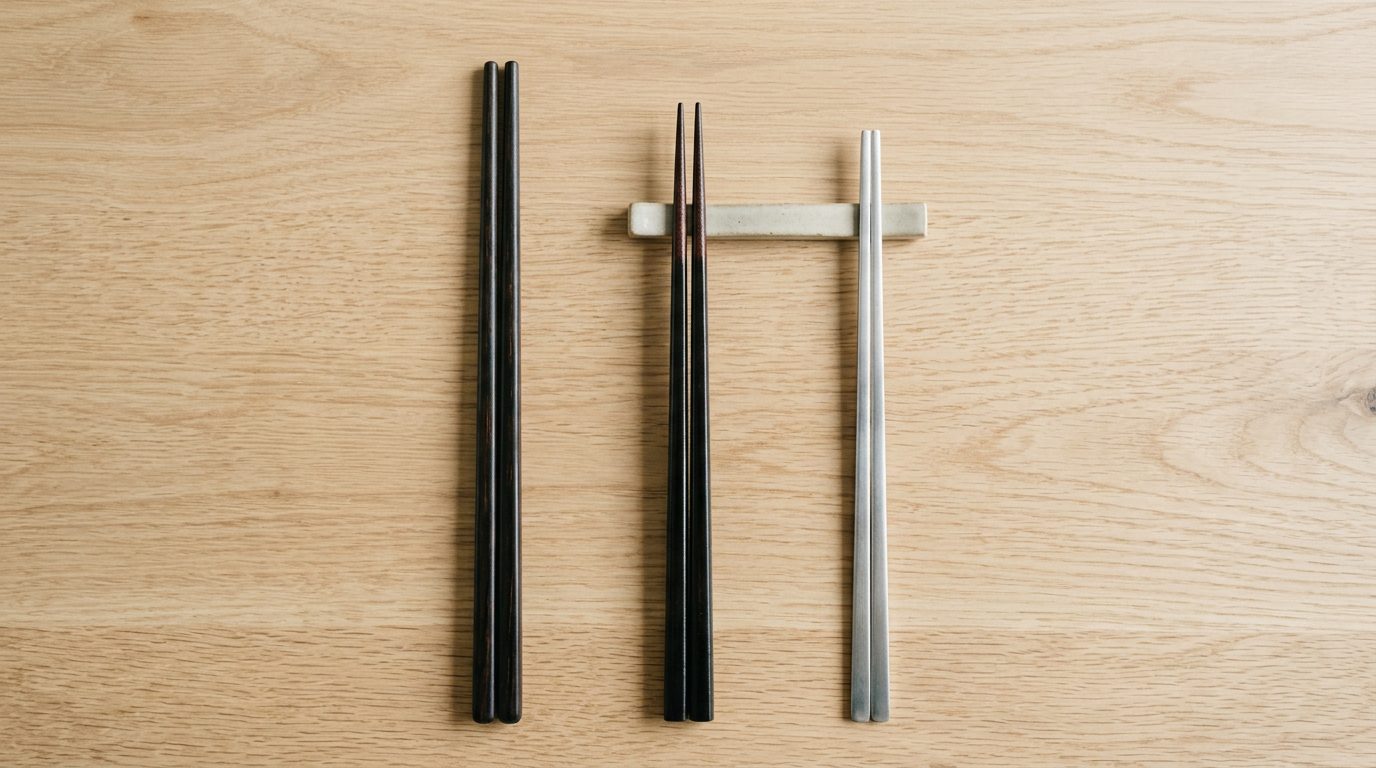
Chinese chopsticks are the longest of the three main types, typically measuring 25 to 30 centimetres. They have a blunt, rounded or squared-off tip and are usually thicker throughout their length. This design is deliberately practical: Chinese meals are often served family-style, with shared dishes placed in the centre of the table. The extra length lets diners reach across a large lazy Susan without standing up. The blunt tip grips chunks of meat, tofu, and stir-fried vegetables efficiently without requiring needle-like precision.
Chinese chopsticks are made from bamboo, wood, melamine plastic, or lacquered wood. The material matters in the kitchen too — bamboo and wood provide a slight surface texture that helps grip slippery foods like silken tofu or blanched greens. If you are practicing at home and own a pair of Chinese-style chopsticks, you are actually starting with the most forgiving type.
Bamboo chopsticks are a standard in Chinese households and restaurants for a reason: they are inexpensive, lightweight, and their natural surface texture improves grip on food. According to the Chinese Bamboo Industry Association, China produces over 45 billion pairs of disposable bamboo chopsticks annually — a figure that reflects just how central this utensil remains to daily life across the country.
Japanese Chopsticks — Shorter and Precisely Pointed
Japanese chopsticks (called hashi) are shorter, typically 18 to 23 centimetres, and taper to a fine pointed tip. That pointed tip is not an aesthetic choice — it is a functional one. Japanese cuisine frequently requires precision work: removing bones from grilled fish, separating delicate pieces of sashimi, or lifting individual pieces of nigiri without disrupting the shape. A pointed tip allows this kind of careful, controlled handling that a blunt tip simply cannot match.
Japanese chopsticks are often lacquered with beautiful designs, and the lacquer serves a practical purpose alongside the aesthetic one — it creates a smooth surface that slides cleanly off the chopstick rest between bites. You will notice that Japanese table settings almost always include a chopstick rest (hashioki), a small ceramic or wooden prop designed to keep the tips elevated off the table between uses. This is not just politeness — it keeps the tips clean and the lacquer undamaged.
Women’s and children’s chopsticks in Japan tend to be shorter still, with some women’s chopsticks measuring as little as 19 centimetres. When buying Japanese chopsticks for a household, sizing to hand width is standard practice — the ideal chopstick length is roughly 1.5 times the distance from the tip of your thumb to the tip of your index finger when held at a right angle.
Korean Chopsticks — Flat and Metal
Korean chopsticks (jeotgarak) stand apart from Chinese and Japanese versions in two significant ways: they are made of metal — typically stainless steel — and they are flat and rectangular rather than round or tapered. The metal construction comes from Korean court tradition, where silver utensils were used to detect poison in food. The flat shape provides a wide gripping surface suited to Korean dining habits, which often involve picking up flat pieces of grilled meat from a BBQ grill or navigating small banchan side dishes.
Metal chopsticks are heavier and more slippery than wood or bamboo, which makes them noticeably harder for beginners. If you are learning on Korean chopsticks, expect a steeper initial learning curve. The weight changes the feel of the lever action, and the smooth metal surface offers almost no natural grip on food. Korean home cooks compensate with slightly different hand tension — a touch firmer than with wood, but still relaxed by Western utensil standards.
One advantage of metal chopsticks: they are reusable for decades, dishwasher-safe, and do not absorb odours or stains the way wood can. From a sustainability standpoint, a single pair of stainless steel Korean chopsticks can replace thousands of disposable bamboo pairs over a lifetime.
| Feature | Chinese | Japanese | Korean |
|---|---|---|---|
| Typical length | 25–30 cm | 18–23 cm | 22–25 cm |
| Tip shape | Blunt / rounded | Pointed / tapered | Flat / squared |
| Material | Bamboo, wood, plastic | Lacquered wood, bamboo | Stainless steel |
| Best for | Shared dishes, stir-fry | Fish, sushi, precision | BBQ, banchan, soup |
| Beginner difficulty | Easy | Medium | Harder |
Practice Exercises: Building Your Skill Progressively
Week 1 — Large, Forgiving Foods
Begin with foods that are large, firm, and forgiving of an imperfect grip. Broccoli florets are an ideal first target — large enough to grab confidently, textured enough to stay put between the tips, and firm enough not to crumble under pressure. Other good starters include baby potatoes, large cubes of firm tofu, chicken pieces, and snap peas. The goal is not precision yet; it is simply getting your hand comfortable with the open-close motion and building confidence.
Eat at least one full meal per day using chopsticks during this first week, even if it is a Western meal that would normally call for a fork. Scrambled eggs with chopsticks is genuinely challenging and will accelerate your skill development faster than any structured drill. The frustration is part of the process.
A useful non-food drill during this week: scatter a handful of dry pasta or large dried beans across a plate and pick them up one by one, transferring them to a bowl. This gives you immediate visual feedback on tip alignment and control without the complication of being hungry.
Week 2 — Intermediate Challenge Foods
Once large foods feel comfortable, move to foods that require more control and precision. This is where the real progress happens. Work with steamed dumplings (gyoza or xiaolongbao), chunks of grilled tofu, pieces of rolled sushi, or sliced meat from a hot pot. These foods are smaller and occasionally slippery, which forces you to refine your tip alignment and grip consistency.
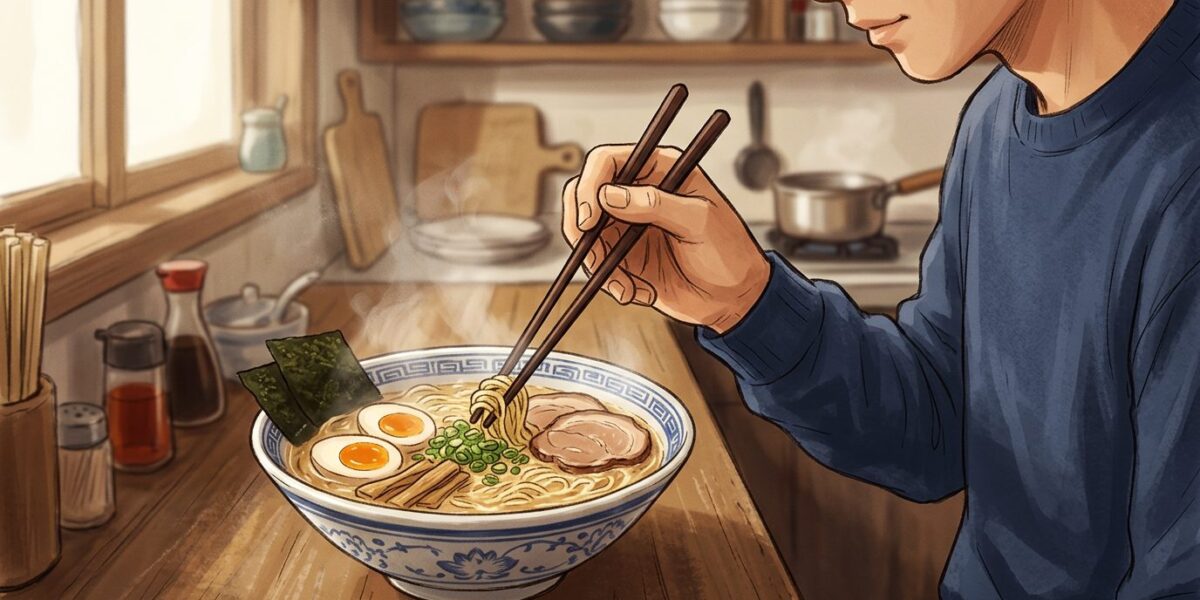
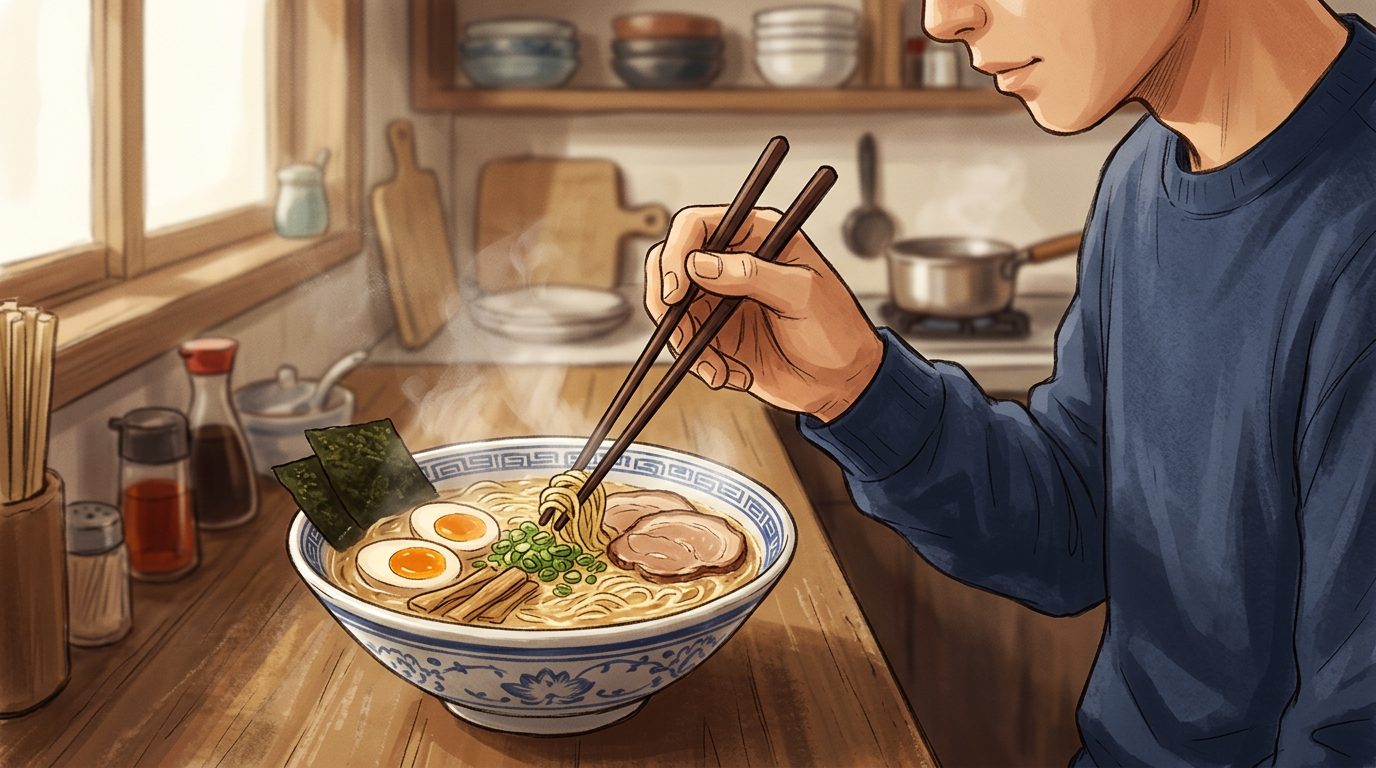
Noodles deserve their own mention as a Week 2 challenge. Long noodles — ramen, udon, soba — are a completely different skill from picking up solid food. The technique is a partial wrap rather than a pinch: bundle a loose clump of noodles between the chopstick tips rather than trying to grab individual strands. This is the same motion you see in every ramen shop in Tokyo, and it becomes natural quickly once you have the basic grip solid.
Our recommendation for Week 2: try cooking and eating our bun cha recipe with chopsticks exclusively. The combination of vermicelli noodles, grilled pork, and fresh herbs gives you multiple textures and sizes to work with simultaneously — exactly the variety that builds skill fastest.
Week 3 and Beyond — Mastery Level Foods
The benchmark for chopstick mastery, by informal convention among Asian cooks, is picking up a single grain of cooked rice with confidence. This is achievable within three to four weeks of consistent practice for most adults. Individual soybeans, single pieces of corn, and slippery items like steamed fish skin are the tests that separate a competent chopstick user from a fluent one.
At this stage, we also recommend practicing with Korean metal chopsticks if you have only practiced with wood or bamboo. The different weight and texture will reveal any weaknesses in your grip that comfortable wooden chopsticks were hiding. Think of it as the chopstick equivalent of a musician practicing scales on a difficult instrument to expose technical gaps.
One milestone worth celebrating: the moment you stop thinking about chopstick technique and just eat. That automatic fluency, where the utensil disappears from your conscious attention, typically arrives somewhere between week three and week six. When it happens, you will understand why billions of people around the world eat this way every single day without a second thought.
Chopstick Etiquette: What Not to Do
Never Stick Chopsticks Upright in Rice
In Japanese, Chinese, Korean, and Vietnamese dining culture, sticking chopsticks vertically into a bowl of rice is considered deeply disrespectful — in Japan specifically, it is associated with the incense sticks placed upright in sand at Buddhist funeral ceremonies. The visual similarity is unmistakable, and the taboo is strong enough that many Asian diners will feel genuine discomfort if they see it at the table, even in a casual Western context.
When you are not using your chopsticks, rest them horizontally on the chopstick rest if one is provided, or lay them across the rim of your bowl. Many restaurants also provide a small paper sleeve from the chopstick packaging that can be folded into an improvised chopstick rest — a neat solution that shows awareness of table manners.
This is not obscure etiquette knowledge reserved for formal Japanese dinners. As Asian restaurants have become a part of everyday dining in cities worldwide, awareness of these conventions has practical social value — it shows respect for the cultural context of the food you are eating.
Never Pass Food Chopstick to Chopstick
Passing food directly from one person’s chopsticks to another person’s chopsticks is taboo in Japanese culture — it replicates the ritual of passing cremated bones between family members during a Buddhist funeral. This particular taboo is less universally observed across all of East Asia, but in Japanese settings it is taken seriously enough that the correct method is always to place food on a shared plate or the rim of the recipient’s bowl, allowing them to pick it up themselves.
The broader principle here is one of respect for the chopsticks as an extension of the person using them. In many East Asian traditions, placing your own chopsticks into a shared dish is similarly discouraged — instead, shared dishes often come with serving chopsticks or a serving spoon. When they do not, it is polite to use the clean far end of your own chopsticks to serve from a communal plate.
Additional etiquette notes worth knowing: do not point chopsticks at other people, do not wave them in the air while speaking, and do not spear food with a chopstick tip as if using a skewer. Each of these behaviours has cultural resonance that marks an unfamiliar diner clearly — whereas simple awareness of these conventions shows genuine engagement with the culture behind the meal.
Other Table Manner Basics
Do not use chopsticks to scrape food from a bowl or plate — this creates the impression of desperation or disrespect toward the host. Do not hover chopsticks indecisively over shared dishes for extended periods, a habit called mayoi-bashi in Japanese, which is considered rude. Decide what you want, reach for it decisively, and take it cleanly. The whole motion — reach, grip, lift — should take two seconds, not ten.
Do not use chopsticks to move bowls or plates across the table. In formal Japanese dining, this is the role of the hand only — chopsticks touch food, not tableware. This rule is less strictly observed in casual Chinese or Korean settings, but knowing it prevents embarrassment in more formal contexts.
Finally, when you finish your meal at a Japanese restaurant, place your chopsticks back in their paper sleeve or lay them neatly on the rest. Leaving them carelessly crossed or propped against a bowl is the equivalent of leaving your cutlery at odd angles in a Western fine dining setting — technically fine, but subtly inattentive.
Teaching Children to Use Chopsticks
The Right Age to Start
Most child development specialists suggest that children are ready to begin learning chopstick basics between ages three and five, when fine motor skills have developed sufficiently to manipulate two independent objects with one hand. Before age three, most children lack the finger coordination required — and forcing the skill too early creates frustration that can put children off chopsticks entirely. There is no rush. Let the child show interest naturally.
In many Asian households, chopsticks are introduced as a natural part of mealtimes from early toddlerhood — not as a lesson, but simply as the utensil on the table. Children observe adults using them and naturally want to try. This observational learning is genuinely effective. If you eat with chopsticks regularly at home, your children will learn faster than if chopstick practice is treated as a separate, formal activity.
Age five to six is typically when children can manage the full standard adult grip with some consistency. Before that age, training chopsticks provide the scaffolding that lets children enjoy the experience without the frustration of the full technique. By age seven or eight, most children who have been exposed to chopsticks regularly can eat a complete meal without assistance.
Training Chopsticks — A Practical Bridge
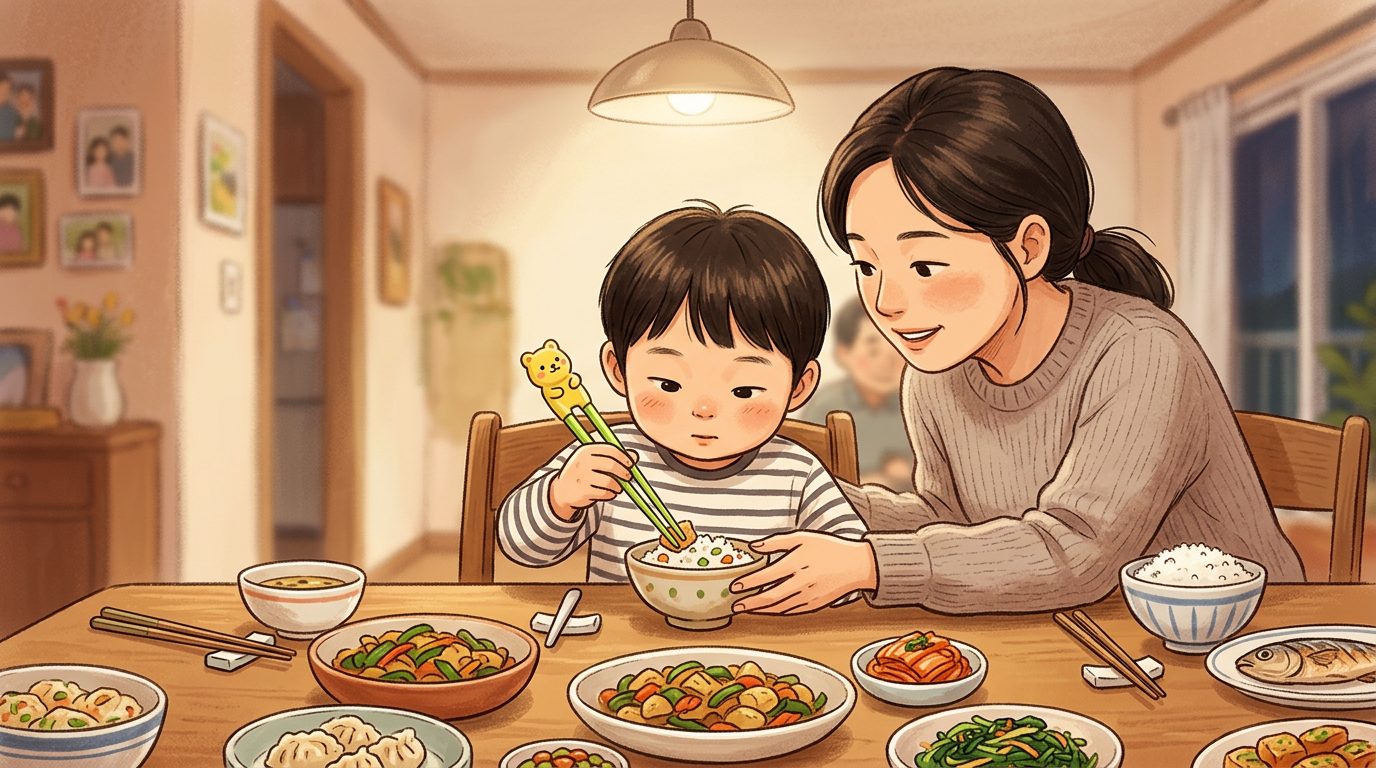
Training chopsticks are an excellent tool — they attach at the top with a spring mechanism or a connector that keeps the tips aligned and provides basic resistance, mimicking the open-close action without requiring the child to manage grip position simultaneously. The child builds confidence and motor memory without the demoralising experience of food rolling away every time.
The best training chopsticks we have seen use a removable connector ring, so the child can transition gradually — first with the ring, then with just the ring loosened, then without it entirely. This graduated approach prevents the common problem of children becoming dependent on the training aid and struggling to transition to standard chopsticks. The goal of training chopsticks is always to make themselves obsolete.
Look for training chopsticks with non-slip silicone tips rather than wooden ones — the textured surface helps young children grip food more easily during the early stages, which keeps frustration low and motivation high. Many training chopstick sets also come sized specifically for small hands, which matters — an adult-length chopstick is genuinely difficult for a five-year-old to control.
Foods and Activities That Work Best for Children
For children learning chopsticks, the food itself is the motivation — so choose foods they genuinely enjoy. Dumplings are a favourite learning food because they are large, firm, and satisfying to grab. Cherry tomatoes work surprisingly well for slightly older children as a challenge food. Marshmallows are a classic teaching tool — soft enough to be forgiving of poor alignment, large enough to feel like a win when lifted successfully.
Make the practice into a game rather than a lesson. Set up a transfer challenge — a bowl of large foods on one side, an empty bowl on the other — and time how quickly the child can move all the pieces. Celebrate every successful pick-up, not just completed transfers. The emotional experience of learning a new physical skill is as important as the technical progress.
If your child is learning alongside you, cook something together that you will both eat with chopsticks. Our velveting chicken technique produces a dish with perfectly sized, tender pieces that are genuinely satisfying to eat with chopsticks — and the process of cooking together makes the meal feel like a shared achievement. You can also explore our full guide to cooking rice perfectly, since a bowl of steamed rice is the ultimate chopstick challenge food for any learner.
Frequently Asked Questions
Is it rude to use chopsticks incorrectly at an Asian restaurant?
Using chopsticks with imperfect technique is not considered rude — making a genuine effort is almost universally appreciated. What matters from an etiquette standpoint is avoiding the specific taboos: do not stick chopsticks upright in rice, do not pass food chopstick to chopstick, and do not point chopsticks at other diners. A Western diner with clumsy technique but good intentions will always be seen more warmly than someone with perfect grip who ignores these cultural conventions entirely.
Which hand should I use for chopsticks?
Use your dominant hand — the same hand you write with. Left-handed chopstick use is completely acceptable and common throughout Asia. There is a historical tradition in some parts of China that encouraged right-hand use for all utensils, but this is not enforced or expected in modern dining contexts anywhere. Use whichever hand gives you the most natural motor control, and do not let anyone tell you otherwise.
Are there beginner chopsticks designed for adults?
Yes — and they are worth considering if you find the standard learning curve frustrating. Adult training chopsticks are available with spring-loaded connectors, corrective grip guides, and non-slip coatings. Several Japanese kitchen brands produce adult-sized versions of the connector-ring training chopstick. That said, most people find that within two to three weeks of eating regular meals with standard chopsticks, they no longer need any training aid. The aid is a shortcut, not a requirement.
Why do my chopstick tips keep crossing like scissors?
Crossing tips almost always means your upper chopstick is positioned too far from your palm — it has slid forward toward your fingertips and is now sitting at an angle rather than parallel to the lower stick. Pull the upper chopstick back slightly in your grip so both sticks run parallel. Then tap both tips together on the table to realign them at the same endpoint. Repeat this check every few minutes while you are still building muscle memory.
What are the best foods to practice chopsticks with as a beginner?
Start with large, firm, textured foods: broccoli florets, potato chunks, firm tofu cubes, and snap peas are ideal first targets. Progress to dumplings, sushi rolls, and noodle dishes in week two. The classic non-food practice tool is a bowl of dry pasta or large dried beans — cheap, available anywhere, and excellent for building tip alignment without the pressure of an actual meal. Avoid slippery foods like steamed fish or edamame until you have at least two weeks of regular practice.

Mei Lin Chen
Mei Lin Chen is an Asian food writer and recipe developer. Melbourne-raised and London-based, she has spent over a decade exploring the rice paddies, hawker stalls, and home kitchens of South-East and East Asia. Her recipes balance traditional technique with everyday practicality.