Last updated: March 13, 2026
Thai food is the loudest, most punch-forward cuisine in Southeast Asia, and once you understand how its four flavor pillars work together, the entire kitchen opens up. A single bite of pad krapow or a spoonful of tom yum is the clearest possible demonstration of what Thai chefs call rot chat—a ”clear taste” where salty, sour, sweet, and spicy each show up as a distinct, recognizable note rather than blending into a muddled middle ground. That balance is the cuisine’s organizing principle, and it explains why a 30-second street-stall stir-fry can taste more vivid than a multi-course tasting menu at home.
This guide walks through Thai cuisine the way a curious home cook should learn it: the regional map first (because there is no single ”Thai food”—there are four distinct culinary kingdoms), then the pantry, the must-try dishes from street to royal court, the techniques that produce that taste at home, and finally a meal-planning framework so your Thai dinners stop feeling like a single dish surrounded by white rice and start feeling like a real Thai table.
A Short History of Thai Cuisine
Thai cuisine as we recognize it today is younger than most diners assume. The chili pepper—now utterly inseparable from a Thai green curry or som tam—arrived only in the 16th and 17th centuries, brought to the Ayutthaya Kingdom by Portuguese traders who had carried it from the Americas. Before then, ”Thai” heat came from black pepper, white pepper, ginger, and galangal. The cuisine that existed in the 14th and 15th centuries was closer to a tropical, herb-driven cousin of regional Mon and Khmer cooking: rice-based, sour from tamarind and lime, fragrant with lemongrass and kaffir lime, but without the bright red burn we now consider non-negotiable.
Three waves of outside influence shaped Thai food into its modern form. The first was Indian, arriving via Buddhist exchange and Indian Ocean trade—this is where dry-spice curries, the technique of frying paste in oil, and dishes like massaman come from. The second was Chinese, especially Teochew migration in the 18th and 19th centuries, which brought the wok, stir-frying, soy sauce, noodles (including the rice noodles that became pad thai and pad see ew), and the entire street-food culture of single-portion fast cooking. The third was European, more subtle but real: Portuguese desserts using egg yolks (the foi thong family of Thai sweets), and later, mid-20th-century pressure from the government to position rice-noodle dishes as a national symbol.
That last point deserves a footnote because it changed how the world saw Thai food. In the late 1930s and 1940s, Prime Minister Plaek Phibunsongkhram promoted a noodle dish—what we now call pad thai—as part of a nation-building campaign aimed at reducing rice consumption during wartime shortages and emphasizing a unified Thai identity. The dish, with its rice noodles, tamarind, fish sauce, palm sugar, peanut, and lime, became the international face of Thai cooking. It is delicious, but it is one dish among hundreds, and treating it as the totem of an entire cuisine has skewed expectations abroad for decades.
The Four Regions of Thailand and Their Food
The single most useful mental model for Thai food is the four-region map. Thailand stretches roughly 1,650 kilometers north to south through monsoon forest, central plains, and tropical coast, and each region developed a different rice, a different attitude toward chili, a different relationship with the sea, and a different repertoire of dishes. A Bangkok dinner table and an Isan dinner table look genuinely different.
Central Thailand (Bangkok and the Chao Phraya plain)
This is the Thai food most travelers meet first, and the cuisine that shaped the royal court tradition. Central Thai food leans on jasmine rice, freshwater fish, palm sugar, and coconut milk. It tends toward balance—sweet, sour, salty, and spicy all moderated against each other. Signature dishes include green curry, tom kha gai, khao man gai, pad krapow, tom yum, and the entire family of stir-fries and curries that built Thailand’s restaurant export. If a dish is fancy-looking, intricately carved, or coconut-rich, it likely traces back to central Thailand.
Northern Thailand (Lanna)
The cuisine of Chiang Mai, Chiang Rai, and the highland north—covered in our Northern Thai food guide—is the cuisine of sticky rice, Burmese and Yunnanese influence, and bold dried-spice curries. There is far less coconut milk here than people expect. Instead, dishes lean on fermented bean (tua nao), pork fat, sour Northern-style sausage (sai ua), tomatoes, and dried chilies. Khao soi—a curry-coconut noodle soup with crispy fried noodles on top—is the regional ambassador, but everyday Northern food looks more like nam prik ong (a tomato-pork chili dip) with sticky rice and steamed vegetables.
Northeastern Thailand (Isan)
Isan is the largest region, sharing a long border with Laos, and the two cuisines are essentially siblings. This is the Thailand of sticky rice eaten by hand, intense fermented funk, grilled meats, raw-vegetable platters, and som tam (green papaya salad) pounded in a clay mortar. The heat here is not the floral burn of a central-Thai green curry; it is the dry, dusty, smoke-laced heat of dried bird’s eye chilies pounded with garlic, lime, and pla ra (fermented fish). Larb, nam tok, grilled chicken (gai yang), and sausages dominate. Isan food has become wildly fashionable inside Bangkok over the past decade, and increasingly abroad, because the flavors are more uncompromising than central-Thai food.
Southern Thailand
South of the Kra Isthmus, on the long peninsula that stretches toward Malaysia, the food turns coastal, hotter, and turmeric-yellow. This is a region of Muslim minorities, deep-sea fishing, rubber and palm plantations, and a heavy hand with fresh chili. Southern curries—gaeng som, gaeng tai pla, massaman in its older Muslim-Thai form—are sharper and more pungent than their central counterparts. Khao yam (a colorful rice salad), shrimp paste (kapi), and stir-fried sator beans are signatures. If a Thai dish is bright yellow with turmeric, ferociously hot, and built on coconut and seafood, you are eating southern.
The Four Flavors: How Thai Cooks Balance a Dish
Every Thai cook, professional or grandmother, is trained—often unconsciously—to taste a finished dish against four reference points: salty (khem), sour (priao), sweet (wan), and spicy (phet). Bitter (khom) and umami exist too, but the four-flavor axis is the working framework. A finished pad thai should hit all four; so should a green curry, a tom yum, and a papaya salad. If a dish tastes flat, the cook tastes it and asks: what’s missing? Add fish sauce for salt. Lime juice for sour. Palm sugar for sweet. Pounded chili for heat. The adjustments happen at the end of cooking, after the dish is otherwise finished, and they are the difference between a Thai dish that tastes like restaurant Thai food and one that tastes like the version a Bangkok auntie made.
This is why almost every Thai table is set with a kreuang prung caddy of four condiments: fish sauce with sliced chili (prik nam pla), sugar, dried chili flakes, and chili vinegar. The cook balances the dish; the diner re-balances it to taste. Nothing is final until it is in your bowl.
Essential Thai Ingredients: The Pantry
Almost everything authentically Thai depends on a relatively short list of pantry staples and fresh aromatics. Stock the table below and roughly 80 percent of the Thai recipe canon is within reach. The good news is that nearly all of these store well: fish sauce keeps for years, palm sugar is essentially indestructible, kaffir lime leaves and lemongrass freeze beautifully, and curry pastes hold for months.
| Ingredient | Thai Name | Role in the Cuisine | Best Substitute |
|---|---|---|---|
| Fish sauce | Nam pla | Primary salt; umami backbone of stir-fries, dips, curries | Light soy sauce + anchovy paste |
| Palm sugar | Nam tan piip | Sweetness with caramel depth; balances sour and salt | Dark brown sugar (less floral) |
| Tamarind paste | Makham piak | Primary souring agent in pad thai, massaman, dipping sauces | Lime juice + brown sugar |
| Thai bird’s eye chili | Phrik kee noo | Sharp, fast heat; pounded fresh or sliced into nam pla | Serrano or Fresno (less floral) |
| Lemongrass | Takhrai | Citrus aromatic in curry pastes, tom yum, salads | Lemon zest (lower complexity) |
| Galangal | Kha | Sharp, piney rhizome; not interchangeable with ginger | Ginger + black pepper (imperfect) |
| Kaffir lime leaves | Bai makrut | Floral citrus perfume; bruised or finely sliced | Lime zest + bay leaf |
| Thai basil | Horapa / Krapao | Two distinct varieties for sweet and savory dishes | Italian basil (sweet only) |
| Coconut milk | Kati | Cream base for curries, soups, desserts | Heavy cream + coconut extract |
| Shrimp paste | Kapi | Funk and depth in curry pastes, nam prik dips | Anchovy paste (less complex) |
| Jasmine rice | Khao hom mali | Default rice for central and southern Thai meals | Long-grain rice (lower aroma) |
| Sticky rice | Khao niao | Default starch for Isan and the north | None—must be sticky rice |
| Roasted chili paste | Nam prik pao | Sweet-smoky chili jam used in tom yum and stir-fries | Sambal oelek + brown sugar |
| White pepper | Phrik thai | The original ”Thai heat”; still essential in soups and marinades | Freshly ground black pepper |
Two ingredients on this list deserve special attention because home cooks routinely substitute the wrong things. Galangal is not ginger—it tastes like pine resin and citrus, not warmth, and it cannot be left out of a proper tom kha. Kaffir lime leaves (also called makrut lime leaves) are not bay leaves; they contribute the unmistakable perfume of a Thai curry, and lime zest is a workable but pale stand-in. For deeper dives on the headline ingredients, see our guides to fish sauce, coconut milk, Thai basil, lemongrass, tamarind, and the Thai bird’s eye chili.
10+ Must-Try Thai Dishes
If you are building a working knowledge of Thai food, these are the dishes to cook through first. Together they cover all four regions, every cooking technique that matters, and the full flavor wheel. Anyone who can confidently make ten of these has a real toolkit; anyone who can make all fifteen is, functionally, cooking Thai.
1. Pad Thai
The dish that launched Thai cuisine internationally. Stir-fried rice noodles with tamarind, fish sauce, palm sugar, dried shrimp, tofu, egg, garlic chive, bean sprouts, and crushed peanuts, finished with a wedge of lime. When made well, it is sour-forward—not sweet—and the noodles have a slight chew, with audible wok hei. The Bangkok-style version is in our authentic pad thai recipe.
2. Green Curry (Gaeng Khiao Wan)
The fresh-chili curry: green chilies, lemongrass, galangal, kaffir lime, coriander root, shrimp paste, and garlic pounded into a paste, fried in coconut cream until the oil separates, then loosened with thin coconut milk and finished with chicken or beef, Thai eggplant, and a fistful of sweet Thai basil. Sweet, herbaceous, and surprisingly hot. See our Thai green curry recipe.
3. Red Curry (Gaeng Phet)
The dried-chili curry, slightly deeper and earthier than green, and the most versatile workhorse in the Thai canon. The same paste underlies dozens of preparations from panang to chu chee. Our Thai red curry recipe covers the technique of cracking coconut cream to bloom the paste, which is the single most important step.
4. Massaman Curry
The Muslim-Thai contribution and one of the most distinctive curries in the world: cinnamon, cardamom, cumin, coriander seed, and clove join the usual lemongrass and galangal, with peanuts and potato in the finished pot. It is the gentle curry—mild, sweet, deeply spiced rather than chili-hot. Our massaman curry recipe uses beef shank for the long braise.
5. Tom Yum Goong
The hot-and-sour shrimp soup that is, with pad thai, Thailand’s most recognized export. Galangal, lemongrass, kaffir lime, lime juice, fish sauce, and fresh chili form the broth; shrimp, straw mushrooms, and tomato go in last. The clear version is nam sai; the creamy version, nam khon, adds evaporated milk and roasted chili paste. Both are correct.
6. Tom Kha Gai
Coconut-galangal chicken soup. Gentler than tom yum, with coconut milk softening the sour-salty edge. The defining flavor is galangal, not ginger—the most common mistake home cooks make is substituting one for the other. Done right, the soup is creamy, perfumed, and just hot enough to register.
7. Pad Krapow Moo Saap (Holy Basil Stir-Fry)
The genuine Thai national dish, despite pad thai’s marketing. Minced pork or chicken stir-fried hard over high heat with garlic, bird’s eye chili, fish sauce, oyster sauce, dark soy, sugar, and a final handful of holy basil (krapow), then plated over jasmine rice with a crispy fried egg. Built in three minutes, eaten in five. Our Thai basil chicken recipe shows the technique.
8. Pad See Ew
Wide rice noodles charred in a smoky wok with dark soy sauce, garlic, Chinese broccoli, and either chicken, beef, or pork. The Teochew Chinese-Thai cousin of pad thai—saltier, smokier, and not at all sour. The hallmark is the dark, almost-burned soy glaze on the noodles. Our pad see ew recipe covers the wok work.
9. Khao Soi (Chiang Mai)
The signature dish of northern Thailand. Egg noodles in a turmeric-and-curry coconut broth, topped with crispy fried noodles, with pickled mustard greens, shallots, lime, and chili oil served on the side. The interaction between the two noodle textures is the dish’s defining feature. See our khao soi recipe.
10. Som Tam (Green Papaya Salad)
Isan’s gift to the world. Shredded green papaya pounded in a clay mortar with garlic, bird’s eye chili, long beans, tomato, dried shrimp, lime, fish sauce, palm sugar, and—in the Isan version—fermented fish (pla ra). Loud, sour, salty, sweet, and aggressively spicy, eaten with sticky rice and grilled chicken.
11. Larb
Minced meat (pork, chicken, beef, or duck) tossed with lime juice, fish sauce, chili, shallots, mint, cilantro, and—critically—toasted ground rice (khao khua), which gives the dish its nutty crunch. Larb is eaten warm or at room temperature with sticky rice and a platter of raw vegetables and herbs. The Isan and Lao versions are nearly identical; northern Thai larb is darker, often with bitter herbs and bile.
12. Khao Man Gai (Thai Hainanese Chicken Rice)
Poached chicken served over rice cooked in the same chicken broth, with a sharp ginger-chili-fermented-soybean sauce. A Chinese-Thai dish that has become a Bangkok lunch institution, sold from carts marked by a hanging poached chicken. Our Thai chicken rice recipe walks through the dipping sauce.
13. Gai Yang (Grilled Isan Chicken)
Butterflied chicken marinated in cilantro root, garlic, white pepper, fish sauce, and palm sugar, then grilled flat over coals until burnished. Served with sticky rice and a tamarind-chili dipping sauce (nam jim jaew). The combination of charred chicken, sticky rice, and som tam is the canonical Isan trio.
14. Mango Sticky Rice (Khao Niao Mamuang)
The most famous Thai dessert. Steamed sticky rice dressed with sweetened, salted coconut cream, served alongside sliced ripe Nam Dok Mai or Ok Rong mango, with a final pinch of toasted mung beans or sesame. Seasonal—at its peak between March and June, when the mangoes are best. The technique behind the rice is in our Thai sticky rice guide.
15. Satay
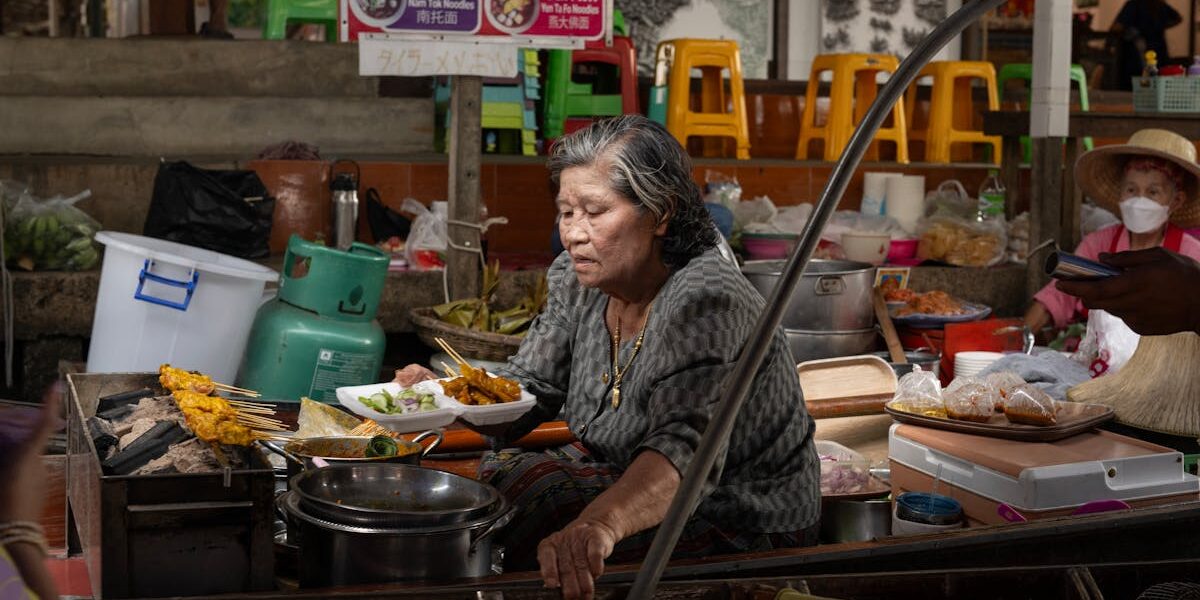
Thin-sliced chicken, pork, or beef marinated in turmeric, coriander seed, cumin, and coconut milk, skewered and grilled over coals, served with a peanut sauce and a sweet cucumber-shallot relish (ajat). Often listed as Indonesian or Malaysian, but Thai satay is a beloved street dish in its own right, especially around the Muslim communities of the south. Our chicken satay recipe includes both sauces.
The Core Techniques of Thai Cooking
Once the pantry is stocked, Thai food becomes a problem of technique rather than ingredients. Five techniques cover almost every category of Thai dish, and they are simpler than they look on the page. The hard part is doing them at the right tempo and committing to the heat.
Pounding (Tum)
The mortar and pestle is the most important tool in a Thai kitchen, more important than the wok. A granite mortar pulverizes lemongrass and galangal fibers in a way no food processor can—the blade method shears, where the pestle crushes and releases oils. A clay mortar is for salads like som tam, where the goal is bruising, not pasting. Almost every Thai curry paste starts with dry ingredients (cumin, coriander seed, salt, dried chili) pounded first, then wet ingredients added one by one in order of toughness. The full technique is in our Thai curry paste guide.
Cracking Coconut Cream (Taek Man)
Every coconut-based Thai curry begins the same way: thick coconut cream is heated in a wide pan until it splits into oil and milk solids—a process called ”cracking” the cream. The curry paste then fries in that oil for several minutes, blooming the spices and concentrating flavor, before thin coconut milk is added to make the soup. Skipping this step is why home Thai curries often taste watery and one-dimensional.
High-Heat Wok Stir-Frying (Pad)
Pad krapow, pad see ew, pad thai, and most of the noodle and protein stir-fries on the menu rely on the same Chinese-derived technique: a screaming-hot wok, oil with a high smoke point, ingredients added in order of cooking time, and aggressive tossing to coat everything in caramelization without overcooking. The goal is wok hei—the smoky, slightly burnt edge that home stoves struggle to produce. Our stir-fry guide and wok hei guide go deep on the mechanics.
Steaming Sticky Rice
Northern and Isan meals depend on sticky rice, which is not boiled like jasmine—it is soaked for hours and then steamed in a bamboo basket over a pot of simmering water. The texture is dense, chewy, and meant to be eaten by hand: pinched into a small ball, used as edible cutlery to scoop curry or grab a piece of chicken. See our sticky rice technique.
Grilling Over Charcoal (Yang)
From gai yang to moo ping (pork skewers) to pla pao (salt-crusted whole fish), grilled meat is everywhere on the Thai street. The defining technique is a marinade heavy in coriander root, garlic, white pepper, and palm sugar—palm sugar is what produces the dark mahogany char—plus the slow, indirect heat of a charcoal grill rather than a gas burner. The dipping sauce, almost always tamarind-and-chili based, completes the dish.
Thai Food Compared to Its Neighbors
One of the fastest ways to understand Thai cuisine is to put it next to its closest culinary cousins. Thai, Vietnamese, Lao, Khmer, and Malay food share a deep ingredient overlap—fish sauce, coconut, lemongrass, chili, lime—but each cuisine combines them according to its own logic. The table below sketches the headline differences.
| Element | Thai | Vietnamese | Lao | Malaysian |
|---|---|---|---|---|
| Primary salt | Fish sauce (nam pla) | Fish sauce (nuoc mam) | Fish sauce + padaek | Soy + belacan shrimp paste |
| Default rice | Jasmine (central/south); sticky (north/Isan) | Long-grain jasmine | Sticky rice almost exclusively | Long-grain |
| Heat profile | Bird’s eye chili, dried + fresh | Lower; chili on the side | Very high; dried chili dust | High; sambal-based |
| Coconut milk use | Heavy in central/southern curries | Light, mostly desserts | Rare | Very heavy in curries and rendang |
| Herb profile | Thai basil, cilantro, mint | Mint, Thai basil, perilla, saw-leaf | Mint, dill, sawtooth | Curry leaf, pandan, lemongrass |
| Sweet/sour balance | Bold across all four flavors | Subtle, sour-forward | Sour and bitter forward | Sweet and savory forward |
| Bread tradition | None (rice-based) | Banh mi (French baguette) | None | Roti canai (Indian flatbread) |
The clearest single contrast is with Vietnamese cuisine, which uses many of the same ingredients but in a much gentler register. Vietnamese pho, for example, depends on aromatic restraint: star anise, cinnamon, and clove perfume the broth, but the dish is fundamentally clear and herbal. A Thai equivalent like kuay teow nam (Thai beef noodle soup) is bolder, with more fish sauce, more spice paste, and a richer broth. Lao cooking, by contrast, is the closest cousin to Isan Thai—so close that ”Lao food” and ”Isan food” are functionally the same cuisine separated by a border.
How a Thai Meal Is Actually Eaten
The Western habit of ordering ”a Thai dish” as a single plate of pad thai or green curry is not how Thai people eat at home or at most family-style restaurants. A real Thai meal is composed: several dishes arrive at once, in the center of the table, and each diner takes small spoonfuls of each onto a personal plate of rice. The dishes are designed to interact, balance, and counter each other.
A typical family table will include, at minimum: a curry (wet, rich, often spicy), a stir-fry (dry, salty, herb-forward), a soup (clear, sour, palate-cleansing), a chili dip with raw or boiled vegetables (nam prik), and a small fried element like an omelet or a piece of crispy fish. The curry and the dip are anchored by rice; the soup is sipped throughout the meal; the stir-fry adds intensity in small doses. Dessert is usually fruit, occasionally a coconut-based sweet on special occasions.
Two utensils matter: the spoon (held in the right hand, for eating) and the fork (held in the left hand, for pushing food onto the spoon). Chopsticks appear only for noodle soups, never for rice dishes. In Isan and the north, fingers replace utensils for sticky-rice meals.
Planning a Thai Menu at Home
The most common mistake home cooks make is choosing dishes that are all in the same flavor lane—two coconut curries, or two sour soups, or two soy-heavy stir-fries. A successful Thai menu deliberately stretches across the flavor wheel so that no single bite is doing the same thing as the previous bite.
Here are three workable menu templates by occasion. Each spans the four flavors, includes contrasting textures, and can be scaled up or down without losing structure.
Weeknight for Two
- Pad krapow gai (holy basil chicken with fried egg)
- Jasmine rice
- Cucumber salad with fish sauce and chili
- Sliced mango or pineapple for dessert
Total cook time: 25 minutes. The stir-fry covers salty, spicy, and umami; the cucumber salad adds sour and crunch; the fruit closes with sweetness.
Family Dinner for Four
- Tom kha gai (coconut chicken soup)
- Green curry with eggplant and Thai basil
- Pad see ew with chicken
- Jasmine rice
- Mango sticky rice
The soup is sour and creamy, the curry is sweet-spicy and rich, the stir-fry is dark-salty and smoky, and the dessert closes the meal with coconut-sweet richness. All four flavors are accounted for; nothing repeats.
Weekend Feast for Six to Eight
- Pomelo or grapefruit salad (yum som-o)
- Tom yum goong (hot and sour shrimp soup)
- Massaman beef curry
- Pad thai or pad see ew
- Gai yang with sticky rice and nam jim jaew
- Som tam (green papaya salad)
- Mango sticky rice or coconut pandan custard
Begin the curries and the marinade the day before; everything else assembles on the day. Two starches—jasmine and sticky—are appropriate when the menu crosses regions.
Thai Food in 2026: Where the Cuisine Is Going
Thai cuisine is in an interesting moment. Inside Thailand, a wave of younger chefs is rediscovering regional and royal-court traditions that had been overshadowed by the global pad-thai-and-green-curry image. Restaurants in Bangkok, Chiang Mai, and Phuket are quietly winning Michelin stars by cooking food that looks foreign even to many Thais: 19th-century palace menus, hyper-local Isan dishes, and Muslim-Thai recipes that rarely leave the south. The 2026 edition of Asia’s 50 Best Restaurants includes a Thai entry firmly in the top ten, the highest position the cuisine has held in over a decade.
Abroad, the trend is toward regional specificity. Northern Thai restaurants—built around khao soi, sai ua sausage, and northern-style curries with no coconut milk—are opening in Los Angeles, New York, London, and Sydney. Isan barbecue spots, anchored by gai yang and som tam, are spreading just as fast. ”Thai food” as a single restaurant category is splintering into the same regional sub-cuisines that exist on the ground in Thailand, which is unambiguously good for diners.
The other 2026 trend is fermentation. Pla ra (fermented fish), tua nao (fermented soybean disc), Thai-style fish sauce, and the entire family of Isan ferments are appearing on plant-forward menus alongside miso and gochujang. Thai cooks have been fermenting for centuries; the rest of the food world is catching up.
Frequently Asked Questions
Is Thai food always spicy?
No. The international reputation for heat is real, but plenty of canonical Thai dishes are mild: massaman curry, khao man gai, tom kha gai in its gentler version, satay with peanut sauce, mango sticky rice, fried rice (khao pad), and most of the central-Thai noodle soups. Even within spicier dishes, every Thai cook adjusts heat to the eater. Asking for mai phet (not spicy) or phet nit noi (a little spicy) is normal and not insulting.
What’s the difference between Thai basil and holy basil?
They are different plants with different roles. Sweet Thai basil (horapa) has a licorice-anise note and goes into curries, soups, and noodle dishes. Holy basil (krapow) is peppery, almost clove-like, and goes into stir-fries like pad krapow. They are not interchangeable. Our Thai basil guide covers the visual and flavor differences in detail.
Can I make authentic Thai food without fish sauce?
Almost no. Fish sauce is the salt of Thai cooking, and it carries umami depth that soy sauce cannot replicate. Plant-based fish sauce (made from fermented mushrooms or pineapple) is now widely available and is a workable substitute for vegetarian and vegan cooks. A 50-50 mix of light soy sauce and a small amount of miso or anchovy paste also works in a pinch.
What’s the right rice for Thai food?
Jasmine rice (khao hom mali) is the default for central and southern Thai meals—curries, stir-fries, and noodle dishes that include rice on the side. Sticky rice (khao niao) is the default for Isan and northern Thai food: it is steamed, not boiled, and eaten by hand. Buying both is normal in a Thai household. Our rice guide covers the differences.
How do I get the smoky flavor of restaurant Thai stir-fries at home?
The smoky note is called wok hei—literally ”breath of the wok”—and it comes from food briefly catching fire as it tosses against a screaming-hot carbon steel surface. Home stoves rarely get hot enough on their own. Workarounds: use a carbon steel wok (not nonstick), preheat it until it smokes, cook in very small batches, dry your ingredients thoroughly, and use a neutral high-smoke-point oil. Our wok hei guide covers the physics in detail.
What’s the best Thai dish for beginners to cook?
Pad krapow. It uses one pan, finishes in about ten minutes once your aromatics are pounded, and demonstrates the entire Thai flavor wheel in a single dish. After pad krapow, move to a red or green curry (which teaches the cracked-coconut-cream technique), then to pad see ew (which teaches wok stir-frying), then to tom kha or tom yum (which teaches Thai soup-building), and finally to a curry paste from scratch.
What’s the difference between Thai food and Chinese food?
Significant overlap and significant divergence. Many Thai techniques (stir-frying, the wok, noodles, dumpling-style snacks) come directly from southern Chinese—mostly Teochew—immigration. But the flavor logic is different. Thai food balances four flavors at high intensity; Chinese cuisine tends to balance fewer flavors at lower intensity and emphasizes xianwei (savory-umami depth) over the sour and spicy axes. Thai food also depends on fresh herbs (basil, cilantro, lemongrass, lime leaf) in a way Chinese cooking generally does not.
Is pad thai really the national dish of Thailand?
It is the most internationally famous Thai dish, and it was promoted by the Thai government in the 1940s as a unifying national symbol, but most Thais today would name pad krapow as the dish they actually eat most often. Pad thai is a beloved street food, but if there is a dish that functions as Thailand’s everyday national meal, it is minced pork or chicken stir-fried with holy basil, served over rice with a fried egg on top.
What’s the typical structure of a Thai meal?
Family-style with multiple dishes shared in the center of the table over individual plates of rice. A balanced spread includes a curry, a stir-fry, a soup, a chili dip with vegetables (nam prik), and rice. Diners take small portions of each onto their own plate and rotate through the dishes. Western-style single-plate ordering exists in restaurants but is not how Thai people eat at home.
Where should I shop for Thai ingredients in the US?
For the basics—fish sauce, coconut milk, jasmine rice, palm sugar, curry paste—a well-stocked supermarket is fine. For fresh aromatics like lemongrass, galangal, kaffir lime leaves, holy basil, and Thai bird’s eye chilies, a Southeast Asian or pan-Asian grocer is much better; many of these items are sold frozen and keep for months. For specialty items like Thai sticky rice, tamarind paste, and roasted chili paste, online Asian grocers including Umamicart deliver fresh nationwide.
Final Thoughts
Thai cuisine rewards effort more than almost any other cooking tradition because the variables are simple but the balance is precise. Once you understand the four flavors, stock the pantry, and learn the five techniques—pounding, cracking coconut cream, high-heat stir-frying, steaming sticky rice, and grilling over charcoal—the entire repertoire becomes accessible. The dishes in this guide span four regions and six centuries of evolution, but they share a single underlying logic: clear, bold flavors balanced against each other and adjusted at the table.
Start with pad krapow and a pot of jasmine rice tonight. Move to a curry next week. Build a four-dish family table the week after. Within a month of consistent cooking, the cuisine stops feeling foreign and starts feeling like a set of patterns. That is how every Thai cook learned it: one dish at a time, tasting at every step, adjusting until the four flavors are loud, clear, and singing together. Aroi mak—very delicious.

Mei Lin Chen
Mei Lin Chen is an Asian food writer and recipe developer. Melbourne-raised and London-based, she has spent over a decade exploring the rice paddies, hawker stalls, and home kitchens of South-East and East Asia. Her recipes balance traditional technique with everyday practicality.