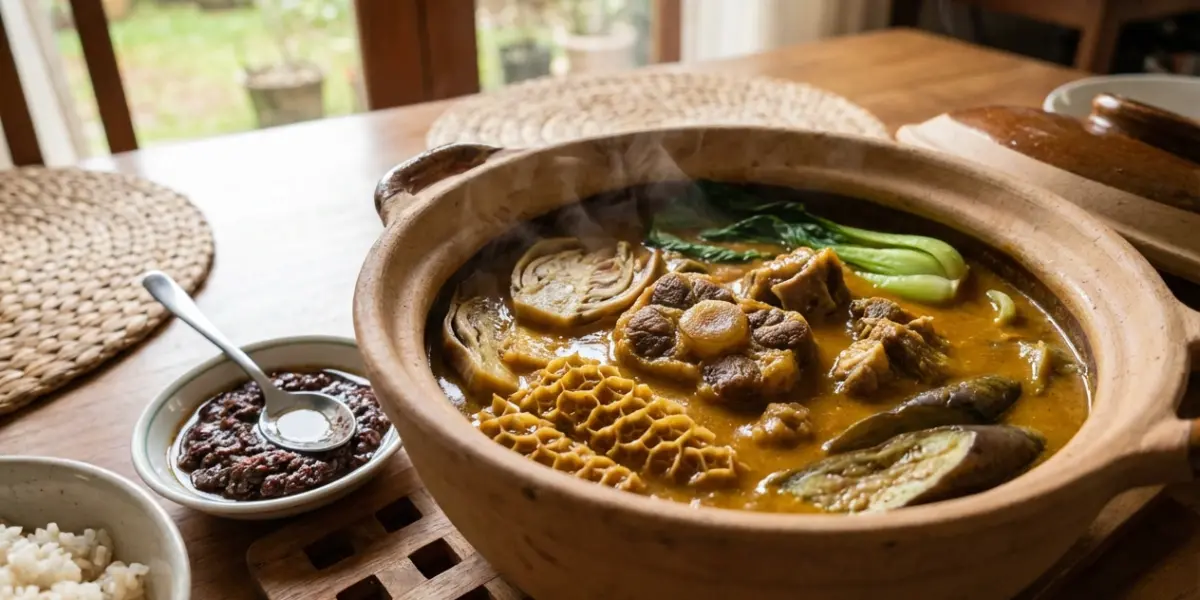
Kare kare is one of the most beloved dishes in Filipino cooking — a slow-simmered stew built on a deeply savory peanut sauce, traditionally made with oxtail and a medley of vegetables. Rich, nutty, and unmistakably Filipino, it is always served alongside bagoong alamang, a pungent fermented shrimp paste that cuts through the richness and brings the whole dish into balance.
What Is Kare Kare?
Kare kare is a Filipino stew distinguished by its thick, golden peanut-based sauce and its inseparable companion, bagoong alamang. The dish is traditionally made with oxtail, though beef tripe, pork knuckle, and even seafood versions exist across the archipelago. The peanut sauce is built from ground roasted peanuts or peanut butter, thickened with toasted rice powder, and colored a warm ochre with annatto seeds or achuete powder. Long beans, eggplant, banana blossom, and bok choy are the classic vegetables folded in toward the end of cooking.
The origins of kare kare are genuinely debated. The most widely accepted story ties it to the Kapampangan people of Pampanga province, who are celebrated as the culinary heartland of the Philippines. Some food historians argue the dish has older roots — that the word ”kare” itself derives from ”curry,” pointing to Indian or Malay influences that arrived through centuries of trade across Southeast Asia. What is certain is that the dish as Filipinos know it today — oxtail, peanuts, annatto, bagoong — is distinctly Philippine in character, shaped by generations of home cooks and festive traditions.
Kare kare occupies a place of honor at celebrations. It appears at fiestas, family reunions, and Sunday lunches where a big pot at the center of the table signals that something special is happening. The preparation is unhurried — oxtail takes two to three hours of gentle simmering to become truly tender — which makes it a dish you cook when you have time and people worth cooking for.
Ingredients
These quantities serve 4 to 6 people.
For the stew
- 1.2 kg (2.6 lbs) oxtail, cut into 5 cm (2-inch) pieces
- 300 g (10.5 oz) beef tripe, cleaned and cut into pieces (optional, traditional)
- 2 litres (8 cups) beef stock or water
- 1 medium onion, quartered
- 6 cloves garlic, smashed
- 2 tablespoons fish sauce
- Salt and black pepper to taste
For the peanut sauce
- 180 g (3/4 cup) smooth peanut butter, unsweetened
- 80 g (1/2 cup) ground dry-roasted peanuts
- 3 tablespoons toasted rice powder (see Tips below)
- 2 tablespoons annatto powder (achuete) or 3 tablespoons annatto water
- 2 tablespoons neutral oil
- 1 medium onion, finely chopped
- 4 cloves garlic, minced
- 500 ml (2 cups) reserved oxtail broth
Vegetables
- 1 small banana blossom (puso ng saging), quartered and blanched, or 1 can banana blossom, drained
- 2 medium eggplants, cut into thick rounds
- 200 g (7 oz) long beans (sitaw), cut into 5 cm (2-inch) segments
- 1 small head bok choy (pechay), leaves separated
To serve
- Bagoong alamang (sautéed fermented shrimp paste), as much as your guests want
- Steamed white rice
How to Make Kare Kare
- Cook the oxtail. Place the oxtail pieces (and tripe, if using) in a large pot. Cover with cold water, bring to a boil, and simmer for 5 minutes. Drain and rinse the meat — this removes impurities and keeps the broth clean. Return the meat to the pot, add the beef stock, quartered onion, and smashed garlic. Bring to a boil, then reduce to a low simmer. Cook for 2 to 3 hours, skimming foam occasionally, until the oxtail is very tender and the meat is pulling away from the bone. If using a pressure cooker, cook at high pressure for 45 to 55 minutes, then natural release. Reserve the broth — you will need it for the sauce.
- Toast the rice powder. While the oxtail cooks, toast 4 tablespoons of raw white rice in a dry skillet over medium heat, stirring constantly, until deep golden and fragrant — about 8 to 10 minutes. Allow to cool completely, then grind to a fine powder in a spice grinder or blender. Set aside 3 tablespoons for this recipe.
- Build the peanut sauce base. In a wide, heavy pot or Dutch oven, heat the oil over medium heat. Sauté the finely chopped onion until soft and translucent, about 5 minutes. Add the garlic and cook for another minute. Stir in the annatto powder and cook for 30 seconds — the oil will turn a vivid orange-red. Add the peanut butter and ground peanuts, stirring to combine everything into a paste. Pour in 500 ml of the reserved oxtail broth, stirring continuously to dissolve the peanut base into a smooth sauce. Bring to a gentle simmer.
- Add the oxtail and thicken the sauce. Transfer the cooked oxtail pieces into the peanut sauce. Add more reserved broth if needed to achieve a stew-like consistency. Season with fish sauce, salt, and pepper. Sprinkle in the toasted rice powder, one tablespoon at a time, stirring between each addition. The sauce will thicken noticeably. Simmer for 10 minutes to cook out the raw starch taste.
- Add the vegetables in stages. Start with the banana blossom — add it to the pot and simmer for 5 minutes, as it takes longest to absorb the sauce. Next add the eggplant and long beans, cooking for another 4 to 5 minutes until just tender but not mushy. Finally, add the bok choy leaves and stir them in gently. They need only 1 to 2 minutes. Taste and adjust seasoning.
- Serve immediately. Ladle the kare kare into a large serving bowl or bring the pot directly to the table. Always serve with bagoong alamang on the side and plenty of steamed white rice. Each person spoons their own bagoong over the stew as they eat.
Tips for the Best Kare Kare
- Toasted rice powder is the traditional thickener — use it. Many modern recipes default to cornstarch, but toasted rice powder is what gives authentic kare kare its characteristic slightly grainy texture and nutty depth. It also does not break or go gluey the way cornstarch can when reheated. The toasting step is non-negotiable — untoasted rice powder tastes raw and floury.
- Quality peanut butter changes everything. Use unsweetened, natural peanut butter with no added hydrogenated oil or sugar. The peanut flavor should be clean and roasted, not sweet. Combining peanut butter with freshly ground dry-roasted peanuts gives the sauce both smoothness and texture.
- Bagoong is not a garnish — it is part of the dish. Kare kare without bagoong alamang is genuinely incomplete. The fermented shrimp paste introduces salt, umami, and a briny funk that the mild, rich peanut sauce needs. Use the sautéed version: bagoong cooked down with garlic, onion, tomato, and a touch of sugar. It keeps for weeks in the refrigerator.
- A pressure cooker is your best tool here. Oxtail is a tough, collagen-rich cut that requires long cooking. A pressure cooker reduces the active cooking time from 2.5 hours down to under an hour without sacrificing tenderness. The collagen that breaks down from the bones also enriches the broth, which goes straight into the peanut sauce.
- Do not overcook the vegetables. Add them in stages by density. Banana blossom first, then eggplant and long beans, then bok choy last. The vegetables should be cooked through but still hold their shape. Mushy vegetables turn a beautiful stew into a heavy, undifferentiated mass.
Variations
Beef Tripe Kare Kare
Many traditional recipes include a mix of oxtail and beef tripe (tuwalya). The tripe is cleaned thoroughly, parboiled separately, and added to the main pot to simmer alongside the oxtail. Tripe has a different texture — chewier and more gelatinous — and it absorbs the peanut sauce beautifully. If you enjoy offal, this is the classic way to make it.
Goat Kare Kare
In some regions of the Philippines, particularly in the Ilocos and Cordillera areas, goat meat is used instead of beef. Goat has a stronger, gamier flavor that stands up well to the rich peanut base. The cooking method is identical, though goat may require slightly longer simmering to reach the right tenderness.
Seafood Kare Kare
A lighter, faster version of the dish substitutes shrimp, squid, and crab for the meat. Because seafood cooks in minutes, you build the peanut sauce first, then add the seafood toward the very end — no more than 5 minutes before serving. Seafood kare kare is popular in coastal areas and at Filipino-Chinese restaurants. The bagoong pairing is just as essential in this version.
What to Serve With Kare Kare
- Bagoong alamang. This is the only truly mandatory accompaniment. Sautéed fermented shrimp paste, seasoned with garlic, onion, tomato, and a small amount of sugar, is served in a separate bowl. Every spoonful of kare kare should be eaten with a small amount of bagoong mixed in. Without it, the dish lacks its defining contrast.
- Steamed white rice. The rich peanut sauce needs a neutral base. Use long-grain white rice or medium-grain Japanese-style rice — both work well. The sauce soaks into the rice and makes each bowl deeply satisfying.
- Atchara. Filipino pickled green papaya is a natural counterpart to kare kare’s richness. The bright, vinegary crunch of atchara cuts through the peanut sauce in the same way that pickles complement a heavy braise. It also adds color to the table. If you cannot find atchara, any quick-pickled vegetable — cucumber, daikon, or carrot — serves a similar purpose.
- A light soup or broth. At larger Filipino meals, a clear sinigang or tinola may be served alongside kare kare so guests can alternate between the rich stew and something sour and clean. This is optional but traditional at festive gatherings.
Storage and Reheating
Kare kare stores exceptionally well and many cooks argue it tastes better the next day, once the peanut sauce has had time to fully absorb into the oxtail and vegetables. Store leftovers in an airtight container in the refrigerator for up to 4 days. Keep the bagoong alamang in a separate container — it does not need to be stored with the stew.
To reheat, place the stew in a pot over medium-low heat with a splash of water or beef broth. The peanut sauce thickens considerably as it cools, so adding a small amount of liquid helps it loosen back to the right consistency. Stir gently to avoid breaking up the vegetables. Heat through completely before serving — oxtail should be steaming hot all the way to the bone.
Kare kare can also be frozen for up to 2 months. For best results, freeze the stew without the leafy bok choy, as it does not hold up well after freezing. Add fresh bok choy when reheating from frozen. Thaw overnight in the refrigerator before reheating.