Last Updated: March 23, 2026
We first reached for a jar of sambal oelek in a Jakarta street kitchen, watching a cook pound red chilies and salt into a rough paste that transformed a bowl of plain rice into something unforgettable. If you cook Asian food at home and haven’t yet discovered this Indonesian chili paste, this guide tells you everything you need to know — from its origins and flavour to how to make it yourself and what to do when the shelves are bare.
Quick answer: Sambal oelek is a raw, chunky Indonesian chili paste made from ground fresh red chilies, salt, and a small amount of vinegar or lime juice — no garlic, no sugar, no fermentation. It’s the base heat-builder for hundreds of Southeast Asian dishes.
Key Takeaways
- The name ”oelek” (also written ulek) refers to the traditional Javanese stone mortar used to grind spices — it literally means crushed chili paste.
- Sambal oelek originates from Indonesia, tracing back to ancient Javanese kingdoms; it is now integral across Southeast Asia.
- Unlike sriracha and gochujang, it contains no garlic, no sugar, and is never fermented — pure chili heat is the point.
- The 2022–2023 Huy Fong shortage drove 6 oz jar prices from roughly $7–$9 up to $25–$30 at peak scarcity.
- Homemade sambal oelek needs only three ingredients and lasts up to six months refrigerated, or one year frozen.
What Is Sambal Oelek?
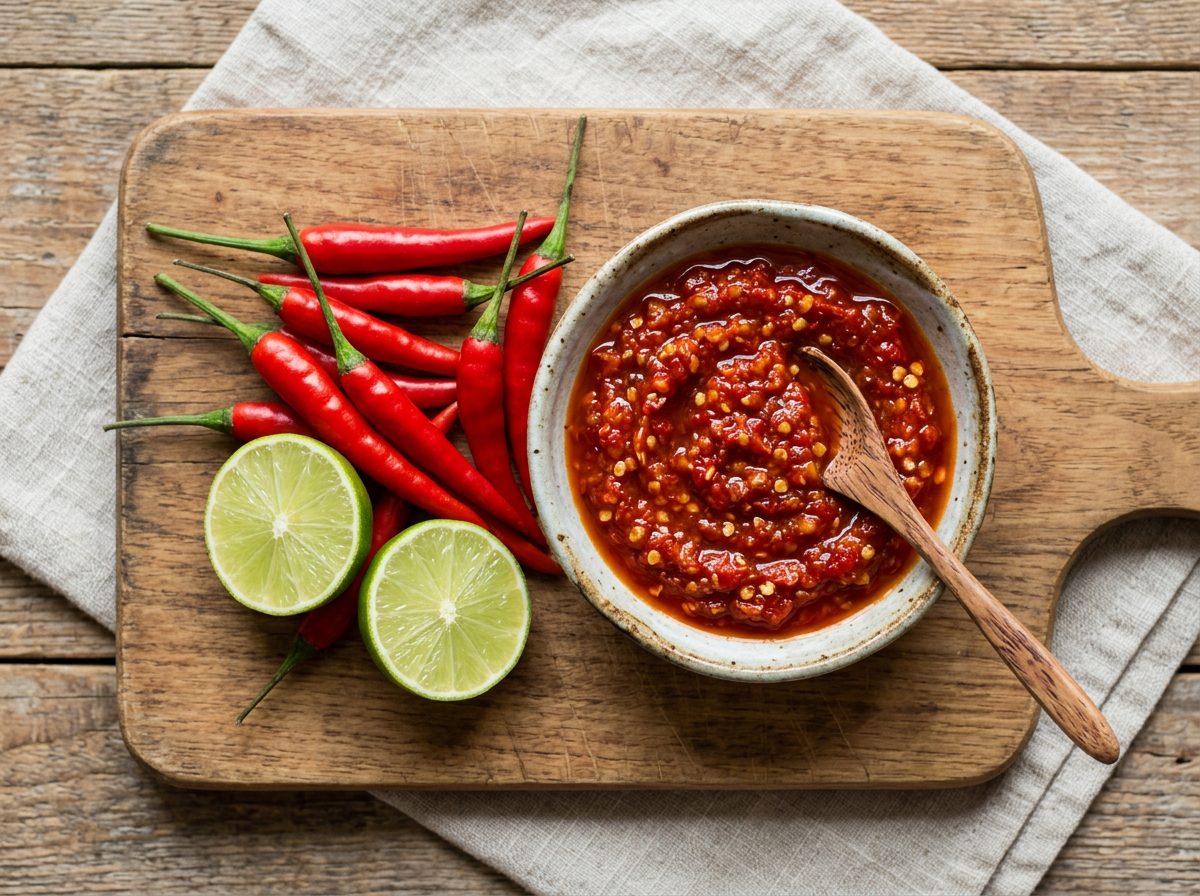
Sambal oelek is a fiery Indonesian chili paste that has earned its place on tables from Jakarta to Jakarta-inspired kitchens in Chicago. At its most basic, it is nothing more than fresh red chilies pounded with salt — a preparation so elemental that its recipe has barely changed across centuries of Southeast Asian cooking history.
The Meaning Behind the Name
The word ”sambal” covers an entire family of chili-based condiments and pastes found across maritime Southeast Asia. Indonesia alone has well over two hundred regional sambal varieties — each shaped by local ingredients, climate, and cooking traditions. The broader category spans everything from the raw, vinegar-bright sambal mentah of West Java to the slow-cooked, coconut-enriched sambal of East Java’s coastal villages.
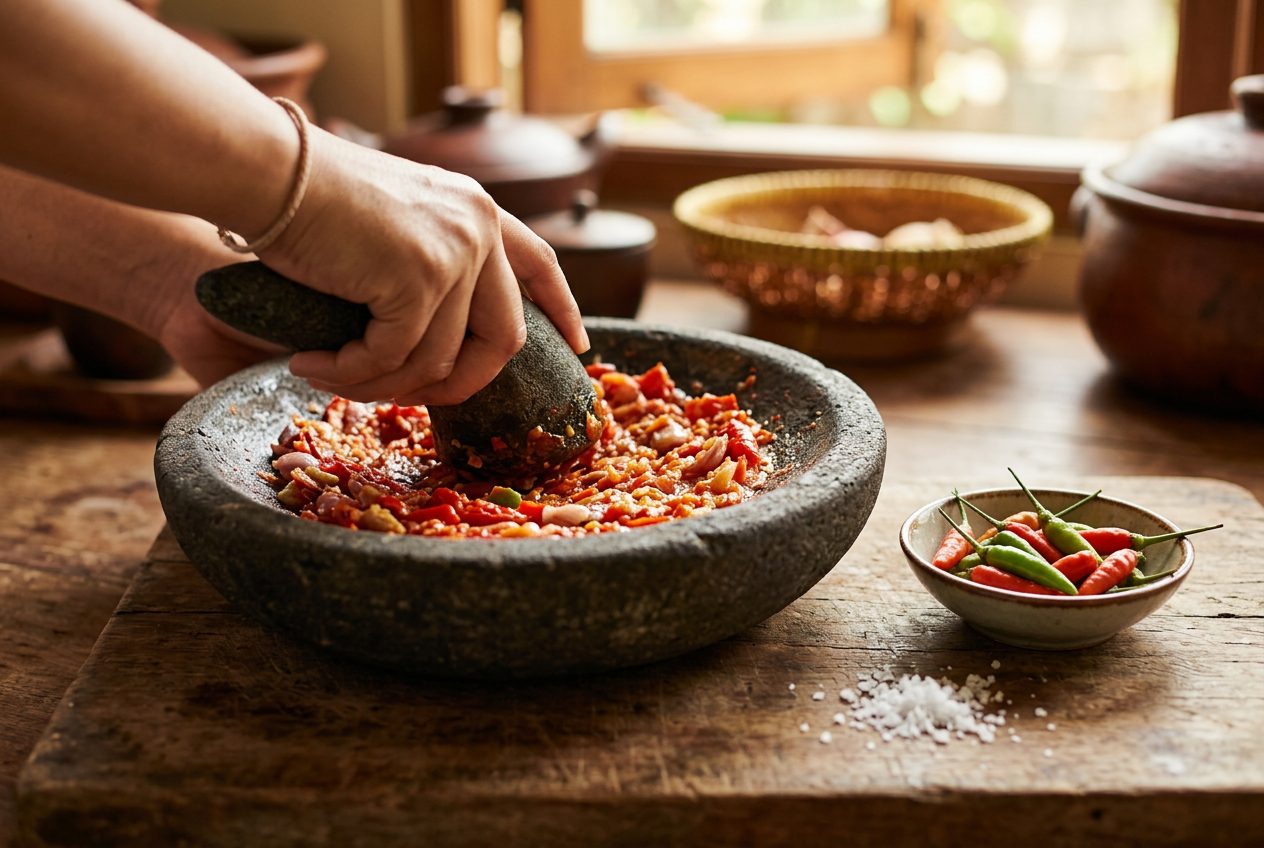
”Oelek” (alternatively spelled ulek) is the Dutch transliteration of the Javanese and Malay word for the traditional stone mortar used to pound spices. The ulek is a heavy, wide grinding vessel — the kind that sits permanently in a traditional Indonesian kitchen and never gets stored away. When a cook prepares sambal oelek the old way, the grinding action on that stone is what gives the paste its characteristic texture: not a smooth purée, but a rough, seed-flecked mass that retains the fresh character of the raw chilies.
The name therefore tells you exactly what you are getting: a chili paste made the way it has always been made, with a grinding stone. This distinction matters because sambal oelek is defined as much by its process as by its ingredients. The paste is not cooked, not fermented, and not blended into submission — it is crushed, briefly, to release heat and juice while keeping the pepper’s raw brightness intact.
Where It Comes From
Sambal oelek’s roots lie in the islands of the Indonesian archipelago, most directly in the culinary traditions of Java. Archaeological and historical records suggest that sambal-style condiments were present in Javanese court cuisine during the era of the Hindu-Buddhist kingdoms — references to ground chili preparations appear in manuscripts and temple reliefs predating the 15th century. Chilies themselves arrived in Southeast Asia via Portuguese traders in the early 1500s, but local cooks adopted and adapted them so rapidly that it is now impossible to imagine the regional cuisine without them.
From Java the preparation spread across the Indonesian archipelago and into the Malaysian peninsula, Singapore, and parts of the Philippines. Each region developed its own variations, but the ulek-style paste — raw chilies ground with salt — remained the foundational version from which other sambals diverged. Today, according to Wikipedia’s documentation of hundreds of sambal varieties, this family of condiments spans dozens of countries and countless ingredient combinations, yet sambal oelek endures as the most recognisably ”pure” member of the group.
The paste entered Western supermarkets largely through the work of Vietnamese-American food producers in the 1980s and 1990s. Huy Fong Foods, founded by David Tran in Los Angeles in 1980, began bottling sambal oelek alongside its now-famous sriracha sauce. The company’s rooster-labelled jar became the default reference point for American home cooks discovering the paste for the first time, and it remains the best-known commercial version in North America today.
What Makes It Different from Other Chili Pastes
The defining quality of sambal oelek is what it leaves out. Unlike virtually every other popular hot sauce or chili paste on the market, it contains no garlic, no sugar, no vinegar base (only an optional small splash), and no fermentation. This restraint is not a limitation — it is a deliberate design philosophy. The paste’s job is to deliver pure, clean chili heat without competing with or masking the other flavours in a dish.
This makes sambal oelek uniquely versatile in a way that sweeter, more complex condiments cannot match. Where sriracha’s garlic-sugar profile can overwhelm a delicate broth, sambal oelek dissolves into the background, amplifying heat without redirecting the dish’s flavour arc. Where gochujang’s fermented depth transforms a sauce entirely, sambal oelek simply turns up the heat. Think of it less as a condiment in the Western sense and more as a cooking ingredient — like salt or acid — that you calibrate rather than apply.
The texture difference is equally significant. Sriracha and most Asian hot sauces are smooth liquids designed to pour. Sambal oelek is a paste — thick enough to spread, chunky enough to show visible chili seeds and skin. That texture means it clings to food rather than running off, which is why it works so well stirred into marinades, pressed into meat, or spooned over rice before eating.
How Sambal Oelek Tastes and How Hot It Is
Tasting sambal oelek for the first time is a different experience from other chili condiments. There is a bright, almost citrus-edged sharpness at the front — the raw character of fresh-ground pepper — followed by a wave of clean, direct heat. Explore our broader Asian cooking ingredients guide to understand how this paste fits within the wider pantry context of Southeast Asian cooking.
The Flavour Profile
The flavour of sambal oelek is best described through three notes: first, the vegetal freshness of raw red pepper; second, the amplifying sharpness of salt; and third, a mild, fruity sweetness that comes from the pepper itself — not from any added ingredient. This tricolon of fresh, sharp, and naturally sweet makes the paste remarkably balanced despite its apparent simplicity. There are no distracting notes of vinegar or smoke to muddy the profile.
When lime juice is added — as is common in Indonesian home recipes — the acidity brightens the heat and extends the paste’s shelf life naturally. The lime’s sourness functions like a frame around the chili heat, making each spoonful feel more defined and lively rather than simply hot. This is why sambal oelek often tastes more flavourful than its ingredient list suggests: the interaction between acid and capsaicin is a sensory amplifier.
It is worth noting that the commercial versions — particularly Huy Fong’s — include a small amount of distilled white vinegar as a preservative. This gives the bottled paste a slightly more acidic edge than traditional homemade versions. Neither is wrong; they are simply different expressions of the same base preparation, in the same way that fresh tomato salsa and jarred tomato salsa both have their place depending on what you are making.
Heat Level and the Chilies Used
Traditional sambal oelek relies on red bird’s eye chilies (Capsicum frutescens), which register between 50,000 and 100,000 Scoville Heat Units (SHU). For context, that puts sambal oelek firmly above jalapeños (2,500–8,000 SHU) and roughly on par with cayenne pepper (30,000–50,000 SHU). The paste is genuinely hot — not novelty-level hot, but enough that a spoonful in a dish designed for four people will be noticeable to every diner at the table.
Commercial versions made for Western markets, including the Huy Fong product, typically use red jalapeños rather than bird’s eye chilies. Jalapeños are significantly milder (under 8,000 SHU), which is why the rooster-labelled jar feels more approachable than a homemade batch prepared with Thai bird’s eye chilies. If you are accustomed to the commercial version and then taste an authentic Indonesian sambal oelek for the first time, the heat difference will be substantial.
Heat tolerance is, of course, personal. What registers as medium-high to a cook raised on mild food might feel almost mild to someone who grew up eating Indonesian or Thai cuisine daily. We find the best way to work with sambal oelek is to start with a small amount — half a teaspoon per serving in a dish — and add more in stages, tasting as you go. The heat builds over time rather than hitting all at once, so patience in the initial seasoning prevents an accidentally scorching result.
Sambal Oelek vs Sriracha vs Gochujang vs Chili Flakes
Understanding how sambal oelek compares to other popular heat sources in the pantry is one of the fastest ways to decide where and how to use it. The contrast between sambal oelek’s raw purity and its nearest rivals is stark — like comparing a freshly squeezed orange to a glass of orange soda.
| Feature | Sambal Oelek | Sriracha | Gochujang | Chili Flakes |
|---|---|---|---|---|
| Base ingredient | Fresh red chilies | Red jalapeños | Fermented red pepper | Dried chilies |
| Texture | Chunky paste | Smooth sauce | Thick paste | Dry flakes |
| Garlic | No | Yes | Yes | No |
| Sugar | No | Yes | Yes (rice) | No |
| Fermented | No | No | Yes | No |
| Heat level | Medium-high | Medium | Mild-medium | Variable |
| Best use | Stir-fries, noodles, marinades | Dipping, eggs, pho | Korean dishes, stews | Pizza, pasta, dry rubs |
| Origin | Indonesia | USA (Vietnamese-inspired) | Korea | Various |
The table above makes the substitution logic clear: if a recipe calls for sambal oelek and you reach for sriracha, you are introducing garlic and sweetness that the recipe did not account for. That might be fine in a casual stir-fry, but it will change the outcome meaningfully in a dish where balance is precise. Gochujang creates a similar problem from the opposite direction — its fermented umami depth and sweetness will redirect the dish toward Korean flavour territory, which is wonderful in Korean cooking but wrong in an Indonesian context.
Chili flakes are the simplest substitute in a pinch, but they are dry and cannot replicate the moisture and fresh-chili character of sambal oelek. Use them in dry rubs or sprinkled over finished dishes; do not expect them to function like a paste in a sauce or marinade. We cover the full substitutes logic in the section below.
How to Use Sambal Oelek in Cooking
Because sambal oelek contains no sweetness, no garlic, and no fermented notes, it functions in cooking the way a confident seasoning should: it amplifies without announcing itself. Browse our Asian recipes collection for specific dishes that feature sambal oelek as a featured ingredient.
Stir-Fries and Noodle Dishes
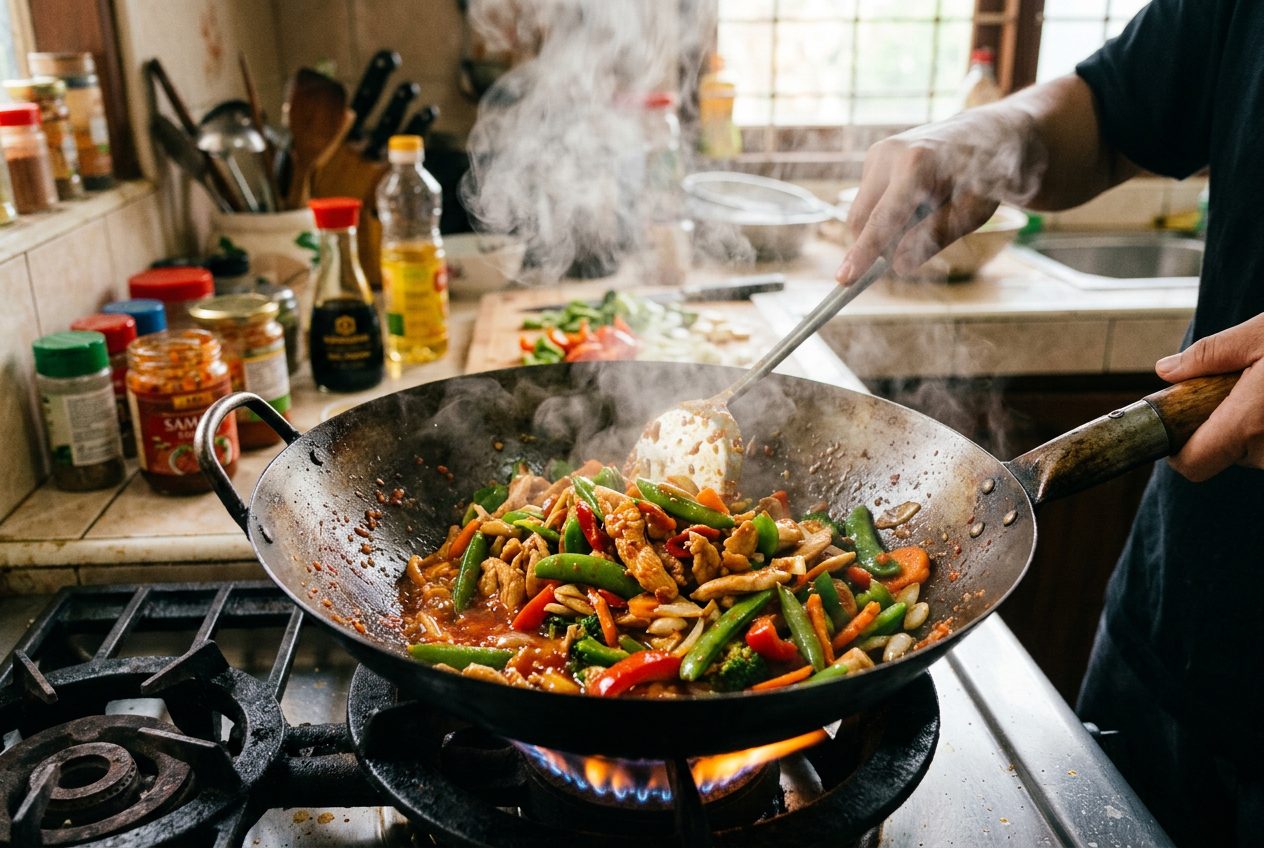
Adding sambal oelek to a hot wok before the vegetables go in is one of the most effective ways to use it. The paste hits the oil first, blooming in the heat, releasing its chili fragrance, and distributing evenly across the surface. By the time the protein and vegetables are added, every element picks up a thin coat of chili-infused oil that anchors the heat throughout the dish rather than leaving it concentrated in a single element.
For noodle dishes — whether it is a quick bowl of stir-fried rice noodles or a more involved plate of Indonesian mie goreng — we typically use one to two teaspoons of sambal oelek per serving as a baseline. The paste pairs naturally with soy sauce, sesame oil, and fish sauce, all of which temper its heat while adding depth. A finish of fresh lime juice just before serving re-activates the brightness that cooking slightly dulls.
Sambal oelek also works beautifully in cold noodle preparations. Stirred into a sesame paste dressing for Chinese-style dan dan noodles, or whisked into a peanut sauce for a Southeast Asian noodle salad, it adds heat without destabilising the sauce’s texture the way a liquid hot sauce might. Its paste consistency integrates cleanly into thick sauces in a way that thinner condiments cannot.
Marinades, Dipping Sauces, and Condiments
A marinade built around sambal oelek is the fastest shortcut to authentic Indonesian flavour. We combine two teaspoons of the paste with a tablespoon of palm sugar or brown sugar, a tablespoon of fish sauce, and the juice of a lime to create a fast marinade for chicken thighs, prawns, or tofu. Left to marinate for thirty minutes — or overnight in the refrigerator — the result is a piece of protein that caramelises beautifully on a grill or in a hot pan, with a heat that penetrates rather than just coats the surface.
As a dipping sauce, sambal oelek is best thinned and balanced. We mix equal parts paste and fish sauce, add a small amount of rice vinegar or lime juice, and finish with a pinch of sugar. This dipping sauce works alongside spring rolls, satay skewers, rice crackers, or any fried snack where you want something with punch. It is the sauce you see served in small ceramic dishes at Indonesian warungs (small food stalls) — simple, direct, and addictive.
At the table, sambal oelek functions as a pure condiment in the way that Tabasco or chili oil does in other cuisines. A small spoonful stirred into a bowl of congee, dropped into a bowl of pho, or spread on a piece of toast with a fried egg is all it takes to feel the impact. Many Southeast Asian households keep a jar on the table at every meal as a default heat source, treating it the way Western households treat black pepper.
Fried Rice, Eggs, and Everyday Cooking
Fried rice is perhaps sambal oelek’s natural habitat. The paste goes into the wok with the aromatics at the start of cooking — a technique that ensures the heat is distributed through every grain of rice rather than sitting on top of the finished dish. A generous teaspoon per two servings is our starting point; we add more at the table if the dish needs more heat. The paste’s chunky texture becomes invisible once it cooks into the rice, leaving behind only flavour.
Eggs and sambal oelek are a combination that crosses cultures. In Indonesia, the classic preparation is telur balado — fried eggs coated in a sambal sauce — but the principle works just as well with a simple fried egg over rice, a soft scramble, or even a poached egg on avocado toast if you want to add an Asian edge. The fat in the egg yolk carries the chili heat in a particularly satisfying way, rounding its sharp edges while keeping the spice present.
Beyond those core applications, sambal oelek is worth keeping in mind for any situation where you want heat without complexity. Stirred into mayonnaise for a chili aioli, whisked into a salad dressing for an Asian-inspired slaw, or spooned over steamed fish before serving — the paste’s clean heat adapts to contexts far beyond its Southeast Asian origins. A 2022 survey by the Specialty Food Association found that chili pastes and condiments grew 14% in North American retail sales year-over-year, reflecting a broad appetite for exactly the kind of versatile heat that sambal oelek delivers.
How to Make Sambal Oelek at Home
Making sambal oelek from scratch is one of those kitchen tasks that rewards you far out of proportion to the effort involved. The ingredient list is almost insultingly short, the process takes under fifteen minutes, and the result — particularly when made with high-quality fresh chilies — is noticeably better than any commercial jar.
Ingredients and Equipment
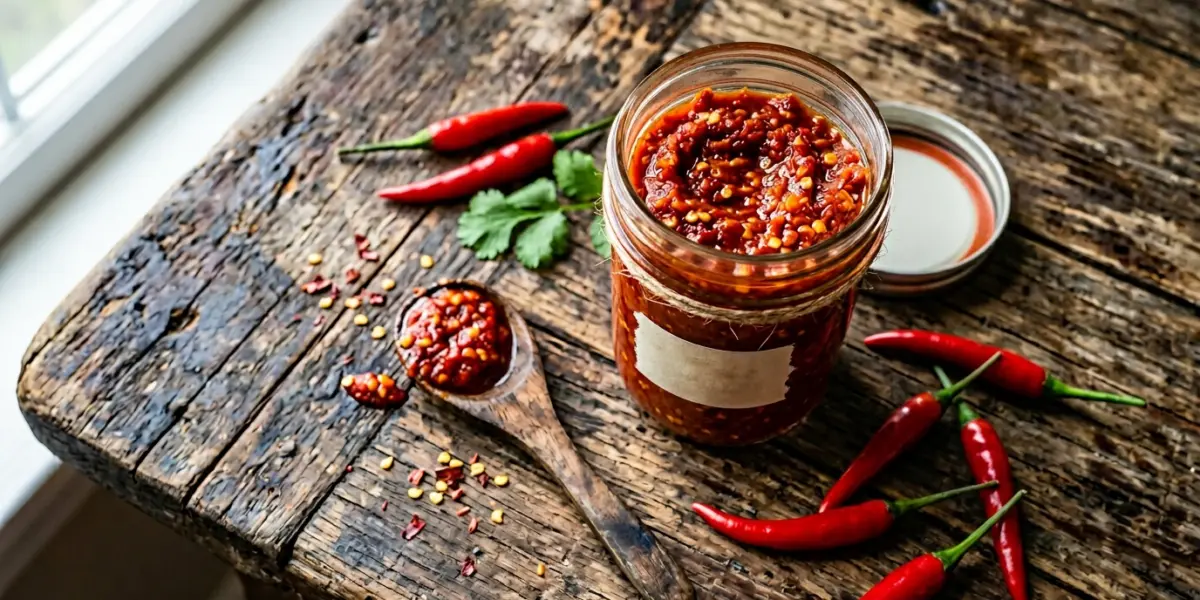
The core ingredients are: 200g of fresh red chilies (bird’s eye for traditional heat, red jalapeños or Fresnos for a milder result), one teaspoon of coarse sea salt, and one tablespoon of fresh lime juice or distilled white vinegar. That is it. Everything else — garlic, sugar, shrimp paste, lemongrass — belongs to other sambal varieties, not to oelek. Resist the urge to improve the recipe by adding things; the discipline of leaving the paste simple is what makes it so versatile.
Equipment-wise, you have two options: a traditional stone mortar and pestle (ideally a heavy Thai or Indonesian ulek, available in Asian kitchenware stores for $20–$60) or a high-speed blender or food processor. Both work. The choice affects texture more than flavour. For storage, you will need a sterilised glass jar with a tight-fitting lid; a small 250ml jar is ideal for a single batch.
One practical tip on chili selection: the colour of your finished paste depends entirely on the colour of your chilies. For the characteristic bright-red sambal oelek that you see in photographs and in store jars, use red chilies that are fully ripe and deeply coloured. Green-tinged or partially ripe chilies will produce a paste that is duller in colour and noticeably more vegetal in flavour — not wrong, but different.
Mortar-and-Pestle vs Blender Method
The mortar-and-pestle method: remove the stems from your chilies (remove seeds too if you want less heat — the seeds and membranes carry the majority of the capsaicin). Place the chilies in the mortar with the salt and begin grinding in a circular motion, working from the outer edges inward. The process takes eight to twelve minutes of consistent effort. The result is a coarse, rustic paste that still shows pieces of chili skin and occasional seeds — exactly the texture you want.
The blender method is faster — under two minutes including prep — but produces a smoother, more uniform paste. To retain some texture in the blender, use short pulses rather than a continuous blend. Start with two or three one-second pulses, check the texture, and continue pulsing until you reach a consistency that looks more like a rough paste than a smooth purée. Adding the lime juice or vinegar to the blender helps everything move without over-processing.
We slightly prefer the mortar method for flavour — the gradual crushing releases the chili oils differently than a blender blade does, producing a paste with more aromatic depth. That said, the blender method is perfectly acceptable for weeknight cooking, and the flavour difference is subtle enough that most dishes will not expose it. Whichever method you choose, taste the paste and adjust salt before storing.
Storage and Shelf Life
Transfer your finished paste to a sterilised jar, press it down to remove air pockets, and top with a thin layer of neutral oil (sunflower or vegetable) to seal the surface. Refrigerated, it will keep for four to six weeks; adding lime juice or vinegar extends this to approximately three months. The acidity creates an environment that inhibits microbial growth without cooking or preserving the paste in the traditional sense.
For longer storage, freeze the paste in ice-cube trays. Once frozen, pop the cubes into a labelled zip-lock bag and store for up to one year. Each cube is roughly one to two teaspoons — a useful portion size for adding directly to a hot wok without needing to defrost. The paste does not change significantly in flavour or texture after freezing, making this the best long-term storage option for a large batch.
Watch for signs of spoilage: any white or grey mould on the surface, an off or fermented smell (sambal oelek should smell fresh and peppery, not funky), or a colour change from bright red to brown or grey. When in doubt, discard and make a fresh batch — the process is quick enough that there is no reason to eat a paste you are uncertain about.
Buying Sambal Oelek: Brands and the 2022–2023 Shortage
For most home cooks, the starting point with sambal oelek is the Huy Fong jar — the one with the rooster on the label and green cap. But the 2022–2023 production crisis reshaped the commercial picture for this paste in ways that are still playing out, and it is worth understanding what happened and what options exist beyond the rooster brand.
The Huy Fong (Rooster) Story
Huy Fong Foods was founded in Los Angeles in 1980 by David Tran, a Vietnamese-Chinese immigrant who had been making chili sauce in Vietnam under the name Pepper Sa-té. Tran named his American company after the Taiwanese freighter that had brought him to Hong Kong as a refugee. The rooster logo on every bottle is a nod to the Chinese zodiac year of his birth. From a single production facility in Rosemead, California, the company grew to supply supermarkets, Asian restaurants, and food service operations across North America.
Huy Fong’s sambal oelek follows a simplified version of the traditional Indonesian recipe: red jalapeños, distilled vinegar, salt, and potassium sorbate as a preservative. The choice of jalapeños over bird’s eye chilies makes the paste significantly milder than traditional Indonesian versions, which has helped it gain mainstream acceptance. The product does not contain garlic or sugar, staying true to the defining feature of the oelek style.
For decades, Huy Fong sourced its red jalapeños almost exclusively from Underwood Ranches, a California farm that had been the company’s primary pepper supplier since the early 1990s. This single-source arrangement was efficient but created a significant supply-chain vulnerability that the company’s rapid growth had made no effort to address.
The 2022–2023 Shortage Explained
The crisis began building in 2020, when production was halted due to low chili stocks — an early warning sign that went unaddressed. In April 2022, Huy Fong announced another production halt, citing peppers that were ”too green” for proper colour. The defining blow came in October 2022, when Underwood Ranches terminated its contract with the company after nearly thirty years — a decision driven by a pricing dispute and Huy Fong’s refusal to commit to a long-term supply agreement.
The timing coincided with severe drought across California, New Mexico, and Mexico — the three key regions where Huy Fong attempted to source replacement peppers. Quality from new suppliers was inconsistent through early 2023, and yield estimates from New Mexico fell by 35% in August 2023 due to continued drought conditions. The compounding effect of a broken supplier relationship and a regional weather crisis created a shortage that lasted well over a year. Retail prices for the 6 oz jar surged from the typical $7–$9 range to $25–$30 at peak scarcity, with secondary-market sellers on Amazon charging even more.
Production began to stabilise by late 2023 as Huy Fong diversified its sourcing across multiple growers. However, full recovery to pre-shortage production capacity remained uncertain into 2025, complicated further by a 2024 production halt for factory maintenance and OSHA compliance issues. The saga served as a broader lesson about food supply chain fragility: a single condiment’s absence from supermarket shelves created genuine anxiety among chefs, home cooks, and restaurant operators who had built recipes and menus around its availability.
Alternative Brands Worth Knowing
The shortage accelerated awareness of non-Huy Fong options that had always existed but rarely received attention. Conimex, a Dutch brand with deep roots in Indonesian cooking (the Netherlands has a large Indonesian diaspora from its colonial history), produces a sambal oelek that is widely available in European markets and in specialty Asian grocery stores in the US. The Conimex version is closer to the traditional Indonesian recipe and typically hotter than the Huy Fong product.
Ox Brand, imported from Indonesia, offers a more traditional formulation and can be found at well-stocked Asian supermarkets in larger cities. For those near a Southeast Asian grocery store, locally imported Indonesian and Malaysian brands — often sold in unmarked plastic jars or vacuum-sealed pouches — are worth seeking out. These products are made for the domestic Southeast Asian market and tend to use hotter chili varieties, so adjust quantities accordingly.
Making your own, as described in the section above, remains the most reliable option when commercial supply is uncertain. The ingredients — red chilies, salt, and optionally lime juice — are available in virtually every supermarket year-round, and a single batch takes under fifteen minutes to prepare. The shortage of 2022–2023 converted many regular buyers of the commercial paste into regular home producers of it, which is arguably the best outcome the crisis produced.
Sambal Oelek Substitutes When You Can’t Find It
No sambal oelek on the shelf does not mean no heat in the dish. The substitution options for this paste are actually quite workable once you understand what sambal oelek contributes — raw chili heat, slight acidity, chunky texture, no sweetness — and which pantry ingredients can approximate that combination. Try pairing any of these substitutes with our pad thai recipe to see how different heat sources change the final dish.
Closest Store-Bought Replacements
Chili garlic sauce (the Huy Fong version with the green cap, or Lee Kum Kee’s version) is the most readily available substitute. It contains garlic, which sambal oelek does not, but the texture is similar and the heat level is comparable. Use it in a one-to-one ratio and be aware that dishes will have a more pronounced garlic flavour as a result. In most cooked applications — stir-fries, marinades, fried rice — the difference is minor.
Sriracha can substitute in a pinch, but it requires adjustment. The sauce is sweeter and smoother than sambal oelek, and it delivers less heat per unit volume. Use 1.5 times the quantity of sriracha relative to the sambal oelek called for, and consider adding a small squeeze of lime juice to re-introduce some acidity. The result will not be identical, but it will be close enough in most contexts to work.
For Southeast Asian dishes specifically, look for Chinese doubanjiang (fermented broad bean and chili paste) or Thai nam prik pao (roasted chili paste) as alternatives that bring complexity of their own. Neither is a direct substitute — both will change the dish’s flavour profile — but both will deliver heat in a way that makes sense within an Asian culinary context. Use them thoughtfully and in smaller quantities, as both are more intense than sambal oelek.
DIY Quick Substitute Ratios
The fastest homemade substitute: combine one tablespoon of crushed red pepper flakes with half a teaspoon of salt, a teaspoon of white vinegar or lime juice, and two teaspoons of water. Stir and let it sit for five minutes to rehydrate the flakes slightly. The result is a rough paste that approximates the heat and acidity of sambal oelek at the cost of texture and fresh-chili brightness. It works in cooked dishes better than as a raw condiment.
If you have a fresh chili of any kind — jalapeño, Fresno, bird’s eye, serrano — you can make a credible one-serving substitute in three minutes. Finely chop or mash the chili with a pinch of salt and a drop of vinegar. The texture is rougher than the commercial product, but the flavour profile is closer to authentic sambal oelek than any store-bought substitute will be. This is the most useful technique to know for impromptu cooking.
Keep in mind that dry substitutes (chili flakes, cayenne powder) will never fully replace sambal oelek’s paste texture, which means they will behave differently in the dish — not dissolving into sauces the same way, not clinging to protein surfaces during marinating. Use dry substitutes only in applications where texture is not critical: adding heat to a braise, seasoning a dry rub, or stirring into a thick sauce where the paste consistency is less important than the heat it provides.
When Gochujang or Chili Garlic Sauce Works Instead
Gochujang is a strong substitute specifically in slow-cooked dishes — braises, stews, and long-simmered sauces — where its fermented complexity and sweetness have time to integrate and contribute something positive to the dish. A Korean-style braised short rib recipe that calls for sambal oelek could legitimately be improved by gochujang, not just covered by it. But in quick-cook applications — a thirty-second stir-fry, a dipping sauce, a marinade for grilled fish — gochujang’s fermented depth can feel out of place in a non-Korean dish.
Chili garlic sauce works best as a substitute when garlic is already present in the recipe. If a dish already calls for garlic cloves in the aromatics, the additional garlic from chili garlic sauce is simply more of something already there, not a new intrusion. In these cases, the texture match is good and the heat delivery is similar enough that most people eating the finished dish would not notice the substitution.
One practical rule: any time you are substituting for sambal oelek in a recipe that is explicitly Indonesian or Malaysian — nasi goreng, mie goreng, satay marinade, gado gado sauce — try to use either the commercial sambal oelek or a homemade version if at all possible. The paste is so central to the flavour identity of those dishes that substituting it meaningfully changes what you are cooking. For everything else — a quick chili mayo, a spicy egg, a fired-up bowl of fried rice — the substitutes above work well enough.
FAQ
What is a substitute for sambal oelek?
The closest store-bought substitute is chili garlic sauce, used in a one-to-one ratio. It adds garlic that sambal oelek lacks, but delivers comparable heat and a similar paste texture. For a DIY substitute, combine crushed red pepper flakes with a pinch of salt and a splash of white vinegar or lime juice, let it sit for a few minutes to rehydrate, and use in place of the paste. Sriracha also works — use about one and a half times the quantity and add a squeeze of lime to compensate for the sweetness.
Why was sambal oelek discontinued (or hard to find)?
The dominant commercial producer, Huy Fong Foods (the Rooster brand), experienced a major supply crisis in 2022–2023. Their thirty-year exclusive supplier of red jalapeños, Underwood Ranches, ended its contract in October 2022 following a pricing dispute. This coincided with severe droughts across California, New Mexico, and Mexico — the regions where Huy Fong sought replacement peppers. The combination of a broken supplier relationship and poor harvests drove retail prices from the usual $7–$9 up to $25–$30 for a 6 oz jar. Production partially resumed by late 2023, though recovery has been slow. Sambal oelek was never actually discontinued — only significantly constrained in supply.
Is sambal oelek very hot?
It depends on the version. Traditional sambal oelek made with red bird’s eye chilies registers 50,000–100,000 Scoville Heat Units, which makes it genuinely hot — noticeably above jalapeños and roughly on par with cayenne pepper. Commercial versions (including Huy Fong’s) use red jalapeños, which measure only 2,500–8,000 SHU, making those versions medium in heat by most standards. If your heat tolerance is moderate, the commercial version is manageable; if you are buying imported or artisanal sambal oelek, expect significantly more heat.
What is the difference between sriracha and sambal oelek?
Both sauces are made by Huy Fong Foods and both use red jalapeños as their primary ingredient — but the similarity ends there. Sriracha contains garlic, sugar, and distilled vinegar, producing a smooth, sweet-savoury sauce with a uniform consistency. Sambal oelek contains only red chilies, salt, and a small amount of distilled vinegar, producing a chunky paste with no sweetness and no garlic. The practical effect is that sriracha has a rounded, complex flavour suited to dipping and finishing, while sambal oelek is a pure heat-builder best used as a cooking ingredient or straightforward condiment.
How long does homemade sambal oelek last?
Homemade sambal oelek keeps for four to six weeks in the refrigerator in a sterilised, sealed glass jar. If you add lime juice or vinegar to the recipe — which the traditional Indonesian version does — the acidity helps preserve the paste and can extend refrigerator life to around three months. For longer storage, freeze the paste in ice-cube trays, then transfer the frozen cubes to a labelled bag; the paste keeps well frozen for up to one year with minimal change in flavour or texture. Never leave it at room temperature for more than two hours after making or opening.

Mei Lin Chen
Mei Lin Chen is an Asian food writer and recipe developer. Melbourne-raised and London-based, she has spent over a decade exploring the rice paddies, hawker stalls, and home kitchens of South-East and East Asia. Her recipes balance traditional technique with everyday practicality.