Last updated: March 11, 2026
Deep-frying is the technique that gives Asian kitchens some of their loudest, crispiest, most addictive textures: glassy tempura that shatters in your mouth, double-fried Korean chicken with a crackly shell that stays crunchy in sauce, Japanese karaage with juice that runs down your wrist, lacquered Cantonese sweet-and-sour pork, and pakoras that crunch through dal. But the difference between brilliant Asian deep-frying and the sad, soggy, oil-logged version most home cooks end up with is not luck. It is temperature control, batter chemistry, moisture management, and a small handful of small decisions made at the right moment.
This guide walks you through the entire toolkit. You will learn how Asian cooks structure their oil, why double-frying works on a molecular level, how Japanese tempura batter differs from Chinese crispy batters and Indian besan batters, how to set up a safe and efficient frying station in a home kitchen, the most common mistakes that ruin a fry, and a set of practice exercises that let you build muscle memory before you tackle a full recipe. By the end, you will be able to choose the right oil, hold a temperature without a thermometer, fry in clean batches, and know exactly why your last batch turned out the way it did.
What Asian Deep-Frying Actually Is
Deep-frying, in the broadest sense, is cooking food by fully submerging it in hot fat. In Asian kitchens, that simple definition splinters into a family of distinct techniques. Chinese cooks talk about zha (炸), which can mean a quick single fry, a longer slow fry, or a two-stage fry with a hot finishing blast. Japanese cooks separate kara-age (lightly dusted in starch), tatsuta-age (marinated and dusted), and tempura (cold batter, hot oil, lacy crust). Korean cooks have built an entire restaurant culture around twigim and the double-fried yangnyeom chicken made famous in the 2000s. Indian and South Asian cooks fry in ghee, mustard oil, or refined vegetable oil for pakoras, samosas, vadas, and bhajis. Southeast Asian cooks deep-fry shallots, garlic, and curry leaves to use as garnishes that finish a dish with crunch and aroma.
What unifies them is a physical reality: when you drop a piece of food into 325 to 375°F oil, the water on the surface flash-boils into steam, the steam pushes outward, and that outward pressure prevents oil from rushing in. As long as the bubbling stays vigorous, the food stays mostly dry inside, the outside dehydrates and browns, and you get crunch. The moment the water runs out or the oil cools too far, the pressure flips inward and the food becomes oily and limp. Everything in this guide is, at heart, a tactic for keeping that outward pressure going for the right amount of time.
The Equipment You Actually Need
You do not need a dedicated deep fryer. A carbon-steel wok, a heavy-bottomed Dutch oven, or a deep stainless saucepan all work beautifully, and in many ways outperform countertop fryers because you can pull food out faster and adjust the heat by hand. The classic Asian setup is a 14-inch carbon-steel wok on a high-output burner, which uses less oil than a stockpot for the same submersion depth thanks to its sloped sides. If you do not own one yet, our best wok buying guide walks through the trade-offs, and our wok seasoning guide covers the patina that makes carbon-steel safe for high-heat oil.
Beyond the vessel, the short list is: an instant-read or clip-on probe thermometer that reads to at least 400°F, a long-handled spider strainer or slotted spoon, a pair of long wooden or bamboo cooking chopsticks, a wire cooling rack set inside a sheet pan, a few sheets of unbleached parchment or brown paper for blotting, and a small bowl of kosher salt for seasoning the second the food leaves the oil. A splatter screen is optional but life-changing if you fry indoors without a strong range hood.
Choosing the Right Oil
Oil selection comes down to three properties: smoke point, flavor, and stability under repeated heating. You want a smoke point comfortably above your target frying temperature, a neutral or complementary flavor, and a fatty-acid profile that does not break down quickly. For most Asian deep-frying, refined peanut oil, rice bran oil, refined sunflower, refined canola, and grapeseed are excellent. Peanut oil is the traditional Chinese restaurant default for its faint sweetness and high smoke point of around 450°F. Rice bran oil is the modern Japanese standard for tempura, prized for its neutrality and very high smoke point. Indian cooks sometimes choose mustard oil or ghee for regional dishes, accepting the lower smoke point in exchange for distinctive flavor.
Avoid extra-virgin olive oil, unrefined coconut oil, and butter for deep-frying: they will smoke, foam, or burn before they hit useful frying temperatures. Toasted sesame oil is a finishing flavor, not a frying oil; learn more in our complete guide to sesame oil. A small splash of toasted sesame oil added to the neutral frying oil at the very end is a classic Cantonese trick for aroma, but the bulk of the oil should remain stable and neutral.
The Three Temperature Zones
Almost every Asian deep-fry happens in one of three temperature windows. Knowing which one you are in dictates batter thickness, food size, and timing.
| Temperature Zone | Range | Best For | Result |
|---|---|---|---|
| Low / Confit Fry | 275–325°F (135–163°C) | Thick, dense items: bone-in chicken first fry, pork belly par-fry, root vegetables, beancurd skins | Cooks the interior fully, dehydrates the surface, gentle browning |
| Medium / Working Fry | 325–350°F (163–177°C) | Most single-fry items: tempura, lumpia, samosas, fish, pakoras, croquettes, karaage | Even golden crust, moist interior, classic fried texture |
| High / Finishing Fry | 350–375°F (177–190°C) | Second fry on double-fried chicken, refry on egg rolls, last-second crisping of shallots and garlic | Crackling, shattering crust, deep mahogany color |
If you do not own a thermometer, two visual cues do the job. First, the wooden chopstick test: dip the dry end of a wooden chopstick into the oil. A slow stream of small bubbles around it means medium heat; a vigorous, immediate eruption of bubbles means high heat; almost no movement means the oil is still warming. Second, the breadcrumb test: drop a single panko crumb in. If it sinks to the bottom and slowly rises, you are around 300°F. If it sinks halfway and rises, around 325°F. If it stays on the surface and sizzles immediately, around 350°F. If it browns within seconds, you are above 375°F.
The Single Fry: Step by Step
A single fry is the most common Asian deep-frying scenario: think tempura shrimp, Japanese chicken karaage, Indian pakoras, Filipino lumpia, or Chinese crispy fried tofu. The basic structure is the same across all of them.
- Cut and dry the food. Cut into pieces that finish cooking in the same time it takes the crust to brown, usually 1 to 1.5 inches for proteins and slightly thicker for vegetables. Pat every piece bone-dry with paper towels; surface water lowers oil temperature, makes the oil spit, and produces a pale, soggy crust.
- Season or marinate. For karaage, marinate in soy sauce, grated ginger, garlic, sake, and a touch of sugar for 30 minutes. For Chinese fried fish, salt the surface 15 minutes before frying to draw out moisture, then blot. For Indian pakoras, the chickpea-flour batter itself carries the salt and spice.
- Dredge or batter. Karaage gets a dust of potato starch shaken in a bag. Tempura gets dipped in a barely-mixed ice-cold batter (more on that below). Beer-battered fish gets a quick swim in carbonated batter. The coating should be thin and even; clumps will fall off in the oil and burn.
- Heat the oil. Fill your wok or pot no more than halfway. Heat the oil to about 25°F above your target temperature, because adding cold food will drop it immediately.
- Fry in small batches. The food should occupy no more than a third of the oil surface at any time. Overcrowding tanks the temperature and steams instead of fries.
- Move and listen. Once the food has set for 30 seconds, gently swirl it with chopsticks or the spider so pieces do not stick to each other or to the bottom. Listen for the bubbling: a steady, energetic sizzle is good; a quiet murmur means the oil is too cool.
- Drain hot, season hot. Lift the food onto a wire rack set over a sheet pan. Salt the moment it lands, while the surface is still slick enough to grab the salt.
The Double Fry: How Korean and Japanese Cooks Get the Crackliest Crust on Earth
The double fry is the single most useful upgrade in Asian deep-frying. The principle is simple: the first fry, at a lower temperature, cooks the food through and dehydrates the surface. The food rests and cools, allowing more moisture to migrate out of the interior to the surface. The second fry, at a higher temperature, blasts that residual moisture off in seconds and produces a glassy, fractured crust that stays crisp even after being tossed in sauce.
To double-fry properly, start at 325°F. Fry the food until just cooked through and pale golden, about 8 to 10 minutes for bone-in chicken pieces or 4 to 5 minutes for boneless thigh strips. Lift to a wire rack and let rest for at least 5 minutes, ideally 10. While the food rests, raise the oil to 375°F. Return the food to the oil in small batches and fry for another 2 to 4 minutes, until the crust is deep gold and audibly crunchy when tapped with a spoon. This is the technique behind Korean fried chicken and the gold standard for almost any battered Asian fried item that needs to stay crisp under a glaze.
Tempura: The Coldest Batter in the World
Tempura is its own discipline. The batter is built to fail in the best possible way: lumpy, undermixed, with visible streaks of dry flour, and so cold that the surface frosts when you touch it. The reason is gluten. The longer flour and water are mixed and the warmer the batter gets, the more gluten develops, which produces a dense, bready crust. Cold temperature and minimal mixing keep gluten asleep, and the result is the lacy, almost translucent shell that makes tempura tempura.
The classical formula is one egg yolk whisked into one cup of ice water, then one cup of low-protein flour (cake flour, or 50/50 all-purpose and cornstarch) dumped on top and stirred just barely, with chopsticks, in a few strokes. Use the batter within ten minutes, keep the bowl sitting in a larger bowl of ice, and fry at 340 to 360°F. For a deeper walkthrough including the famous tenkasu crispy bits, see our complete guide to tempura batter.
Karaage and Tatsuta-age: Starch as a Crust
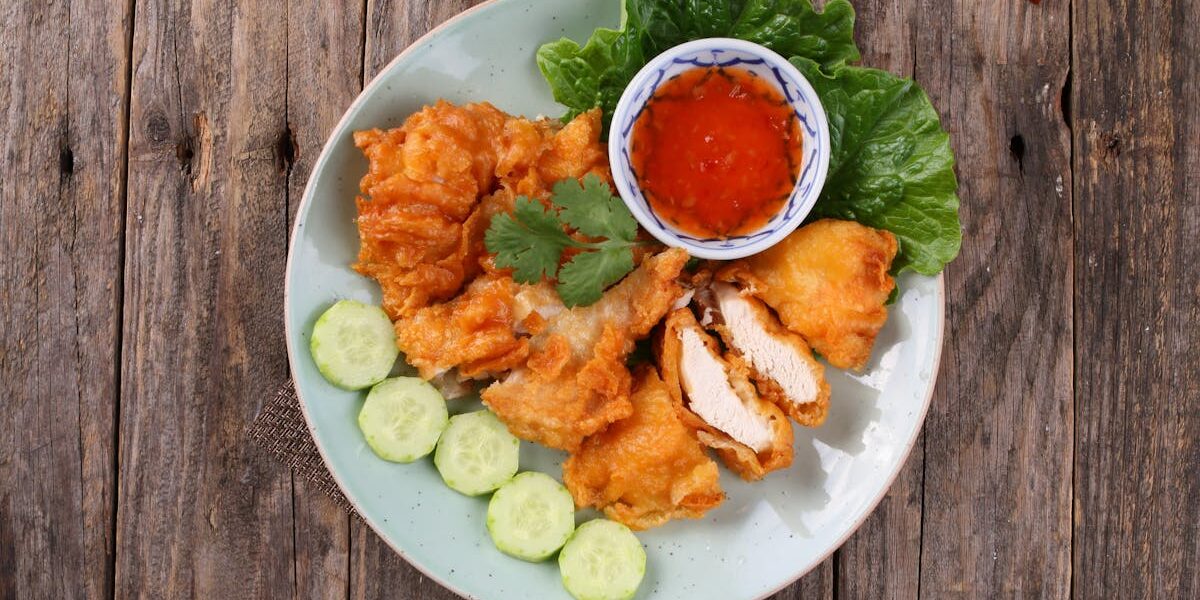
Where tempura builds a separate batter, karaage uses the food itself as the structure and adds only a thin starch dust. Boneless chicken thigh, cut into roughly 1.5-inch pieces, marinates in soy sauce, sake, mirin, ginger juice, and garlic for 30 minutes. The pieces are drained, then tossed in potato starch (the traditional choice) or a mix of potato starch and a small amount of flour. The starch absorbs the surface marinade and forms a crinkled, paper-thin armor that fries up rough and crunchy.
Tatsuta-age is the same idea with a stronger soy-and-mirin marinade and slightly more starch, producing a darker, more savory crust. Both techniques benefit from a 60-second rest after the starch coating, which lets the starch hydrate slightly before it hits the oil. Our full chicken karaage recipe shows the exact ratios and timing for restaurant-grade results.
Crispy Batters: Beer, Vodka, Cornstarch, and Beyond
Outside Japan, Asian fried foods often use a wet batter built around starch and a leavening agent. Chinese sweet-and-sour pork batter typically uses cornstarch, all-purpose flour, a pinch of baking powder, and ice water, sometimes with an egg. The cornstarch keeps the crust crisp; the baking powder produces tiny bubbles that increase surface area; the cold water slows gluten development; the egg adds richness and color. South Asian pakora batter uses chickpea flour (besan), which is naturally gluten-free, with rice flour added for crunch, and spices folded directly into the batter.
Two upgrades are nearly universal. First, replace some of the water with sparkling water, beer, or a splash of vodka. The carbonation contributes additional bubbles and the alcohol evaporates faster than water, opening up the crust. Second, double-coat: dip in batter, lift, drip for two seconds, dip again. The second layer adds the rough texture that catches sauce.
Common Mistakes and How to Fix Them
| Mistake | What Goes Wrong | Fix |
|---|---|---|
| Oil too cold | Pale crust, oily interior, soggy texture, batter slides off | Heat oil 25°F higher than target before adding food; check with thermometer or chopstick test |
| Oil too hot | Dark crust, raw inside, bitter flavor, smoking oil | Lower heat, wait for oil to settle, fry slightly larger batch to absorb heat |
| Overcrowding | Temperature crashes, food clumps together, steams instead of fries | Fry in batches that cover no more than one-third of the oil surface |
| Wet food | Violent spitting, dangerous spatter, soggy crust | Pat dry with paper towels; for very wet items like tofu, press 20 minutes between towels |
| Soggy batter | Bread-like crust instead of crisp shell | Use ice-cold liquid, undermix, fry within 10 minutes of mixing batter |
| Sticking to pot | Crust tears off when you lift the food | Let the food float free for 30 seconds before disturbing; use a spider, not tongs |
| Drained on paper towels | Bottoms steam and turn soft | Use a wire rack over a sheet pan; only blot the top briefly with paper |
| Salting after cooling | Salt slides off, food tastes flat | Salt immediately after lifting from oil, while the surface is still hot and slick |
| Reusing burned oil | Off flavors, lower smoke point, dark color | Strain oil through cheesecloth after cooling; discard if smell is acrid or color is very dark |
| Adding to overcrowded oil | Sticky clumps, uneven cook | Lower pieces one at a time, away from you, with a spider |
Setting Up a Safe Frying Station
Oil fires are the most common kitchen accident in home deep-frying, and they are almost entirely preventable. Use a pot or wok that is deep enough that the oil only fills it about a third to halfway. Make sure the handle of your vessel does not stick out over a walkway. Keep a metal lid within arm’s reach: if oil ignites, slide the lid over the pan and turn the heat off. Never throw water on an oil fire. Keep children and pets out of the kitchen during frying. Tie back long hair and sleeves.
Lay out your station before you turn on the heat: dry food on the left, batter or dredge in the middle, oil in the center, wire rack on the right, salt and serving plate beyond. Practice the motion of lowering food into oil with a spider once or twice with the heat off so your hands know where to go. The single most important habit is to lower food away from yourself, never toward yourself, so any splash travels in a safe direction.
Filtering, Storing, and Reusing Oil
Fresh frying oil is a luxury, and home cooks who fry weekly will want to reuse it two or three times. After frying, let the oil cool to room temperature in the pan. Pour it through a fine-mesh strainer lined with cheesecloth or a coffee filter into a clean, dry, sealable jar. Label the jar with the date and what you fried in it. Fish-fried oil keeps fish flavor; chicken-fried oil is more versatile. Store in a cool, dark cupboard, not the refrigerator (refrigeration can cause cloudiness and condensation).
Smell the oil before each reuse. Fresh oil smells faintly grainy or nutty. Spent oil smells acrid, fishy, or paint-like; if it does, discard it. Also watch the color and viscosity: very dark, syrupy oil has broken down and will produce off flavors and lower smoke points. Never pour used oil down the drain. Solidify it with paper towels or cat litter and put it in the trash, or pour it into a sealable container for a local waste-oil recycling program.
Practice Exercises to Build Real Skill
Reading about deep-frying will not make you good at it. These four exercises, done in order, will. Each takes 30 to 45 minutes and uses cheap ingredients.
- Thermometer-free temperature reading. Heat one inch of oil in a small saucepan. Use only the chopstick and breadcrumb tests to identify three target temperatures: 300°F, 340°F, 365°F. Verify with a thermometer afterward. Repeat until you can hit each within 10°F by feel.
- Single-fry potatoes. Cut a large russet potato into matchsticks. Fry at 325°F for 4 minutes until just translucent, drain, raise oil to 375°F, fry again for 2 minutes. Salt immediately. You have just made restaurant fries, and more importantly, you have practiced the double-fry sequence with almost zero cost if it fails.
- Tempura broccoli florets. Mix tempura batter as described above and fry small broccoli florets at 350°F until just turning gold, about 90 seconds. Eat them in front of the stove with salt. You are learning the feel of a delicate batter without spending money on shrimp.
- Karaage cubes. Cut boneless chicken thigh into 1-inch cubes, marinate 30 minutes in 2 tablespoons soy sauce, 1 tablespoon sake, 1 teaspoon grated ginger, 1 minced garlic clove. Toss in potato starch, fry at 340°F for 4 minutes. Cool 3 minutes, fry again at 365°F for 90 seconds. Compare a piece from the single fry to a piece from the double fry. This is the lesson.
Advanced Tips From Professional Asian Kitchens
Once the basics feel automatic, a handful of advanced moves separate good deep-frying from outstanding deep-frying. Many of these are habits inherited from Chinese banquet kitchens, Japanese tempura counters, and Korean fried chicken shops.
- Salt the food, then dry it again. A 15-minute dry brine on chicken pieces or fish fillets pulls moisture to the surface. Blot that moisture off before coating. The result is more seasoned, drier-surfaced, crispier fried food.
- Use two starches. A blend of potato starch and cornstarch in karaage gives a balance of rough texture (potato) and gloss (corn). For shatter-crisp Chinese-style batters, replace 25 percent of the flour with cornstarch or rice flour.
- Add a tablespoon of vodka or shochu to wet batters. Alcohol evaporates faster than water, opening the crust and inhibiting gluten formation. The flavor cooks off completely.
- Skim constantly. Use a fine-mesh skimmer to remove every loose crumb between batches. Loose crumbs burn, foul the oil, and stick to the next batch.
- Triple-fry for sauce-glazed items. For fried chicken that will be tossed in a wet sauce like gochujang glaze or sweet-and-sour, a third 30-second fry at 385°F right before saucing locks the crust against moisture.
- Garnish with fried aromatics. Sliced shallots, garlic chips, curry leaves, and dried chiles fried in the residual oil after the main fry become some of the most powerful flavor garnishes in any kitchen. Cook them at 250°F and pull just before they reach the color you want; they continue to darken on the rack.
- Rest before serving. Fried food piled on a rack and served immediately is at its loudest. Fried food kept warm in a 200°F oven on a rack stays crisp for 20 minutes; fried food covered with foil steams itself soft within 2 minutes.
Six Asian Recipes That Showcase Deep-Frying
The fastest way to internalize the techniques in this guide is to cook them inside complete dishes. These six recipes each highlight a different facet of Asian deep-frying.
- Korean fried chicken is the canonical double-fry. The boneless or bone-in chicken gets a starch slurry coating, a low first fry, a rest, and a high second fry, then a glossy glaze. See our Korean fried chicken recipe.
- Chicken karaage is the canonical single fry with starch dust: simple marinade, light coating, one stage of frying, immediate salt. Our karaage recipe walks through the marinade and timing.
- Tonkatsu teaches you panko crumb breading at medium heat, where the goal is even golden cover and a perfectly juicy pork loin. See our tonkatsu recipe.
- Chicken katsu is the same panko technique on chicken breast or thigh, paired with Japanese curry or a sweet katsu sauce. Try our chicken katsu recipe.
- Filipino lumpia teaches you to deep-fry wrapped items without bursting them: slow, gentle frying at 325°F until the wrapper is uniformly amber. See our lumpia recipe.
- Crispy tofu is the vegetarian gateway: press, cube, dust, and fry. Our crispy tofu guide covers pressing methods and the cornstarch-baking soda coating that makes restaurant tofu shatter.
Healthier Deep-Frying: What the Science Actually Says
Deep-fried food has a worse reputation than it deserves, but only when it is fried correctly. Studies of oil uptake during frying consistently show that the major variable is temperature: properly fried food, cooked at the right heat with the food kept moving, absorbs surprisingly little oil. A piece of tempura shrimp fried correctly gains about 6 to 8 percent oil by weight. The same piece fried in cool oil can absorb double that. In other words, keeping the oil hot is also the healthier choice.
Choose stable refined oils, fry in clean oil, drain on a rack rather than on paper, and salt lightly rather than heavily. If you want to reduce oil even further without abandoning the technique, two strategies work. First, use shallow fry: less oil, half submersion, flipping once. Second, use an air fryer for items that do not need true submersion, such as tonkatsu cutlets and katsu chicken; the crust will be slightly different but the flavor profile is nearly identical.
Frequently Asked Questions
What is the best oil for Asian deep-frying?
For most applications, refined peanut oil is the classic Chinese choice and rice bran oil is the Japanese standard. Both have smoke points above 450°F, neutral flavor, and good stability across multiple fries. Refined sunflower, refined canola, and grapeseed are excellent substitutes if peanut or rice bran is unavailable. Avoid extra-virgin olive oil, butter, and unrefined coconut oil; they burn before reaching frying temperature.
How do I tell when the oil is at the right temperature without a thermometer?
Use the wooden chopstick test. Dip the dry end of a wooden chopstick into the oil. A slow, lazy stream of small bubbles means 300 to 325°F. A steady, active stream means around 350°F. Fast, vigorous bubbling that sounds aggressive means above 375°F. A panko crumb that floats and immediately sizzles signals roughly 350°F.
Why does my fried food turn out soggy?
Sogginess almost always traces back to one of three causes: oil too cool, overcrowding the pan, or wet food. Oil below 325°F lets water seep in and steam the food. Crowding crashes the temperature on contact. Surface moisture instantly drops the heat and produces a damp crust. Fix all three: heat oil higher to start, fry in small batches, and pat food bone-dry before it touches the oil.
Can I really double-fry anything?
Almost. Double-frying works brilliantly on dense proteins (chicken, pork, beef cuts), starchy vegetables (potatoes, sweet potatoes, lotus root), and battered items that need to hold up to sauce. It is less useful for delicate items like tempura shrimp or thin fish fillets, which overcook on the second pass. As a rule, if the food still feels moist or pale after the first fry, it is a candidate for a second.
How many times can I reuse frying oil?
Two to three reuses is the safe range for clean home frying. Strain after each use, store in a dark, cool cupboard in a sealed jar, and discard when the oil smells acrid, looks very dark, or foams excessively when reheated. Frying very wet, breaded, or fish items shortens the lifespan; frying lightly coated dry items extends it.
What is the difference between karaage and tempura?
Karaage uses a marinade on the food itself with only a thin starch dust as coating, producing a craggy, savory crust glued directly to the protein. Tempura uses a barely-mixed ice-cold flour batter that surrounds the food in a lacy, almost translucent shell. Karaage is intensely flavored; tempura is delicate and reveals the ingredient inside.
Can I deep-fry in a regular saucepan?
Yes, as long as it is heavy-bottomed (stainless steel, cast iron, or enameled cast iron), deep enough to fill no more than halfway with oil, and has a tight-fitting lid you can grab quickly if oil ignites. A 3- to 5-quart Dutch oven is ideal. Carbon-steel woks use even less oil thanks to their sloped sides, but a saucepan is perfectly safe and effective.
How do I keep fried food crispy until serving?
Place fried food on a wire rack set over a sheet pan in a 200°F oven, uncovered, for up to 20 minutes. Never stack hot fried food or cover it with foil; the trapped steam will turn the crust soft within minutes. Salt only after the food comes out of the oil, and toss with sauces or glazes at the very last moment before serving.
Is air-frying the same as deep-frying?
No. Air-frying is a convection-roasting technique that circulates very hot air around food, browning the surface and producing a crunchy texture. It uses far less oil but cannot reproduce the lacy crust of tempura or the glassy shell of double-fried chicken, which depend on full oil immersion. Air-frying is excellent for already-breaded items like panko cutlets, frozen dumplings, and starch-coated tofu, but is not a one-to-one substitute for true deep-frying.
What is the smoke point of an oil and why does it matter?
The smoke point is the temperature at which an oil begins to break down, smoke, and release acrid flavors and free radicals. Frying near or above the smoke point ruins the oil and the food. For Asian deep-frying, choose oils with a smoke point of at least 400°F, ideally 450°F, so you have safety margin above your target temperature of 350 to 375°F.
Final Thoughts on Mastering Asian Deep-Frying
Asian deep-frying is not one technique but a family of related approaches united by a single principle: control the relationship between heat, moisture, and time. Tempura, karaage, double-fried Korean chicken, pakoras, lumpia, and crispy tofu all sit on the same continuum, and once you understand the continuum, recipes stop feeling like instruction sets and start feeling like dialects of a language you already speak.
Spend an afternoon on the practice exercises in this guide. Cook one karaage batch every weekend for a month. Try tempura broccoli on a weeknight. Move on to a full Korean fried chicken project when you can hit oil temperatures without checking. The discipline that produces shatter-crisp crusts and clean, light interiors is built one fry at a time, and the only secret is that there is no secret, only attention.

Mei Lin Chen
Mei Lin Chen is an Asian food writer and recipe developer. Melbourne-raised and London-based, she has spent over a decade exploring the rice paddies, hawker stalls, and home kitchens of South-East and East Asia. Her recipes balance traditional technique with everyday practicality.