# Nasi Goreng Recipe (Indonesian Fried Rice)
*Last Updated: March 23, 2026*
When we first made **nasi goreng recipe** in a proper Indonesian kitchen, the moment the spice paste hit the smoking wok, the smell alone told us everything — this was something far beyond ordinary fried rice.
> **Key Takeaways**
> – Kecap manis (sweet soy sauce) is the single ingredient that separates nasi goreng from every other fried rice on earth.
> – Day-old jasmine rice, a screaming-hot wok, and a strict 30-second no-stir pause create the signature char.
> – Terasi (Indonesian) and belacan (Malaysian) are the same shrimp paste family — the regional name tells you the flavour profile.
> – Traditional garnishes — telur mata sapi (sunny-side up egg), kerupuk, cucumber, tomato, fried shallots — are not optional decorations; they are part of the dish.
> – Indonesian and Malaysian nasi goreng share a name but diverge meaningfully in sauce and spice approach.
## What Makes Nasi Goreng Different from Chinese Fried Rice
### The Kecap Manis Factor
Kecap manis is a thick, palm-sugar-sweetened soy sauce with a molasses-like consistency — and it is the ingredient that makes authentic Indonesian fried rice unmistakable. Unlike Chinese fried rice, which relies on light or dark soy sauce for a purely savoury profile, nasi goreng gets its characteristic amber glaze and caramelised sweetness entirely from kecap manis. When it hits the hot wok, it coats every grain and begins to reduce, forming a sticky, deeply flavoured layer that no regular soy sauce can replicate.
A single swap tells you everything: if you replace kecap manis with standard soy sauce, the dish loses not just sweetness but also depth, colour, and that glossy visual signature. We always keep a 300 ml bottle of kecap manis as a kitchen staple — you will go through it faster than you expect.
Quality matters here. Brands like ABC Kecap Manis and Bango are the household standards in Indonesia. If you are sourcing ingredients, our Asian cooking ingredients guide covers where to find authentic Southeast Asian pantry staples.
### Terasi vs. Belacan: Same Family, Different Character
Terasi is the Indonesian word for fermented shrimp paste; belacan is the Malaysian equivalent. They are produced using the same method — salted shrimp fermented and dried under the sun — but regional variations in shrimp species and fermentation time mean the flavours differ. Terasi tends to be earthier and more pungent; belacan is slightly sweeter and less aggressive.
Both are added to the spice paste before frying, not sprinkled in later. Frying the paste in hot oil transforms the raw, sharp smell of the shrimp paste into a rounded, savoury depth that permeates every grain of rice. If you skip this step, or add it raw at the end, the result is a flat, one-dimensional dish.
For our recipe, we use terasi — crumbled directly into the mortar with the shallots, garlic, and chillies. If you only have belacan, use the same quantity. The dish will lean slightly milder and sweeter, reflecting the Malaysian palate.
### Indonesian vs. Chinese Fried Rice: A Side-by-Side Comparison
| Feature | Indonesian Nasi Goreng | Chinese Fried Rice |
|—|—|—|
| Primary sauce | Kecap manis (sweet, thick) | Light or dark soy sauce (savoury) |
| Shrimp paste | Terasi or belacan (required) | Not used |
| Rice type | Day-old jasmine rice | Day-old jasmine or long-grain |
| Spice paste | Shallot, garlic, chilli, terasi | Garlic, ginger, scallion |
| Signature garnish | Fried egg, kerupuk, cucumber, tomato | Spring onion, sesame oil drizzle |
| Flavour profile | Sweet-savoury-smoky | Savoury-umami |
| Heat level | Moderate to high (bird-eye chilli) | Usually mild |
The contrast is clear: where Chinese fried rice is a savoury, clean-flavoured dish, nasi goreng is sweet, smoky, and layered with fermented depth. Same technique — different soul.
## Ingredients for Nasi Goreng (Serves 2)
### The Spice Paste
The paste is the heart of the dish. We make it fresh every time, either with a mortar and pestle (preferred — the rough texture caramelises better on the wok) or a small blender.
– 3 shallots, roughly chopped
– 3 garlic cloves
– 2 red bird-eye chillies (adjust to your heat preference)
– 1 tsp terasi (Indonesian shrimp paste) or belacan (Malaysian)
Pound or blend to a coarse paste — not a smooth puree. Those rough edges and uneven surfaces are what catch the heat and develop colour in the wok.
### The Rice and Sauces
– 2 cups day-old cooked jasmine rice (cold from the fridge)
– 2 tbsp vegetable oil (or coconut oil for extra aroma)
– 2 tbsp kecap manis
– 1 tbsp regular soy sauce
– 1 tsp fish sauce
– 2 eggs (for scrambling into the rice)
### The Garnishes
Garnishes in nasi goreng are structural — they add contrasting textures and temperatures that complete the eating experience.
– 2 eggs, fried sunny-side up (telur mata sapi)
– 2 tbsp crispy fried shallots
– 4 kerupuk (prawn crackers)
– 4–5 slices cucumber
– 4–5 slices tomato
– 2 spring onions, sliced
– Sambal on the side
## How to Make Nasi Goreng: Step-by-Step Instructions
### Preparing Your Mise en Place
Before the wok goes on the flame, every ingredient should be measured, sliced, and within arm’s reach. Nasi goreng cooks in under five minutes at full heat — there is no time to reach for a bottle halfway through. We lay out the spice paste, kecap manis, soy sauce, fish sauce, and beaten eggs in a row. The rice is broken up in its container so no clumps remain.
This preparation discipline is one reason restaurant nasi goreng tastes better than rushed home versions. The cook never hesitates. Every addition is immediate, confident, and in the right sequence. Once you learn the rhythm — paste, rice, char, sauce, egg — the dish becomes second nature.
Day-old rice is non-negotiable. Fresh-cooked rice holds too much moisture; when it hits the wok, it steams rather than fries, producing a heavy, clumped result. Refrigerating rice overnight reduces surface moisture and firms the grains so they separate and sear cleanly. If you are cooking same-day, spread the cooked rice on a baking tray and refrigerate for at least two hours.
### The Wok Technique: Heat, Char, and Timing
Place your wok over the highest heat your stove produces. Wait until the wok just begins to smoke — this takes about 90 seconds on a gas burner. Add the vegetable oil and let it shimmer for ten seconds, then add the spice paste. Fry it for two full minutes, pressing and spreading it against the wok’s surface. The paste should darken from pale yellow to deep amber; you will smell the terasi transform from sharp and raw to rounded and savoury.
Add the cold rice. Spread it across the entire wok surface in a single, flat layer. Now do nothing. Leave it untouched for 30 seconds. This is the step most home cooks skip — and the step that separates a great nasi goreng from an average one. The direct contact between cold rice and hot metal creates Maillard browning on the grain surfaces, producing a subtle char and smoky aroma called wok hei.
After 30 seconds, toss the rice vigorously. Add the kecap manis, soy sauce, and fish sauce in quick succession, tossing after each addition to coat every grain. The kecap manis will reduce almost instantly at this temperature, forming a sticky, caramelised glaze. Push the rice to the sides of the wok, crack both eggs into the centre, scramble them quickly, then fold them into the rice. Cook for one more minute, taste, and adjust salt with a few drops of fish sauce if needed.
### Plating and Serving Nasi Goreng the Traditional Way
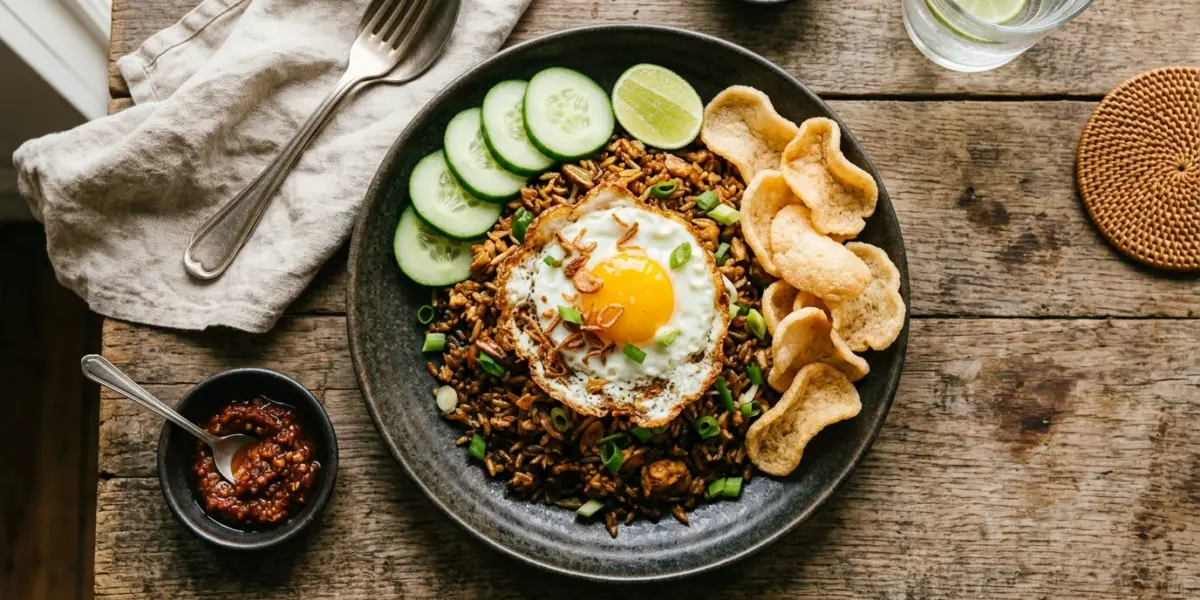
Mound the rice in the centre of a warm plate — or use a small bowl to press it into a dome shape for a cleaner presentation. Lay the sunny-side up egg directly on top. Arrange the cucumber and tomato slices around the mound. Scatter fried shallots over the egg and rice. Place two kerupuk on each side — they are meant to be broken and scooped through the rice, adding a shatteringly crisp contrast to the soft grains. Add a spoonful of sambal to one side.
The visual balance of a properly plated nasi goreng — dark amber rice, bright yellow yolk, green spring onion, red chilli garnish, pale kerupuk — is as much a part of the experience as the flavour. According to a 2023 Statista survey, nasi goreng is among the top three most recognised Indonesian dishes globally, alongside satay and rendang.
## Indonesian vs. Malaysian Nasi Goreng
### Key Differences at a Glance
| Feature | Indonesian Nasi Goreng | Malaysian Nasi Goreng |
|—|—|—|
| Sweet sauce | Kecap manis (thick, caramel) | Often regular soy sauce |
| Shrimp paste | Terasi (earthy, pungent) | Belacan (milder, sweeter) |
| Typical protein | Chicken, shrimp, egg | Chicken, seafood, egg |
| Garnish style | Kerupuk, cucumber, tomato, fried egg | Fried egg, fried shallots, acar (pickled veg) |
| Spice level | Moderate — bird-eye chilli in paste | Often higher — more sambal |
| Regional variant | Nasi Goreng Kampung | Nasi Goreng Pattaya (omelette-wrapped) |
### Nasi Goreng Kampung
The kampung (village) version is the most rustic form of the dish — rice, shrimp paste, chilli, and very little else. No kecap manis, no elaborate garnish, often cooked over charcoal. The technique is the same but the simplicity amplifies the shrimp paste and chilli. Kampung style is the version most Indonesians grew up eating at home; the restaurant-style dish most Westerners encounter is a more polished, garnish-heavy evolution of this original.
We find the kampung approach genuinely illuminating: it strips the dish to its skeleton and shows you exactly what terasi and high heat contribute on their own, without the sweetness of kecap manis to balance them. If you want to understand nasi goreng at its core, make a batch without kecap manis first.
### Why These Differences Matter
The Indonesian-Malaysian split in nasi goreng reflects a broader cultural pattern across the region’s cuisines: shared ingredients, shared techniques, but distinct national flavour identities. Indonesia’s heavy reliance on kecap manis reflects centuries of palm sugar agriculture; Malaysia’s lighter, spicier approach reflects a different trade history and coastal influence. Knowing which version you are making — and why — makes you a more confident, intentional cook.
For a broader tour of the region’s cooking, our Asian recipes collection covers dishes from across Southeast and East Asia, with the same depth of cultural context.
## Kecap Manis vs. Regular Soy Sauce
| Aspect | Kecap Manis | Regular Soy Sauce |
|—|—|—|
| Sweetness | High — palm sugar base | None |
| Viscosity | Thick, syrup-like | Thin, watery |
| Colour result | Deep amber, glossy | Light-medium brown |
| Flavour contribution | Sweet-savoury, caramelised | Purely savoury, salty |
| Authenticity for nasi goreng | Essential | Not traditional |
| Substitution risk | Cannot replicate the dish authentically | Will produce a flat, savoury result |
There is no authentic substitute for kecap manis in nasi goreng. Some recipes suggest mixing regular soy sauce with brown sugar and molasses — and while this approximation works in a pinch, the result is thinner, less complex, and lacks the palm sugar dimension that gives kecap manis its character.
According to the Indonesian Ministry of Agriculture’s 2022 commodity report, kecap manis accounts for approximately 70% of all soy sauce consumed in Indonesia — a figure that reflects just how central it is to the national cuisine (Indonesian Ministry of Agriculture, 2022). If you cook Indonesian food with any regularity, kecap manis is as fundamental as garlic.
## Tips, Storage, and Variations
### Make-Ahead and Storage Tips
Nasi goreng is best eaten immediately — the char and crispness of the rice begin to fade within 20 minutes. That said, leftover nasi goreng reheats surprisingly well in a dry wok over high heat for two minutes. Avoid the microwave; it steams the rice and destroys the texture you worked to create.
The spice paste can be made up to three days ahead and refrigerated in an airtight container. This is genuinely useful for weeknight cooking: with the paste ready, you can have the dish on the table in under eight minutes from a cold start.
Cold day-old rice actually improves further if left for two days rather than one. The extra dehydration produces an even crisper result in the wok. A practical habit: whenever you cook a large batch of jasmine rice, set aside two cups specifically for nasi goreng the following night.
### Protein Variations
The traditional village-style nasi goreng contains no meat beyond the shrimp paste itself — the dish was historically a vehicle for using leftover rice and whatever protein was available. Modern versions commonly include chicken thigh (more flavour than breast, and more forgiving at high heat), prawns, or a combination of both.
For a vegetarian version, omit the terasi and fish sauce; use a teaspoon of fermented soy paste (tauco) for umami depth and replace fish sauce with a few drops of tamari. The result will not be identical — the shrimp paste’s oceanic depth is genuinely difficult to replicate — but it produces a flavourful, satisfying dish in its own right.
### Scaling the Recipe
The recipe scales cleanly up to four servings. Beyond four, we recommend cooking in two separate batches rather than crowding the wok. Overloading the wok drops the temperature immediately, turning the char into steam and the fried rice into something closer to congee. The 30-second no-stir rule only works when the wok is properly hot and the rice layer is no more than 2–3 centimetres deep.
Our fried rice recipe guide covers the broader technique principles — understanding those will make you a better nasi goreng cook as well.
## Frequently Asked Questions
### What ingredients are in nasi goreng?
The core ingredients are day-old jasmine rice, a spice paste of shallots, garlic, bird-eye chillies, and terasi (shrimp paste), kecap manis, regular soy sauce, fish sauce, and eggs scrambled into the rice. Traditional garnishes — a fried sunny-side up egg, kerupuk, cucumber, tomato, and crispy fried shallots — complete every proper serving. Optional protein additions include chicken thigh, prawns, or tofu depending on preference.
### What is the secret to authentic nasi goreng?
Two things, working together: kecap manis and the char technique. Kecap manis provides the sweet, caramelised sauce base that no other ingredient replicates. The char comes from day-old rice spread flat on a smoking wok and left untouched for 30 seconds — this single pause creates the smoky, slightly crisp exterior that distinguishes restaurant-quality nasi goreng from the home version. The terasi in the spice paste is the third defining element, delivering the fermented umami depth that defines the dish’s character.
### How unhealthy is nasi goreng?
A standard two-serving portion of nasi goreng with egg contains approximately 420 kcal, 12 g protein, 18 g fat, and 55 g carbohydrate. The calorie count rises with added protein and the kerupuk garnish. As a complete meal with vegetables, egg protein, and a moderate fat content, it sits comfortably within a balanced diet. Using lean proteins like prawns or chicken breast and reducing oil to one tablespoon keeps the fat content lower without sacrificing the char technique.
### What is the main meat in nasi goreng?
Traditional nasi goreng has no fixed protein — it was historically a leftover-rice dish adapted to whatever was available. The most common versions today use chicken (usually thigh for flavour) or prawns, and many households use a combination of both. Kampung-style nasi goreng often contains no meat at all, relying on the shrimp paste for protein flavour. Egg — scrambled into the rice and fried on top — is the constant across virtually every version.
### What is the difference between Indonesian and Malaysian nasi goreng?
The most significant difference is the sauce: Indonesian nasi goreng is built around kecap manis, producing a sweet, amber-glazed rice; Malaysian versions typically use regular soy sauce and produce a lighter, more savoury result. The shrimp paste also differs — terasi in Indonesia versus belacan in Malaysia — though both function similarly. Malaysian nasi goreng tends to be spicier with more sambal, while Indonesian versions emphasise the sweet-savoury balance of the kecap manis. Both use the same high-heat wok char technique.