Last updated: March 29, 2026
Vietnamese caramel sauce, known as nuoc mau or nuoc hang, is the dark, bittersweet liquid that gives countless Vietnamese braises, claypot dishes, and marinades their signature mahogany sheen and savory depth. Unlike Western caramel, which prizes sweetness, Vietnamese caramel is intentionally pushed past the golden stage into a deeply bitter, almost burnt territory that balances fish sauce, shallots, and pork in dishes like thit kho and ca kho to. Learning to control sugar at high temperatures is one of the most useful technique skills you can develop for Southeast Asian home cooking, and once you understand the visual and sensory cues, you will never reach for store-bought browning sauce again.
This guide walks through the full technique in detail: why Vietnamese caramel is built on the boundary between caramelization and combustion, how to read color stages by eye and aroma, which sugars work best, the safety protocols that prevent kitchen burns, and how to apply finished nuoc mau in the dishes where it matters most. By the end you will be able to produce a small jar in fifteen minutes with little more than a heavy saucepan, a wooden spoon, and tap water.
What Is Nuoc Mau? Understanding Vietnamese Caramel Sauce
Nuoc mau translates loosely as ”color water,” and the name describes its primary culinary role. It is a concentrated syrup made by melting and toasting granulated sugar until the molecules break down, then quickly arresting the reaction with water to lock in flavor and viscosity. The resulting liquid is the color of dark molasses, fluid enough to pour from a spoon, and carries a flavor profile that is roughly twenty percent sweet, fifty percent bitter, and thirty percent toasted-malt complexity. That bitterness is the entire point. In a finished braise it disappears into the background, leaving only color and a savory backbone that fish sauce, pork fat, and aromatics build upon.
Across Vietnam the sauce goes by several names. In the north it is often called nuoc hang; in the south it is nuoc mau or sometimes nuoc duong. Hue cooks in the central region make a slightly darker version with rock sugar, while southern home cooks tend to favor the speed of granulated white sugar. The concept is universal across Vietnamese kitchens, though, and most households keep a small jar within reach of the stove the same way an Italian household keeps olive oil.
Why Vietnamese Caramel Is Different from Western Caramel
When you make a caramel for creme brulee or salted-caramel sauce, you stop the sugar at a deep amber, somewhere between 340 and 350 degrees Fahrenheit. The flavor is sweet, lightly toasty, and bright. Vietnamese caramel keeps going. You push the sugar past 380 degrees Fahrenheit, often closer to 400, into a stage where most Western recipes would call the pan ruined. The sugar releases hard-toasted, slightly smoky notes that approach the edge of charred coffee. Only then do you add water to stop the reaction.
This difference matters because nuoc mau is rarely used as a stand-alone sauce. It functions as a seasoning that adds color and bitter contrast to savory dishes. If you stop too early, the finished braise tastes cloying. If you push too far the sauce turns acrid and is unusable. The window is roughly thirty seconds wide, which is why technique is more important here than in any other Asian sugar work.
Equipment You Need
Nuoc mau requires minimal equipment but each item matters. Sugar at 400 degrees is one of the most dangerous substances in a home kitchen because it sticks to skin and continues cooking, so the right pan and tools are not negotiable.
- Heavy-bottomed saucepan, 1 to 2 quart capacity. Stainless steel with an aluminum or copper core is ideal because you can see color changes against the bright interior. Avoid nonstick because high-heat caramel will degrade the coating, and avoid cast iron because the dark surface hides color cues.
- Wooden spoon or silicone spatula rated to 450 degrees Fahrenheit. Metal spoons conduct heat to your hand and can cause crystals to form when stirred too aggressively.
- Heat-resistant measuring cup with hot water. Have it pre-measured and within arm’s reach before you start. There is no time to fumble.
- Long oven mitt or heavy kitchen towel. The pan will release a violent burst of steam when water hits the molten sugar.
- Pan lid or splatter guard. Useful as a shield during the water addition.
- Heat-safe storage jar, 4 to 8 ounce capacity. A small Mason jar or recycled spice jar works well. Glass holds up to the hot pour better than thin plastic.
- Optional thermometer rated to 450 degrees Fahrenheit. Not strictly required because most Vietnamese cooks work by sight and smell, but useful for first attempts.
Choosing the Right Sugar
Different sugars behave differently at high temperatures, and the choice you make affects color depth, smoke point, and final flavor. Most American kitchens default to granulated white sugar, which works perfectly. But other options exist and each carries trade-offs.
| Sugar Type | Caramelization Behavior | Best For | Notes |
|---|---|---|---|
| Granulated white | Predictable, even melt at 320 to 340 degrees Fahrenheit | First attempts, all-purpose nuoc mau | The standard. Pure sucrose with no impurities to throw off timing. |
| Yellow rock sugar (duong phen) | Slower melt, deeper caramel notes, slightly more bitter finish | Central Vietnamese braises, Hue-style thit kho | Traditional choice in Vietnam. Crush large pieces before melting. |
| Coconut sugar (duong dua) | Faster scorching, smoky molasses notes | Southern claypot dishes, fish braises | Already contains some moisture; reduce starting water. |
| Palm sugar (gula melaka) | Low smoke point, very strong flavor | Mekong Delta-style sweets, not braising | Easy to burn. Not typical for nuoc mau. |
| Light brown sugar | Faster browning due to molasses content | Acceptable substitute when white is unavailable | Watch carefully; window narrows by half. |
| Demerara or turbinado | Slow even melt, slightly toasted base notes | Restaurant-style nuoc mau with rounder finish | Larger crystals take longer to dissolve initially. |
For your first three or four batches, use granulated white sugar. It melts cleanly, gives you a wide visual range across color stages, and is the easiest to abort safely if something goes wrong.
The Wet Method vs the Dry Method
There are two ways to start nuoc mau. Both produce usable results, but they suit different skill levels and different sugars.
The wet method starts with a small amount of water added to the sugar before any heat is applied. The water dissolves the sugar into a syrup, which then boils off as the temperature climbs. The wet method is forgiving because the water gives you a buffer; sugar cannot scorch while it is still being held below the boiling point of the syrup. This is the recommended approach for beginners and the technique most Vietnamese home cooks use.
The dry method heats sugar in an empty pan with no liquid. It is faster but unforgiving. Sugar at the edges of the pan can scorch before the center is melted, and even a brief inattentive moment can ruin the batch. Restaurant cooks use this method for speed; we recommend the wet method for any home application.
The Color Stages of Caramel: A Visual Map
Mastering nuoc mau means mastering color recognition. The sugar will pass through six identifiable stages once it begins to brown. Each stage has a temperature range, a visual signature, and an aroma. Memorize these because you will work from sight, not from a clock.
| Stage | Temperature | Color | Aroma | What to Do |
|---|---|---|---|---|
| 1. Clear syrup | 220 to 290 degrees Fahrenheit | Colorless, bubbles small and tight | Faint sweetness, no toast | Hold and wait. Do not stir. |
| 2. Pale gold | 290 to 320 degrees Fahrenheit | Faint yellow tint at edges | Light sweet butter notes | Begin watching closely. Tilt pan gently to even out. |
| 3. Light amber | 320 to 340 degrees Fahrenheit | Honey color, bubbles larger | Sweet toast, like creme brulee | Western caramel stops here. Keep going. |
| 4. Deep amber | 340 to 360 degrees Fahrenheit | Maple syrup brown | Toasted nuts, slightly bitter | Nuoc mau is approaching but not ready. |
| 5. Mahogany | 360 to 385 degrees Fahrenheit | Dark coffee, surface foam | Bitter cocoa, faint smoke | Pull the pan within the next 20 seconds. |
| 6. Black with smoke | Over 400 degrees Fahrenheit | Opaque black, visible smoke | Acrid burn | Too far. Discard and restart. |
The window between stage 5 and stage 6 is the critical zone. The sugar transitions from useful to ruined in about twenty seconds, and the only way to develop reliable timing is repetition. Expect to ruin one or two batches while you calibrate your stove and pan combination. That is normal.
Step-by-Step Technique
Step 1: Mise en Place
Before any heat touches the pan, set up your workstation. Measure 1 cup of granulated white sugar into the saucepan. Add 3 tablespoons of cold water and stir briefly with a wooden spoon until the sugar looks like wet sand. Place a separate heat-resistant measuring cup with one-third cup of hot water within arm’s reach. Pre-position your oven mitt and lid. Once the sugar starts to color, you will not have time to look for anything.
Step 2: Dissolve the Sugar
Set the saucepan over medium heat. Do not stir. Let the sugar dissolve into the water as it heats. You will see it bubble lightly at first, then more vigorously as the water boils off. This stage takes roughly three to five minutes depending on your burner. If you see undissolved crystals on the walls of the pan, use a wet pastry brush to wash them back down, or swirl the pan gently. Crystals on the sides can seed crystallization through the whole batch.
Step 3: Begin the Color Watch
Once the bubbling becomes loud and rapid, most of the water is gone. The syrup will look completely clear and slightly thicker. This is the moment to drop the heat to medium-low and begin watching the color closely. From here forward you do not leave the stove. Do not check your phone. Do not turn to the cutting board. The sugar will move from clear to pale gold in about two minutes.
Step 4: Push Through the Amber Range
The sugar will pass through pale gold, then light amber, then deeper amber over the course of perhaps ninety seconds. Tilt the pan gently every fifteen seconds to keep the color even and to read the shade in thin film at the pan walls. Do not stir with the spoon at this stage; agitation can cause crystallization. The aroma will shift from sweet toast to nutty, then to bittersweet cocoa.
Step 5: Hit the Mahogany Target
When the syrup reaches dark coffee color and you can smell a faint hint of smoke, you are at the right stage. The bubbles will be large, foamy, and slow. This is the point where Vietnamese cooks describe the sugar as ”ngu” or sleeping, just before it transitions to burning. Pull the pan off the heat immediately.
Step 6: Arrest with Hot Water
This is the most dangerous step. Wearing your oven mitt and holding the lid as a shield, stand back from the pan and pour the hot water into the molten sugar in a steady stream. The reaction is violent. Steam will erupt, the syrup will bubble up to two or three times its volume, and the sugar may seize into solid chunks momentarily. Once the eruption settles, return the pan to low heat and stir gently until any seized sugar dissolves back into liquid. This takes about thirty seconds. The finished sauce should be the consistency of warm maple syrup.
Step 7: Cool and Store
Let the sauce cool in the pan for two to three minutes. It will thicken as it drops below 200 degrees Fahrenheit. Pour into your storage jar while still warm and pourable. The finished nuoc mau will keep in a sealed jar at room temperature for up to six months, or in the refrigerator indefinitely. The high sugar concentration acts as a preservative.
Common Mistakes and How to Fix Them
Every nuoc mau cook ruins batches while learning. The following table covers the issues that come up most often, what causes them, and how to recover.
| Mistake | Cause | Symptom | Fix or Prevention |
|---|---|---|---|
| Sauce too sweet, dish tastes cloying | Pulled the pan at amber instead of mahogany | Light brown finished sauce, no bitter edge | Push 30 seconds further next time. Stop only when smoke is visible. |
| Acrid, harsh, smoky bitter taste | Pushed past mahogany into the burn stage | Black sauce, smoke filled the kitchen | Discard and restart. There is no recovery once the sugar tastes acrid. |
| Sugar crystallizes during cooking | Stirred the syrup, or crystals on pan walls | Grainy, sandy mass instead of smooth syrup | Add a tablespoon of water and re-melt slowly. Do not stir. |
| Sauce seizes solid when water is added | Cold water added to very hot sugar | Hardened chunk of sugar in pan | Return to low heat and stir gently until dissolved. Use hot water next time. |
| Sauce too thin | Too much water added at the arrest stage | Watery liquid, not syrup | Simmer over low heat for 5 minutes to reduce. |
| Sauce too thick or hardens in jar | Too little arrest water, or stored cold | Solid block in storage jar | Add a tablespoon of hot water and warm gently in microwave. |
| Color uneven, light and dark patches | Hot spots on burner, pan not tilted | Streaky finished sauce | Tilt and swirl pan during caramelization. Do not stir with spoon. |
| Burned the back of your hand | Stood directly over pan during water addition | Steam burn or sugar splatter | Always pour water from arm’s length with a shield. Use oven mitt. |
| Sauce tastes flat, no depth | Used flavored sugar substitute or stevia blend | Sweet but one-dimensional | Use only pure sucrose. Artificial sweeteners do not caramelize. |
| Pan damaged or stained | Pushed sugar too far in thin pan | Black residue stuck to pan bottom | Soak with hot water and baking soda overnight. Use heavier pan next time. |
Safety Protocols for High-Temperature Sugar Work
Sugar at 400 degrees Fahrenheit is hotter than frying oil and roughly 250 degrees hotter than boiling water. Unlike water, it sticks to skin on contact and continues cooking the flesh underneath. Anyone learning nuoc mau should treat the technique with the same respect they would give a deep fryer.
- Wear long sleeves and closed shoes. A sugar splatter onto bare skin is a serious burn.
- Use a long oven mitt that covers the wrist. Standard pot holders are too short for this work.
- Keep children and pets out of the kitchen. The arrest step releases a sudden burst of steam and bubbles that can rise above the rim of the pan.
- Run the exhaust fan on high. The smoke from mahogany-stage sugar is acrid and irritating to lungs.
- Never substitute cold water for hot water. The thermal shock can shatter a thin saucepan or send molten sugar flying.
- Have a bowl of ice water at the sink. If sugar contacts your skin, plunge the area immediately. Do not try to wipe it off.
- Do not lean over the pan to check color. Read from the side. Steam and sugar splash travel upward.
- Empty the pan completely before adding water. Any sugar above the water line will not dissolve and will harden when you store it.
Practice Exercises to Build Skill
The fastest way to develop reliable timing is structured practice. Work through these four exercises over the course of a single afternoon. They use small amounts of sugar so the cost of failure is low.
Exercise 1: The Color Ladder
Make four mini-batches of caramel using one-quarter cup of sugar each. Pull them at four different stages: light amber, deep amber, mahogany, and slightly past mahogany. Pour each into a separate small ramekin and label them. Once cool, taste a tiny piece from each on the tip of a spoon. This trains your tongue to identify the bitter threshold and gives you a reference library for future cooking.
Exercise 2: Aroma Mapping
Make a single batch but stop and smell the pan every fifteen seconds once color appears. Write down what you smell. Most cooks notice that the aroma shifts from sweet toast to butter, to nut, to chocolate, to bitter coffee, to smoke. Mapping these transitions teaches you to identify the mahogany stage by nose alone, which is faster than reading color in low light.
Exercise 3: The Arrested Pour
Practice the water addition with sugar held at light amber, where the consequences are mild. The eruption is gentler at this stage, and you can rehearse the choreography of mitt, shield, pour, and stir without the full risk profile of mahogany sugar. Once the movement feels natural, repeat at deeper stages.
Exercise 4: Direct Application
Once you can produce nuoc mau reliably, make a small batch of Vietnamese caramel pork (thit kho) using your homemade sauce. Compare it to the same dish made with store-bought browning sauce or with brown sugar added directly. The depth difference will be immediately obvious and will reinforce why the technique matters.
Advanced Tips from Vietnamese Home Cooks
The following refinements come from generations of Vietnamese cooks and are the small adjustments that take a competent batch to an excellent one.
- Add a teaspoon of fish sauce to the finished sauce. Some southern cooks finish their nuoc mau with a splash of nuoc mam after the water has settled. The salty umami integrates better when added warm than when added during braising.
- Use coconut water in place of half the arrest water. Common in Mekong Delta households, this gives the finished sauce a faint coconut-tropical note that pairs beautifully with pork.
- Scale up only as far as your pan allows. A 1-quart pan can hold about 1 cup of sugar safely. Going larger means the eruption from water addition can overflow the pan.
- Reheat solidified sauce gently. If your jar sets up in cold weather, hold it in a bowl of warm tap water for two minutes rather than microwaving on high.
- Reserve some for non-braised applications. Nuoc mau makes an excellent glaze for grilled wings, a base for sweet-savory dipping sauces, or a colorant for clear chicken broths that need more visual depth.
- Use the same pan as the braise. Many traditional thit kho recipes build the caramel directly in the claypot or braising vessel, then add aromatics and meat without transferring. This saves washing and captures every drop of sauce.
- Note your timing in a notebook. Stove output varies, and a written record of how long your particular burner takes to push 1 cup of sugar from clear syrup to mahogany will save you guesswork on every future batch.
- Watch for the ”stop bubbling” signal. At the deepest stage, just before burn, the bubbles slow dramatically as the syrup viscosity peaks. This visual cue often arrives a few seconds before the smoke signal.
How to Use Nuoc Mau in Vietnamese Dishes
The technique is only as valuable as the dishes it enables. The following are the canonical Vietnamese preparations where nuoc mau is essential, with brief notes on how much to use and when to add it.
Thit Kho (Vietnamese Caramel Pork and Eggs)
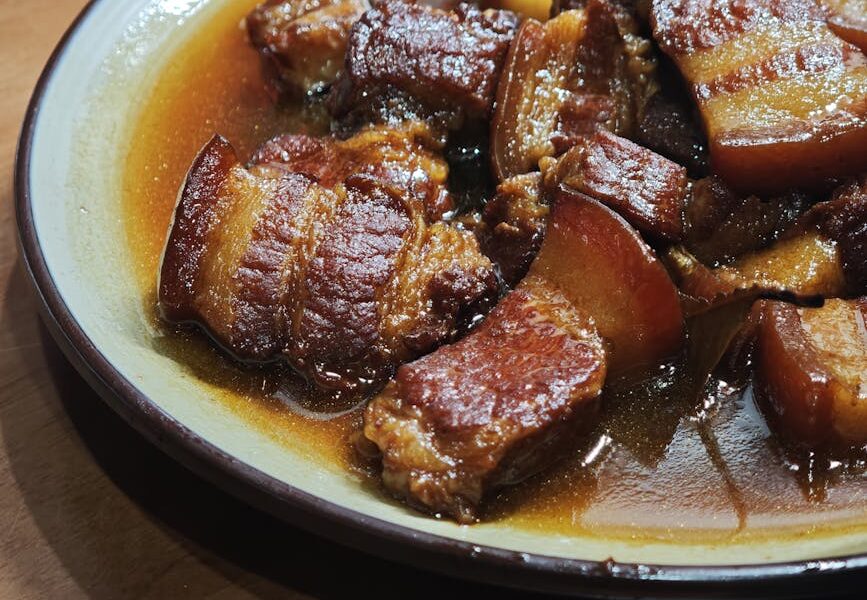
The most famous application. Pork belly is marinated with fish sauce and shallots, then braised in coconut water with eggs and 3 to 4 tablespoons of nuoc mau per pound of pork. The sauce provides the mahogany color that defines the dish. See our detailed Thit Kho recipe for the full preparation.
Ca Kho To (Vietnamese Caramel Fish in Claypot)
Catfish or basa is layered with sliced pork belly, ginger, and chili, then braised in a small claypot with 2 tablespoons of nuoc mau, fish sauce, and a splash of water. The bitter edge of the caramel balances the natural sweetness of the fish and the saltiness of the fish sauce. Pair with steamed jasmine rice and a side of pickled mustard greens.
Suon Kho (Caramelized Pork Ribs)
Pork spareribs cut into one-inch pieces are seared, then braised with 3 tablespoons of nuoc mau, fish sauce, and water until the sauce reduces to a sticky glaze. This is a common workday dinner across Vietnam and an excellent introduction for cooks who find pork belly intimidating.
Bo Kho (Vietnamese Beef Stew)
Although bo kho relies primarily on annatto for its red color, a tablespoon of nuoc mau added during the simmer provides background bitterness and depth that distinguishes a homemade version from a restaurant approximation.
Banh Mi Pate and Roast Pork Fillings
Many sandwich shops use a tablespoon of nuoc mau in their pate base or in the marinade for char siu-style roast pork that fills a banh mi. The sauce adds color and a faint bitter contrast to the typically sweet fillings. Compare the technique to our Banh Mi recipe for context on Vietnamese sandwich building.
Pho and Bun Bo Hue Color Adjustments
Vietnamese beef noodle soups often need color correction when the bones produce a paler broth than expected. A teaspoon of nuoc mau stirred into the finished pot adds richness without overwhelming the aromatics. See our guide to Vietnamese pho broth and Bun Bo Hue for full broth-building techniques.
Marinade and Glaze Applications
Mix one tablespoon of nuoc mau with two tablespoons of fish sauce, one tablespoon of lime juice, and one minced garlic clove for an instant marinade that works on chicken thighs, pork chops, or shrimp. Apply at least thirty minutes before grilling for color and depth.
Recipe: Classic Nuoc Mau (Vietnamese Caramel Sauce)
This is the master recipe in printable form. Yields about half a cup of finished sauce, which is enough for three to four braises.
Ingredients
- 1 cup granulated white sugar
- 3 tablespoons cold water (for dissolving)
- 1/3 cup hot water (for arresting)
- Optional: 1 teaspoon fish sauce
Method
- Combine sugar and cold water in a 1 to 2 quart heavy saucepan. Stir until the texture resembles wet sand.
- Set over medium heat. Do not stir. Allow the sugar to dissolve and the water to boil off over 3 to 5 minutes.
- When the syrup is clear and bubbling rapidly, lower the heat to medium-low. Watch color closely.
- The syrup will pass through pale gold, light amber, and deep amber over 90 seconds.
- When the sauce reaches dark mahogany and you detect a faint hint of smoke, remove the pan from the heat.
- Wearing an oven mitt and using the lid as a shield, pour the hot water into the molten sugar in a steady stream. Stand back. The pan will erupt with steam.
- Return the pan to low heat and stir until any seized sugar dissolves, about 30 seconds.
- If using fish sauce, stir it in now.
- Cool in the pan for 2 to 3 minutes, then transfer to a heat-safe jar.
- Store at room temperature for up to 6 months, or refrigerate indefinitely.
Variations Worth Trying
Once you have the basic technique down, the following variations expand its range without changing the core method.
- Coconut nuoc mau. Replace half the arrest water with coconut water for a faintly tropical, smoother finish. Best for pork and seafood applications.
- Ginger nuoc mau. Add a slice of bruised ginger to the arrest water before pouring. The aromatic note carries into braises beautifully. See our notes on working with fresh ginger.
- Star anise nuoc mau. Steep one whole star anise pod in the arrest water for ten minutes before pouring. Strain before using. Excellent for beef braises and red-cooked dishes.
- Citrus nuoc mau. Add a strip of orange peel during the arrest step. The peel scents the sauce and pairs especially well with duck or game.
- Smoky nuoc mau. Push the sugar a few seconds further past mahogany for a bolder, almost charcoal note. Reserved for cooks confident in their timing. Excellent in claypot fish.
How Nuoc Mau Fits in the Broader Asian Pantry
Vietnamese caramel sauce is part of a broader tradition of caramelization in Southeast Asian cooking. Indonesian kecap manis is a related product, though it incorporates soy sauce and is sweeter overall. Thai cooks sometimes use a similar dark caramel in northern braises. Chinese cooks make a comparable substance called jiaohu tang or ”browning sugar water,” used in red-cooked dishes. Each of these regional cousins shares the same principle: take sugar past the point of pleasant sweetness, lock in the bitter complexity, and use the result as seasoning rather than dessert.
Within Vietnamese cooking, nuoc mau lives alongside fish sauce, shallots, garlic, and ground black pepper as part of the foundational savory pantry. Most Vietnamese home cooks would consider a kitchen without nuoc mau and fish sauce to be incomplete in the same way an Italian kitchen feels incomplete without olive oil and parmesan.
Storage, Shelf Life, and Troubleshooting Stored Sauce
Properly made nuoc mau is shelf-stable for an extraordinary length of time because of the sugar concentration. A finished sauce contains roughly 65 to 70 percent dissolved solids by weight, which falls within the range where bacterial and fungal growth is suppressed without refrigeration.
- Pantry storage: Up to 6 months in a sealed glass jar at room temperature. Keep away from direct sunlight.
- Refrigerator: Indefinitely, but the sauce will thicken substantially. Bring back to pourable consistency by warming the jar in a bowl of hot water.
- Freezer: Not recommended. The sauce does not freeze hard because of its sugar content but the texture changes after thawing.
- Signs of spoilage: Cloudiness, mold growth, or sour smell. If any of these appear, discard.
- Crystallization in jar: Sometimes the sauce develops crystals on the surface during storage. This is harmless. Stir in a teaspoon of warm water and the crystals will redissolve.
FAQ: Vietnamese Caramel Sauce
Can I substitute Vietnamese caramel sauce with brown sugar?
Brown sugar provides sweetness and a faint molasses note but lacks the bitter complexity of properly caramelized nuoc mau. In a pinch you can use one tablespoon of brown sugar plus a quarter teaspoon of soy sauce as an approximation, but the depth and color will not match. For authentic results, make the real thing.
Is nuoc mau the same as kecap manis?
No. Kecap manis is Indonesian sweet soy sauce, made by combining soy sauce with palm sugar and aromatics. It is much sweeter and contains the umami of fermented soy. Nuoc mau is pure caramelized sugar with water. The two cannot be substituted directly without significant flavor changes.
What if I do not have a thermometer?
Most Vietnamese home cooks work without a thermometer. The visual color stages and the smoke signal are reliable enough on their own. A thermometer is useful for your first two or three attempts to confirm what mahogany looks like at 380 degrees Fahrenheit. After that you can work by sight.
Can I make a large batch and store it?
Yes, but scale carefully. The eruption at the arrest stage scales with sugar volume, and a batch larger than 2 cups of sugar can be hard to manage in a home pan. We recommend making 1 cup batches when needed rather than a single large batch. The sauce keeps so well that making it fresh is rarely a burden.
Why does my sauce taste burned even though I pulled it on time?
Sugar continues to cook from residual pan heat for fifteen to twenty seconds after you remove it from the burner. If your pan is very heavy, the residual cooking can push the sauce past mahogany even after the heat is off. Pull the pan slightly earlier on subsequent batches, or transfer the molten sugar to a cooler vessel before adding water.
Can I use this technique with sugar substitutes?
No. Sucralose, aspartame, stevia, and erythritol do not caramelize because they are not pure sucrose. They will either decompose without browning or burn without developing flavor. Allulose can caramelize but produces an unfamiliar flavor profile. For nuoc mau, real sugar is required.
How much nuoc mau do I add to a braise?
The standard ratio is 2 to 4 tablespoons per pound of meat or fish. Add it early in the braise so the flavor integrates fully. Start with 2 tablespoons if you are unsure; you can always add more, but you cannot remove what is in the pot.
Does nuoc mau work in non-Vietnamese dishes?
Yes, with experimentation. A small amount adds depth to barbecue sauces, brown gravies, mole bases, and dark beer reductions. It can also replace the burnt sugar component in Caribbean cooking, where similar caramelization techniques are used. Treat it like a bitter molasses with no sulfur notes.
Is the smoke during cooking dangerous?
The smoke is irritating but not toxic in small amounts. Run your exhaust fan on high during the technique. If smoke fills the kitchen, you have pushed the sugar too far and should discard the batch. Excessive smoke indicates burned, not caramelized, sugar.
Can I make nuoc mau in advance for a big family meal?
Absolutely. Many Vietnamese households keep a standing jar at all times. Making nuoc mau a week or two before a Lunar New Year feast is common practice. The sauce only deepens in flavor over the first few days of storage.
Pairing Nuoc Mau with Other Vietnamese Techniques
To get the most out of your homemade caramel sauce, build it into a broader Vietnamese cooking practice. Master nuoc mau, then layer on related techniques. Begin with a working knowledge of Vietnamese regional cuisines so you understand which dishes call for which preparation. Practice the foundation savory soups by making your own pho broth. Then move into the caramel-driven dishes that define southern home cooking. Finally, explore the steamed and griddled snacks like banh xeo crepes and banh bao steamed buns that round out the home repertoire.
The thread connecting all of these is the Vietnamese pantry triad of fish sauce, fresh aromatics, and nuoc mau. Once these three become second nature, almost any Vietnamese home dish becomes accessible. The caramel sauce is the smallest of the three to master, but arguably the most defining of the cuisine’s character.
Final Thoughts
Vietnamese caramel sauce is a technique that rewards repetition. The first batch will probably be too pale or too dark; the third will be acceptable; the fifth will be reliable. From that point forward you have permanent access to a foundation ingredient that elevates everything from weekday braises to holiday feasts. The cost in money is trivial, the time investment is fifteen minutes, and the resulting depth of flavor is impossible to replicate with any store-bought substitute.
Treat the technique with respect. Sugar at 400 degrees is one of the most dangerous substances in a home kitchen. But once you understand the color stages, the aroma signals, and the safety protocols, nuoc mau becomes a satisfying, even meditative kitchen ritual. It is one of the small daily skills that separates competent home cooking from the kind of cooking that draws compliments at the table.

Mei Lin Chen
Mei Lin Chen is an Asian food writer and recipe developer. Melbourne-raised and London-based, she has spent over a decade exploring the rice paddies, hawker stalls, and home kitchens of South-East and East Asia. Her recipes balance traditional technique with everyday practicality.