Last updated: March 15, 2026
Punjabi food is the most globally recognized regional Indian cuisine, the source of nearly every ”Indian restaurant” dish you have ever ordered abroad. Butter chicken, tandoori chicken, dal makhani, naan, chole bhature, sarson da saag with makki di roti, lassi, paneer tikka — these are not generic ”Indian” creations. They were born in the wheat-belt villages and tandoor-driven dhabas of the Punjab region, a fertile plain straddling India and Pakistan, and they conquered the world because of a unique combination of refugee migration after 1947, dairy abundance, communal generosity, and a cooking style built around fire, fat, and fragrance.
This guide is the full picture of Punjabi cuisine: the land and history that shaped it, the staples that define it, the must-try dishes that anchor it, the techniques that distinguish it from other South Asian traditions, and the practical know-how you need to plan Punjabi meals at home. Whether you are cooking for the first time or trying to move beyond the takeout repertoire, this is your roadmap.
What Is Punjabi Food?
Punjabi food is the cuisine of the historical Punjab region — a vast alluvial plain in the northwest of the Indian subcontinent that is now divided between the Indian state of Punjab and the Pakistani province of the same name. The word ”Punjab” itself is Persian: panj (five) and ab (water), referring to the five rivers — Jhelum, Chenab, Ravi, Beas, and Sutlej — that have made the region one of the most agriculturally productive zones in all of Asia.
This agricultural wealth dictates the food. Punjab is India’s breadbasket, producing the majority of the country’s wheat. Its cattle, water buffalo, and goats provide ghee, butter, milk, cream, and yogurt in unmatched quantities. Mustard, sugarcane, lentils, and a long list of vegetables thrive on its irrigated fields. The result is a cuisine that is wheat-based rather than rice-based, dairy-heavy, generously fatty, and built around bold spicing executed without subtlety — Punjabi cooks aim for forwardness, not restraint.
If you want to understand how Punjabi food relates to other South Asian traditions, our broader guide to Indian cuisine places it in the wider context of Indian regional cooking, alongside the rice-and-fish world of Bengal, the coconut-driven cuisine of Kerala, and the lamb-and-saffron tradition of Kashmir.
A Brief History of Punjabi Cuisine
Punjab sits at a crossroads. For three thousand years it has been the gateway through which armies, traders, missionaries, and migrants entered the Indian subcontinent — Aryans, Persians, Greeks under Alexander, Kushans, Huns, Arabs, Mongols, Mughals, Afghans, Sikhs, and the British have all left culinary fingerprints on the region. Modern Punjabi food is the cumulative result.
The deepest layer is Indo-Aryan and agricultural: cattle and dairy, wheat, lentils, ghee, and yogurt — the foundations of Vedic-era diet. Persian and Central Asian influences came with successive invasions and brought clay-oven cooking, slow braises, the use of nuts and dried fruit in savory dishes, and the cultural reverence for rich, generous tables. The Mughal Empire (1526–1857) was particularly transformative: Mughal court chefs introduced creamy gravies, kebabs, saffron, almonds, and the elaborate tandoor-cooked preparations that became the foundation of restaurant-style Punjabi food.
The single most important event in modern Punjabi food history, however, is the Partition of 1947. When British India was divided into India and Pakistan, the Punjab itself was split, and roughly fifteen million people were displaced across the new border. Sikh and Hindu Punjabis fled west-to-east, settling primarily in Delhi, where they opened small restaurants and dhabas to feed themselves and other refugees. These exiled cooks took the rustic tandoor traditions of Peshawar, Lahore, and Amritsar and adapted them for urban customers — inventing dishes like butter chicken (created at Moti Mahal in Delhi around 1948 to use leftover tandoori chicken in a tomato-cream sauce), dal makhani, paneer tikka masala, and the modern restaurant repertoire. When Punjabi diaspora communities later spread to the UK, Canada, the US, East Africa, the Gulf, and Australia, they took this post-Partition Delhi-style Punjabi food with them. That is why ”Indian restaurant food” almost everywhere in the world is, in fact, Punjabi food.
The Regions of Punjab and Their Distinct Styles
”Punjabi food” is not monolithic. The historical Punjab is enormous, and three broad sub-regions have meaningfully different cooking traditions:
Majha (Central Punjab — Amritsar, Lahore, Gurdaspur). The heartland. This is the tandoor zone, home to Amritsari kulcha, fish tikka, Amritsari fish fry (battered freshwater fish flavored with carom seeds), and the most iconic versions of tandoori chicken and seekh kebab. Lahori cuisine in particular is famed for its street food: nihari, paya, chargha, and Lahori chicken karahi.
Doaba (Between the Beas and Sutlej rivers — Jalandhar, Hoshiarpur, Kapurthala). The most agricultural and historically the largest source of overseas Punjabi migration. Food here leans rustic and vegetable-forward: sarson da saag, makki di roti, ma di dal (whole black lentils slow-cooked with ginger and dairy), kadhi pakora, and gajar ka halwa during the winter months.
Malwa (Southern Punjab — Patiala, Bathinda, Ferozepur). Drier, with stronger influences from Rajasthan and Haryana. Patiala cuisine is famously rich — the eponymous ”Patiala shahi” cooking uses heavy doses of ghee, cream, and dried fruit. Pinni (a winter sweet of wheat flour, ghee, and dried fruit), maa cholian di dal, and rich meat preparations come from this zone.
Within the broader Punjabi-speaking world, there are also distinct Pothohari (northern Pakistani Punjab), Saraiki (southern Pakistani Punjab), and Pahari (foothills) sub-traditions, each with their own specialties.
Essential Ingredients in the Punjabi Pantry
Punjabi cooking relies on a relatively short, fundamental ingredient list. Master the items below and you can produce nearly any dish in the canon.
| Ingredient | Hindi/Punjabi Name | Role in the Cuisine | Where You Will See It |
|---|---|---|---|
| Whole wheat flour | Atta | Foundation of every flatbread | Roti, paratha, kulcha, naan |
| Clarified butter | Ghee / Desi ghee | Primary cooking fat; finishing fat | Tadka, dal, sweets, parathas |
| Whole milk yogurt | Dahi | Marinade base, sauce thickener, side dish | Tandoori marinades, lassi, raita, kadhi |
| Cream | Malai | Adds richness to gravies and dals | Butter chicken, dal makhani, paneer dishes |
| Paneer | Paneer | Fresh non-melting cheese | Palak paneer, paneer tikka, shahi paneer |
| Tomato | Tamatar | Base of nearly every restaurant-style gravy | Curries, makhani sauce, bhuna masala |
| Onion | Pyaaz | Sautéed brown for gravies; raw as garnish | Almost everything savory |
| Ginger and garlic | Adrak, lehsun | Aromatic base, usually as a paste | All savory cooking |
| Cumin | Jeera | Primary tempering spice | Tadka, jeera rice, dal |
| Coriander | Dhania | Ground spice and fresh herb | Masala blends, garnishes |
| Garam masala | Garam masala | Finishing spice blend | Curries, biryani, kebabs |
| Kasuri methi | Kasuri methi | Dried fenugreek leaves — signature aroma | Butter chicken, dal makhani, paneer dishes |
| Turmeric | Haldi | Color and earthy backbone | Dal, curries, marinades |
| Kashmiri red chili | Kashmiri lal mirch | Deep red color, mild heat | Tandoori marinades, makhani sauce |
| Mustard oil | Sarson da tel | Pungent oil for rustic dishes and pickles | Sarson da saag, fish, achaar |
| Mustard greens | Sarson | Winter green for the iconic saag | Sarson da saag |
| Black lentils (whole) | Sabut maa / urad | Slow-cooked, becomes dal makhani | Dal makhani, ma di dal |
| Chickpeas | Kabuli chana | Hearty pulse staple | Chole, chana masala |
| Black cardamom | Badi elaichi | Smoky, resinous; defines Mughal-style stews | Korma, biryani, garam masala |
| Cornmeal | Makki da atta | Winter flatbread flour | Makki di roti |
Several of these deserve standalone deep-dives. For tempering, see our guide to tadka tempering. For paneer, this is one of the most recognizable Indian ingredients and the foundation of vegetarian Punjabi cooking — see how to make paneer from scratch. And for the warm earthy color and flavor that runs through every Punjabi gravy, refer to our complete guide to turmeric.
10 Must-Try Punjabi Dishes
The dishes below represent the absolute core of the cuisine — both at home and in restaurants. If you eat your way through this list, you have eaten Punjab.
1. Butter Chicken (Murgh Makhani)
The single most internationally recognized Indian dish. Tandoor-cooked chicken simmered in a tomato-and-cream gravy enriched with butter and finished with kasuri methi. The original was created at Moti Mahal in Delhi in the late 1940s by Kundan Lal Gujral, who needed to use leftover tandoori chicken at the end of the night. Done well, the gravy is silky, slightly sweet, lightly smoky, and balanced — not the cloyingly sugary version that has become common abroad. See our chicken tikka masala recipe for a closely related dish.
2. Tandoori Chicken
Whole or jointed chicken marinated twice — first in lemon and salt, then in a thick yogurt marinade with ginger-garlic paste, garam masala, Kashmiri chili, and mustard oil — and roasted in a clay tandoor at temperatures above 480°F. The signature char, smoke, and crimson color are unmistakable. Our authentic Punjabi tandoori chicken recipe walks you through how to replicate the effect in a home oven or on a grill.
3. Dal Makhani
Whole black urad lentils and red kidney beans simmered for as long as 24 hours with tomato, ginger, butter, and a generous final splash of cream. The texture is luxurious, almost glossy. This is the most famous lentil dish in Indian cuisine and another Moti Mahal invention, born from the same instinct that produced butter chicken — to turn a humble pulse into something fit for a banquet.
4. Sarson da Saag with Makki di Roti
The seasonal soul of village Punjab. Pureed mustard greens (often blended with spinach and bathua) slow-cooked with ginger, green chili, garlic, and a final tempering of ghee, served with thick handmade cornmeal flatbreads. It is a winter dish — mustard greens are tender and sweet only from November through February — and traditionally crowned with a chunk of jaggery and a generous knob of homemade white butter (makhan). This is Punjab at its most rustic and unforgettable.
5. Chole Bhature
The breakfast and brunch champion. Spicy chickpeas (chole) cooked dark and rich with onions, tomatoes, ginger, garam masala, and amchoor (dried mango powder), paired with bhatura — a leavened, deep-fried wheat bread that puffs into a pillow. The combination is hearty, tangy, and emphatically not subtle. A Delhi-Punjabi institution.
6. Amritsari Kulcha
A stuffed flatbread that is the pride of Amritsar. The dough is studded with a spiced potato or paneer filling, then slapped onto the wall of a tandoor where it puffs and crisps. Served torn open with chole, raw onion, mint chutney, and a final brush of ghee, it is one of the most satisfying single dishes you can eat on the subcontinent.
7. Paneer Tikka and Palak Paneer
The two flagship paneer dishes. Paneer tikka is yogurt-and-spice-marinated cubes of paneer skewered with bell pepper and onion and tandoor-cooked, while palak paneer is paneer simmered in a smooth, ghee-tempered spinach gravy. Vegetarian Punjabi cooking is centered on paneer, and these dishes are why. Try our palak paneer recipe for the classic preparation.
8. Rajma Chawal
Red kidney beans slow-cooked in a tomato-onion gravy, served over steaming basmati rice. This is the Sunday-lunch dish of Punjabi households across India and the diaspora — comforting, frugal, and forgiving. A bowl of rajma chawal with a side of onion-and-chili pickle is the platonic Punjabi family meal.
9. Aloo Paratha
The breakfast hero. A wheat-flour dough stuffed with spiced mashed potato (cumin, green chili, coriander, garam masala, sometimes ginger) and shallow-fried with ghee on a tawa until golden and slightly crisp. Served with butter, dahi, and lime pickle. Every dhaba on the Grand Trunk Road serves them by the hundreds, and no Punjabi child grows up without them.
10. Lassi
Yogurt blended with water (and sometimes ice, sugar, salt, or fruit) into a thick, refreshing drink. Sweet lassi gets sugar or rosewater; salty lassi gets a pinch of salt and roasted cumin. The famous ”Punjabi” version is the meal-in-a-glass thick lassi from Amritsar, topped with a cap of malai (clotted cream) so dense you can stand a spoon in it. Served in a tall metal tumbler, it is the universal cooling agent against summer heat and spicy food.
Bonus: Seekh Kebab, Naan, and Kheer
No tour of Punjab is complete without seekh kebab (spiced minced lamb molded onto skewers and tandoor-grilled), naan (the leavened tandoor flatbread that has become the universal Indian-restaurant bread), and kheer (rice pudding simmered in milk and finished with cardamom, saffron, and nuts).
Punjabi Cooking Techniques
Punjabi cuisine is built on a handful of core techniques. Understand these and you understand the cuisine.
The Tandoor
A cylindrical clay oven, traditionally about three feet tall, fired with charcoal or wood and reaching internal temperatures of 480–900°F. Marinated meats are skewered and lowered into the chamber; flatbreads are slapped onto the screaming-hot interior walls. The combination of direct radiant heat, smoke from drippings, and the porous clay’s reflective heat creates the characteristic char, smokiness, and dry-yet-juicy texture of tandoor cooking. Restaurant-style butter chicken, tandoori chicken, kebabs, naan, kulcha, and tandoori roti all depend on it. At home, a hot oven, a cast-iron skillet, and a grill can approximate the effect.
Tadka (Tempering)
Tadka is the act of blooming whole and ground spices in hot ghee or oil and pouring the entire fragrant mixture over a finished dish — typically a dal. It is the single most important Indian flavor-extraction technique because most Indian spices are fat-soluble and release their aromatics only when fried briefly in hot oil. A dal without tadka is incomplete. See our full guide to spice tempering for the technical details.
Bhuna (Slow Sautéing the Masala)
Bhuna is the long, patient sauté of onion, ginger, garlic, tomato, and spices in fat until the mixture reduces, darkens, and releases its oil at the edges. This is the foundation of nearly every Punjabi gravy. Done quickly, you get raw, sharp, watery sauces; done properly — 20 to 40 minutes, with patience — you get the deep, sweet, glossy base that defines restaurant-style cooking. Look for the moment when the oil separates from the masala and pools at the sides of the pan: that is your signal that the bhuna is complete.
Dhungar (Smoking)
A small bowl is placed in the center of a finished dish, a piece of glowing charcoal is dropped into it, a teaspoon of ghee is poured onto the charcoal, and the entire pot is covered for two to three minutes. The smoke from the burning ghee infuses the dish with a tandoor-like aroma. Dhungar is used to give a ”fresh from the clay oven” flavor to dishes cooked on the stovetop — dal makhani, butter chicken sauces, and biryani in particular.
The Yogurt Marinade
Hung yogurt (thickened by straining), combined with ginger-garlic paste, lemon juice, salt, oil or mustard oil, and ground spices, is the universal Punjabi marinade for proteins. The yogurt’s lactic acid tenderizes meat while coating it in a layer that holds spices against the surface during high-heat cooking. For tandoor-style dishes, this marinade is non-negotiable.
Dum (Sealed Slow Cooking)
An inheritance from Mughal cuisine: a heavy pot is sealed shut with dough around the lid, then cooked over very low heat or with hot coals above and below. The trapped steam and aromas concentrate inside. Used for biryani and certain rich meat preparations. Our authentic dum-style biryani recipe uses the same technique.
Punjabi Food vs. Other South Asian Cuisines
To place Punjabi food correctly in your mental map, here is how it compares with five other major regional South Asian cuisines:
| Cuisine | Staple Grain | Primary Fat | Defining Flavor Profile | Iconic Dish | Spice Level |
|---|---|---|---|---|---|
| Punjabi | Wheat (atta, maida) | Ghee, butter, cream | Rich, smoky, tomato-and-dairy forward | Butter chicken, dal makhani | Medium |
| Bengali | Rice | Mustard oil | Pungent, fish-and-mustard, subtly sweet | Maacher jhol, shorshe ilish | Mild–medium |
| Kerala | Rice, tapioca | Coconut oil | Coconut, curry leaves, sour kokum, seafood | Meen moilee, appam | Medium–hot |
| Kashmiri | Rice | Mustard oil, ghee | Saffron, fennel, dried ginger, lamb-heavy | Rogan josh, yakhni | Mild–medium |
| Sichuan (China) | Rice, wheat noodles | Chili oil, lard | Numbing-hot mala from peppercorns | Mapo tofu, dan dan noodles | Hot, numbing |
| Hyderabadi | Rice | Ghee, oil | Mughlai-meets-Andhra, tamarind, fried onions | Hyderabadi dum biryani | Medium–hot |
The contrast with Bengali cuisine is especially instructive. Bengali food is rice-based, fish-centric, and built around mustard oil and panch phoron — it favors sharper, fresher flavors and dishes are often soupy. Punjabi food is the opposite on nearly every axis: wheat, meat-and-dairy-heavy, slow-cooked, dry or thick gravies, generous fat. Both are quintessentially Indian; they could not be more different on the plate.
Vegetarianism in Punjabi Food
Despite the international reputation of butter chicken and tandoori meats, the majority of everyday Punjabi cooking — especially in Sikh and Hindu households — is vegetarian or lacto-vegetarian. The cuisine has one of the world’s richest vegetarian repertoires precisely because it leans so heavily on dairy: paneer, butter, ghee, cream, yogurt, and lassi all provide the richness and protein that meat does in other cuisines.
Sikh langar — the free community kitchen served in every gurdwara — is strictly vegetarian and feeds tens of millions of people daily worldwide. A typical langar plate consists of dal, a sabzi (vegetable dish), roti, rice, and kheer, all cooked in massive cauldrons and served on the floor to all visitors regardless of religion or caste. This tradition has shaped Punjabi vegetarian cooking into something deeply communal, simple, generous, and nutritionally complete.
Iconic vegetarian Punjabi dishes include sarson da saag, dal makhani, chana masala, palak paneer, shahi paneer, malai kofta (paneer-and-potato dumplings in a creamy gravy), aloo gobi, baingan bharta (smoked, mashed eggplant), kadhi pakora (yogurt-and-besan curry with fritters), and rajma. For everyday cooking, a simple yellow dal tadka with rice or roti is the workhorse.
Punjabi Breads: A Universe of Flatbreads
Punjab is a wheat-eating culture, and bread variety is enormous. Here are the most important:
- Roti / Phulka: Thin unleavened whole-wheat bread cooked on a tawa and finished directly over an open flame so it puffs.
- Tandoori roti: A thicker version slapped onto a tandoor wall — slightly chewy with leoparded char spots.
- Naan: Leavened with yogurt and yeast, soft and pillowy, baked in a tandoor; ubiquitous in restaurants. Garlic, butter, and stuffed versions are common.
- Kulcha: A leavened tandoor-baked bread, traditionally with a pleat or stuffing of potato, paneer, or onion (Amritsari kulcha is the gold standard).
- Paratha: A layered or stuffed flatbread shallow-fried in ghee. Aloo, paneer, gobi, mooli, and methi parathas are everyday breakfasts.
- Bhatura: A leavened, deep-fried wheat bread that puffs into a pillow. The carrier for chole bhature.
- Makki di roti: Cornmeal flatbread, partner to sarson da saag, traditional in winter.
- Lachha paratha: A multi-layered, flaky paratha made by twisting the dough into a spiral before rolling — common in dhabas.
If you are starting at home, master a basic phulka and a tandoor-style naan made without a tandoor first, then move on to parathas and bhatura. Most Punjabi homes still make breads fresh for every single meal.
Punjabi Sweets and Desserts
Punjabi sweets are characteristically rich, dairy-based, and seasonal. Many are tied to specific festivals or to the cold winter months when ghee and dried fruit are believed to provide warmth and strength.
- Gajar ka halwa: Grated red carrots slow-cooked in milk, ghee, and sugar, finished with cardamom and nuts. The defining winter dessert.
- Pinni: Whole-wheat flour, ghee, jaggery, dried fruit, and edible gum — pressed into balls and eaten through the winter for sustained energy.
- Kheer: Rice and milk slow-cooked to a creamy pudding, scented with cardamom, saffron, and nuts.
- Jalebi: Spiraled, deep-fried batter soaked in saffron syrup — crisp, syrupy, often eaten warm in winter with hot milk.
- Phirni: A coarser-than-kheer ground-rice pudding, traditionally set in earthen pots that draw out excess moisture.
- Patiala lassi: Technically a drink, but with its layer of clotted malai it crosses into dessert territory.
- Sohan halwa: A dense, chewy, ghee-rich confection with nuts, a specialty of Multan and Amritsar.
Meal Planning and Eating Like a Punjabi at Home
A traditional Punjabi meal — what you would be served as a guest in a household — follows a recognizable structure. Once you understand it, planning at home becomes intuitive.
The Thali Template
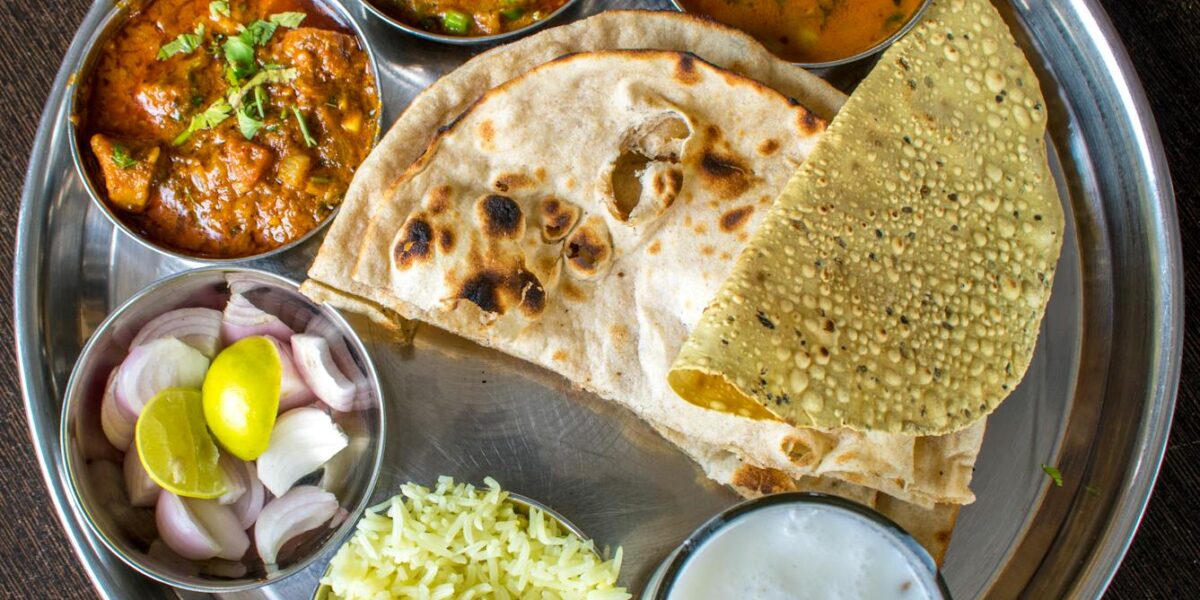
A standard meal includes: a dal (lentil dish), a sabzi (dry or semi-dry vegetable), a curry (a wet vegetable, paneer, or meat dish in gravy), roti or paratha, rice (often optional), dahi (plain yogurt), a salad of sliced onion-tomato-cucumber-green chili, mango pickle or lemon pickle, and a small sweet. This is balanced not by Western nutritional logic but by the traditional concept of ”rasa” — sour, salty, sweet, bitter, pungent, and astringent flavors all represented.
Sample Weeknight Plans
A practical Punjabi weeknight dinner can be much simpler. Three classic combinations:
- The dhaba combo: Dal tadka + jeera rice + raita + onion salad. Twenty-five minutes of work.
- The Sunday lunch: Rajma + steamed basmati rice + cucumber raita + lemon pickle. The rajma can be made in advance.
- The vegetarian feast: Palak paneer + aloo gobi + roti + raita + sweet lassi.
Sample Weekend Dinner Party (8 People)
- Starter: Paneer tikka (skewers, grilled)
- Mains: Butter chicken + dal makhani + chana masala + aloo gobi
- Breads: Naan and tandoori roti
- Rice: Jeera rice or vegetable pulao
- Sides: Cucumber raita, kachumber salad, lemon-and-chili pickle
- Dessert: Gajar ka halwa with vanilla ice cream
- Drink: Sweet lassi or salted lassi, plus masala chai after
Pantry Build-Out
If you are starting from scratch, the priority order is: whole wheat atta, basmati rice, ghee, mustard oil, full-fat yogurt, ginger, garlic, fresh tomatoes and onions, turmeric, ground coriander, cumin seeds, garam masala, Kashmiri chili powder, kasuri methi, and bay leaves. With this kit you can cook 80% of the Punjabi canon. Add channa dal, urad dal, rajma, and chickpeas (dried or canned) for the lentil dishes, and paneer for vegetarian options.
Common Mistakes When Cooking Punjabi Food at Home
- Rushing the bhuna. The number one mistake. Onions need to brown fully, and the masala needs to fry until the oil separates. There is no shortcut.
- Skimping on fat. Punjabi food is supposed to be rich. Reduced-fat versions taste hollow. If you do not want the calories, eat smaller portions of the real thing rather than diluting it.
- Using the wrong yogurt. Thin or low-fat yogurt waters down marinades and curries. Use full-fat, and hang it in a muslin cloth for an hour if you need extra body.
- Forgetting kasuri methi. The crushed dried fenugreek leaves finished into butter chicken, dal makhani, and paneer dishes are the single most identifiable ”restaurant flavor” you are likely missing.
- Adding cream too early. Cream should go in at the end, off heat or on a very low simmer, or it will split.
- Using pre-ground spice blends past their prime. Garam masala loses potency within months. Buy small quantities, store airtight, and replace often. Or toast and grind your own.
- Under-salting. Salt brings out the spices; under-salted Indian food tastes flat regardless of how much chili is in it.
- Substituting butter for ghee in everything. Butter burns at lower temperatures and does not have the nutty depth of ghee. For tempering and frying spices, ghee is non-negotiable.
Punjabi Food Across the Diaspora
One of the most fascinating things about Punjabi cuisine is how it has been re-invented around the world. In the UK, chicken tikka masala — a tomato-cream variation invented in a Glasgow Punjabi-Bangladeshi restaurant in the 1970s — is so popular it has been called a ”true British national dish.” In Toronto, butter chicken is folded into roti wraps for lunch. In Kenya, Punjabi families brought their cooking with railway workers in the late 1800s; today nyama choma marinades there often borrow tandoori techniques. In California’s Central Valley, the largest Sikh community outside India runs roadside dhabas that feed truckers Punjabi-Mexican fusion — channa-stuffed burritos and tandoori chicken tacos. The pizza-style ”butter chicken pizza” found in Indian fusion restaurants from Sydney to Seattle is a direct descendant of this diaspora creativity.
What unifies all of these adaptations is the underlying Punjabi flavor logic — the tomato-onion-ginger-garlic-garam-masala base, the dairy-and-tandoor-cooked protein, the dialed-up richness. Once you know that grammar, you can read every variation as a sentence built on the same rules.
Punjabi Food FAQ
Is Punjabi food the same as Indian food?
Punjabi food is one of dozens of distinct regional Indian cuisines. However, because of the post-Partition migration and diaspora export pattern, most ”Indian restaurants” outside of India serve a Punjabi-dominated menu, which has led many people to assume the two are synonymous. They are not. Real Indian cuisine includes the rice-and-fish traditions of Bengal and Kerala, the lamb-saffron cooking of Kashmir, the tamarind-and-curry-leaf flavors of Tamil Nadu, and many more — each profoundly different from the Punjabi tradition.
Is Punjabi food very spicy?
It is well-spiced, not strongly hot. Punjabi food uses a generous hand with whole spices (cumin, coriander, cardamom, cloves, cinnamon, black pepper, fennel) but relatively moderate chili heat — Kashmiri chili in particular is used as much for its red color as for its mild warmth. By contrast, Andhra, Sichuan, or Thai cuisines deliver much more heat. If you find a Punjabi restaurant dish painfully hot, it has probably been adapted toward Indo-Chinese or generic curry-house tropes, not toward traditional Punjab.
Do I need a tandoor to cook authentic Punjabi food?
No. While a tandoor delivers unmatched results for breads and kebabs, you can approximate the effect at home. For naan: use a screaming-hot cast-iron pan or pizza stone in a 550°F oven, then finish under a broiler. For tandoori chicken: marinate properly, then roast at 475°F for char, and finish with a brief broil. For dhungar (smoking) effects, drop a piece of glowing charcoal on a ghee-greased steel bowl inside your covered pot for two minutes. The vast majority of Punjabi cooking — gravies, dals, vegetables, breads on a tawa — needs no tandoor at all.
What is the difference between Punjabi food in India and Pakistan?
Indian Punjabi cuisine has a higher share of vegetarian dishes (Sikh and Hindu households), strong dairy emphasis, and the deep influence of the post-Partition Delhi restaurant style. Pakistani Punjabi cuisine, especially Lahori, is more meat-centered, leans further into Mughal and Central Asian dishes (nihari, paya, haleem, chargha, chapli kebab), and uses oil and red chili more aggressively. The breads, the tandoor, the dairy base, and most of the day-to-day dishes are identical or near-identical. Our guide to Pakistani cuisine covers the meat-forward side in detail.
Is paneer the same as cottage cheese or feta?
No. Paneer is a fresh, unaged, non-melting cheese made by curdling whole milk with lemon juice or vinegar and pressing the curds. It is firmer than cottage cheese, much milder than feta, and crucially holds its shape during cooking — which is why it can be cubed and added to curries or skewered for tikka. Cottage cheese will fall apart in a sauce; feta will dissolve into briny mush. There is no good substitute for paneer in Punjabi cooking — fortunately, it is easy to make at home in about 30 minutes.
Why is so much Punjabi restaurant food orange or red?
Two reasons. First, the legitimate one: Kashmiri red chili powder is naturally a deep red and is used heavily in tandoori marinades and makhani sauces, giving an authentic crimson hue. Second, the less legitimate one: many commercial restaurants add tartrazine, sunset yellow, or carmoisine food dyes to get a more intense orange or fluorescent red. Properly made tandoori chicken and butter chicken are red, but a muted red — never neon. If your butter chicken looks like a traffic cone, dye is involved.
What should I drink with Punjabi food?
Lassi (sweet or salty) is the traditional pairing — its yogurt content is meant to balance heat and rich fat. Masala chai is the universal post-meal closer. For something cold and modern, jal jeera (a salty cumin-mint cooler) is excellent before a meal. If you are drinking alcohol, a crisp Indian lager (Kingfisher) or a slightly off-dry Riesling pairs surprisingly well with the dairy and spice. Avoid heavy reds with butter chicken — the sweetness clashes.
How healthy is Punjabi food?
Restaurant-style Punjabi food, with its butter, cream, and frying, is calorically dense and not designed for daily consumption. Home-style Punjabi food is much lighter — dal, sabzi, roti, and yogurt is a balanced, fiber- and protein-rich meal with moderate fat. The trick is to distinguish between celebration food (butter chicken, chole bhature, paneer dishes) and everyday food (dal-roti-sabzi). Traditional Punjabis ate the latter every day and the former on special occasions; modern restaurant menus invert that ratio, which is what has given Punjabi food a ”heavy” reputation it does not deserve.
Where do I start if I am new to cooking Punjabi food?
Start with three dishes that build your fundamentals: a basic dal tadka (teaches you tempering), a simple chana masala (teaches you bhuna), and a tandoori-style yogurt-marinated chicken cooked under a broiler (teaches you the marinade). Once you can produce all three reliably, add a paneer dish, a sabzi like aloo gobi, and homemade rotis. From there, butter chicken, dal makhani, and chole are the next logical step.
The Cultural Heart of Punjabi Food
Punjabi food is fundamentally generous. The cuisine evolved among farmers feeding agricultural laborers, soldiers, pilgrims, and an unending stream of guests — and the rule was always the same: feed more than the table can finish. The Sikh institution of langar formalizes this into a daily practice of free public meals. The home institution of ”atithi devo bhava” — the guest is god — formalizes it into a moral obligation. Even today, a Punjabi host who serves you a single helping of food has failed; you must be pressed, repeatedly, into a second and third helping, and ideally sent home with leftovers.
This is why Punjabi dishes are designed to be made in big pots and to taste better the next day. It is why the breads are eaten the moment they come off the heat. It is why every gravy is a little richer than it strictly needs to be, why every dal gets an extra tablespoon of ghee on top, why a meal is never truly over until kheer is brought out. The food carries the values of the culture: warmth, abundance, hospitality, and a particular kind of unembarrassed pleasure in feeding the people you love. Cook it that way, eat it that way, and you have understood it.
Where to Go Next
If you are ready to start cooking, our most-used Punjabi recipes are chicken tikka masala, tandoori chicken, palak paneer, dal, naan, and chicken biryani. To go deeper on technique, our guide to tadka tempering and guide to making paneer are the two most useful skill-builders. And if you want to keep exploring the broader Indian regional landscape, our overview of Indian cuisine, alongside the regional guides to Bengal, Kerala, and Kashmir, will round out the picture.
Punjabi food rewards practice. The bhuna gets shorter and deeper with experience. The dal develops more layers the longer you cook it. The naan gets puffier each batch. Start simple, cook often, and the cuisine will open up dish by dish.

Mei Lin Chen
Mei Lin Chen is an Asian food writer and recipe developer. Melbourne-raised and London-based, she has spent over a decade exploring the rice paddies, hawker stalls, and home kitchens of South-East and East Asia. Her recipes balance traditional technique with everyday practicality.