Last updated: March 10, 2026
If your introduction to Vietnamese food was a bowl of pho in Hanoi or a banh mi from Saigon, you have only met two of three Vietnams. The country’s narrow waist — Hue, Hoi An, Danang, Quang Nam, Quang Ngai, and the highlands that ripple inland — speaks a different culinary language. It is louder, redder, more fermented, more chili-forward, and built on a very specific kind of layering that takes a single bowl and makes it taste like a banquet. This is the part of Vietnam that fed emperors, that dries the air with shrimp paste in the morning, that boils beef bones with lemongrass for ten hours and calls it breakfast.
Central Vietnamese food is the country’s least exported regional cuisine and, in our opinion, its most rewarding to learn. It is what gives Vietnamese cooking its sharpness, its salt, and its imperial complexity. This guide walks through the geography, history, ingredients, techniques, must-try dishes, and a practical home-cook framework so you can build a Hue-style meal in your own kitchen with confidence.
What Is Central Vietnamese Cuisine?
Central Vietnamese cuisine — known locally as am thuc mien Trung — is the cooking of the long, narrow strip of country running from Thanh Hoa province in the north to Binh Thuan in the south. It is bracketed by the Truong Son mountain range to the west and the East Sea to the east, and it includes three culinary capitals: Hue, the former imperial seat; Hoi An, a UNESCO-listed trading port; and Danang, the modern coastal city that links them.
If Northern Vietnamese cooking is restrained and Southern Vietnamese cooking is sweet and tropical, Central is the spicy middle child. The flavor profile is dominated by chili, fermented shrimp paste (mam tom and mam ruoc), lemongrass, and salt. Portions are deliberately small — a legacy of imperial banquets where dozens of tiny dishes mattered more than one large one — and presentation is taken extremely seriously.
Central cooking is also the most ”complete bowl” tradition in Vietnam. A single dish like bun bo Hue can contain a dozen elements — broth, beef shank, pork knuckle, congealed pig blood, lemongrass, shrimp paste, fried shallots, banana flower, perilla, lime — and every one of them has a job. Nothing is decorative.
A Short History: Why Central Vietnam Tastes the Way It Does
Three historical forces shaped the cuisine you eat today.
The Cham Kingdom (2nd to 17th centuries)
Long before Vietnamese settlers pushed south, central Vietnam was the heart of the Champa civilization, a Hindu-influenced maritime kingdom with strong trade ties to India, Java, and the Malay world. The Cham introduced the heavy use of chili, turmeric, fermented fish products, coconut, and the concept of layering aromatics — all of which became defining elements of regional cooking. You can still taste this clearly in dishes like cao lau and my Quang, which use turmeric-stained noodles and curry-adjacent broths.
The Nguyen Imperial Court (1802 to 1945)
When Emperor Gia Long established Hue as Vietnam’s capital in 1802, the city became home to a court that demanded ceremony in everything, including dinner. A single royal meal — com vua — could contain up to 50 small plates, each beautifully arranged, each calibrated to balance the others. This is where Hue’s obsession with miniaturization, garnish, and color came from. It is why banh beo are served in tiny saucer-sized portions instead of one big plate, why dipping sauces are individually adjusted for each dish, and why a Hue cook will not let you mix two sauces meant for two different bowls.
Geography and Hardship
Central Vietnam is also one of the country’s poorest and most weather-beaten regions. Typhoons hit hard, the soil is thin, and farmland is squeezed between mountains and sea. This created a cuisine of preservation: shrimp paste fermented for months, fish sauce aged in wooden barrels, salted dried fish, pickled greens. It also pushed cooks to extract maximum flavor from minimum ingredients — which is why a Hue household will simmer pork bones with lemongrass and turmeric for hours to make broth from what other regions might discard.
The Three Sub-Regions of Central Vietnamese Cooking
Central Vietnam is not monolithic. The cuisine breaks roughly into three zones, each with its own dialect of flavor.
North-Central (Thanh Hoa, Nghe An, Ha Tinh, Quang Binh, Quang Tri)
The food here is salty and bracing — closer to Northern Vietnamese in restraint but with more chili. Specialties include nem chua (fermented pork sausage from Thanh Hoa) and chao luon (rice porridge with eel) from Nghe An. Fish sauce here is darker and saltier than in the south.
Hue and Thua Thien (the Imperial Heart)
This is the capital of Central Vietnamese cooking. Bun bo Hue, com hen, the entire banh (cake) family — banh beo, banh nam, banh loc, banh ram it — are all Hue dishes. Flavors are intensely layered, chili is generous but precise, and shrimp paste (mam ruoc Hue) is the backbone of everything. Hue cooks will tell you that the sea must be exactly the right distance from the chili — a metaphor for balance you will hear often.
South-Central (Quang Nam, Quang Ngai, Binh Dinh, Phu Yen, Khanh Hoa)
Here is where Hoi An and Danang sit. The cooking is lighter, more turmeric-driven, more reliant on seafood, and more open to outside influence. Chinese, Japanese, and Cham trade have all left fingerprints — most famously on cao lau, Hoi An’s signature noodle dish, which has visible Japanese udon DNA in its thick chewy strands. South-central cooks use less broth and more dry-style noodle bowls eaten with crispy rice crackers crumbled in.
Essential Central Vietnamese Ingredients
You can cook a hundred Central Vietnamese dishes with a relatively short pantry. Build out from the items below and you will be set for almost any recipe in this tradition.
| Ingredient | Vietnamese Name | What It Is | Typical Uses |
|---|---|---|---|
| Fermented shrimp paste | Mam ruoc / mam tom | Salted, fermented tiny shrimp aged into a purple-brown paste | Bun bo Hue broth, dipping sauces, marinades |
| Lemongrass | Sa | Fragrant citrus-scented stalk, bruised or sliced | Soups, marinades, grilled meats |
| Fish sauce | Nuoc mam | Aged anchovy extract, the salt of Vietnam | Dipping sauces, broths, dressings |
| Bird’s eye chili | Ot hiem | Tiny fierce red chilies, fresh or dried | Broths, sauces, table condiments |
| Annatto seeds | Hat dieu mau | Brick-red seeds bloomed in oil for color | Bun bo Hue oil, my Quang broth |
| Turmeric | Nghe | Fresh or powdered, gives yellow color | Cao lau, my Quang, banh xeo |
| Galangal | Rieng | Pine-and-citrus rhizome, sharper than ginger | Sauces, braises, grilled meat marinades |
| Rice paper | Banh trang | Thin dried rice sheets | Wraps, fresh rolls, grilled snacks |
| Tapioca starch | Bot loc | Translucent starch from cassava | Banh loc dumplings, thickening |
| Rice vermicelli (round) | Bun | Round white rice noodles | Bun bo Hue, bun thit nuong |
| Rice vermicelli (thick, square) | Bun bo Hue noodle | Thicker, square-cut bun | Specifically for Hue beef noodle soup |
| Pork knuckle and shank | Mong gio, gio heo | Connective-tissue-rich pork cuts | Bun bo Hue, braises |
| Banana blossom | Hoa chuoi | Purple unripe banana flower, sliced thin | Soup garnish, salads |
| Perilla and Vietnamese mint | Tia to, rau ram | Aromatic herbs | Garnish for noodle soups |
| Pork blood | Tiet heo | Set, congealed pork blood, sliced into cubes | Bun bo Hue, certain congees |
For pantry deep-dives, our guides to lemongrass, shrimp paste, and galangal will save you a lot of frustration in the supermarket aisle. Central Vietnamese cooking is unforgiving about substitutions for these three.
10 Must-Try Central Vietnamese Dishes
If you only ever ate ten dishes from this region, these ten would give you the full vocabulary.
1. Bun Bo Hue — The Empress of Beef Noodle Soup
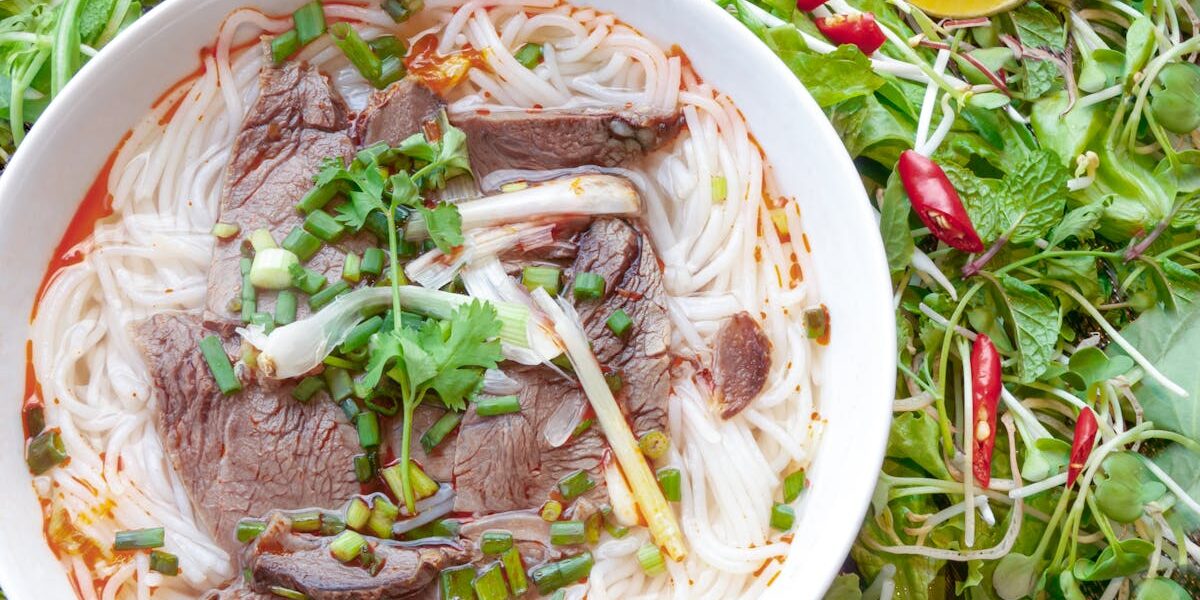
Bun bo Hue is the dish that converts pho loyalists into central Vietnam evangelists. Beef shank and pork knuckle are simmered with lemongrass, fermented shrimp paste, and a fiercely red annatto-chili oil until the broth turns the color of a sunset. It is served with thick round rice noodles, banana blossom, and a forest of herbs. It is unapologetically spicy, salty, and aromatic — the opposite of pho’s clean simplicity. Our complete bun bo Hue recipe walks you through it step by step.
2. Cao Lau — Hoi An’s Single Greatest Dish
Cao lau is unique. The noodles are thick, chewy, and faintly yellow, traditionally made with water from a single ancient well in Hoi An (Ba Le well) and lye derived from local tree ash. They are tossed — not soupy — with sliced char siu-style pork, fresh greens, and crispy fried wonton-cracker shards. A small splash of pork-bone broth keeps it from being dry. The Japanese-Cham-Chinese fusion you taste here is not a marketing pitch; it is literally six centuries of trade-port history in a bowl.
3. My Quang — The Turmeric Noodle of Quang Nam
My Quang is the everyday eater of central Vietnam. Wide, flat, golden noodles dyed with turmeric are placed in a shallow bowl with just enough rich broth to coat — never enough to drown them. The toppings are flexible: shrimp, pork, chicken, or quail eggs, plus crushed peanuts, and a piece of crispy sesame rice cracker (banh trang me) that you snap and crumble in. It eats half like a noodle, half like a salad.
4. Com Hen — Hue’s Beloved Clam Rice
Com hen is the masterclass in Hue cuisine’s ”small things, layered” philosophy. Cold cooked rice is topped with tiny baby clams from the Perfume River, then a parade of accompaniments: crispy pork rind, peanuts, fried shallots, herbs, banana flower, sesame, fermented shrimp paste, and a dribble of clam broth. You mix it yourself at the table. It costs almost nothing in Hue and is breakfast for half the city.
5. Banh Beo — Steamed Rice Saucers
Banh beo are tiny shallow steamed rice cakes — about the diameter of a soju shot — topped with dried shrimp powder, crisp pork rinds, scallion oil, and chili-spiked fish sauce. They come in batches of ten or twenty on a tray. You eat them with a small spoon, lift, dress with sauce, slide into your mouth. They are joyful. They are also the snack closest to Hue’s imperial roots, originally served as one of dozens of plates at court.
6. Banh Loc — Translucent Tapioca Dumplings
Banh loc are tapioca-flour dumplings filled with shrimp and pork belly, wrapped in banana leaf or served unwrapped (banh loc tran). They are translucent enough that you can see the pink shrimp inside, slightly chewy, almost gelatinous. You dip them in fish sauce that is darker and saltier than the southern style. They are addictive and very easy to overeat.
7. Banh Xeo Mien Trung — The Smaller, Crispier Crepe
Saigon-style banh xeo is huge — pizza-sized. The central Vietnamese version is a saucer-sized crepe, thinner, crisper, made in a small clay or cast-iron mini-pan, and stuffed with shrimp, pork, mung bean sprouts, and sometimes squid. You eat it wrapped in lettuce and herbs with peanut-fish sauce. Our banh xeo recipe can easily be adapted to the smaller central format.
8. Nem Lui — Lemongrass Pork Skewers
Nem lui is a Hue specialty: minced pork seasoned with lemongrass, garlic, sugar, fish sauce, and a little pork fat, packed onto a peeled lemongrass stalk and grilled over charcoal. You pull the meat off, wrap it in rice paper with herbs and rice noodles, and dunk it in a peanut-pork-liver sauce that is — controversially for some — slightly thick and savory-sweet rather than tangy.
9. Banh Khoai — The ”Happy Pancake”
Sometimes called the cousin of banh xeo, banh khoai is smaller, thicker, and uses an egg-rich batter. The Hue specialty is filled with shrimp, pork, and bean sprouts, served with peanut-liver sauce and a pile of greens. The name khoai means ”happy” or ”satisfied,” which is exactly how you feel after one.
10. Mi Quang Ech — Frog Noodles of Quang Nam
An adventurous pick that locals love: my Quang made with frog meat instead of shrimp or pork. The frog is marinated with turmeric, lemongrass, and chili and stewed briefly. It is delicate, slightly sweet, and very local — a dish you would essentially never find in the United States but that defines Quang Nam home cooking.
Honorable Mentions: 8 More Dishes Worth Hunting Down
- Banh nam — flat steamed rice flour cakes wrapped in banana leaves, filled with shrimp and pork.
- Banh ram it — a stack of crispy fried glutinous dumpling on top of a soft glutinous dumpling, drizzled with sauce.
- Bun mam nem — vermicelli with anchovy fish sauce, raw vegetables, and grilled pork.
- Bun cha ca Da Nang — fish-cake noodle soup, the Danang answer to bun bo Hue.
- Banh canh ca loc — thick tapioca noodles with snakehead fish, common in Quang Tri and Hue.
- Mi Quang ga — chicken version of my Quang, simpler and child-friendly.
- Bo nuong la lot — beef wrapped in betel leaves and grilled over charcoal.
- Che Hue — a dessert family of dozens of sweet soups: green bean, taro, lotus seed, longan, and the famous che bot loc boc heo quay with tiny dumplings hiding caramelized pork inside.
Core Techniques of Central Vietnamese Cooking
You can identify a Central Vietnamese cook by the techniques they reach for first.
Long Lemongrass Simmering
Bones and lemongrass go in the pot together at the start, not later. The lemongrass is bashed with the back of a knife to bruise it, tied into bundles for easy removal, and simmered for at least four hours. This produces the citrus-savory backbone you taste in bun bo Hue.
Annatto Oil Blooming
Annatto seeds are heated gently in oil over low heat for two to three minutes — never long enough to fry — until the oil turns brick red. The seeds are strained out. This colored oil is the secret behind the dramatic red shimmer on top of any decent bun bo Hue. Without it the broth looks pale and looks wrong.
Shrimp Paste Tempering
Raw mam ruoc tastes aggressive. Central cooks dilute it with water, let the sediment settle, then gently warm just the liquid into broths or sauces. This mellows the funk and brings forward the umami. Skipping this step is the most common mistake first-time cooks make.
Charcoal Grilling Over Open Flame
Nem lui, thit nuong, bo nuong la lot — all are grilled over real charcoal at relatively high heat with frequent turning. The fat drips down and flares back up, kissing the meat with the kind of smoky char that gas grills cannot mimic. If you cannot do charcoal at home, a cast-iron grill pan over high heat is the next best option.
Banana Leaf Wrapping
Banh nam, banh loc, and many sticky-rice cakes are wrapped in banana leaves and steamed. The leaf imparts a faint herbal scent and traps moisture. Frozen banana leaves are widely available at Asian groceries; thaw, wipe clean, and pass quickly over a flame to make pliable.
Tabletop Wrapping
A signature feature of central meals: the diner builds the bite. A platter of grilled meat, a stack of rice paper, a basket of herbs, a plate of pickles, and a bowl of dipping sauce are placed in the center. Each person dips, wraps, dunks, and eats. This is true for nem lui, banh khoai, and most of the central banh family.
Central Vietnamese vs. Northern vs. Southern: A Comparison
If you have eaten Vietnamese food in the United States, you have probably eaten primarily Southern Vietnamese (Saigon style) cooking with some Hanoi-style pho thrown in. Here is how the three regions actually compare.
| Dimension | Northern (Hanoi) | Central (Hue / Hoi An) | Southern (Saigon) |
|---|---|---|---|
| Dominant flavor | Restrained, savory, salty | Spicy, salty, fermented, layered | Sweet, tropical, herbaceous |
| Chili use | Minimal | Generous and direct | Moderate, often sweet-chili sauces |
| Sweetness | Low — dishes rarely use sugar | Low to medium | High — palm sugar in most savory dishes |
| Coconut milk | Almost never | Rare, light usage | Common — caramels, curries, desserts |
| Signature dish | Pho, bun cha | Bun bo Hue, cao lau, my Quang | Banh mi, hu tieu, com tam |
| Herb usage | Moderate, simple herbs | Heavy, with banana flower and rau ram | Massive — huge herb baskets |
| Portion size | Standard | Small, multiple plates | Generous, often a single big bowl |
| Fish sauce style | Saltier, darker | Salty, often with extra chili | Sweeter, more diluted |
| Cooking technique | Boiling, light grilling | Long simmering, charcoal, steaming | Stir-frying, deep-frying, grilling |
For a broader cross-region tour of Vietnamese cooking, our Vietnamese recipes guide covers the highlights from all three.
What a Central Vietnamese Meal Looks Like
A typical Hue family meal is built around three or four small dishes plus rice and a soup. It is rarely a single big course. Imperial Hue dining took this further — twenty to fifty dishes for a banquet, each in tiny portions. The home version keeps that ”many flavors, small servings” structure but at a manageable scale.
The Daily Structure
- Breakfast — usually a noodle soup or rice porridge eaten outside the home: bun bo Hue, com hen, my Quang, or banh canh.
- Lunch — the most substantial meal: rice with three or four main dishes (a braise, a stir-fry, a stewed vegetable, and a clear soup).
- Dinner — often lighter, sometimes leftovers from lunch, occasionally a noodle dish or fresh rolls.
- Snacks — banh beo, banh loc, banh nam, banh khoai, fruit, and che desserts in the late afternoon.
The Plate Composition
A Central Vietnamese meal aims for a five-element balance — sour, sweet, bitter, salty, spicy — and a five-color balance: green (herbs), red (chili or tomato), yellow (turmeric), white (rice or fish), and black (mushrooms or pepper). This is consciously enforced in serious cooking, not just an aesthetic accident.
How to Build a Central Vietnamese Pantry at Home
You do not need to buy everything at once. Start with the eight items below and you can cook 80 percent of the recipes in this region.
- Three Crabs or Red Boat fish sauce — a traditional aged Vietnamese fish sauce, not a Thai brand.
- Mam ruoc Hue — small jar of fermented shrimp paste, sold at Asian groceries.
- Lemongrass — fresh stalks (frozen works for soups but not grilling).
- Annatto seeds — a small packet lasts months.
- Bird’s eye chilies — fresh and dried.
- Round rice vermicelli (bun) — the thick variety for bun bo Hue.
- Banana leaves — frozen, for wrapping.
- Tapioca starch — for banh loc.
Add fresh perilla, Vietnamese mint, banana blossom, and rice paper as you start tackling specific dishes. Umamicart stocks most of these ingredients with reliable sourcing.
Meal Planning: Three Sample Menus
Beginner Menu (Easy Weeknight)
- My Quang with chicken and shrimp
- Cucumber and banana flower salad
- Sliced mango with chili-salt for dessert
Intermediate Menu (Saturday Lunch)
- Bun bo Hue with all the trimmings
- Banh beo as a starter
- Vietnamese iced coffee (ca phe sua da)
Hue Banquet (Weekend Project)
- Banh beo, banh nam, banh loc trio
- Nem lui (lemongrass pork skewers) with rice paper wraps
- Cao lau or my Quang as the main
- Stir-fried morning glory with garlic
- Che bot loc boc heo quay (tapioca dumplings with caramelized pork) for dessert
Drinks and Desserts
Central Vietnam is one of the few places in Asia where the classic meal pairing is beer, not tea or wine. Huda is the local beer of Hue, light and crisp, and it cuts through fermented shrimp paste better than any other beverage. For non-alcoholic options, look for nuoc sam (an herbal cooling drink), tra atiso (artichoke tea), or fresh sugarcane juice.
Desserts are taken seriously. The che family alone contains dozens of versions: green bean, taro, mung bean, lotus seed, jelly, longan, and the legendary che bot loc boc heo quay, which is a chewy tapioca dumpling concealing a tiny piece of caramelized roast pork inside, served warm in a clear ginger syrup. It is the most surprising sweet you will eat in Asia.
Common Mistakes Home Cooks Make
- Skipping the shrimp paste. It smells aggressive, but bun bo Hue is not bun bo Hue without it. Use less if you must, but use some.
- Not enough lemongrass. Five stalks for a four-quart pot is not too much.
- Using the wrong noodles. Thin pho noodles in bun bo Hue are a structural mistake — the broth needs the thick round bun to grip.
- Underseasoning the broth. Central broths should be aggressively salty before you add lime and herbs at the table.
- Treating central food like Thai food. The chilies are similar, but the role of fermented shrimp paste, lemongrass, and annatto oil is uniquely Vietnamese.
- Adding hoisin and Sriracha. Stop. That is a Saigon and overseas-American innovation, not a central one. Hue cooks would gently take the bottle away from you.
Where Central Vietnamese Cuisine Is Heading
Two trends are reshaping the cuisine in 2026. First, restaurants in the United States are finally opening dedicated central Vietnamese kitchens, especially in Houston, Orange County, San Jose, and Philadelphia. The first wave of Vietnamese-American restaurants in the 1980s and 1990s skewed Saigon and Hanoi; the second wave, opening now, is Hue and Hoi An. Search interest for ”bun bo Hue” in the United States grew significantly in late 2025 and early 2026, faster than for pho.
Second, chefs in Vietnam are reviving imperial banquet traditions. Hue’s tourism authority has worked with culinary schools to standardize and document royal recipes that nearly disappeared after 1945. Multi-course com vua banquets are now offered at heritage restaurants in Hue’s Citadel district, with up to 12 dishes plated as the Nguyen court would have served them.
Frequently Asked Questions
Is Central Vietnamese food spicier than Thai food?
Comparable in heat to many Thai dishes, but the heat profile is different. Central Vietnamese chili comes with fermented shrimp paste and lemongrass, which adds a salty, fermented depth that Thai dishes round out instead with palm sugar and lime. Hue cooking is the spiciest in Vietnam, but rarely as fiery as a Thai jungle curry.
What is the most famous Central Vietnamese dish?
Bun bo Hue. Globally, it is the dish most associated with the region and increasingly recognized as Vietnam’s ”second pho.” Cao lau is also famous but tied so tightly to Hoi An that it is hard to find done correctly elsewhere.
Can I substitute fish sauce for shrimp paste in bun bo Hue?
You can, but the result will not be bun bo Hue. Shrimp paste contributes a fermented, fungal depth that fish sauce alone cannot deliver. If you must skip it, use double the fish sauce and accept that the broth will be lighter and sharper.
What is cao lau and why is it so unique?
Cao lau is a Hoi An noodle dish whose chewy yellow noodles are traditionally made with ash-water lye and water from the Ba Le well. The result is a noodle texture closer to Japanese udon than to Vietnamese pho — historians attribute this to centuries of Japanese, Cham, and Chinese trade in Hoi An. The dish itself is part stir-fry, part salad, part broth.
What is the difference between Hue and Hoi An cooking?
Hue is imperial — small portions, intricate plating, fermented shrimp paste, generous chili. Hoi An is mercantile — turmeric, seafood, dry noodle bowls, and trade-port fusion. They are about 75 miles apart but cook quite differently.
Are there vegetarian central Vietnamese dishes?
Yes — Hue is one of Vietnam’s great Buddhist vegetarian cities. The royal court included vegetarian banquets for fasting days, and many Hue restaurants today serve com chay (vegetarian rice meals) with mock pork and vegetable preparations that mimic the imperial style. Banh beo, banh loc, and my Quang all have vegetarian versions.
Where can I buy mam ruoc Hue in the US?
Most Vietnamese supermarkets in California, Texas, Virginia, Georgia, and the Pacific Northwest stock it. Look for the brand ”Co Ba” or any jar labeled ”mam ruoc Hue.” Online retailers including Umamicart and several Asian e-grocers ship it nationwide.
Is central Vietnamese food healthy?
Generally yes. The cuisine is herb-heavy, vegetable-forward, low in dairy, and uses small portions. Sodium is the main thing to watch — fish sauce, shrimp paste, and salted preserved foods are central. If you have blood-pressure concerns, dilute the dipping sauces and skip extra salt at the table.
How do I eat bun bo Hue properly?
Squeeze a wedge of lime into the bowl. Tear several leaves of perilla, Vietnamese mint, and banana flower into the broth. Stir once. Take a sip of broth, then alternate between noodles, beef, herbs, and broth. Add chili paste from the table to taste. Slurp; this is encouraged.
Can I make bun bo Hue in a slow cooker or Instant Pot?
Yes. A pressure cooker can extract pork knuckle and beef shank flavor in 90 minutes that would normally take five hours on the stove. Add the lemongrass, shrimp paste, and annatto oil after pressure release for the most aromatic result.
What desserts should a beginner try first?
Start with che dau xanh (mung bean che) or che chuoi (banana coconut che). Both are simple, sweet, and showcase the cuisine’s coconut-and-bean dessert logic without the technical demands of the more elaborate Hue ches.
Is Central Vietnamese food good for entertaining?
Outstanding. The ”many small plates” structure means you can prep dozens of components in advance and lay them out for guests to assemble. Nem lui dinners and banh-tray spreads are some of the best dinner-party formats in Asian cooking.
Final Thoughts
Central Vietnamese cuisine sits at one of the most interesting intersections in Asian food: imperial precision meets street-food intensity, with a Cham accent, a Chinese trade-port note, and a Buddhist vegetarian undercurrent. It is more demanding than Saigon-style cooking and more layered than Hanoi-style cooking. It rewards a real pantry, real time, and real attention to balance.
Start with one bowl of bun bo Hue. Then build from there: banh beo, my Quang, cao lau, nem lui, com hen. Within a few months you will have a working knowledge of one of Asia’s most underrated cuisines — and once you do, no other Vietnamese cooking will quite taste complete without it.

Mei Lin Chen
Mei Lin Chen is an Asian food writer and recipe developer. Melbourne-raised and London-based, she has spent over a decade exploring the rice paddies, hawker stalls, and home kitchens of South-East and East Asia. Her recipes balance traditional technique with everyday practicality.