Last updated: March 22, 2026
Peking duck is the crown jewel of Chinese roasting technique, a centuries-old method that transforms an ordinary duck into a lacquered, mahogany-skinned masterpiece with skin so crisp it shatters between the teeth. Born in the imperial kitchens of the Yuan Dynasty and refined in Beijing’s hutongs over six centuries, the technique is built on a single obsession: separating the skin from the fat layer so that, in the heat of the oven, the fat renders away and the skin crisps into glassy shards. Done well, you carve a duck whose skin crackles audibly, whose meat slips off the bone in tender ribbons, and whose pancakes, scallions, cucumber, and sweet bean sauce assemble into one of the most iconic bites in world cuisine. Done poorly, you end up with a soggy roast chicken in disguise.
The technique looks intimidating because it spans two days, requires inflating the duck’s skin, demands a glazing wash, and finishes with high-heat roasting that punishes any sloppy step. The reward is a dish you cannot order from a delivery app and cannot fake with a shortcut. This guide walks you through every stage of the classic Beijing technique, adapted for a home kitchen, and explains why each step matters so you can troubleshoot when something goes sideways.
What Makes Peking Duck Different From Other Roast Duck
Most Western roast duck recipes treat the bird like a chicken: season, roast, baste, slice. Peking duck refuses that approach. The defining trick is mechanical separation of the skin from the subcutaneous fat layer, traditionally done by blowing air between them through a hollow reed inserted at the neck. That air pocket allows the fat to render outward into the roasting pan while the skin dries into a parchment-thin shell that crisps at high heat instead of steaming against wet flesh.
The second defining element is the maltose-and-vinegar glaze, applied as a boiling pour-over while the duck hangs. Maltose is far less sweet than sugar but far stickier when hot, and it caramelizes into the deep red-brown lacquer that distinguishes a Beijing-style bird from a French confit duck or a Cantonese roast duck. Vinegar lowers the pH, which helps the skin tighten and dry faster, and rice wine in the glaze adds aromatic depth.
The third difference is the air-drying period. After glazing, the duck hangs in cool, dry air for at least 8 hours, often 24, while a fan circulates air across the skin. This is the same logic behind air-drying a Cantonese roast goose or a Spanish jamón: surface moisture must leave before the protein can crisp. Skip the dry, and the skin steams under the glaze and turns leathery rather than crackling. Cousins in the Cantonese tradition (which we cover in our Cantonese food guide) use a similar drying logic for roast meats like char siu and siu mei.
The Three Pillars of the Technique
Every step of Peking duck preparation serves one of three functions. Once you understand the pillars, the recipe stops feeling like a list of arbitrary chores and starts feeling like a system you can adjust.
- Skin separation. Air-pumping under the skin lifts it off the fat. Without this step, the fat will not render fully, and the skin will not crisp evenly.
- Surface dehydration. Boiling water blanching tightens the skin, the maltose glaze seals it, and 8 to 24 hours of cold air drying removes the surface moisture that would otherwise convert to steam in the oven.
- Heat staging. The duck roasts at high heat to render fat and crisp skin, sometimes with a low-heat finish to keep the breast meat from drying out. The traditional Quanjude restaurant uses an open-hearth fruitwood oven; the Bianyifang lineage uses a closed brick oven; both rely on radiant heat the duck never touches with a pan or rack alone.
Equipment You Will Actually Need
Restaurant Peking duck requires a wood-fired hearth or a hung-roast brick oven, which most home cooks do not own. The good news is that a competent home version is achievable with normal equipment, plus a few inexpensive specialty pieces. Here is what works and why.
| Equipment | Purpose | Home Substitute |
|---|---|---|
| Bicycle pump or air compressor with sanitized needle attachment | Inflating skin away from fat layer | A sturdy drinking straw and lung power; less even but functional |
| S-hook or duck hook | Hanging duck for glazing and air-drying | Refrigerator shelf with the duck propped on a beer can |
| Stockpot tall enough to submerge a hanging duck | Boiling-water blanch and glaze pour-over | Large Dutch oven plus a ladle and a tray to catch runoff |
| Convection oven | Even heat circulation, faster fat rendering | Conventional oven with a tabletop fan setup outside the oven for the drying stage only |
| Vertical roaster or beer-can stand | Letting fat drip away and air circulate around the duck | A 12-ounce can filled halfway with water on a foil-lined sheet pan |
| Sharp boning knife or thin slicer | Carving the skin in single shards | Any sharp 8-inch knife; a Chinese cleaver works for the meat portion |
| Bamboo steamer | Warming the pancakes without drying them | A folded damp towel in a covered dish in a 250 degree F oven for 5 minutes |
| Refrigerator with open shelf space | The 8 to 24 hour drying stage | A cold cellar, an unheated garage in winter, or a dedicated drying box with a small fan |
Choosing the Duck
The bird matters as much as the method. The traditional duck is the Pekin (also called the Long Island duck in the United States), a white-feathered breed selected for thick fat under thin skin and a generous breast. Look for a duck weighing 4.5 to 5.5 pounds. Smaller birds dry out before the skin crisps; larger birds take so long to render that the breast meat overcooks. Avoid Muscovy and Moulard ducks, which are leaner, gamier, and built for confit or breast searing rather than this style of roasting.
Buy a fresh, never-frozen duck if possible. Freezing ruptures the cell walls in the fat layer and makes clean skin separation almost impossible. If you must buy frozen, thaw it slowly in the refrigerator for 48 hours and accept that your skin may not lift as cleanly. Inspect the skin for tears, especially around the neck and cavity opening; any tear becomes an air leak during the inflation step and ruins the separation.
Ask your butcher to leave the head and neck attached if you can. The traditional Beijing presentation includes the head split lengthwise, and a long neck flap gives you something to tie off after inflation. If the head is removed, the technique still works; you will just need to pinch and tie the neck skin tightly with kitchen twine before pumping.
The Maltose Glaze and Why You Cannot Substitute Honey
Maltose syrup is a malt-derived sugar, viscous as roofing tar and only mildly sweet. Honey, corn syrup, and brown sugar are common substitutes online, and each one will give you a duck that tastes pretty good but looks wrong. Here is the chemistry: maltose has a higher caramelization temperature than sucrose or fructose, so it deepens to mahogany red rather than burning to acrid black at the temperatures Peking duck requires. It is also stickier when hot, which means it bonds to the just-blanched skin rather than running off into the pan.
If you cannot find maltose at an Asian grocer, the closest substitute is brown rice syrup, which behaves similarly though it sets up slightly faster. Honey works in a pinch but darkens too quickly and adds a floral note that is not authentic. Corn syrup gives color but no body. The traditional glaze is roughly six parts maltose to one part Chinese rice vinegar to one part Shaoxing wine, thinned with hot water until it pours like warm caramel. (For more on Shaoxing, see our Shaoxing wine guide.)
Step by Step: Day One
1. Inspect, Clean, and Truss
Pat the duck dry inside and out with paper towels. Pluck any pinfeathers with tweezers; missed pinfeathers char and look unsightly. Trim away the loose flap of fat at the cavity opening but leave the rest of the fat intact. If the wing tips look ragged, trim them off cleanly. Tie the legs together with kitchen twine and tuck the wing tips behind the back so the bird sits compactly when hung.
2. Separate the Skin From the Fat
This is the moment that intimidates most home cooks. Insert the inflation needle into the gap between the skin and flesh at the base of the neck, aiming the needle along the breast toward the body. Begin pumping slowly. The skin will balloon outward, first along the breast, then over the legs and back. You are not trying to inflate the duck like a balloon; you are creating an air gap of perhaps a quarter-inch between skin and fat. Stop when the skin feels tight to the touch but still has give. Tie off the neck skin tightly with twine to trap the air. If you do not have a pump, slide a clean drinking straw under the skin and blow firmly while pinching the entry point with your fingers; it is harder, but generations of cooks managed without compressors.
3. Plug the Cavity
Sew or skewer the cavity closed so the duck does not deflate during blanching. A few bamboo skewers woven through the skin like a basket will do. Some traditionalists fill the cavity with aromatic stock (star anise, ginger, scallion, Shaoxing wine, water) so the duck steams from the inside while it roasts from the outside. This is optional but adds depth. If you fill the cavity, plug it tightly so the liquid does not pour out during glazing.
4. Blanch the Skin
Hang the duck over a deep pot or set it on a rack in the sink. Bring a kettle of water to a hard boil. Ladle the boiling water over the entire surface of the duck for about three minutes, rotating to hit every angle. The skin will tighten visibly and turn from pale yellow to a parchment-white shade. This step pre-shrinks the skin and removes surface oils that would prevent the glaze from sticking. Pat the skin dry immediately with paper towels.
5. Glaze and Hang
Bring the maltose glaze to a simmer until it loosens to a syrupy pour. Hang the duck again and ladle the hot glaze over the entire surface, paying special attention to the breast and legs. Let the first coat set for two minutes, then apply a second. The skin should look glossy and slightly orange. Hang the duck in the coldest, driest part of your refrigerator with a sheet pan beneath to catch drips. Run a small fan inside the refrigerator if possible, or at least leave space around the bird for air to circulate. Drying time is 8 hours minimum, 24 hours ideal.
Step by Step: Day Two
6. Bring the Duck to Room Temperature
Pull the duck from the refrigerator 30 to 45 minutes before roasting. A cold duck dropped into a hot oven creates condensation on the skin, which undoes everything you accomplished during drying. The bird should feel cool but not chilled.
7. Preheat the Oven Aggressively
Set your oven to 475 degrees F (245 degrees C) on convection if available, 500 degrees F (260 degrees C) without convection. Place a large rimmed sheet pan on the lowest rack and fill it with a half-inch of water. The water catches dripping fat (preventing smoke alarms) and adds a touch of humidity that paradoxically helps render fat without drying the skin too fast.
8. Roast in Stages
Place the duck breast-up on a rack set above the water pan. Roast at 475 degrees F for 20 minutes to set the skin and start fat rendering. Drop the temperature to 350 degrees F (175 degrees C) and roast for another 60 to 75 minutes, until the internal temperature at the thickest part of the breast reads 160 degrees F (71 degrees C) and the skin is deeply mahogany. If the skin browns faster than the breast cooks, tent loosely with foil. Rotate the pan once at the halfway mark for even color.
9. Rest, Then Carve Immediately
Rest the duck on a cutting board for 10 minutes. Longer rests soften the skin you worked so hard to crisp. Carving Peking duck is its own discipline: the goal is to slice the skin into rectangular pieces an inch or two long, with a sliver of meat attached, in a single arcing motion. Restaurant carvers aim for 108 slices from one duck. At home, aim for 60 to 80 clean pieces. Reserve the legs and remaining meat for a second course (see the recipe ideas below).
Common Mistakes and How to Fix Them
| Mistake | Symptom | Why It Happens | Fix |
|---|---|---|---|
| Skipping the air-pumping | Greasy, soft skin even after long roasting | Fat cannot render fully because skin is glued to subcutaneous fat | Use a pump or straw; even a partial separation helps |
| Punctured skin during pumping | Skin will not hold inflation | Tear at neck or wing pinhole | Pinch and tie off the tear with twine; continue pumping |
| Too short a drying period | Pale, leathery skin instead of glossy mahogany | Surface moisture steams under the glaze | Always dry at least 8 hours; ideally use a fan |
| Honey or sugar instead of maltose | Skin burns black before fat renders | Lower caramelization temperature of fructose and sucrose | Use brown rice syrup as a closer substitute |
| Cold duck into hot oven | Condensation softens the dried skin | Temperature shock pulls moisture out of the air onto the cold skin | Rest at room temperature 30 to 45 minutes before roasting |
| No water pan beneath | Smoking oven, charred drippings, fire hazard | Duck fat hits a 475 degree F surface and ignites | Always use a half-inch of water in a deep pan below |
| Roasting breast-down | Breast meat dry, legs underdone | Most home oven heat radiates from below; legs need more heat than breast | Roast breast-up; tent breast with foil if browning too fast |
| Resting too long | Crisp skin turns soft and chewy | Steam from the meat softens skin from below | Rest 10 minutes max; carve and serve immediately |
| Slicing through meat in one slab | Pancake bites are unbalanced and tough | Wrong knife angle, treating duck like Western roast | Slice skin and meat in thin rectangles, two-bite size |
| Pancakes served cold | Crack when folded, taste of raw flour | Mandarin pancakes are steamed wheat dough; they need warmth to stay pliable | Steam pancakes 5 minutes just before serving |
Practice Exercises Before You Commit a Whole Duck
Roasting a 30 dollar duck is a bad place to learn. These four exercises let you practice the individual skills on cheaper ingredients before you commit.
Exercise 1: Practice Skin Inflation on a Chicken
Buy a whole roasting chicken. The skin is thinner and more fragile than duck, which makes it the perfect tutorial in how much pressure your skin can take before tearing. Use a drinking straw to inflate just the breast skin. The goal is not to roast Peking chicken; the goal is to feel where the skin attaches to the flesh and where it floats above the fat. Once you can do this without tearing, duck will feel manageable.
Exercise 2: The Maltose Glaze, Solo
Mix a small batch of maltose, vinegar, and rice wine. Brush it on a chicken thigh and a piece of pork shoulder. Roast both at 475 degrees F until the surface caramelizes. You will learn how fast maltose darkens, how it behaves with fat, and at what point it starts to burn. The lessons transfer directly to duck and to char siu, which uses similar caramelizing principles.
Exercise 3: Mandarin Pancakes
The pancakes (baobing) are technically separate from the duck, but a great Peking duck dinner can be ruined by tough or torn wrappers. Practice the dough at least once before duck day. The classic recipe is simple: 2 cups all-purpose flour, three-quarters cup boiling water, mixed quickly and rested. The trick is rolling them in pairs with a thin layer of sesame oil between, then peeling them apart after cooking. Two paired raw discs cook in a dry skillet in 60 seconds per side and separate into two paper-thin pancakes.
Exercise 4: Carving on a Practice Bird
Roast a regular supermarket duck once before attempting full Peking duck. Carve it the Beijing way: slice down the breast in a fan, removing skin-and-meat rectangles in single arcs. The motion is closer to slicing a roast beef than to butchering a chicken. You will develop knife confidence that pays off when the real bird emerges from the oven and a hungry table is waiting.
The Service: Pancakes, Sauce, and Garnishes
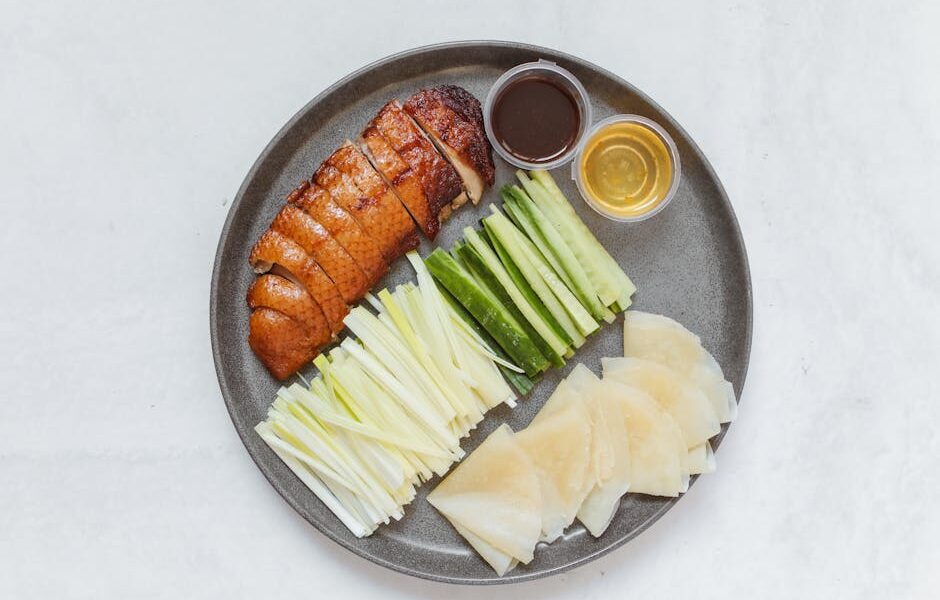
Peking duck is a constructed bite, not a plated entree. The pancake is the canvas; the duck is the centerpiece; the sauce and garnishes are non-negotiable supporting players. The classic accompaniments are sweet bean sauce (tianmianjiang), thinly julienned scallions, and matchstick cucumber. Some restaurants offer hoisin sauce as a substitute or in addition; tianmianjiang is darker, less sweet, and more aromatic. (Our hoisin sauce guide covers the difference.)
Assembly works best when each diner builds their own. Lay a warm pancake flat. Brush a half-teaspoon of sweet bean sauce down the center. Add two slivers of scallion and two batons of cucumber. Drape one or two pieces of duck across, skin-side up. Fold the bottom edge over the filling, then roll the sides in. Eat immediately. The pancake should not be saturated with sauce; the duck and the cucumber should still be the dominant flavors.
The Three-Course Tradition
In a proper Beijing duck restaurant, one duck becomes three courses. Understanding the tradition helps you waste less and stretch the meal at home.
- Course one: skin and pancakes. The crisp skin is sliced first while at peak texture, served with pancakes, sauce, and garnishes. Some old-school restaurants serve the skin separately with a small dish of granulated sugar for dipping; the sugar amplifies the caramel flavor of the lacquer.
- Course two: meat stir-fry. The carcass is returned to the kitchen and the leg and thigh meat is stripped, sliced, and stir-fried with bean sprouts, leeks, and a brown sauce, often served wrapped in lettuce cups.
- Course three: bone broth. The remaining carcass simmers with napa cabbage, ginger, and tofu into a clear, restorative broth that closes the meal. At home, this works beautifully as next-day lunch.
Advanced Tips From the Beijing Old Guard
Glaze in Multiple Coats Across the Drying Period
The Quanjude method applies the glaze in three thin coats over the first two hours of drying rather than two thick coats at once. Each coat dries before the next is applied, building a deep mahogany layer that does not run when heated. At home, this means setting an alarm and re-glazing at the 60-minute and 120-minute marks of your drying period.
Use Fruitwood Smoke if You Can
Beijing’s Quanjude lineage roasts over jujube, peach, or pear wood. The smoke is mild and adds a faint fruit note that is more aromatic than smoky. If you have a covered grill or a kettle smoker, you can mimic this effect by adding a small handful of soaked apple or cherry wood chips to the coals during the last 20 minutes of cooking. Avoid mesquite or hickory; they overwhelm the delicate duck.
Cavity Stock for Internal Steaming
Pour a cup of hot aromatic stock into the cavity right before sealing it shut. The stock simmers inside the duck during roasting, gently steaming the meat from within while the dry oven heat crisps the skin. The bird stays measurably more tender. Make the stock from chicken broth, two slices of ginger, two scallions, a star anise pod, a tablespoon of Shaoxing wine, and a teaspoon of soy sauce.
The Skin Off the Bone Trick
For the highest-end presentation, carve the skin off the breast first, in slabs as large as possible, and serve it on its own plate with the pancakes. Then return the rest of the duck to a 200 degree F oven while the first course is eaten. The meat carves more cleanly when slightly cooled, and the skin retains its peak crispness because it is not sitting on hot, steaming meat.
Five-Spice on the Inside, Not the Outside
Some recipes rub five-spice powder on the duck’s exterior. Beijing tradition does not. The skin is meant to taste of pure caramel, fat, and roasted bird; the spice belongs in the cavity, where it perfumes the meat. Rub one teaspoon of five-spice and one teaspoon of salt inside the cavity before plugging it shut.
Two Working Recipes
Home-Kitchen Peking Duck (serves 4 to 6)
One 5-pound Pekin duck, fresh. For the cavity rub: 1 teaspoon five-spice, 1 teaspoon kosher salt. For the glaze: half cup maltose syrup, 2 tablespoons rice vinegar, 2 tablespoons Shaoxing wine, half cup hot water. For service: 24 mandarin pancakes, half cup sweet bean sauce, 1 bunch scallions cut into 3-inch slivers, 1 English cucumber cut into matchsticks.
Day one: clean and pat the duck dry. Inflate the skin with a pump or straw. Rub the cavity with five-spice and salt. Skewer the cavity shut. Hang the duck and pour boiling water over the skin for 3 minutes. Pat dry. Whisk the glaze ingredients and bring to a simmer. Brush or pour glaze over the skin in three coats over 30 minutes. Hang the duck in the refrigerator with a drip pan beneath for 12 to 24 hours, ideally with a small fan circulating air.
Day two: rest the duck at room temperature 45 minutes. Preheat oven to 475 degrees F. Place a sheet pan with a half-inch of water on the bottom rack. Set the duck breast-up on a rack above. Roast 20 minutes at 475 degrees F, then drop to 350 degrees F and roast 60 to 75 more minutes until internal temperature reads 160 degrees F and the skin is deep mahogany. Rest 10 minutes. Carve into 60 to 80 thin pieces. Serve immediately with steamed pancakes, sweet bean sauce, scallions, and cucumber.
Day-After Duck Stir-Fry With Bean Sprouts (serves 2)
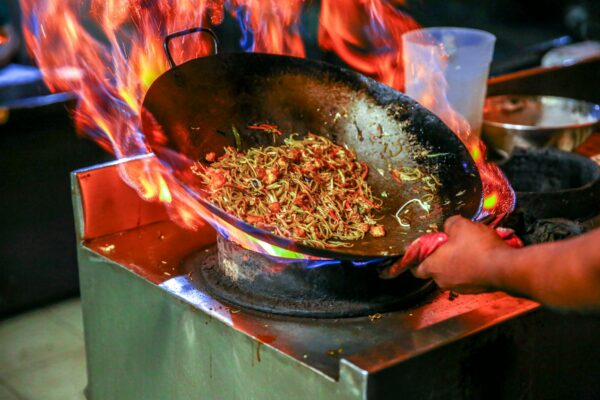
From the leftover carcass, strip 2 cups of duck meat. Heat 1 tablespoon of duck fat (or neutral oil) in a wok over high heat. Add 2 sliced scallions and 1 tablespoon julienned ginger; stir-fry 30 seconds. Add the duck meat and 2 cups bean sprouts; stir-fry 90 seconds. Add a sauce of 2 tablespoons soy sauce, 1 tablespoon Shaoxing wine, 1 teaspoon sugar, and 1 teaspoon sesame oil. Toss to coat and serve in iceberg lettuce cups. (For wok technique fundamentals, see our stir-fry guide.)
Pairing Peking Duck
The classic Beijing pairing is jasmine tea, which cuts the duck fat with delicate floral aromatics. For wine, look for off-dry Riesling, Gewurztraminer, or a light, fruit-forward Pinot Noir. Heavy reds clash with the sweet bean sauce. Beer drinkers should consider a clean Pilsner or a Belgian witbier. For a non-alcoholic option, fresh chrysanthemum tea is traditional in Beijing and shockingly good with the meal.
For the meal itself, do not overload the table. Two cold appetizers (smashed cucumber, century-egg tofu), the duck in three courses, and a single rice or noodle dish on the side is more than enough. Peking duck is the star; everything else is a supporting role.
Storage and Reheating
Carved Peking duck does not store well. The skin loses its crispness within 30 minutes of carving and cannot be revived. If you have leftovers, debone the meat and store separately from any remaining skin. Refrigerate up to 3 days. Reheat the meat gently in a 250 degree F oven covered with foil, or stir-fry it as in the recipe above. Reheat skin under a broiler for 60 seconds; it will not return to its original state but will become palatably warm and slightly re-crisped.
The carcass freezes well for up to 3 months. Use it for stock, soup, or congee, where it adds a deep, smoky richness no other bird produces. Our congee recipe is an ideal home for leftover duck bones.
Frequently Asked Questions
Can I make Peking duck without inflating the skin?
You can make a respectable roast duck without inflation, but it will not be Peking duck. Skin separation is the defining technique. If you cannot pump or blow air under the skin, use a wooden spoon handle to gently work between the skin and flesh through the neck cavity. The result is uneven but better than nothing. Crisp areas will appear where you separated; soft areas will remain where you did not.
How long does the whole process take?
Plan for 36 hours start to finish. Day one: about 90 minutes of active work (cleaning, inflating, blanching, glazing) plus the 12 to 24 hour drying period. Day two: 45 minutes of resting plus 90 minutes of roasting plus 10 minutes of resting and carving. Most of that is passive time; total active work is around 2.5 hours.
Where do I buy maltose syrup?
Asian grocery stores stock it in plastic tubs, usually labeled maltose or maltose syrup in English. Online, search for maltose syrup for Peking duck to find food-grade product. A 1-pound tub costs 5 to 8 dollars and lasts for many ducks. Avoid maltodextrin, which is a different product and does not behave the same way.
Can I do this on a charcoal grill?
Yes, and it is closer to the original technique than oven roasting. Set up a kettle grill for indirect heat with the coals banked on one side and the duck hanging or sitting upright on the other. Maintain 350 degrees F with the lid on, vents open. Add fruitwood chunks to the coals for traditional smoke. The trade-off is less precise temperature control; budget extra time and a probe thermometer.
What if my skin is not crisping?
The cause is almost always insufficient drying or insufficient skin separation. Crank the oven to 500 degrees F for the last 10 minutes and watch closely; this rescues many borderline cases. If the skin is brown but soft, place the carved skin pieces on a sheet pan under the broiler for 60 seconds, watching constantly. Next time, dry longer and pump more air.
Can I freeze the duck before cooking?
You can use a previously frozen duck, but the technique works dramatically better with fresh. Freezing damages the fat layer, which makes skin separation difficult and reduces the dramatic crisping. If you must use frozen, thaw in the refrigerator for 48 hours, accept that your inflation will be partial, and extend the drying time on day one to 24 hours.
Are mandarin pancakes the same as moo shu pancakes?
Yes, identical recipe. Both are thin, steamed wheat-flour wrappers brushed with sesame oil. You can buy frozen mandarin pancakes at most Asian grocery stores; they steam in 8 minutes from frozen and are perfectly acceptable when you do not have time to make your own.
Can I substitute hoisin for sweet bean sauce?
You can, but the result is sweeter and less complex. Sweet bean sauce (tianmianjiang) has a deeper umami and less sugar. If you only have hoisin, thin it with a teaspoon of soy sauce and a splash of sesame oil to bring it closer in flavor.
Why is the breast meat dry?
Two likely causes: you cooked past 165 degrees F internal, or you did not use a water pan beneath the duck. Pull the bird at 160 degrees F and rest 10 minutes; carryover takes it to 165 degrees F. The water pan adds humidity to the dry oven environment, which keeps breast meat tender while still allowing skin to crisp.
What is the smoke point if I deep-fry the duck briefly to crisp the skin?
Some Chinese-American restaurants finish the duck with a 30-second hot oil bath to maximize crisping. This works but is not traditional. If you try it, use peanut or refined soybean oil at 400 degrees F, lower the duck for 30 seconds, and drain immediately. The technique requires comfort with hot oil and a deep pot; it is not for first-timers.
Where to Go Next
Peking duck is the gateway to a deeper Chinese roasting practice. Once you have one successful duck behind you, the related techniques become approachable: Cantonese roast duck, soy sauce chicken, crispy-skin chicken, char siu pork. Each builds on the same fundamentals of skin preparation, glaze chemistry, and heat staging that you just learned. Explore our Chinese recipes hub for the next dish, or browse our broader Asian cooking techniques library to see how dehydrate-then-crisp logic shows up in everything from red-braised pork to crispy tofu.
The first Peking duck you make will not be perfect. The skin may be uneven, the glaze may go dark in patches, the carving may produce more shreds than slabs. Make it anyway. The second one will be visibly better, the third one will earn applause, and by the fifth, you will be the friend who hosts the duck dinner. There is no other home-cooking project quite like it: two days of patient preparation rewarded by a single hour of theater at the table. Start with a fresh duck, a tub of maltose, and the willingness to fail forward. Beijing has been refining this technique for 600 years; you have permission to take a few tries.

Mei Lin Chen
Mei Lin Chen is an Asian food writer and recipe developer. Melbourne-raised and London-based, she has spent over a decade exploring the rice paddies, hawker stalls, and home kitchens of South-East and East Asia. Her recipes balance traditional technique with everyday practicality.