Last updated: March 01, 2026
A well-seasoned wok is the single most important tool in Asian cooking. That dark, slick patina built up over time transforms a plain piece of metal into a naturally nonstick surface that sears meat in seconds, tosses vegetables without sticking, and imparts that elusive smoky flavor — wok hei — that defines great stir-fried food. Learning how to season a wok properly is the first step toward restaurant-quality results at home.
Whether you just bought a brand-new carbon steel wok or inherited a cast iron one from your grandmother, this guide walks you through everything: the initial seasoning, ongoing maintenance, troubleshooting, and the science behind why it all works. By the end, you will know exactly how to build, maintain, and restore a wok’s seasoning so it lasts a lifetime.
What Does It Mean to Season a Wok?
Seasoning a wok is the process of building up thin layers of polymerized oil on the metal surface. When oil is heated past its smoke point on bare metal, it undergoes a chemical reaction called polymerization — the fatty acid molecules bond together and to the metal, forming a hard, durable coating. This layer is what gives a seasoned wok its dark color and nonstick properties.
Think of it like lacquer being applied to wood. Each thin layer of oil you heat and bond to the surface adds another coat of protection. Over time, those layers build up into a thick, glossy, nearly indestructible patina that outperforms any synthetic nonstick coating — without any of the chemical concerns.
Seasoning serves three critical purposes:
- Prevents rust. Carbon steel and cast iron are highly reactive metals. Without seasoning, they will oxidize within hours of exposure to moisture.
- Creates a nonstick surface. Polymerized oil fills in the microscopic pores and rough spots in the metal, creating a smooth cooking surface that food slides off.
- Enhances flavor. A well-seasoned wok develops complex flavor compounds trapped in the patina, contributing that subtle depth that makes stir-fried dishes taste better each time you cook.
Which Woks Need Seasoning (And Which Don’t)
Not every wok requires seasoning. The material dictates whether you need to season, and how you approach it. Here is a quick breakdown:
| Wok Material | Needs Seasoning? | Notes |
|---|---|---|
| Carbon steel | Yes — essential | The most common and recommended wok material. Seasons beautifully over time. Lightweight and responsive to heat. |
| Cast iron (Chinese-style) | Yes — essential | Thin cast iron woks are traditional in Chinese cooking. They hold heat well but are heavier. Season the same way as carbon steel. |
| Cast iron (Western-style, Lodge etc.) | Yes — essential | Thicker and heavier. Many come pre-seasoned but benefit from additional layers. |
| Stainless steel | No | Does not hold seasoning. Food sticks more but cleanup is straightforward. Not ideal for stir-frying. |
| Nonstick / Teflon | No — never | Synthetic coating handles the nonstick job. Cannot withstand the high heat needed for proper stir-frying. |
| Aluminum | No | Too soft and reactive. Not suitable for traditional wok cooking at high heat. |
If you are shopping for a new wok, a 14-inch flat-bottomed carbon steel wok is the best choice for most home kitchens. Check out our complete wok buying guide for specific brand recommendations.
Equipment You Need to Season a Wok
Seasoning a wok does not require specialized tools. You likely have everything you need already:
- Your wok — carbon steel or cast iron
- High smoke point oil — flaxseed oil, grapeseed oil, vegetable oil, or peanut oil all work well
- Paper towels or a clean lint-free cloth
- Tongs — for holding paper towels while oiling a hot wok
- Stove — gas is ideal, but electric and induction work with modifications
- Steel wool or stainless steel scrubber — for the initial cleaning only
- Dish soap — for the initial cleaning only (you will not use soap again after seasoning)
- Heat-resistant gloves — optional but recommended, especially for oven methods
- Scallions, ginger, and Chinese chives — optional, for the traditional Chinese stir-fry seasoning method
A note on oil choice: flaxseed oil creates the hardest seasoning layer due to its high omega-3 content, which polymerizes exceptionally well. However, some cooks report that flaxseed oil seasoning can flake off over time. For most home cooks, regular vegetable oil or peanut oil provides a durable, forgiving seasoning that builds up reliably with use.
How to Season a New Wok: Step-by-Step
A brand-new carbon steel wok comes from the factory coated with a protective layer of machine oil or lacquer to prevent rust during shipping. Your first job is to strip that coating, then build your seasoning from scratch.
Step 1: Strip the Factory Coating
Scrub the wok inside and out with hot water, dish soap, and steel wool or a stainless steel scrubber. Scrub aggressively — you want to remove every trace of the factory coating. The water may turn dark or have an oily sheen. Keep scrubbing until the water runs clean.
Some cooks prefer to boil water in the new wok for 10 minutes first to help loosen the coating, then scrub. Either approach works.
Rinse thoroughly and dry the wok completely with a clean towel. Then place it on a burner over low heat for one to two minutes to evaporate any remaining moisture. This is important — any water left on bare carbon steel will start rusting within minutes.
Step 2: Heat the Wok
Place the clean, dry wok on your burner over high heat. As the wok heats up, you will see the metal change color. The shiny silver surface will start turning yellow, then brown, then a blue-black. This color change — called bluing — indicates the metal is reaching the right temperature for oil to polymerize on contact.
Tilt and rotate the wok so the heat reaches the sides as well as the bottom. On a gas stove, you can angle the wok to direct the flame up the sides. This process takes about 5 to 10 minutes depending on your heat source.
The wok will smoke. This is normal and expected. Turn on your range hood or open windows for ventilation.
Step 3: Apply Oil
Once the wok has changed color and is very hot, reduce the heat to medium. Using tongs to hold a folded paper towel, dip it in about two teaspoons of your chosen oil and wipe a thin, even layer across the entire interior surface of the wok.
The key word here is thin. If you apply too much oil, it will pool, turn sticky, and create an uneven, gummy layer that flakes off. You want just enough oil to leave a faint sheen — not a visible puddle. The paper towel should be barely damp with oil.
The oil will smoke immediately upon contact with the hot metal. This is the polymerization happening in real time. Continue wiping and turning the wok for two to three minutes, letting the oil smoke off completely. The surface should look dry and slightly darker than before, not wet or shiny.
Step 4: Repeat the Oil Layers
Let the wok cool slightly (about one minute), then repeat the oiling process. Apply another thin layer of oil with the paper towel, let it smoke off completely, and wipe again. Do this three to five times total for the initial seasoning.
After three to five rounds, the interior of the wok should have an even, dark brown to black color. It will not yet look like a well-used wok — that deep, glossy black comes with time and cooking. But you have built a solid foundation that will prevent rust and provide a functional nonstick surface for your first cook.
Step 5: The Traditional Chinese Aromatics Method (Optional but Recommended)
Many Chinese home cooks finish the initial seasoning with a stir-fry of aromatics. After your oil layers are done, add two tablespoons of oil to the wok over high heat. Toss in a handful of sliced scallions, a few slices of ginger, and if available, a bunch of Chinese chives (garlic chives).
Stir-fry the aromatics for 15 to 20 minutes, pressing them against the sides of the wok so the oil and juices coat every surface. The aromatics help neutralize any metallic taste from the new steel and deposit additional seasoning. The scallions and ginger contain sulfur compounds that help bond the oil to the metal more effectively.
Discard the aromatics (they will be very charred and not good to eat), then wipe the wok clean with a paper towel. Your wok is now ready for its first real meal.
How to Season a Wok on an Electric or Induction Stove
Gas stoves are ideal for wok seasoning because the flame can wrap around the curved sides. But if you cook on electric or induction, you can absolutely still build a great seasoning — you just need a slightly different approach.
Electric Coil or Glass-Top Stove
Use a flat-bottomed wok (round-bottomed woks will not make stable contact with the burner). Follow the same stovetop steps above, but expect the process to take longer since electric burners cannot achieve the same concentrated heat as gas. You may need to tilt and rotate the wok more aggressively to season the sides.
Alternatively, use the oven method (see below) to get heat evenly across the entire wok surface.
Induction Stove
Make sure your wok is induction-compatible (most carbon steel woks are). Flat-bottomed is required. Induction burners heat the bottom of the wok aggressively but the sides receive less direct heat. Spend extra time tilting the wok to season the upper walls manually, or finish the sides with the oven method.
Oven Method (Works for All Stove Types)
Preheat your oven to 450 degrees Fahrenheit (230 degrees Celsius). Clean and dry the wok as described in Step 1. Apply a very thin coat of oil over the entire wok — inside and outside. Place the wok upside down on the middle oven rack with a sheet of foil on the rack below to catch any drips. Bake for 30 minutes, then turn off the oven and let the wok cool inside with the door closed.
Repeat the oil-and-bake cycle two to three more times. This method heats the wok evenly from all directions, making it especially good for seasoning the sides and rim. Many cooks use a combination: oven method for the initial seasoning, then stovetop maintenance as they cook.
The Science Behind Wok Seasoning
Understanding the chemistry helps you avoid mistakes and troubleshoot problems. Here is what actually happens when you season a wok:
Polymerization: When cooking oil is heated past its smoke point in the presence of metal (which acts as a catalyst), the triglyceride molecules break apart. The resulting free fatty acids and glycerol fragments recombine into long polymer chains. These chains cross-link with each other and bond covalently to the iron oxide on the metal surface. The result is a thin, hard, plastic-like layer that is chemically bonded to the wok.
Why thin layers matter: Thick layers of oil do not polymerize uniformly. The outer surface may harden while the interior remains gummy, creating a weak layer that peels and flakes. Multiple thin layers, each fully polymerized, stack up into a stronger overall coating — similar to how plywood (many thin layers of wood glued together) is stronger than a single thick board.
Why high heat is essential: Polymerization requires temperatures above the oil’s smoke point. Below that temperature, the oil simply sits on the surface as a liquid or a sticky residue. Common smoke points: vegetable oil at 400 degrees Fahrenheit (204 degrees Celsius), peanut oil at 450 degrees Fahrenheit (232 degrees Celsius), and flaxseed oil at 225 degrees Fahrenheit (107 degrees Celsius). Flaxseed oil’s very low smoke point is why it polymerizes so readily — even moderate heat pushes it past the threshold.
The role of iron: Iron atoms on the wok’s surface catalyze the oxidation and polymerization reaction. This is why seasoning works so well on carbon steel and cast iron but not on stainless steel or aluminum — those metals do not provide the same catalytic surface for oil polymerization.
Common Wok Seasoning Mistakes (And How to Fix Them)
Most seasoning problems come from a handful of repeated mistakes. Here is a quick-reference table for diagnosing and fixing issues:
| Mistake | What Happens | How to Fix |
|---|---|---|
| Too much oil | Sticky, gummy residue that does not dry. Food sticks worse than an unseasoned wok. | Scrub off the gummy layer with steel wool and hot water. Re-season with thinner oil applications. |
| Heat too low | Oil does not smoke and remains as a wet, tacky film. | Increase heat until oil smokes freely. The surface should look dry after each round. |
| Skipping factory coating removal | Machine oil or lacquer trapped under seasoning. Food tastes metallic or chemical. | Strip everything with steel wool and soap. Start the full seasoning process over. |
| Using soap after seasoning | Soap does not actually strip seasoning (this is a myth), but it can leave a soapy taste if not rinsed well. | Gentle soap is fine occasionally. Just rinse thoroughly and dry immediately on heat. |
| Not drying after washing | Rust spots appear within hours. | Scrub off rust with steel wool, re-season the affected area, and always dry on heat after washing. |
| Cooking acidic foods too early | Vinegar, tomatoes, or citrus strip new seasoning. Metallic taste in food. | Avoid acidic ingredients for the first 15-20 cooks. Build the seasoning with high-heat stir-fries first. |
| Seasoning with butter or olive oil | Low smoke point oils burn and create a weak, flaky layer. Butter contains milk solids that char unevenly. | Use high smoke point neutral oils: vegetable, peanut, grapeseed, or canola. |
| Storing wok while damp | Rust forms overnight, especially in humid climates. | Always heat-dry on stove after cleaning. Apply a thin oil wipe before storing. |
Ongoing Wok Maintenance: How to Keep Your Seasoning
The initial seasoning is just the beginning. A wok’s real seasoning comes from regular cooking. Every time you heat oil and stir-fry, you add another microscopic layer to the patina. Here is how to care for your wok between cooks to protect and build that seasoning over time.
Cleaning Your Wok After Cooking
- Clean while hot. As soon as you plate your food, run hot water into the still-warm wok. The thermal shock helps loosen any stuck food.
- Use a wok brush or non-abrasive scrubber. A traditional bamboo wok brush is ideal. Avoid steel wool on a seasoned wok (steel wool is only for the initial cleaning or re-seasoning).
- Skip the soap. Hot water and a brush is usually all you need. If you cooked something particularly pungent, a tiny drop of dish soap will not ruin your seasoning — just do not soak the wok in soapy water.
- Dry immediately on heat. Place the cleaned wok back on a burner over medium heat for one to two minutes until all moisture evaporates. This is the most important maintenance step. Never air-dry a carbon steel wok.
- Apply a thin oil film. While the wok is still warm, use a paper towel to wipe a barely-there layer of oil across the interior surface. This protects the seasoning between uses.
What to Cook (and Avoid) on a Newly Seasoned Wok
For the first 15 to 20 cooks on a newly seasoned wok, stick to high-heat, oil-heavy dishes that actively build the seasoning. Excellent choices include:
- Fried rice — high heat, plenty of oil, constant motion
- Beef stir-fry — searing meat builds seasoning fast
- Shrimp stir-fry — quick, hot, and oily
- Chicken fried rice — another seasoning-building classic
- Char kway teow — the ultimate wok seasoning workout
- Stir-fried vegetables with garlic and oil
Avoid these until the seasoning is well-established (after at least 20 sessions of cooking):
- Acidic sauces (tomato-based, vinegar-heavy, citrus)
- Steaming or boiling water in the wok for extended periods
- Eggs cooked directly on the surface without adequate oil (eggs are fine once the seasoning is established)
- Braising or slow simmering liquids
How to Re-Season a Wok (Restoring Damaged Seasoning)
Sometimes seasoning gets damaged. Maybe rust developed from improper storage, a well-meaning family member scrubbed it with soap and steel wool, or someone braised tomatoes in it. The good news: wok seasoning is completely renewable. You can always start over.
When to Re-Season
- Visible rust spots that do not wipe off
- Large patches of bare, shiny metal exposed
- Sticky or gummy residue that will not come off with normal cleaning
- Food sticks aggressively despite using adequate oil
- Uneven, flaky seasoning that chips off during cooking
How to Strip and Re-Season
- Strip the old seasoning. Scrub the wok aggressively with steel wool, hot water, and dish soap. For severely damaged seasoning, you can use a mixture of coarse salt and oil as an abrasive paste, or run the wok through a self-cleaning oven cycle to burn off all the old seasoning completely.
- Inspect the bare metal. Once stripped, the wok should look like new — matte gray carbon steel with no dark patches. If you see rust, keep scrubbing until it is gone.
- Follow the full initial seasoning process. Start from Step 2 in the initial seasoning section above and repeat all the oil layers.
- Cook seasoning-friendly foods. Use the wok immediately for high-heat stir-frying to reinforce the new seasoning.
A completely stripped and re-seasoned wok can reach its previous performance level within two to three weeks of regular cooking.
Practice Exercises: Build Your Wok Seasoning Through Cooking
The best way to build wok seasoning is to cook with it. Here are five exercises specifically designed to develop your seasoning while producing great food. Complete them in order during your first two weeks with a new or re-seasoned wok.
Exercise 1: The Garlic Oil Stir-Fry
Heat the wok over high heat until it smokes. Add three tablespoons of vegetable oil and swirl to coat the surface. Add four minced garlic cloves and a handful of leafy greens (bok choy, water spinach, or gai lan). Stir-fry for two minutes. Season with salt and a splash of soy sauce. This exercise teaches heat control and coats the wok’s surface with a fresh layer of seasoning.
Exercise 2: Classic Egg Fried Rice
Using day-old rice, make a batch of fried rice. This exercise pushes rice grains across the entire surface of the wok, depositing starch and oil in every pore. If rice sticks a little during your first attempt, that is completely normal — it will stick less each time.
Exercise 3: High-Heat Beef Sear
Slice beef into thin strips and velvet them (the technique works for beef too). Sear in small batches over the highest heat you can achieve. The Maillard reaction between the meat proteins and the hot metal builds seasoning rapidly. Use this as the base for a quick beef stir-fry.
Exercise 4: Noodle Toss
Cook a batch of lo mein or char kway teow. Noodles make extensive contact with the wok surface and the combination of oil, soy sauce, and high heat creates excellent seasoning layers. Flat rice noodles are especially effective.
Exercise 5: The Egg Test
After a week of regular cooking, try frying an egg directly in the wok with one tablespoon of oil. If the egg slides around freely without sticking, your seasoning is well-established. If it sticks, you need more cooking sessions — go back to exercises one through four.
Advanced Wok Seasoning Tips
Once you have mastered the basics, these advanced techniques will help you take your wok’s seasoning to the next level.
The Blue Steel Method
Professional wok cooks in Chinese restaurants often season their woks over extreme heat — the kind produced by commercial jet burners that reach 100,000 or more BTU. At these temperatures, the steel turns a deep blue-black color before any oil is applied. This blue oxide layer (magnetite, Fe3O4) is actually a form of controlled rust that is more stable and corrosion-resistant than raw steel. Home cooks can approximate this with a blowtorch on the exterior of the wok, though the stovetop method produces adequate results.
Maintaining Wok Hei
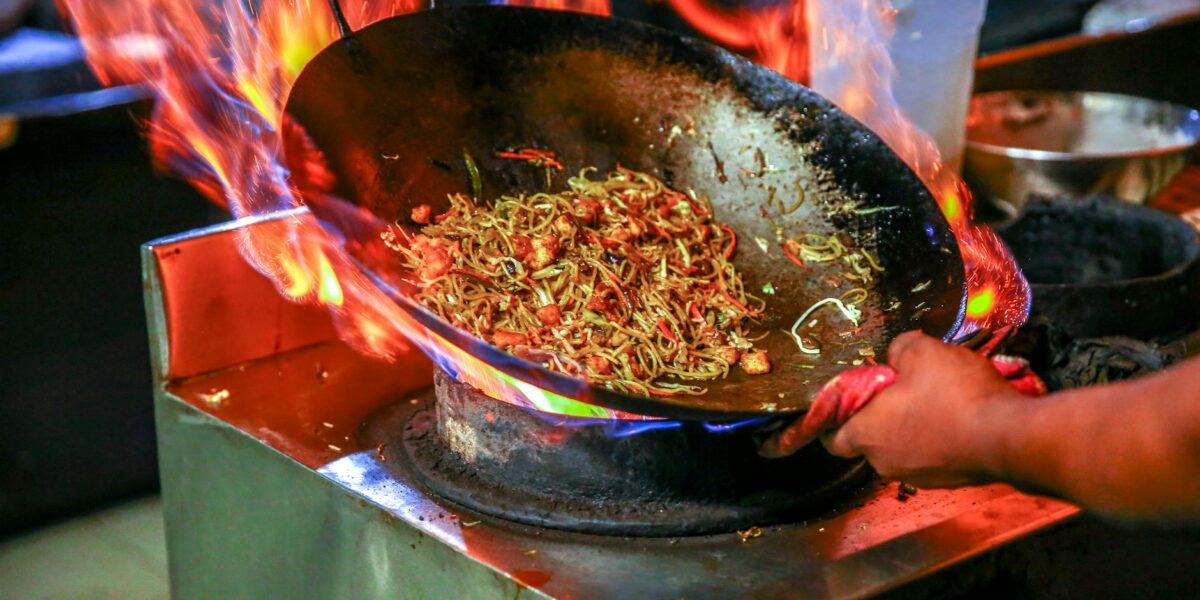
Wok hei — the breath of the wok — is that smoky, slightly charred flavor that defines professional stir-fries. It comes from the combination of extreme heat, vaporized oil, and the seasoned wok surface. A well-seasoned wok produces better wok hei because the polymerized oil layer helps food release quickly, allowing it to be tossed through the hottest part of the flame. On a home gas stove, you can generate modest wok hei by preheating the wok until it just begins to smoke before adding oil. Learn more in our guide to essential Asian cooking techniques.
Seasoning the Outside of Your Wok
Most guides focus on the interior, but the outside of a carbon steel wok also benefits from seasoning. This prevents rust and protects the metal from the direct flame. When doing the oven method, oil the outside as well. On gas stoves, the exterior will gradually build its own seasoning from the flame — you will notice it darkening over time.
The Patchy Look Is Normal
New wok owners often worry that their seasoning looks uneven — dark in some spots, lighter in others. This is completely normal. The center of the wok, where heat is most concentrated, will darken faster than the sides. With continued cooking, the color will even out. A six-month-old well-used wok will be uniformly dark. A six-day-old wok will be patchy. Both are working correctly.
Recipe Examples: Seasoning-Building Dishes
These recipes are specifically chosen because they build wok seasoning efficiently while teaching fundamental Asian cooking techniques. Cook through these in your first two weeks with a new wok.
Quick Garlic Bok Choy
Heat wok on high. Add 2 tablespoons vegetable oil. When oil shimmers, add 3 minced garlic cloves, stir for 10 seconds. Add 1 pound baby bok choy (halved). Stir-fry 2 minutes. Add 1 tablespoon soy sauce, 1 teaspoon sesame oil. Toss 30 seconds. Serve immediately.
10-Minute Shrimp Stir-Fry
Follow our shrimp stir-fry recipe — it is one of the fastest seasoning builders because the high protein content of shrimp, combined with oil and high heat, deposits excellent seasoning layers on the wok surface.
Soy Sauce Noodles
Cook 8 ounces of dried rice noodles or lo mein noodles according to package directions. Heat wok on high, add 3 tablespoons oil. Add noodles, spread flat, let them sear for 1 minute without moving. Flip, sear the other side. Add 2 tablespoons soy sauce, 1 tablespoon hoisin sauce, and toss. Finish with sliced scallions. The extended contact between noodles and the hot wok surface builds seasoning fast.
Frequently Asked Questions About Wok Seasoning
How long does it take to season a wok?
The initial seasoning takes about 30 to 45 minutes. But a wok reaches its full potential after weeks or months of regular cooking. Think of the initial seasoning as laying the foundation — the house gets built every time you cook.
Can I use olive oil to season my wok?
Extra virgin olive oil has a low smoke point (320 degrees Fahrenheit / 160 degrees Celsius) and contains compounds that can create a weak, sticky seasoning layer. Regular (refined) olive oil has a higher smoke point and works in a pinch, but neutral oils like vegetable, canola, peanut, or grapeseed are significantly better choices for wok seasoning.
Will soap ruin my wok’s seasoning?
This is one of the most persistent myths in cooking. Modern dish soap is a surfactant — it breaks up grease and food particles. It does not dissolve polymerized oil. A properly seasoned wok can handle an occasional gentle wash with dish soap without any damage. That said, hot water and a wok brush are usually sufficient for daily cleaning.
My wok has rust spots. Is it ruined?
Absolutely not. Rust on carbon steel is superficial and easy to fix. Scrub the rust away with steel wool, wash and dry the wok, and re-season the affected area. Carbon steel and cast iron woks are essentially indestructible — they can always be restored.
How do I know when my wok is properly seasoned?
A well-seasoned wok has a dark, matte-to-slightly-glossy surface. Food releases easily with minimal oil. The egg test described in the practice exercises section is the most reliable indicator. You can also look for a uniform dark color across the cooking surface — though as mentioned, some patchiness is normal for newer woks.
Can I season a wok on an induction stove?
Yes, as long as you use a flat-bottomed carbon steel wok. Induction stoves generate excellent heat at the bottom but less heat on the sides. Season the bottom on the stovetop and use the oven method for the upper walls and rim.
Should I season a pre-seasoned wok?
Some woks (like certain Lodge cast iron models) come pre-seasoned from the factory. This factory seasoning is functional but usually thin. Adding two to three additional seasoning layers on top will improve performance significantly.
How often should I re-season my wok?
If you use your wok regularly and follow proper maintenance (heat-dry, thin oil coat after each use), you should rarely if ever need to do a full re-season. The seasoning builds itself through normal cooking. A full strip-and-re-season is only necessary if the seasoning is severely damaged by rust, abrasive scrubbing, or acidic food exposure.
What is the best oil for seasoning a wok?
For the initial seasoning, a high smoke point neutral oil like vegetable oil, peanut oil, or grapeseed oil is best. Flaxseed oil creates the hardest initial layer but can flake for some users. For daily cooking and maintenance, use whatever high smoke point oil you normally cook with. Consistency matters more than which specific oil you choose.
Can I put my wok in the dishwasher?
Never. Dishwashers use harsh detergents, high water temperatures, and extended soaking — all of which will strip your wok’s seasoning and cause immediate rusting. Always hand-wash your carbon steel or cast iron wok.
Your Wok Gets Better With Time
Unlike most cooking equipment that degrades with use, a carbon steel wok improves every time you fire it up. Each stir-fry adds another invisible layer to the patina. Each high-heat sear reinforces the nonstick surface. The wok your grandchildren inherit will cook better than the one you bought yesterday — and that is the beauty of this tool.
Start with the initial seasoning process outlined above, cook through the practice exercises, and follow the maintenance steps after each use. Within a few weeks, you will have a wok that rivals the ones hanging in professional Chinese kitchens. Within a few months, you will understand why experienced cooks guard their woks like family heirlooms.
Ready to put that seasoned wok to work? Try our kung pao chicken, Thai basil chicken, or nasi goreng — all recipes that taste dramatically better in a well-seasoned wok. And if you still need to pick the right wok for your kitchen, our best wok buying guide has you covered.

Mei Lin Chen
Mei Lin Chen is an Asian food writer and recipe developer. Melbourne-raised and London-based, she has spent over a decade exploring the rice paddies, hawker stalls, and home kitchens of South-East and East Asia. Her recipes balance traditional technique with everyday practicality.