Last updated: March 20, 2026
Store-bought dumpling wrappers get the job done, but they cannot match the supple, tender chew of freshly made dough. A homemade dumpling wrapper recipe is one of the most rewarding skills in Chinese cooking — once you master the basic technique, you unlock an entire world of jiaozi, gyoza, potstickers, wontons, and more. The dough itself requires just two ingredients (flour and water), yet the way you mix, knead, rest, and roll it determines whether your dumplings are silky and delicate or thick and doughy.
This guide walks you through every step of making homemade dumpling wrappers from scratch, covering the science behind gluten development, the tools you need, rolling techniques for both Chinese and Japanese styles, and troubleshooting for every problem you might encounter. Whether you are making your first batch of jiaozi or refining your technique for paper-thin har gow skins, this is your complete reference.
Why Make Dumpling Wrappers from Scratch?
The difference between homemade and store-bought dumpling wrappers is immediately obvious. Fresh wrappers are pliable and easy to seal, they cook up tender with a pleasant chew, and they absorb sauce and broth in a way that packaged versions simply cannot. Commercial wrappers contain preservatives and extra starch to prevent sticking in the package, which often makes them brittle and prone to cracking when you fold them.
Making wrappers from scratch also gives you complete control over thickness, size, and texture. Want ultra-thin wrappers for boiled dumplings? Roll them thinner. Prefer a sturdier skin for pan-fried potstickers? Leave them slightly thicker. Planning to make wonton soup? Cut them into squares instead of circles. Once you understand the basic dough, you can adapt it to any dumpling style across Asian cuisine.
The process is also surprisingly fast. After an initial 15-minute rest, you can roll out 40 to 50 wrappers in about 20 minutes — not much longer than a trip to the grocery store. And the flavor difference is dramatic enough that most home cooks never go back to packaged wrappers.
The Science of Dumpling Dough: Flour, Water, and Gluten
Understanding a few basic principles of dough science will make you a better dumpling wrapper maker. Dumpling dough is an unleavened dough, meaning it contains no yeast or baking powder. Its texture comes entirely from gluten development — the network of proteins that forms when flour meets water.
Flour choice matters. All-purpose flour (with 10 to 12 percent protein content) is the standard choice for most Chinese dumpling wrappers. Bread flour creates a chewier, tougher wrapper — useful for boiled dumplings that need to withstand vigorous cooking. Cake flour produces a softer, more delicate wrapper but tears easily. For most home cooks, all-purpose flour strikes the ideal balance between tenderness and strength.
Water temperature changes everything. This is the single most important variable in dumpling dough. Cold water (room temperature or below) produces a firmer, more elastic dough with strong gluten development — ideal for boiled dumplings (shui jiao) and pan-fried potstickers (guo tie). Boiling water partially cooks the starch and limits gluten formation, producing a softer, more translucent wrapper — this is the technique for steamed dumplings, har gow, and some types of bao. Many experienced dumpling makers use a combination of both — roughly 60 percent boiling water and 40 percent cold water — to get the best of both worlds.
Salt is optional but helpful. A small pinch of salt (about half a teaspoon per two cups of flour) strengthens the gluten network and adds a subtle flavor boost. It is not traditional in all regional styles, but it makes the dough slightly easier to work with.
Resting is non-negotiable. After kneading, the dough must rest for at least 30 minutes (and up to 2 hours). During this time, the gluten network relaxes, making the dough dramatically easier to roll thin without springing back. Skipping the rest is the single most common mistake beginners make.
Essential Equipment for Making Dumpling Wrappers
One of the beauties of making dumpling wrappers is that you need very little specialized equipment. Here is what you need and what is optional but helpful.
| Equipment | Purpose | Essential? | Notes |
|---|---|---|---|
| Large mixing bowl | Mixing dough | Yes | Any material works; stainless steel retains less heat |
| Kitchen scale | Measuring flour accurately | Highly recommended | Volume measurements vary by up to 20% |
| Chinese rolling pin (擀面杖) | Rolling individual wrappers | Yes | A thin dowel 30 cm / 12 in long, no handles — gives more control than Western rolling pins |
| Bench scraper | Cutting dough portions | Helpful | A knife works too, but a scraper is faster |
| Large cutting board or clean counter | Rolling surface | Yes | Wood or silicone mat preferred; marble is too cold |
| Cornstarch or flour for dusting | Preventing sticking | Yes | Cornstarch brushes off more cleanly than flour |
| Round cookie cutter (8-9 cm / 3-3.5 in) | Cutting uniform circles | Optional | Only needed for the sheet-and-cut method |
| Pasta machine | Rolling thin sheets | Optional | Useful for wonton wrappers; not traditional for round jiaozi skins |
| Damp kitchen towel | Covering resting dough and finished wrappers | Yes | Prevents drying out — critical in dry climates |
The most important item on this list is the Chinese rolling pin. Unlike a Western rolling pin with handles, the Chinese version is a thin, handleless dowel about 30 centimeters (12 inches) long and 2 to 3 centimeters (about 1 inch) in diameter. Its small size lets you roll from the center outward while rotating the wrapper, creating the characteristic shape that is thinner at the edges and slightly thicker in the center — essential for dumplings that hold their filling without tearing. You can find these at any Asian grocery store or online for just a few dollars. In a pinch, a wooden dowel from a hardware store works perfectly.
Basic Dumpling Wrapper Recipe: Step by Step
This recipe makes approximately 40 to 50 wrappers, enough for a generous batch of dumplings for 4 to 6 people. The technique works for jiaozi, gyoza, and potsticker wrappers.
Ingredients
- 300 g (2⅓ cups) all-purpose flour, plus more for dusting
- 160 ml (⅔ cup) just-boiled water (see notes below for cold-water variation)
- Pinch of fine salt (optional)
Step 1: Mix the Dough
Place the flour and salt in a large mixing bowl. Pour the hot water over the flour in a steady stream while stirring continuously with chopsticks or a fork. The hot water will create shaggy, steaming clumps — this is exactly what you want. Keep stirring until no dry flour remains and the dough is cool enough to handle, about 2 minutes.
Step 2: Knead the Dough
Turn the dough out onto a lightly floured surface and knead for 8 to 10 minutes. Use the heel of your palm to push the dough away from you, then fold it back over itself and rotate 90 degrees. Repeat. The dough will start out rough and slightly sticky but will transform into a smooth, elastic ball that springs back gently when poked. If it sticks to your hands, add flour a teaspoon at a time. If it cracks and feels dry, wet your hands slightly and continue kneading.
The finished dough should feel like an earlobe — soft, smooth, and pliable. This is the classic Chinese benchmark, and it is surprisingly accurate.
Step 3: Rest the Dough
Shape the dough into a ball and place it back in the bowl. Cover tightly with plastic wrap or a damp towel and let it rest at room temperature for at least 30 minutes, or up to 2 hours. During this time, the gluten relaxes and the moisture distributes evenly throughout the dough. You will notice a dramatic difference — the rested dough is silky and rolls out effortlessly.
Step 4: Divide the Dough
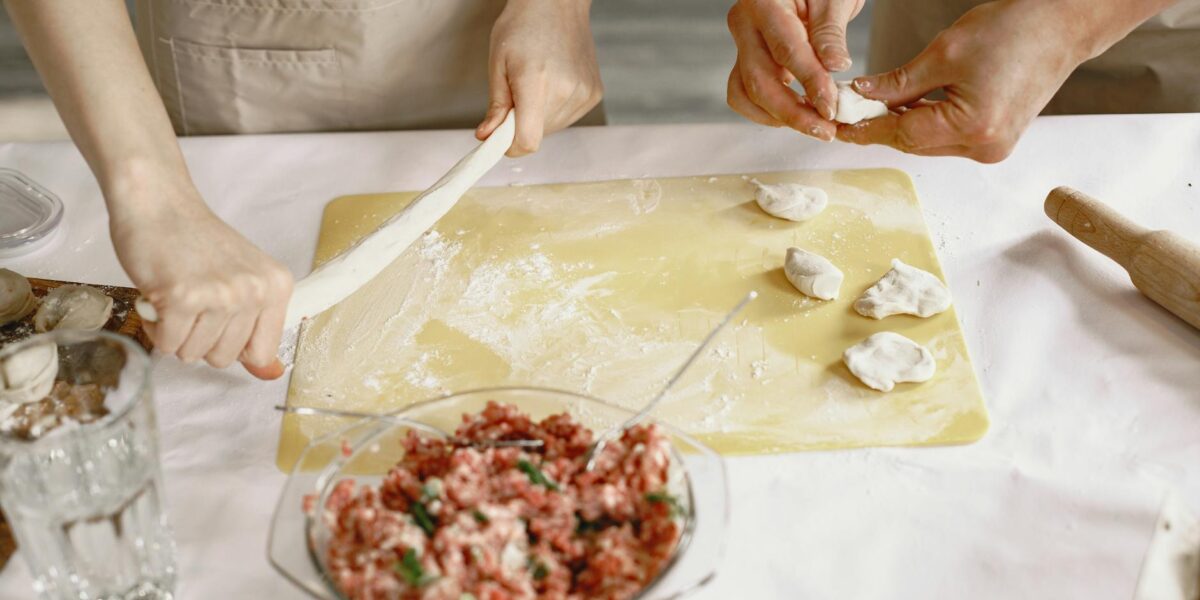
Lightly flour your work surface. Roll the rested dough into a log about 3 centimeters (1.25 inches) in diameter. Using a bench scraper or knife, cut the log into pieces approximately 10 grams each (about the size of a large marble). You should get 40 to 50 pieces.
Take each piece and press it flat with the palm of your hand to form a small disc about 4 centimeters (1.5 inches) across. Keep the pieces you are not working on covered with a damp towel to prevent drying.
Step 5: Roll the Wrappers
This is the step that separates good dumpling wrappers from great ones. Here is the technique used in Chinese households and professional dumpling kitchens:
Dust a disc lightly with flour and place it on your work surface. Hold the rolling pin in your dominant hand. With your non-dominant hand, hold the edge of the disc and rotate it counterclockwise (or clockwise if you are left-handed) as you roll. Roll from the edge toward the center with short, firm strokes — never roll all the way across the wrapper. After each stroke, rotate the disc about 30 degrees and roll again.
This technique naturally creates a wrapper that is thinner at the edges and slightly thicker in the center. The thicker center supports the weight of the filling, while the thin edges seal easily and cook through quickly without becoming doughy. Aim for wrappers about 8 to 9 centimeters (3 to 3.5 inches) in diameter, with edges thin enough to see your hand through when held up to the light.
Stack the finished wrappers with a light dusting of flour or cornstarch between each one. Work efficiently — in a dry kitchen, exposed wrappers can dry out in just a few minutes.
Hot Water vs. Cold Water Dumpling Dough: When to Use Each
The water temperature you use fundamentally changes the character of your dumpling wrappers. Understanding when to use each style is essential for matching your wrappers to your cooking method and filling.
| Property | Cold Water Dough (冷水面) | Hot Water Dough (烫面) | Mixed Water Dough |
|---|---|---|---|
| Water temperature | Room temp or cold | Freshly boiled (95-100°C / 200-212°F) | 60% boiling + 40% cold |
| Texture when cooked | Chewy, firm, elastic | Soft, tender, slightly translucent | Balanced chew with tenderness |
| Best for | Boiled dumplings (shui jiao), pan-fried potstickers | Steamed dumplings, crystal shrimp dumplings | All-purpose — works for any cooking method |
| Gluten development | High — strong network | Low — starch gelatinizes, limiting gluten | Moderate |
| Ease of rolling | Requires more resting; can spring back | Very easy to roll; less elastic | Moderate effort |
| Shelf life (raw) | Holds well for several hours | Dries out faster; use quickly | Moderate shelf life |
| Color | Opaque, white | Slightly translucent, off-white | Between the two |
For most home cooks making jiaozi or potstickers, the mixed water method is the most versatile starting point. It produces wrappers that work well whether you boil, steam, or pan-fry them. As you gain confidence, you can adjust the ratio to match your specific needs.
Regional Variations: Gyoza, Wonton, Mandu, and More
The basic dumpling wrapper technique adapts across Asian cuisines. Here are the key differences for each regional style.
Chinese Jiaozi Wrappers (饺子皮)
The standard. Round, 8 to 9 centimeters in diameter, thicker in the center. Made with all-purpose flour and usually hot or mixed water. These are the most forgiving for beginners because the dough is relatively thick and easy to fold and pleat.
Japanese Gyoza Wrappers (餃子の皮)
Thinner than jiaozi wrappers, typically 7 to 8 centimeters in diameter. Japanese gyoza wrappers often include a small amount of oil or egg in the dough to create a more supple, slightly richer skin. The thinner profile creates a crispier bottom when pan-fried, which is essential for the classic gyoza presentation with its golden, lacy skirt.
Wonton Wrappers (馄饨皮)
Square rather than round, about 8 centimeters per side, and notably thinner than jiaozi wrappers. Wonton dough typically includes egg, which gives it a yellow color and a silkier texture. The egg also makes the dough easier to roll very thin — essential because wontons are served in broth, where thick wrappers would become soggy and unpleasant. A pasta machine is especially useful for rolling wonton wrappers to a uniform thinness.
Korean Mandu Wrappers (만두피)
Similar to jiaozi wrappers but often slightly larger (9 to 10 centimeters) to accommodate the generous fillings typical of Korean mandu. The dough is usually a straightforward cold-water dough. Mandu are commonly boiled, steamed, or pan-fried, and the wrappers are sturdy enough for all three methods. Korean cooks sometimes add a small amount of sweet potato starch for extra chew.
Har Gow Wrappers (虾饺皮)
The most technically demanding wrapper in the dumpling family. Har gow (crystal shrimp dumplings) use a dough made from wheat starch and tapioca starch rather than flour, mixed with boiling water and a little oil. This creates the translucent, slightly chewy skin that is the hallmark of dim sum shrimp dumplings. The dough is fragile and must be worked quickly — this is an advanced technique best attempted after you are comfortable with standard jiaozi wrappers.
Common Mistakes and How to Fix Them
Even experienced dumpling makers encounter problems. Here are the most common issues with homemade dumpling wrappers, their causes, and how to fix or prevent them.
| Problem | Likely Cause | Fix |
|---|---|---|
| Dough is too sticky and clings to hands | Too much water or not enough kneading | Add flour one tablespoon at a time; knead for a full 10 minutes |
| Dough is dry and cracking | Not enough water or flour measured too generously | Wet your hands and knead; add water one teaspoon at a time |
| Wrappers spring back when rolled | Insufficient resting time | Cover the dough and let it rest 15-30 more minutes |
| Wrappers tear when folding | Rolled too thin, dough too dry, or wrapper edges dried out | Roll slightly thicker; keep unused wrappers covered with a damp towel |
| Wrappers are uneven thickness | Rolling pin pressure is inconsistent | Apply more pressure at the edges, lighter in the center; rotate consistently |
| Edges will not seal properly | Edges are too thick or have flour on the sealing surface | Roll edges thinner; brush off excess flour; moisten the edge lightly with water |
| Wrappers stick together when stacked | Insufficient dusting between layers | Dust each wrapper with cornstarch before stacking; do not press the stack |
| Dumplings burst open during cooking | Wrapper too thin in the center, or air trapped inside | Keep center slightly thicker; press out air when sealing; do not overfill |
| Wrappers taste doughy after cooking | Wrappers too thick overall | Roll thinner, especially at the edges; for boiled dumplings, cook 1-2 minutes longer |
| Dough has an uneven texture | Insufficient kneading or uneven water distribution | Knead for a full 10 minutes until completely smooth; add water gradually while mixing |
The Rolling Technique: Mastering the Chinese Method
The rolling technique is what separates average dumpling wrappers from excellent ones, and it is worth practicing deliberately. Here is a detailed breakdown of the Chinese rolling method.
Grip: Hold the Chinese rolling pin lightly in your dominant hand, about one-third of the way from the end. Your grip should be relaxed — a death grip on the rolling pin creates uneven pressure and inconsistent thickness.
Positioning: The dough disc sits flat on your work surface. Your non-dominant hand holds the edge of the disc between your thumb and index finger, ready to rotate it.
The stroke: Roll the pin from the outer edge of the disc toward the center — not past it. Use a firm, quick stroke. The pin should travel about 3 to 4 centimeters (1 to 1.5 inches). After each stroke, use your non-dominant hand to rotate the disc about 30 degrees and repeat. After a full rotation (about 12 strokes), your wrapper should be done.
Speed matters: Professional dumpling makers in China can roll a wrapper in about 3 seconds. You will not start at that speed, but working quickly is important — it prevents the dough from drying out and keeps your production line moving. Aim for 8 to 10 seconds per wrapper as a beginner, working down to 5 seconds with practice.
The thick-center principle: The reason you roll edge-to-center (never center-to-edge or all the way across) is to maintain a slightly thicker center. This center bears the weight of the filling, while the thinner edges fold easily and do not create a doughy bite at the pleats. If you roll all the way across like a pie crust, you get uniform thickness — which sounds good but actually produces inferior dumplings.
Practice Exercises for Beginners
If you are new to making dumpling wrappers, these structured exercises will build your skills progressively. Each exercise focuses on a specific aspect of the technique.
Exercise 1: The Kneading Test
Make a half batch of dough (150 g flour, 80 ml water). Knead for the full 10 minutes, setting a timer. Every 2 minutes, tear off a small piece and stretch it between your fingers. Notice how the dough becomes progressively smoother and more elastic. By the end, it should stretch without tearing. This teaches you to feel when dough is properly developed.
Exercise 2: The Circle Challenge
Cut 10 dough pieces and roll them into wrappers, focusing only on making perfect circles. Do not worry about thickness yet — just aim for a round shape with no bulges or flat spots. Lay all 10 out and compare. By wrapper number 7 or 8, you will notice a significant improvement. This exercise trains your rotation hand to move at a consistent pace.
Exercise 3: The Thickness Test
Roll 5 wrappers and hold each one up to a light source. The edges should be translucent (you can see light through them), while the center should be opaque. If the whole wrapper is opaque, it is too thick at the edges. If the center is also translucent, it is too thin everywhere. Adjust your rolling pressure accordingly.
Exercise 4: Speed Rounds
Once you are making reasonably round, properly thick wrappers, time yourself. Set a timer for 5 minutes and see how many wrappers you can roll. Record your number and try to beat it each time you make dumplings. Professional speed is around 15 to 20 per minute, but 6 to 8 per minute is a great home-cook pace.
Advanced Tips for Perfect Dumpling Wrappers
Once you have the basics down, these techniques will elevate your wrappers to the next level.
Add a splash of oil to the dough. One teaspoon of neutral oil (vegetable or grapeseed) per 300 grams of flour makes the dough slightly more pliable and gives the cooked wrapper a subtle sheen. This is common in gyoza wrappers and also helps with pan-fried applications.
Use a two-rolling-pin method for speed. Some dumpling shop workers hold a rolling pin in each hand, rolling both sides of the wrapper simultaneously while an assistant rotates the disc. At home, you can approximate this by using two quick half-rolls in succession before rotating, which roughly doubles your speed.
Freeze wrappers for later use. Stack finished wrappers with parchment paper between each one, place them in a zip-lock bag, press out all air, and freeze. They keep for up to 3 months. Thaw in the refrigerator for 2 hours before using — do not thaw at room temperature, which causes condensation and sticking.
Adjust hydration for your climate. In humid environments, reduce water by about 5 percent (e.g., use 150 ml instead of 160 ml). In dry climates, you may need an extra tablespoon. The dough should feel tacky but not sticky when you first start kneading.
Color and flavor your wrappers. For visual variety, replace some or all of the water with vegetable juice: spinach juice for green wrappers, beet juice for pink, carrot juice for orange, or butterfly pea flower tea for blue. Use the same total liquid measurement. These colored wrappers are particularly impressive for hot pot dumpling platters or celebratory meals.
The overnight rest method. For the silkiest texture, wrap your kneaded dough tightly in plastic and refrigerate it overnight (8 to 12 hours). The extended rest allows the gluten to fully relax and the moisture to distribute completely. The next day, bring the dough to room temperature for 30 minutes before rolling. The difference in texture is noticeable — the dough rolls out like butter.
Recipe Applications: What to Make with Your Homemade Wrappers
Now that you have a stack of freshly made wrappers, here are the best ways to use them, matched to the wrapper style that works best for each dish.
Classic Pork and Cabbage Jiaozi
The most iconic use for homemade wrappers. Use standard hot-water or mixed-water wrappers rolled to 8 to 9 centimeters. Fill with a mixture of ground pork, napa cabbage (salted and squeezed dry), ginger, garlic, Shaoxing wine, soy sauce, and sesame oil. Fold using the traditional pleated crescent shape. Boil in a large pot of water for 6 to 8 minutes (they are done when they float and the wrappers look translucent). Serve with a dipping sauce of black vinegar, soy sauce, and chili oil. For the full technique and filling ratios, see our dumpling recipe.
Pan-Fried Potstickers (Guo Tie)
Use cold-water or mixed-water wrappers for maximum sturdiness. Roll them slightly thicker than boiled dumplings. Heat oil in a nonstick or well-seasoned carbon steel pan, arrange the dumplings in a tight circle, fry until the bottoms are golden (about 2 minutes), then add water and cover to steam (3 to 4 minutes), and finally uncover to let the remaining water evaporate and the bottoms crisp again. For a lacy skirt, add a slurry of flour and water instead of plain water during the steaming step.
Shrimp and Chive Dumplings
A lighter filling that showcases the delicacy of homemade wrappers. Use hot-water dough rolled thin. Combine raw shrimp (chopped, not minced, for texture), Chinese garlic chives, a touch of ginger, white pepper, and sesame oil. Pleat and steam over boiling water in a bamboo steamer for 8 to 10 minutes. The thin, translucent wrapper lets you see the pink shrimp filling inside — a sign that your wrapper technique is on point.
Vegetable Mandu (Korean Dumplings)
Use larger wrappers (9 to 10 centimeters) made from cold-water dough. Fill with a mixture of firm tofu (pressed and crumbled), glass noodles, kimchi, bean sprouts, and scallions — seasoned with soy sauce and sesame oil. Korean mandu are often sealed simply by pressing the edges together and then bringing the two corners together to form a round shape. Pan-fry, steam, or add to soups.
Storing and Freezing Dumpling Wrappers
One of the advantages of making dumpling wrappers from scratch is that you can prepare a large batch and store them for future use. Here is how to handle storage at every stage.
Unrolled dough: Wrapped tightly in plastic, the kneaded dough keeps in the refrigerator for up to 48 hours. Bring it to room temperature for 30 minutes before rolling. Beyond 48 hours, the dough may oxidize (turning grayish) and the texture deteriorates.
Rolled wrappers (fresh): Stack with cornstarch between layers, place in a sealed bag or covered container, and use within 4 to 6 hours at room temperature or within 24 hours refrigerated. Fresh wrappers dry out quickly, so keeping them covered is critical.
Rolled wrappers (frozen): Stack with parchment paper between each wrapper (cornstarch alone is not enough — frozen wrappers fuse together). Place in a freezer bag with all air pressed out. Freeze flat. The wrappers keep for 2 to 3 months. Thaw slowly in the refrigerator for best results. Avoid refreezing thawed wrappers — they become brittle.
Assembled dumplings (frozen): For the best results, freeze assembled dumplings on a parchment-lined baking sheet in a single layer until solid (about 2 hours), then transfer to freezer bags. This prevents them from sticking together. Cook directly from frozen — do not thaw first. Add 2 to 3 extra minutes to the cooking time.
Troubleshooting: Frequently Asked Questions
Can I use a regular Western rolling pin instead of a Chinese one?
Yes, but it is harder to control. A Western rolling pin’s handles and larger diameter make the edge-to-center rolling technique more difficult. If you use one, roll gently and rotate the wrapper by hand after each stroke. A thin French-style rolling pin (without handles) is a closer substitute.
My wrappers always come out oval instead of round. How do I fix this?
This almost always means your rotation is inconsistent. You are either rotating too much or too little between rolls, or you are skipping rotations. Practice rotating exactly 30 degrees (about the width of a clock number) after each roll. If the wrapper starts going oval, stop and rotate it 90 degrees before continuing — this corrects the shape in just a few strokes.
Can I use a pasta machine for dumpling wrappers?
A pasta machine works well for wonton wrappers and can work for jiaozi wrappers in a pinch. Roll the dough through the machine to your desired thickness, then cut circles with a round cutter. The result is perfectly even but uniformly thin, which means you lose the thick-center advantage of hand-rolling. For pan-fried and boiled dumplings, hand-rolling is still preferable.
What is the best flour brand for dumpling wrappers?
Any quality all-purpose flour works. In the US, King Arthur All-Purpose (11.7% protein) produces a slightly chewier wrapper, while Gold Medal (10.5% protein) gives a softer result. For Asian flour, look for Hong Kong Flour Mills or Bob’s Red Mill. The protein content matters more than the brand — check the nutrition label and aim for 10 to 12 percent protein.
How thin should my wrappers be?
For boiled dumplings: about 1 to 1.5 millimeters thick at the edges, 2 millimeters in the center. For steamed dumplings: slightly thinner, about 0.5 to 1 millimeter at the edges. For pan-fried potstickers: about 1.5 to 2 millimeters at the edges. When in doubt, err on the side of too thin rather than too thick — a slightly too-thin wrapper produces a better-tasting dumpling than a thick, doughy one.
Why do my homemade wrappers taste so much better than store-bought?
Store-bought wrappers contain cornstarch, preservatives, and sometimes added gums to extend shelf life and prevent sticking. These additives change the texture and mute the clean wheat flavor. Fresh wrappers have a pure, wheaty taste and a tender, supple texture that is impossible to replicate with commercial products. The difference is similar to fresh pasta versus dried — both are useful, but fresh has an undeniable edge in flavor and texture.
Can I make gluten-free dumpling wrappers?
Traditional dumpling wrappers depend on gluten for their structure, so a direct substitution is tricky. The closest option is a dough made from rice flour and tapioca starch (similar to har gow wrappers), mixed with boiling water. The texture will be different — more delicate and less chewy — but it can be delicious in its own right. Use a 2:1 ratio of wheat starch to tapioca starch, add boiling water, and work the dough while it is still warm.
How do I scale this recipe for a large dumpling party?
The recipe scales linearly. For 100 dumplings, double everything (600 g flour, 320 ml water). For a large gathering, make the dough in batches rather than one massive ball — it is easier to knead properly. A good rule of thumb: plan for 12 to 15 dumplings per person as a main course, or 6 to 8 as an appetizer. For a dumpling party of 8 people, you will want about 100 to 120 dumplings, which means roughly two batches of dough.
The Cultural Significance of Handmade Dumplings
Making dumpling wrappers by hand is more than a cooking technique — it is a cultural practice that has brought families and communities together across Asia for centuries. In China, making dumplings is a family affair, especially during Chinese New Year (春节), when families gather to wrap hundreds of jiaozi together. The crescent shape is said to resemble ancient Chinese gold ingots, symbolizing wealth and prosperity for the coming year.
In Japanese households, gyoza-making often becomes a weekend activity where children learn to fold alongside their parents. In Korea, mandu-making (만두빚기) is traditionally a communal activity during the Lunar New Year and Chuseok holidays. And across all these cultures, the process of sitting together — mixing dough, rolling wrappers, spooning filling, and folding — creates a rhythm of conversation and connection that is as nourishing as the food itself.
Learning to make your own wrappers from scratch connects you to this tradition in a way that opening a plastic package never can. There is something deeply satisfying about transforming flour and water into a pile of perfectly round, paper-thin wrappers — and knowing that this same transformation has been happening in kitchens across Asia for over a thousand years.
Your Next Steps
Now that you understand the technique behind making dumpling wrappers from scratch, it is time to put it into practice. Start with the basic hot-water dough recipe above, focus on the rolling technique, and do not worry about perfection on your first batch. Even imperfect homemade wrappers will taste dramatically better than anything from a package.
Once you are comfortable with the basic technique, explore the variations: try cold-water dough for chewier boiled dumplings, add egg for silky wonton wrappers, or experiment with colored doughs for a stunning presentation. Pair your homemade wrappers with our classic jiaozi filling recipe, try them as pan-fried gyoza, or use them in a steaming bowl of wonton soup.
For the best results, shop for quality flour and essential Asian pantry staples to complete your dumpling spread — from Shaoxing wine and soy sauce to homemade chili oil for the dipping sauce. The journey from packet wrappers to handmade dough is one of the most rewarding upgrades you can make in your Asian cooking practice.

Mei Lin Chen
Mei Lin Chen is an Asian food writer and recipe developer. Melbourne-raised and London-based, she has spent over a decade exploring the rice paddies, hawker stalls, and home kitchens of South-East and East Asia. Her recipes balance traditional technique with everyday practicality.