Last updated: March 12, 2026
Mongolian food is one of the world’s most distinctive cuisines, shaped by centuries of nomadic life on the vast Central Asian steppe. Unlike the vegetable-heavy cooking traditions of East and Southeast Asia, Mongolian cuisine centers on meat and dairy — the two pillars of a herding culture that has survived some of the planet’s harshest winters. From hand-formed dumplings stuffed with mutton to salty milk tea sipped inside felt-covered gers, every dish tells a story of resourcefulness, seasonal rhythm, and deep connection to the land.
Whether you have tasted ”Mongolian barbecue” at an American restaurant (spoiler: it is not actually Mongolian) or you are exploring traditional Mongolian food for the first time, this guide covers everything you need to know. We will walk through Mongolia’s culinary history, essential ingredients, must-try dishes, key cooking techniques, meal planning tips, and answers to the most common questions about this bold, hearty cuisine.
A Brief History of Mongolian Cuisine
Mongolian food has been shaped by geography, climate, and a nomadic way of life that stretches back thousands of years. The Mongolian steppe — a windswept grassland covering over 1.5 million square kilometers — offers limited arable land but abundant pasture for livestock. This single fact explains nearly everything about the cuisine.
For most of Mongolia’s history, families moved with their herds of sheep, goats, cattle, horses, and camels across seasonal grazing lands. Meals were built around what the animals provided: meat, milk, and fat. Vegetables, grains, and spices were rare luxuries, traded along Silk Road routes or gathered wild in brief summer months.
The Mongol Empire (1206–1368) under Genghis Khan and his successors created the largest contiguous land empire in history, and with it came culinary exchange. Mongol warriors carried dried meat and curd (aaruul) as portable rations — an early form of military field rations that could sustain riders for weeks. As the empire expanded, Mongolian dumpling-making traditions influenced cuisines across Eurasia, from Russian pelmeni to Turkish mantı to Korean mandu.
During the 20th century, Mongolia’s 70-year period as a Soviet satellite state introduced Russian culinary influences — bread, potatoes, pickled vegetables, and vodka became common. Chinese culinary traditions also seeped in through the southern border, adding stir-frying techniques and wheat noodles to the Mongolian pantry.
Today, modern Ulaanbaatar offers a thriving restaurant scene that ranges from traditional Mongolian eateries to international fusion, but in the countryside, families still cook many of the same dishes their ancestors prepared centuries ago. This blend of ancient nomadic tradition and modern influence makes Mongolian food endlessly fascinating.
Regional Variations in Mongolian Food
While Mongolia is often treated as a single culinary region, there are meaningful differences across its vast territory. Understanding these regions helps explain the diversity within what might seem like a simple, meat-forward cuisine.
Central Mongolia (Ulaanbaatar and surrounding provinces): The capital city is home to nearly half of Mongolia’s population and offers the most diverse food scene. Here you will find traditional dishes alongside Korean, Chinese, Russian, and Western restaurants. Street food vendors sell khuushuur (fried meat pastries) and buuz (steamed dumplings) year-round. Modern Mongolian chefs in Ulaanbaatar are experimenting with fine-dining interpretations of nomadic staples.
Western Mongolia (Bayan-Ölgii, Khovd): Home to Mongolia’s Kazakh minority, this region features Central Asian influences including beshbarmak (boiled meat with flat noodles), horsemeat sausages (kazy), and stronger use of spices. Eagle hunting traditions also mean that game meat plays a larger role here than in other regions.
Eastern Mongolia (Dornod, Khentii): The birthplace of Genghis Khan, this region is known for its particularly rich dairy traditions and horse culture. Airag (fermented mare’s milk) production is especially prized here, and the grasslands support some of Mongolia’s largest herds.
Gobi Region (South): The harsh desert climate means camel meat and camel milk products are more common here than elsewhere. Gobi herders prepare dried camel meat and a distinctive camel milk yogurt. The limited water supply makes dairy preservation techniques especially important.
Northern Mongolia (Khövsgöl): Bordering Siberia, this forested, lake-rich region includes Tsaatan (reindeer herder) communities whose cuisine revolves around reindeer milk, meat, and foraged forest products like pine nuts and wild berries — a notable departure from the steppe diet.
Essential Mongolian Ingredients
Mongolian cooking relies on a relatively small but essential pantry. The simplicity of the ingredient list reflects the nomadic lifestyle — everything needs to be portable, storable, or produced directly from livestock. Here are the ingredients you will encounter most often in traditional Mongolian food.
| Ingredient | Mongolian Name | Description | Common Uses |
|---|---|---|---|
| Mutton / Lamb | Khoniny makh | The most important protein in Mongolian cuisine; fat-tailed sheep are prized for their rich flavor | Buuz, khuushuur, khorkhog, tsuivan |
| Beef | Ükhriyn makh | Second most common meat, used especially in urban areas | Stews, noodle soups, dried meat |
| Horse meat | Aduuny makh | Eaten seasonally, particularly in winter; lean and slightly sweet | Sausages, dried meat, stews |
| Flour | Guril | Wheat flour for dough-based dishes; became staple after Chinese and Russian influence | Buuz wrappers, tsuivan noodles, boortsog |
| Onion | Songino | One of the few vegetables used regularly; adds moisture and sweetness to meat fillings | Dumpling fillings, stews, soups |
| Salt | Davs | Primary seasoning; Mongolian cooking uses minimal spices | All savory dishes, milk tea |
| Animal fat | Ööh | Rendered fat from sheep tail or beef; primary cooking fat | Frying, enriching stews, waterproofing |
| Milk (various) | Süü | From cows, mares, goats, camels, and yaks; basis of the ”white food” tradition | Tea, aaruul, airag, öröm (clotted cream) |
| Rice | Budaa | Introduced through Chinese trade; cooked simply as a side | Side dish for stews, bansh soup |
| Garlic | Sarimsag | Used sparingly compared to Chinese or Korean cooking | Meat seasonings, some urban dishes |
| Potatoes | Töms | Introduced during Soviet era; now a common addition | Tsuivan, khorkhog, stews |
| Carrots | Luuvan | Another Soviet-era addition to the Mongolian pantry | Tsuivan, soups, salads |
White Foods and Red Foods: Mongolia’s Seasonal Eating System
One of the most distinctive aspects of traditional Mongolian food is the division of the diet into two seasonal categories: tsagaan idee (white foods) and ulan idee (red foods). This system is not just a cultural tradition — it is a practical survival strategy refined over centuries.
White foods (summer, spring): During warmer months when animals are lactating, the Mongolian diet shifts heavily toward dairy. Fresh milk, yogurt, clotted cream (öröm), soft curds, dried curds (aaruul), and fermented mare’s milk (airag) form the backbone of meals. Meat consumption decreases because animals need to fatten up on summer grasses. This seasonal dairy focus provides essential vitamins, calcium, and probiotics.
Red foods (autumn, winter): As temperatures plunge to minus 30°C or colder, the diet pivots to meat. Families slaughter livestock in late autumn and freeze whole carcasses outdoors — nature’s freezer. Mutton, beef, goat, and horse meat provide the caloric density needed to survive brutal winters. Dried meat (borts) is also prepared: strips of beef or horse dried in the cold wind until rock-hard, then ground into powder that can be reconstituted into soup in seconds.
This ancient system of seasonal eating is remarkably aligned with modern nutritional thinking about eating locally, seasonally, and minimizing food waste. Mongolian herders have practiced nose-to-tail eating and zero-waste cooking for centuries out of sheer necessity.
12 Must-Try Mongolian Dishes
From steamed dumplings to hot stone-cooked meat, these are the essential Mongolian dishes every food lover should know. Some are everyday staples; others are reserved for celebrations and special occasions.
1. Buuz (Steamed Dumplings)
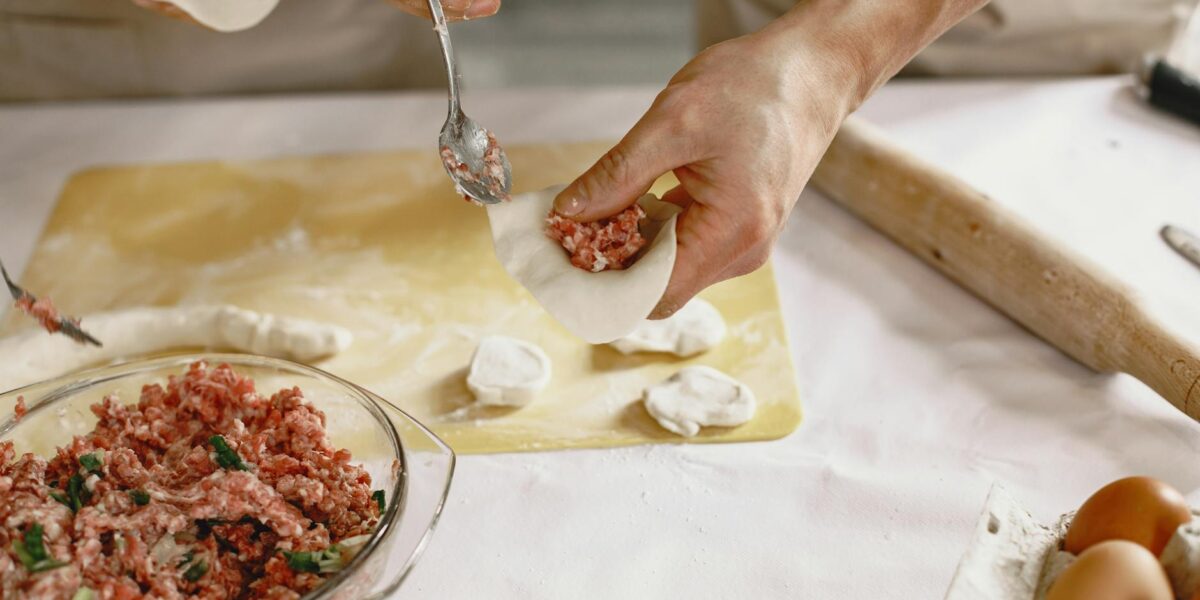
Buuz are Mongolia’s national dish — steamed dumplings filled with seasoned minced mutton (or beef) and onion. The dough is thicker than Chinese jiaozi wrappers, and each buuz is hand-formed with a small opening at the top to release steam. They are the centerpiece of Tsagaan Sar (Lunar New Year) celebrations, when families prepare thousands in advance and stack them outside to freeze. Buuz are eaten by hand — you bite a small hole first and sip the hot broth inside before eating the rest.
2. Khuushuur (Deep-Fried Meat Pastries)
If buuz are for celebrations, khuushuur are for everyday eating and festivals. These half-moon shaped pastries are filled with the same mutton-onion mixture as buuz but deep-fried until golden and crispy. They are the quintessential Mongolian street food, sold at every Naadam festival (Mongolia’s biggest sporting event) and from roadside stalls across the country. The best khuushuur have a shatteringly crisp exterior and juicy, savory interior.
3. Khorkhog (Hot Stone Meat)
Khorkhog is perhaps the most uniquely Mongolian cooking method in the world. River stones are heated in a fire until scorching hot, then layered inside a sealed metal container (traditionally a milk can) with chunks of mutton or goat, potatoes, carrots, and onions. The hot stones cook the meat from the inside while the sealed container traps steam. After cooking, the stones are passed from hand to hand — they are believed to have healing properties. The resulting meat is impossibly tender, with a smoky, mineral flavor you cannot replicate with any other technique.
4. Boodog (Whole Animal Roast)
Boodog takes the hot stone concept further. A whole marmot or goat is deboned through the neck, stuffed with hot stones, onions, and water, then the skin is sealed and blowtorched from the outside. The animal cooks simultaneously from inside (hot stones) and outside (open flame), creating an extraordinary combination of textures. Boodog is a special occasion dish, often prepared for hunting trips or gatherings in the countryside.
5. Tsuivan (Stir-Fried Noodles with Meat)
Tsuivan is Mongolia’s comfort food — hand-cut wheat noodles stir-fried with sliced mutton or beef, onions, carrots, potatoes, and cabbage. The noodles are made fresh, rolled out by hand, and cut into thick, rustic strips. Unlike Chinese chow mein or lo mein, tsuivan noodles are steamed over the meat and vegetables rather than boiled separately, absorbing all the savory juices. It is hearty, filling, and deeply satisfying — the dish most Mongolians cite as their ultimate comfort meal.
6. Banshtai Shöl (Dumpling Soup)
A simple, restorative soup of small meat dumplings (bansh) simmered in a clear mutton broth. The dumplings are smaller than buuz and fully sealed. This is quintessential cold-weather food, served steaming hot on winter days when temperatures drop well below freezing. Some versions add rice or noodles for extra substance. Think of it as Mongolia’s answer to wonton soup, but with richer, more robust broth.
7. Guriltai Shöl (Noodle Soup)
Hand-cut noodles in a mutton broth with meat and sometimes vegetables. Guriltai shöl is to Mongolia what pho is to Vietnam or ramen is to Japan — the everyday noodle soup that provides warmth and nourishment. The noodles are thick and chewy, the broth is rich with rendered fat, and the whole bowl is designed to fuel you through a day of physical labor in cold weather.
8. Boortsog (Fried Dough)
These golden, puffy pieces of fried dough are served at nearly every Mongolian celebration and with daily tea. The dough is simple — flour, butter, sugar, and milk — shaped into various forms (twists, rectangles, rounds) and deep-fried. Boortsog are stacked into elaborate towers for Tsagaan Sar and symbolize prosperity. They keep well for weeks, making them ideal nomadic snacks.
9. Airag (Fermented Mare’s Milk)
Mongolia’s most iconic beverage, airag is made by fermenting fresh mare’s milk in a large leather sack (khukhuur), which is stirred thousands of times daily. The result is a slightly fizzy, sour, mildly alcoholic drink (around 2% ABV) rich in vitamins and probiotics. Airag season runs from mid-June through October when mares are lactating. Offering airag to guests is a fundamental Mongolian hospitality tradition, and refusing it is considered impolite.
10. Suutei Tsai (Mongolian Milk Tea)
Mongolian milk tea is unlike any tea you have tried. Green or black tea is boiled with water, milk, salt, and sometimes a pat of butter. The result is savory, rich, and warming — more like a light broth than a sweet beverage. Suutei tsai is served all day long, offered to every guest who enters a ger, and consumed in enormous quantities (some estimates suggest Mongolians drink several liters per day). It provides essential hydration, calories, and minerals in a climate where water alone is not enough.
11. Aaruul (Dried Curds)
These rock-hard nuggets of dried milk curd are Mongolia’s original energy bar. Made by straining yogurt, shaping the curds, and drying them in the sun and wind, aaruul can last for months or even years without refrigeration. They come in many flavors — plain, sweetened, or mixed with berries. Aaruul provides concentrated protein and calcium and is carried by herders, travelers, and children as a portable snack. The texture is extremely hard; most people soften them in tea or suck on them slowly.
12. Chanasan Makh (Boiled Meat)
Sometimes the simplest dishes are the most important. Chanasan makh is nothing more than large bone-in chunks of mutton boiled in salted water. It is the foundational Mongolian dish — what herding families eat most often during winter. The meat is served on a communal platter, eaten with the hands, and accompanied by broth served separately. A sharp knife is the only utensil needed. The beauty is in the quality of the meat itself: grass-fed, free-range Mongolian mutton has an intense, clean flavor that needs nothing more than salt.
Mongolian Cooking Techniques
Mongolian cooking techniques are defined by practicality. Without permanent kitchens, running water, or electricity for most of the cuisine’s history, nomadic cooks developed methods that work with minimal equipment and available fuels (dried animal dung, wood, and brush).
Hot stone cooking: The most distinctly Mongolian technique. River stones are heated directly in flames and used as internal heat sources inside sealed vessels (khorkhog) or inside the animal itself (boodog). The stones provide even, sustained heat and impart a subtle mineral flavor. This method requires no pot, oven, or specialized equipment — just stones, fire, and a container.
Boiling: The most common everyday cooking method. Meat is boiled in large pots over the central stove inside the ger. The resulting broth is never wasted — it becomes soup or is used for cooking noodles and dumplings. Boiling is efficient because a single pot and fire serve multiple purposes: cooking, heating the dwelling, and warming water.
Steaming: Buuz and other dumplings are steamed over boiling water, similar to Chinese bamboo steamer techniques but using metal steamers layered over a pot. Steaming preserves the juiciness of the meat filling while cooking the dough through.
Deep-frying: Khuushuur, boortsog, and other fried items are cooked in rendered animal fat in a shallow pan. Deep-frying in animal fat produces exceptionally crispy results and adds richness. Oil was traditionally scarce, so animal fat was the universal frying medium.
Drying and preservation: With no refrigeration, Mongolians perfected air-drying as a preservation technique. Borts (dried meat) is made by cutting meat into thin strips and hanging it in winter wind until completely desiccated. The dry, cold air prevents spoilage while removing moisture. Borts can be stored for years and weighs a fraction of fresh meat — legend says the entire meat from one cow can fit in the stomach lining of a single animal once dried.
Fermentation: Dairy fermentation is central to the white food tradition. Airag, tarag (yogurt), and various aged cheeses are produced through natural fermentation, aided by Mongolia’s clean air and consistent cold temperatures. Each family’s fermentation cultures are passed down through generations.
Mongolian Food vs. Other Asian Cuisines
How does Mongolian food compare to other Asian cuisines you might already know? This comparison table highlights the key differences and similarities.
| Feature | Mongolian | Chinese | Korean | Japanese |
|---|---|---|---|---|
| Primary protein | Mutton, beef, horse | Pork, chicken, seafood | Beef, pork, seafood | Seafood, pork, chicken |
| Use of vegetables | Minimal; onions, potatoes, carrots | Extensive; leafy greens, root vegetables | Extensive; kimchi vegetables, greens | Moderate; seasonal vegetables |
| Spice level | Very mild; salt-focused | Varies by region (mild to fiery) | Moderate to spicy (gochugaru, gochujang) | Mild; wasabi and shichimi are condiments |
| Fermented foods | Dairy-based (airag, aaruul) | Soy-based (soy sauce, doubanjiang) | Vegetable and soy-based (kimchi, doenjang) | Soy and grain-based (miso, koji) |
| Staple carb | Wheat flour (noodles, dumplings) | Rice and wheat | Rice | Rice |
| Cooking fats | Animal fat (mutton, beef) | Vegetable oil, lard | Sesame oil, vegetable oil | Vegetable oil, sesame oil |
| Umami sources | Meat broth, rendered fat | Soy sauce, oyster sauce | Doenjang, soy sauce, anchovy stock | Dashi, soy sauce, miso |
| Dining style | Communal platters, eaten by hand | Shared dishes, chopsticks | Individual bowls, shared side dishes | Individual portions, chopsticks |
| Dairy usage | Extremely high; central to cuisine | Very low; lactose intolerance common | Low; limited traditional use | Low; limited traditional use |
| Signature technique | Hot stone cooking | Wok stir-frying | Fermentation, grilling | Raw preparation, precise knife work |
What About ”Mongolian Barbecue”?
If you have been to a ”Mongolian barbecue” restaurant in the United States, you might be surprised to learn that it has almost nothing to do with actual Mongolian food. The concept — where diners fill bowls with raw ingredients that are then cooked on a large, flat griddle — was invented in Taiwan in the 1950s by a restaurateur named Wu Zhaonan. He used the name ”Mongolian” for its exotic appeal, not for culinary accuracy.
Real Mongolian cuisine does not use flat griddles, oyster sauce, soy sauce, or the array of vegetables and sauces found at these restaurants. Authentic Mongolian cooking is much simpler in its seasoning — typically just salt, onion, and perhaps garlic — and relies on boiling, steaming, and hot stone methods rather than griddling. The similarly popular American-Chinese Mongolian beef dish (sliced beef in sweet soy sauce) is also not Mongolian at all.
That said, there are similarities in spirit. Both real Mongolian cooking and the American ”Mongolian barbecue” concept celebrate communal eating and the centrality of meat. The key difference is one of flavor philosophy: authentic Mongolian food lets high-quality, grass-fed meat speak for itself, while the American version layers on bold sauces and seasonings.
Mongolian Dairy: The White Food Tradition
No overview of Mongolian food is complete without exploring the extraordinary dairy tradition. Mongolia is one of the few Asian cultures where dairy is not just consumed but celebrated as the foundation of warm-weather eating. Mongolian herders milk five species of animal — cows, mares, goats, sheep, and camels — and transform their milk into a dazzling array of products.
Öröm (Clotted Cream): Fresh milk is heated slowly until a thick layer of cream rises to the surface. This cream is skimmed off and served as a spread, topping, or accompaniment to boortsog and bread. Rich, buttery, and slightly tangy.
Tarag (Yogurt): Naturally fermented yogurt made from cow or yak milk. Thicker and tangier than most commercial yogurts, tarag is eaten plain, mixed with sugar, or used as a base for aaruul production.
Byaslag (Pressed Cheese): A firm, mild cheese made by pressing curds into rectangular blocks. Byaslag has a texture similar to paneer and is served sliced as a snack or side dish.
Shimiin Arkhi (Milk Vodka): Distilled from fermented milk, this clear spirit has a lighter alcohol content than grain vodka (typically 10-15% ABV) and a distinctive lactic tang. It is an important part of ceremonial and social drinking traditions.
This dairy-centric tradition is especially remarkable in an Asian context. While coconut milk serves as the dairy equivalent in Southeast Asian cooking and soy milk fills that role in East Asian cuisine, Mongolia stands alone in its embrace of animal milk as a culinary cornerstone.
Meal Planning Tips for Cooking Mongolian Food at Home
Ready to try cooking Mongolian food in your own kitchen? Here are practical tips to get started, even without access to specialty ingredients.
Start with dumplings: Buuz and bansh are the most accessible Mongolian dishes for home cooks. The dough is a simple flour-water mixture, and the filling is ground meat (lamb is ideal, but beef works) with onion and salt. If you already know how to fold dumplings, you are halfway there — buuz use a similar pleating technique with an open top.
Source quality lamb: Since Mongolian cooking uses minimal seasoning, the quality of your meat matters enormously. Look for grass-fed lamb at butcher shops or farmers’ markets. The fat is a feature, not a flaw — do not trim it away.
Make tsuivan for weeknight dinners: Tsuivan is essentially a one-pot noodle dish that comes together in under an hour. Roll out a simple dough, cut it into strips, and steam the noodles over stir-fried meat and vegetables. It is forgiving and customizable — add whatever vegetables you have on hand.
Try Mongolian milk tea: Brew strong green or black tea, add whole milk and a generous pinch of salt. It sounds unusual if you are accustomed to sweet tea, but the savory-salty combination is surprisingly addictive. Add a small pat of butter for the richest version.
A sample Mongolian meal plan for the week:
- Monday: Guriltai shöl (noodle soup) — make a big pot of lamb broth on the weekend and use it as a base
- Tuesday: Tsuivan (stir-fried noodles with lamb and vegetables)
- Wednesday: Banshtai shöl (dumpling soup) — use leftover broth from Monday
- Thursday: Khuushuur (fried meat pastries) with a simple salad
- Friday: Buuz feast — make a large batch for steaming, freeze extras
- Weekend: Try khorkhog if you have access to an outdoor cooking setup, or make chanasan makh (boiled meat platter) for a communal family meal
Essential equipment: You do not need any specialty tools. A large pot, a steamer basket (metal or bamboo), a rolling pin, and a deep skillet or wok are sufficient for virtually every Mongolian dish. A well-seasoned wok works beautifully for tsuivan.
Mongolian Food Culture and Dining Etiquette
Understanding Mongolian food means understanding the customs that surround it. Mongolian hospitality is legendary, and food plays a central role in every social interaction.
Accepting food and drink: When offered food or drink in a Mongolian home (or ger), you should accept with your right hand or both hands. Using only your left hand is considered disrespectful. Even if you are not hungry, it is polite to at least taste what is offered — especially suutei tsai and airag.
The snuff bottle ritual: Before a meal in traditional settings, the host may offer a snuff bottle. You take it with your right hand, open it, sniff or pretend to sniff, and return it. This ritual is a greeting, not an expectation that you actually use snuff.
Knife etiquette: When eating chanasan makh (boiled meat), a knife is used to cut meat from the bone. Always cut toward yourself, never away — cutting away from yourself is considered aggressive. Pass the knife handle-first.
Communal eating: Most Mongolian meals are served on a single large platter or in a single pot from which everyone eats. There is no concept of individual plating in traditional settings. This communal approach reinforces the social bonds that are essential for survival in a harsh, sparsely populated landscape.
Tsagaan Sar (Lunar New Year): The most important food holiday in Mongolia. Families spend weeks preparing thousands of buuz, towers of boortsog, and a boiled sheep back (uuts). Visiting families during Tsagaan Sar means eating buuz at every stop — it is common to consume dozens in a single day of visits.
Where to Find Mongolian Ingredients in the US
The good news about cooking Mongolian food at home in the US is that most ingredients are readily available. Since Mongolian cuisine relies on basic proteins and pantry staples rather than exotic sauces or spices, you likely already have most of what you need.
Lamb and mutton: Look for bone-in lamb shoulder, lamb leg, and ground lamb at butcher shops, Costco, or halal markets (which typically carry excellent, affordable lamb). For the most authentic flavor, seek out fat-tailed or grass-fed varieties.
Flour: Any all-purpose wheat flour works for buuz wrappers, tsuivan noodles, and boortsog.
Dairy: Whole milk, plain yogurt, and butter are available everywhere. For öröm (clotted cream), you can use English clotted cream or make your own by slowly baking heavy cream. Airag is difficult to source outside Mongolia, but kefir provides a roughly similar tangy, slightly effervescent experience.
Online Asian grocery stores: While Mongolian food does not require many Asian pantry staples, having quality Asian cooking ingredients on hand is always helpful. Well-stocked pantries make it easy to explore fusion possibilities — imagine buuz with a sriracha dipping sauce or tsuivan seasoned with a touch of sesame oil.
Frequently Asked Questions About Mongolian Food
Is Mongolian food spicy?
No. Traditional Mongolian food is one of the mildest cuisines in Asia. Salt is the primary seasoning, with onion and garlic providing additional flavor. The focus is on the natural taste of high-quality, grass-fed meat and fresh dairy. If you are sensitive to spice, Mongolian food is an excellent Asian cuisine to explore.
Is Mongolian barbecue actually Mongolian?
No. ”Mongolian barbecue” was invented in Taiwan in the 1950s and has no connection to authentic Mongolian cooking. Real Mongolian food relies on boiling, steaming, frying, and hot stone cooking — not flat-griddle stir-frying. Similarly, the American-Chinese dish ”Mongolian beef” is not Mongolian.
What does Mongolian food taste like?
Mongolian food tastes clean, meaty, and rich. Without complex sauces or heavy spicing, the dominant flavors are well-raised meat, rendered animal fat, onion, and salt. Dairy products add tangy, creamy dimensions. The overall flavor profile is hearty and satisfying rather than complex or layered.
Is Mongolian food healthy?
Traditional Mongolian food is high in protein, healthy fats, and essential minerals. The reliance on grass-fed, free-range meat means higher omega-3 content and lower use of processed ingredients compared to many modern diets. The dairy tradition provides probiotics, calcium, and vitamins. However, the diet is low in fiber and plant-based vitamins, which is why modern Mongolian cooking often incorporates more vegetables than traditional preparations. For those following low-carb, paleo, or keto dietary approaches, Mongolian food aligns naturally.
Can I make Mongolian food as a vegetarian?
This is one of the most meat-centric cuisines in the world, so vegetarian Mongolian food requires significant adaptation. That said, boortsog (fried dough), dairy products like aaruul and byaslag, and suutei tsai are naturally vegetarian (though not vegan). You could also make tsuivan with vegetables only, or fill buuz with a mushroom-onion mixture. Authentic vegetarian Mongolian food is extremely rare in Mongolia itself, but creative home cooks can adapt the techniques.
What is the best Mongolian dish to try first?
Start with buuz (steamed dumplings). They are the national dish, relatively simple to make at home, and a great introduction to Mongolian flavors. If you enjoy Chinese jiaozi or Japanese gyoza, you will appreciate the family resemblance — and the differences.
How is Mongolian food different from Chinese food?
The differences are significant. Chinese cuisine emphasizes balanced flavors (sweet, sour, salty, bitter, umami), extensive use of vegetables, soy-based seasonings, and diverse cooking techniques including wok hei. Mongolian food is minimally seasoned, meat-dominant, dairy-heavy, and relies on boiling and steaming rather than stir-frying. The two cuisines share dumpling traditions and wheat noodles, reflecting centuries of cultural exchange along their shared border.
Where can I eat authentic Mongolian food in the US?
Authentic Mongolian restaurants are rare in the US but can be found in cities with Mongolian communities, including the Washington DC metro area, Chicago, Denver, San Francisco, and Los Angeles. Look for restaurants that serve buuz, khuushuur, and tsuivan rather than ”Mongolian barbecue” buffets. The Mongolian community in the US has grown significantly in recent years, making authentic options more accessible than ever.
Explore More Asian Cuisines
Mongolia’s cuisine stands apart from its Asian neighbors in fascinating ways. If this guide has sparked your curiosity about how different cultures across Asia approach food, explore our other cuisine guides:
- Chinese Recipes: 30 Authentic Dishes to Cook at Home
- Japanese Recipes: 20 Essential Dishes to Make at Home
- Korean Recipes: From Kimchi to BBQ
- Vietnamese Recipes: From Pho to Banh Mi
- Thai Recipes: Essential Dishes from Thailand
- Filipino Recipes: Essential Dishes and the Complete Guide
- Cambodian Food: Essential Dishes and the Complete Guide to Khmer Cuisine
- Laotian Food: Essential Dishes and the Complete Guide to Lao Cuisine

Mei Lin Chen
Mei Lin Chen is an Asian food writer and recipe developer. Melbourne-raised and London-based, she has spent over a decade exploring the rice paddies, hawker stalls, and home kitchens of South-East and East Asia. Her recipes balance traditional technique with everyday practicality.