Laksa is one of the most complex and regionally diverse noodle soups in all of Southeast Asia — a dish so variable from state to state that two bowls served under the same name can taste like entirely different soups. In Malaysia, it is simultaneously a hawker-stall staple, a source of fierce regional pride, and a litmus test for culinary authenticity. To understand laksa is to understand something essential about Malaysian food culture: the way Chinese, Malay, and Indian influences braid together into something entirely new.
What Is Laksa?
Laksa describes a family of spiced noodle soups found across Malaysia, Singapore, and parts of Indonesia. The word’s etymology is debated — some trace it to the Sanskrit word for 100,000, a reference to the soup’s many spices, while others link it to the Hokkien Chinese term for a type of noodle. What is not debated is that laksa as Malaysians eat it today emerged from the Peranakan (Straits Chinese) communities of the Malay Peninsula, where Chinese cooking techniques merged with Malay spice traditions to produce something neither culture had made before.
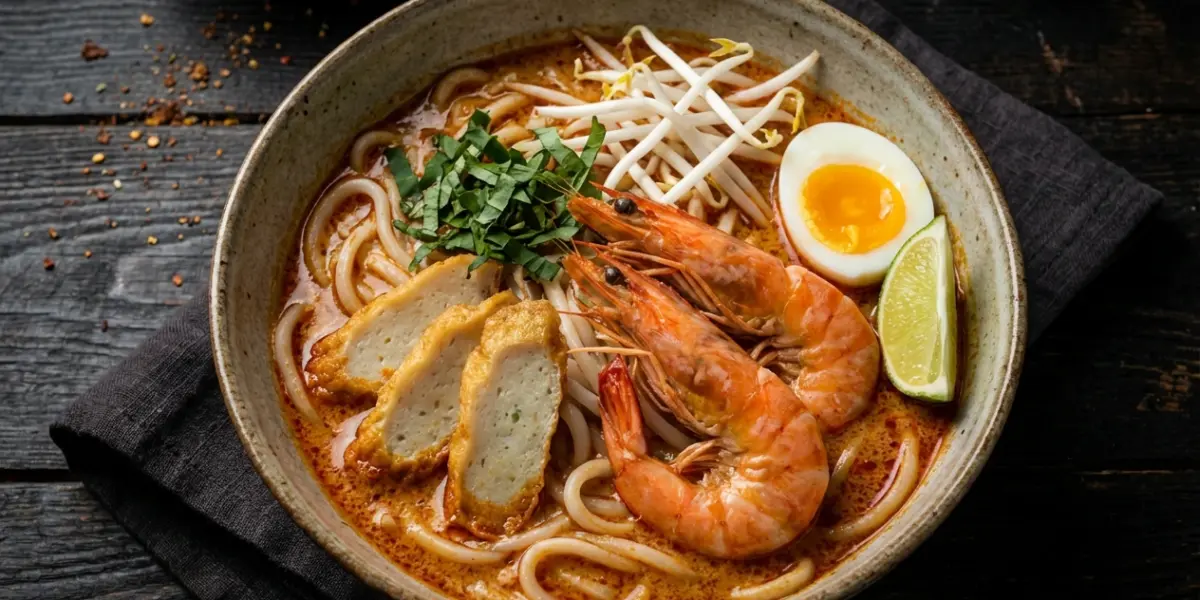
The two main categories are curry laksa (also called laksa lemak or Nyonya laksa) and asam laksa. Curry laksa is rich, coconut-milk-based, and deeply spiced with a rempah paste of dried chilies, shallots, lemongrass, galangal, and candlenuts. It is aromatic and filling, served with thick round noodles or thin rice vermicelli, topped with prawns, tofu puffs, cockles, and fish cake. Asam laksa, most associated with Penang, is the opposite: a tart, fish-based broth without coconut milk, soured with asam gelugor (dried tamarind slices) and given a pungent depth by fermented shrimp paste (hae ko). It is an acquired taste for many visitors, and the obsession of many who acquire it.
This recipe focuses on curry laksa — specifically a Kuala Lumpur-style version that is rich, moderately spicy, and built around a ground rempah paste cooked until the oil separates. It is the style most familiar to people outside Malaysia and the most approachable starting point for home cooks.
Ingredients
Serves 4
For the Rempah (Spice Paste)
- 8 dried red chilies, soaked in hot water for 20 minutes, seeds removed
- 4 fresh red chilies
- 6 shallots, roughly chopped
- 4 cloves garlic
- 3cm (1 1/4 inch) piece galangal, roughly chopped
- 2cm (3/4 inch) piece fresh turmeric (or 1 teaspoon ground turmeric)
- 2 stalks lemongrass, white part only, sliced
- 6 candlenuts (or macadamia nuts as substitute)
- 1 1/2 teaspoons shrimp paste (belacan), toasted
- 1 tablespoon dried shrimp, soaked for 10 minutes
For the Broth
- 4 tablespoons neutral oil
- 1 litre (4 cups) chicken or prawn stock
- 400ml (1 2/3 cups) full-fat coconut milk
- 3 fresh curry leaf sprigs
- 1 tablespoon fish sauce, or to taste
- 1 teaspoon sugar
- Salt to taste
For the Toppings
- 300g (10 1/2 oz) medium prawns, peeled and deveined (tails on)
- 200g (7 oz) tofu puffs (tau pok), halved diagonally
- 150g (5 1/2 oz) fish cake or fish balls
- 200g (7 oz) bean sprouts, blanched briefly
- 400g (14 oz) thick round laksa noodles (or substitute thick rice vermicelli)
- 2 hard-boiled eggs, halved
- Fresh coriander or Vietnamese mint (laksa leaf / daun kesum) for garnish
- Sambal belacan, to serve
Note on key ingredients: Galangal is essential and not interchangeable with ginger. It has a piney, citrusy quality ginger lacks and is available fresh or frozen at Asian grocery stores. Candlenuts are used to thicken and enrich the rempah; macadamia nuts are a valid substitute. Tofu puffs (pre-fried tofu pieces that absorb broth beautifully) are sold refrigerated or frozen at most Asian supermarkets. Laksa leaf (Vietnamese mint, Persicaria odorata) has an intensely herbal, slightly peppery aroma very different from regular mint; use fresh coriander if unavailable, but seek it out if you can.
How to Make Laksa
- Make the rempah. Drain the soaked dried chilies. Combine all rempah ingredients in a blender with 3 to 4 tablespoons of water. Blend to a very smooth paste, scraping down the sides frequently. The paste should be homogenous — any remaining fibrous chunks of lemongrass or galangal will affect the broth texture.
- Fry the rempah. Heat the oil in a large wok or heavy-bottomed pot over medium heat. Add the rempah paste and cook, stirring almost constantly, for 15 to 20 minutes. You are looking for the oil to separate from the paste and pool at the edges — this is called pecah minyak and signals that the paste is properly cooked and the raw flavours are gone. The paste will deepen in colour from orange-red to a darker brick-red.
- Add the stock. Pour in the chicken or prawn stock and add the curry leaf sprigs. Raise the heat to medium-high and bring to a simmer, stirring to incorporate the rempah fully into the liquid. Simmer for 10 minutes to let the flavours develop.
- Add the coconut milk. Reduce heat to medium-low. Pour in the coconut milk slowly, stirring as you go. Do not boil the soup vigorously after adding coconut milk — a gentle simmer is all it needs. Season with fish sauce, sugar, and salt. Taste carefully: the broth should be rich, spicy, slightly sweet from the coconut milk, and deeply aromatic. Adjust seasoning.
- Cook the prawns. Add the prawns to the simmering broth and cook for 2 to 3 minutes until pink and just cooked through. Remove with a slotted spoon and set aside.
- Prepare the tofu puffs. Add the tofu puffs to the broth and simmer for 5 minutes. They will absorb the broth and swell slightly. Leave them in the broth until serving.
- Prepare the noodles. Cook the laksa noodles according to package instructions. Most thick round noodles need 3 to 4 minutes in boiling water. Drain and rinse with cold water to stop cooking. Divide among four deep bowls.
- Blanch the bean sprouts. Drop the bean sprouts into a pot of boiling water for 30 seconds. Drain immediately and divide among the bowls on top of the noodles.
- Assemble. Ladle the hot broth generously over the noodles in each bowl. Arrange prawns, tofu puffs, sliced fish cake, and half a hard-boiled egg on top. Scatter fresh laksa leaves or coriander over everything. Serve immediately with sambal belacan on the side.
Tips for the Best Laksa
- Use prawn stock if possible. The best laksa broth is made with prawn shell stock — simmer the shells from peeling your prawns with water, onion, and ginger for 30 minutes. It adds an irreplaceable sweetness and depth. Good quality chicken stock is a practical alternative.
- Cook the rempah until the oil truly separates. This is the most important step and the most commonly cut short by impatience. Undercooked rempah produces a raw, harsh-tasting broth. The transformation is real and worth the time.
- Never boil after adding coconut milk. A rolling boil will cause the coconut milk to split, giving you a greasy, grainy broth instead of a silky one. Keep it at a gentle simmer once the coconut milk goes in.
- Make the broth a day ahead. Laksa broth improves enormously overnight. The spices mellow and integrate in a way they simply cannot on the same day. Reheat gently and cook fresh toppings to order.
- Balance the seasoning precisely. The broth needs sufficient salt (from fish sauce) and a small amount of sugar to balance the chili heat and coconut richness. Under-seasoned laksa broth tastes flat despite the complexity of the rempah.
Variations
Penang Asam Laksa: Penang’s version is a fish-based soup (mackerel is traditional) made sour with asam gelugor (dried tamarind slices) rather than coconut milk. It is garnished with shredded fish, pineapple, thinly sliced shallots, cucumber, and a dollop of fermented prawn paste (hae ko). The flavour profile — intensely sour, funky, and herbal — is completely unlike curry laksa.
Sarawak Laksa: From the Borneo state of Sarawak, this version uses a rempah paste with dried prawns and a particular combination of spices that makes it simultaneously shrimpy and aromatic. It is served with thin rice vermicelli, strips of omelette, peeled prawns, shredded chicken, and coriander. The broth is thinner than KL-style curry laksa but arguably more complex.
Johor Laksa: Uses spaghetti instead of rice noodles — a quirk attributed to Italian influence during the British colonial era — with a thick fish-based sambal sauce rather than a liquid broth. It is arguably closer to a sauced noodle dish than a soup, and one of the most unusual variations in the laksa family.
What to Serve With Laksa
- Roti canai: Flaky Malaysian flatbread is ideal for scooping up extra broth. At Malaysian mamak stalls, it is common to order laksa and roti together specifically for this purpose.
- Otah-otah: Spiced fish paste grilled in banana leaves — a smoky, firm accompaniment that complements the richness of curry laksa without competing with it.
- Popiah (fresh spring rolls): The mild, cool filling of fresh popiah provides textural and temperature contrast to a bowl of hot, spiced laksa.
- Teh tarik (pulled tea): Malaysia’s frothy, sweet pulled tea is the classic drink pairing with laksa at hawker stalls — the sweetness cuts through the chili heat effectively.
Storage and Reheating
Store the laksa broth separately from the noodles and toppings. The broth keeps refrigerated for up to 3 days and freezes well for up to 2 months. Reheat gently over medium-low heat; do not boil. Noodles are best cooked fresh for each serving, as they become waterlogged and soft when stored in the broth. Bean sprouts should also be blanched fresh rather than stored.
Prawns and other seafood toppings are best cooked to order rather than stored in the broth, where they will overcook on reheating. Store cooked prawns separately and add them to the bowl just before serving.