Last Updated: March 23, 2026
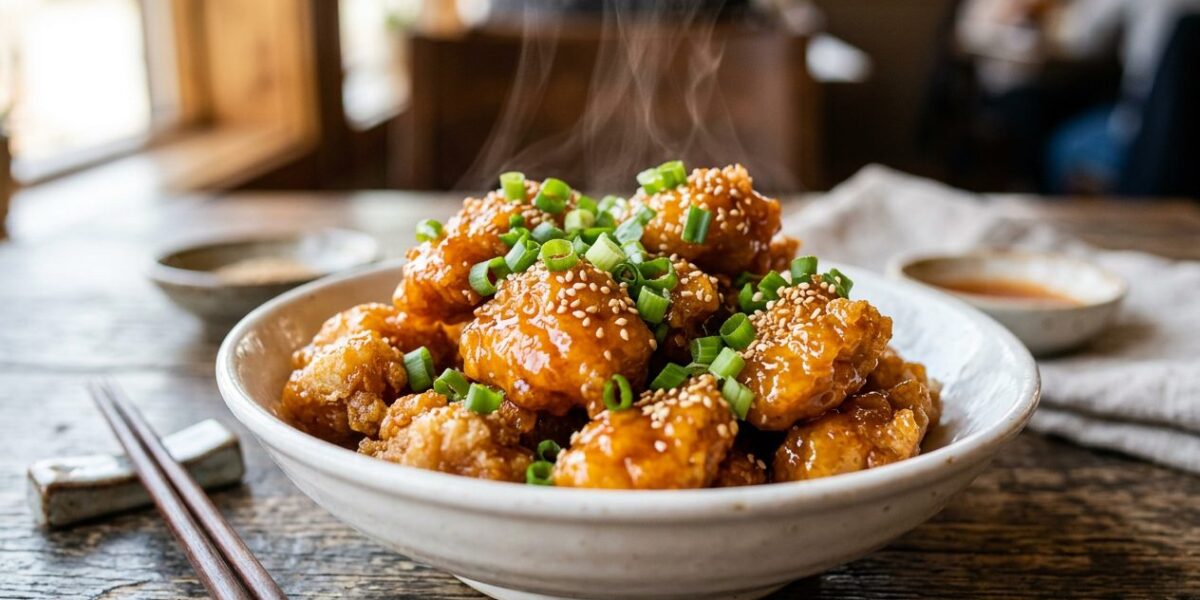
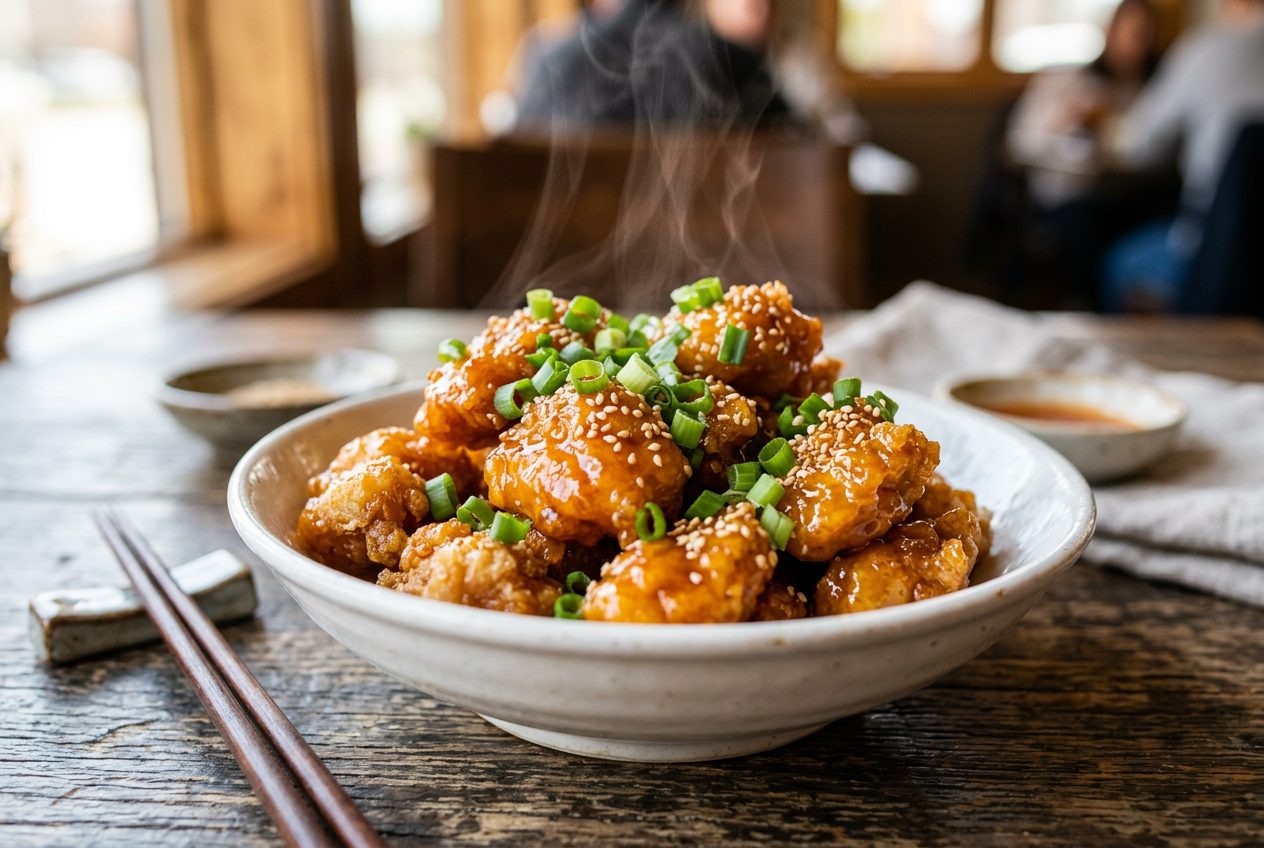
Our orange chicken recipe delivers a crispy, golden crust and a bright, fragrant orange glaze that puts takeout to shame — and we’re going to show you exactly how we make it. From the double-fry technique to the use of real dried tangerine peel, every step here is designed to give you a result that’s leagues ahead of anything that comes in a cardboard box.
Key Takeaways
- The secret to restaurant-style crunch is double-frying the chicken — it’s non-negotiable.
- Chen pi (dried tangerine peel) gives the sauce an authentic citrus depth that bottled sauces simply cannot replicate.
- A homemade version costs roughly $5.50 per serving versus $8.00 at Panda Express — with better nutrition numbers.
- Fresh orange juice and real ginger lift the sauce into genuinely bright, aromatic territory.
- Toss the chicken in sauce at the last moment to keep the coating crisp all the way to the table.
Why Our Orange Chicken Recipe Beats Panda Express
The Panda Express Origin Story
Orange chicken as the world knows it today was created in 1987 by chef Andy Kao at a Panda Express location in Hawaii — a verified fact, confirmed by company co-founder Andrew Cherng. The dish was engineered for speed, consistency, and mass appeal: a sauce built from sweeteners, vinegar, and artificial orange flavoring that could be replicated identically across hundreds of locations at once. The goal was never authenticity; it was scale.
The strategy worked spectacularly. Panda Express now serves over 100 million portions of orange chicken every year, making it the chain’s single best-selling dish by a wide margin. For millions of Americans, this dish is their first — and sometimes only — exposure to something labeled ”Chinese food.” That’s a heavy cultural footprint for a recipe that has no counterpart anywhere in China.
What Panda Express created is, essentially, American Chinese cuisine: a category of cooking adapted for a Western palate, prioritising sweetness and familiarity over the complex layering of flavors found in the source traditions. It’s a remarkable commercial achievement. But when we cook this dish at home, we have the opportunity to do something the chain cannot — we can go back to the real thing.
What Changes When You Cook It at Home
Cooking orange chicken in your own kitchen changes three things in a single stroke: ingredients, technique, and intention. We choose boneless chicken thighs instead of preprocessed nuggets, use real orange juice rather than concentrate, and control our own oil temperature rather than relying on a commercial fryer pre-set at the cheapest operational cost. Each of those choices compounds into a noticeably better dish.
The batter is where we gain the most. A blend of all-purpose flour, cornstarch, and baking powder creates a coating that puffs slightly in hot oil, forming air pockets that stay crunchy even after being sauced. The chain’s uniform coating is designed to look the same in every store — which means it’s optimised for appearance, not texture. Our coating is optimised for your mouth.
We also avoid the preservatives, artificial colorings, and flavour enhancers that processed takeout depends on. According to the USDA FoodData Central database, a homemade serving of this dish comes in around 520 calories and 950 mg of sodium per portion — versus approximately 620 calories and 1,200 mg of sodium in the equivalent Panda Express serving. Over a week of meals, that difference adds up. For a deeper look at how we build our Asian recipes with nutrition in mind, we go through the full approach on that page.
The Chen Pi Difference: Real Orange Flavour vs. Synthetic
Chen pi — 陳皮, dried aged tangerine peel — is a staple of Hunan and Cantonese cooking that’s been used for centuries. It’s the ingredient that almost certainly inspired Andy Kao’s Panda Express creation, channelled through the traditional Hunan dish known as chen pi ji (tangerine peel chicken). The dried peel releases essential oils during cooking that carry a citrusy, slightly bitter, faintly floral aroma — the kind of complexity you simply cannot get from bottled orange extract.
When we add two tablespoons of chen pi to our sauce as it simmers, the kitchen transforms. The scent alone tells you something real is happening — not a simulation of orange, but a genuine conversation between citrus and heat. The finished sauce carries a depth that makes tasters stop and think about what they’re tasting. That pause, that moment of recognition, is what separates a recipe worth making from one worth ordering.
Chen pi is widely available through Asian grocery stores and online retailers. If you’re already browsing our Chinese recipes section, you’ll find it turning up in other Hunan and Cantonese preparations — it’s an ingredient worth keeping in your pantry. If you can’t source it for this particular cook, a strip of fresh orange zest can stand in, though the earthy depth of the aged peel will be missing.
The Ingredients You Need
For the Crispy Fried Chicken
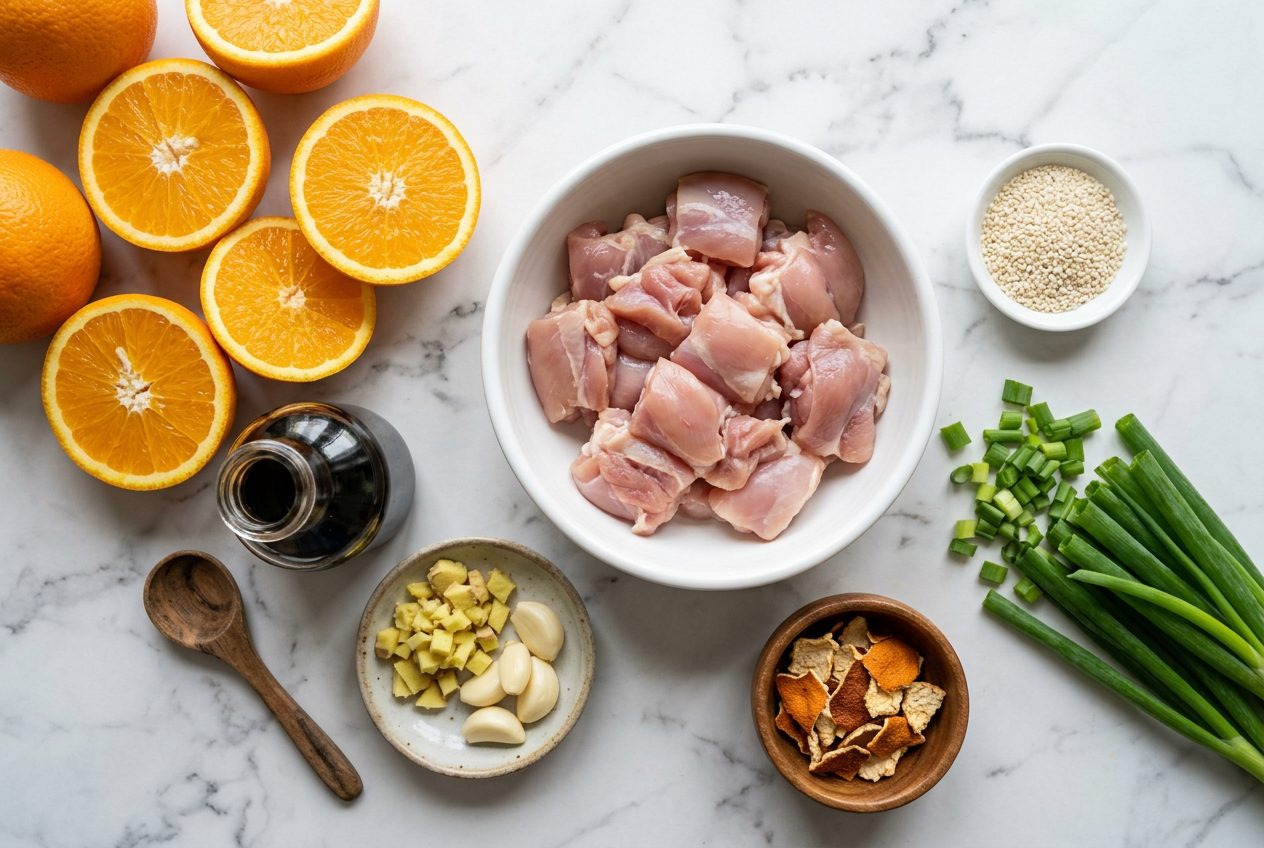
We use boneless, skinless chicken thighs — 450 g / 1 lb, cut into bite-size pieces. Thighs stay juicy under the heat of double-frying where breast meat dries out. They also carry more fat, which translates to flavour inside that otherwise plain batter coating. Cut the pieces uniform — roughly 3 cm cubes — so every piece fries in the same time.
The dry coating is ¾ cup all-purpose flour, ¼ cup cornstarch, ½ teaspoon baking powder, and a pinch of salt. The cornstarch is the crunch architect here: it gelatinises at a lower temperature than flour, creating a thin glassy shell before the flour sets. The baking powder contributes tiny CO₂ bubbles that make the coating feel lighter than it looks. Season the chicken pieces with 1 teaspoon salt, ½ teaspoon black pepper, and ½ teaspoon garlic powder before battering — the seasoning lives inside the crust, not just on top.
For the frying medium, use 2 cups of peanut oil or neutral canola oil. Peanut oil has a smoke point around 232°C (450°F) and a clean, almost nutty background note that suits Chinese-style frying well. Canola is neutral and performs just as reliably. Avoid olive oil — its lower smoke point will cause burning and off-flavours at the temperatures we need.
For the Orange Sauce
The sauce is built on ½ cup freshly squeezed orange juice — from approximately two medium oranges. Fresh juice contains natural fructose, citric acid, and volatile aromatics that bottled juice has largely lost. Alongside that: ¼ cup soy sauce (light or all-purpose), 2 tablespoons rice vinegar for acidity, 2 tablespoons brown sugar for the gloss, 1 tablespoon each of minced ginger and minced garlic, and 1 teaspoon sesame oil added off the heat.
The star addition is 2 tablespoons of chen pi — torn or lightly crumbled to expose more surface area. Alongside it: ¼ teaspoon dried chili flakes if you want a gentle heat that cuts through the sweetness. The sauce thickens naturally as it simmers; if you need more body, a teaspoon of cornstarch dissolved in two teaspoons of cold water stirred in near the end will bring it to a glossy, coating-weight consistency.
Garlic and ginger are the aromatic foundation — sweet, sharp, and grounding. Without them, the sauce tastes like orange candy. With them, it tastes like a dish with a history. Don’t skip them, and don’t use powder in the sauce; the fresh versions give a brightness that dried simply cannot provide at this stage of cooking.
Ingredient Notes and Substitutions
For a gluten-free version: replace the all-purpose flour with a 1:1 gluten-free baking flour blend, and swap regular soy sauce for tamari. Both substitutions work seamlessly and produce virtually identical results in texture and flavour. Make sure your baking powder is certified gluten-free as well, since some brands process it in shared facilities.
If you’re reducing sugar: cut the brown sugar to 1 tablespoon and add a teaspoon of honey instead. The honey contributes a floral sweetness that’s more complex than straight sugar and gives the glaze a better sheen. You can also use coconut sugar as a 1:1 swap for a slightly lower glycemic index option with a mild caramel note.
Chen pi can be ordered from most Asian supermarkets or online — it keeps indefinitely in a sealed jar. If you genuinely cannot source it, use 1 tablespoon of fresh orange zest plus a small pinch of dried bitter orange peel (available in some herbal stores). The result won’t have the same aged depth, but it’ll get close. Fresh zest added at the end of cooking preserves more of the volatile aroma than zest cooked in from the start.
How to Make Orange Chicken Step by Step
Step 1: Prepare and Marinate the Chicken
Cut 450 g of boneless chicken thighs into uniform 3 cm pieces. Uniform size is the difference between a dish where half the pieces are overcooked and half are underdone — it matters more than it might seem. Place the pieces in a bowl and season with 1 teaspoon salt, ½ teaspoon black pepper, and ½ teaspoon garlic powder. Toss to coat evenly and leave to sit for 15 minutes at room temperature.
The 15-minute rest is a brief dry-brine: the salt draws a little moisture to the surface, which then gets reabsorbed along with the seasoning. It’s a small step but one that visibly improves the flavour of the finished chicken. If you have more time, you can refrigerate the seasoned chicken uncovered for up to 4 hours — the drier surface will batter even more cleanly.
While the chicken rests, prepare your batter and sauce ingredients so the entire cook moves efficiently from here. Set up a wire rack over a baking sheet near your frying station — this is where the chicken rests between the two fries, and it’s critical that air circulates underneath to prevent steam from softening the crust.
Step 2: Make the Batter and Fry
In a wide bowl, whisk together ¾ cup flour, ¼ cup cornstarch, ½ teaspoon baking powder, and a pinch of salt. Working in batches, toss the seasoned chicken pieces in the dry mix until each piece is evenly coated. Shake off any excess — a thick, clumpy coating is the enemy of crunch. Each piece should look lightly dusted, not caked.
Heat your oil to 175°C (350°F) in a deep saucepan or wok over medium-high heat — a thermometer is the only reliable way to know you’re there. Fry the chicken in batches of 6 to 8 pieces, being careful not to crowd the pan. Overcrowding drops the oil temperature dramatically and results in greasy, pale chicken rather than golden, crisp chicken. Each first fry takes approximately 3 minutes; the chicken should be cooked through but the coating still pale gold.
Transfer to the wire rack and allow to rest for at least 5 minutes. Then raise the oil temperature to 190°C (375°F) and fry the same pieces again for 90 seconds to 2 minutes — you’ll see the coating transform from pale gold to deep amber. This second pass is where the magic happens: the residual steam from the chicken interior escapes through the batter and creates a texture that’s almost shatteringly crisp. Rest again on the rack while you finish the sauce.
Step 3: Build the Orange Sauce
In a small saucepan over medium heat, combine ½ cup fresh orange juice, ¼ cup soy sauce, 2 tablespoons rice vinegar, 2 tablespoons brown sugar, 1 tablespoon minced ginger, 1 tablespoon minced garlic, and the crumbled chen pi. Stir everything together before applying heat — the sugar should begin dissolving even before the pan heats up.
Bring the sauce to a gentle simmer and let it reduce for 4 to 5 minutes, stirring occasionally. You’ll notice the colour deepening and the aroma shifting from raw citrus to something richer and more complex — that’s the ginger and garlic beginning to bloom in the heat, and the orange oils releasing from the chen pi. The sauce should coat the back of a spoon lightly but not thickly.
If the sauce needs more body, stir in a cornstarch slurry (1 teaspoon cornstarch dissolved in 2 teaspoons cold water) and simmer for another 30 seconds until it thickens to a glossy, coating-weight consistency. Remove from heat and stir in the sesame oil — this goes in off the heat to preserve its delicate nutty aroma. The sauce is now ready; move quickly to the toss.
Step 4: Toss and Serve
Place all of the double-fried chicken pieces into a large mixing bowl. Pour the hot orange sauce over the chicken and toss gently but quickly — use tongs or two spoons — until every piece is evenly coated. Work fast; the longer the sauce sits on the chicken before serving, the softer the coating becomes. Speed here is the difference between crispy orange chicken and saucy orange chicken — both are delicious, but only one earns the compliments.
Plate immediately over steamed jasmine rice and garnish with sliced green onions and a scattering of toasted sesame seeds. The green onions are not just a visual touch — they provide a mild, fresh allium bite that cuts through the richness of the glaze. The sesame seeds add a faint nuttiness and a delicate crunch that plays off the crust below.
This dish moves fast at the table. In our experience, four portions disappear before anyone has finished their first glass of water. If you’re feeding a crowd, consider frying in advance (first fry only), holding the chicken on the rack for up to 30 minutes, then doing the second fry and saucing in batches as needed. The technique holds up beautifully.
Tips for the Crispiest Orange Chicken
Choosing the Right Oil and Temperature
The two most common reasons homemade fried chicken disappoints are the wrong oil and imprecise temperature. Peanut oil is the professional standard in Chinese cooking: it handles high heat without breaking down, imparts a clean, faintly nutty background flavour, and produces a beautifully golden colour. Canola oil is a perfectly acceptable neutral alternative. What to avoid: olive oil (too low a smoke point), butter (burns immediately at frying temperatures), and coconut oil (its distinctive flavour doesn’t belong in this dish).
Temperature discipline requires a thermometer. Without one, you’re guessing — and guessing is expensive in time, oil, and ingredients. At 175°C, the first fry cooks the chicken through without burning the coating. At 190°C, the second fry crisps the exterior in under two minutes without overcooking the interior. That 15°C difference is precise and intentional; don’t eyeball it.
Between batches, always let the oil return to temperature before adding the next. Rushing this step is the single most common cause of greasy, pale chicken. A kitchen thermometer that clips to the side of the pan costs less than £15 and will change how you fry everything, not just this recipe.
Double-Fry for Restaurant Crunch
Every Chinese restaurant that serves crispy fried chicken — orange chicken, general Tso’s, sweet and sour — uses a double-fry. It’s not a shortcut or a gimmick; it’s structural. The first fry at lower heat sets the coating and cooks the protein. The resting period allows the interior steam to redistribute and the surface to dry slightly. The second fry at higher heat then creates a rapid, violent crisping of that dry surface — the Maillard reaction happening at speed, building the amber colour and snap-crunch texture that no single fry can achieve.
The rest between fries is as important as the fries themselves. Minimum five minutes on the wire rack — not paper towels, which trap steam underneath the chicken and soften the base of the coating. The wire rack allows air to circulate on all sides, which means the entire surface arrives at the second fry in the driest, readiest state possible.
If you want to verify the technique before committing to it for a dinner party, fry a test batch of two pieces using single fry and two using double fry, sauce them both, and taste side by side. The difference in texture after saucing is dramatic and will make the case better than any description we can write.
Sauce Timing: Why You Must Toss at the Last Moment
This is the rule that separates cooks who understand fried chicken from those who don’t: the sauce never touches the chicken until the moment before serving. Orange sauce is mostly water and sugar — both are devastating to crispy coatings. The moment liquid hits the batter, it begins wicking into the coating via capillary action, softening the very structure we spent all that effort building. This process begins in seconds and is largely complete within two to three minutes.
The practical implication is to have everything — rice plated, garnishes ready, sauce finished and hot — before you begin the final toss. Two minutes of rushed prep between sauce and plate costs you all the crunch you earned. Think of it the way a baker thinks about meringue: the structure is there right up until you stop respecting it.
If you’re serving the dish in courses or buffet-style, consider serving the sauce on the side for guests to add themselves. It’s less dramatic than the full toss presentation, but it preserves the texture for late-arrivals and second helpings. In a sit-down setting, toss to order in small batches — four or five portions at a time — rather than all at once.
Variations and Serving Ideas
Baked or Air-Fryer Orange Chicken
For a lower-fat version, the same battered chicken can be baked at 220°C (425°F) for 20 minutes, turning the pieces at the halfway mark. Spray or brush with a thin layer of neutral oil before baking — this is what drives the browning in the absence of an oil bath. The result is crispier than most people expect from baked chicken, though it won’t match the deep-fry texture on a direct comparison.
Air-frying is arguably the better alternative to deep-frying: at 200°C (400°F) for 12 to 15 minutes (turning at 8 minutes), the circulating hot air mimics the double-fry effect to a surprisingly convincing degree. Use a light spray of oil and don’t overcrowd the basket. The coating comes out significantly crispier than oven-baked, and the cleanup is trivial compared to a deep-fry session. According to testing data published by Serious Eats, air frying reduces fat absorption by approximately 70% compared to traditional deep frying while retaining comparable surface texture when batter formulas are adapted appropriately.
The orange sauce itself is identical regardless of which cooking method you choose — the sauce is the sauce. The only variable is the coating crunch level, which the deep-fry version wins by a clear margin. Choose your method based on how much you care about maximum crispiness versus minimum oil use.
What to Serve With Orange Chicken
Steamed jasmine rice is the classic, and for good reason: its mild sweetness and sticky texture absorb the orange sauce beautifully, extending every drop of the glaze and providing a textural counterpoint to the crisp chicken. Long-grain jasmine cooked by the absorption method — 1 cup rice to 1.5 cups water, brought to boil, then covered and simmered for 12 minutes — is the foundation of half the dishes we cover in our fried rice recipe guide and works just as well here.
For vegetables: stir-fried bok choy with garlic and a splash of oyster sauce is the natural partner — its mild bitterness cuts the sweetness of the glaze where rice simply absorbs it. Steamed tenderstem broccoli, Chinese broccoli (gai lan), or a quick cucumber and sesame salad all work in the same role. The key is something green and either lightly bitter or acidic to balance the richness of the main.
For a full spread: serve alongside a simple egg drop soup or hot and sour soup, add a portion of spring rolls or dumplings, and you have a dinner that feels genuinely restaurant-grade. Orange chicken is a strong-flavoured centrepiece — everything around it should be quieter and cleaner in flavour to let it lead.
Storing and Reheating Leftovers
Store leftover orange chicken in an airtight container in the refrigerator for up to 3 days. Keep the chicken and any remaining sauce in separate containers if possible — this slows the softening of the coating and gives you more options when reheating. The sauce keeps well for 5 days in the fridge and freezes beautifully for up to 3 months.
For reheating: the oven method is best. Spread the chicken pieces on a wire rack set over a baking sheet, and bake at 200°C (400°F) for 10 minutes. This drives off the residual moisture and partially restores the crust — not quite fresh-fried, but genuinely good. An air fryer achieves the same result in 6 to 8 minutes. Microwaving is the method of last resort; it softens the coating irreversibly, though the flavour remains intact.
Reheat the sauce in a small saucepan over low heat with a splash of water to loosen it, or in a microwave-safe bowl for 30 seconds. Toss the reheated chicken in the reheated sauce just before eating, following the same last-moment timing principle that governs the original cook. Day-two orange chicken, done right, is almost as satisfying as day one.
Comparison: Homemade vs. Panda Express Orange Chicken
| Feature | Our Homemade Recipe | Panda Express |
|---|---|---|
| Calories (per serving) | ~520 kcal | ~620 kcal |
| Sodium (per serving) | ~950 mg | ~1,200 mg |
| Cost per serving | ~$5.50 / £4.20 | ~$8.00 / £6.10 |
| Orange flavour source | Fresh orange juice + chen pi | Artificial orange flavoring |
| Chicken cut | Boneless thigh, fresh | Pre-processed, frozen |
| Frying method | Double-fry (two temperatures) | Single commercial fry |
| Additives/preservatives | None | Multiple |
Frequently Asked Questions
What are the ingredients for orange chicken?
The core ingredients are boneless chicken thighs, all-purpose flour, cornstarch, baking powder, salt, pepper, garlic powder, fresh orange juice, soy sauce, rice vinegar, brown sugar, fresh ginger, fresh garlic, sesame oil, and chen pi (dried tangerine peel). Optional additions include dried chili flakes for heat, green onions and sesame seeds for garnish. Full quantities for four servings are listed in the recipe card above.
What does Panda Express put in their orange chicken?
Panda Express uses a proprietary pre-made sauce containing sweeteners, white distilled vinegar, soy sauce, artificial orange flavoring, and various preservatives. The chicken is pre-battered, par-cooked, and frozen before delivery to individual stores. The dish is then assembled quickly in a commercial fryer and wok station. Chef Andy Kao created the original recipe in 1987 in Hawaii, though the current industrial version differs significantly from that original in both ingredients and method.
Is orange chicken the same as sweet and sour chicken?
No — they share a family resemblance but are distinct dishes. Sweet and sour chicken uses a generic sweet and sour sauce (typically with pineapple juice, ketchup, or both) that delivers a broad, unfocused flavour. Orange chicken is a specific variation centred on citrus: fresh orange juice, orange zest, or chen pi give the sauce a bright, aromatic identity that generic sweet and sour sauce lacks. The coating style is similar, but the sauce is entirely different in character.
Can I make orange chicken gluten-free?
Yes, easily. Replace the all-purpose flour with a 1:1 certified gluten-free baking flour blend, and substitute tamari for regular soy sauce. Verify that your baking powder and cornstarch are processed in gluten-free facilities. Every other element of the recipe — chicken, orange juice, rice vinegar, ginger, garlic, sesame oil, chen pi — is naturally gluten-free. The finished dish should be indistinguishable in texture and flavour from the standard version.
What is the difference between orange chicken and General Tso’s chicken?
General Tso’s chicken is typically darker, spicier, and sweeter than orange chicken. Its sauce leads with dried red chillies and a heavier hit of sugar, producing a bold, heat-forward flavour profile. Orange chicken is lighter and brighter, with fresh citrus at the front and a more balanced sweet-sour-umami structure. General Tso’s originated in New York City in the 1970s, while orange chicken came from Panda Express in Hawaii in 1987. Both are entirely American Chinese inventions with no direct equivalent in China.

Mei Lin Chen
Mei Lin Chen is an Asian food writer and recipe developer. Melbourne-raised and London-based, she has spent over a decade exploring the rice paddies, hawker stalls, and home kitchens of South-East and East Asia. Her recipes balance traditional technique with everyday practicality.