Last Updated: March 23, 2026
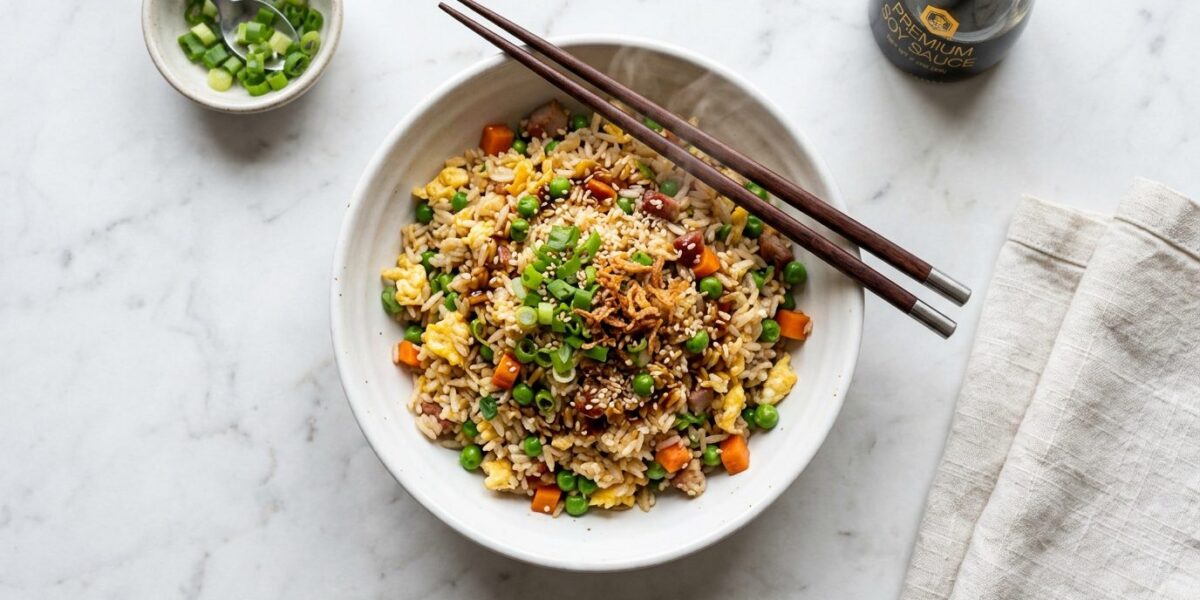
The fried rice recipe most home cooks struggle with is not a matter of ingredients — it is a matter of heat and rice. We have tested this dish dozens of times in our kitchen, tracing its roots back to Chinese chao fan (炒饭), and what we found changed how we cook it every single time.
In 25 minutes, using ingredients you likely already have, you can produce a wok-kissed, deeply savory plate of fried rice that outperforms anything from a takeout container — and this guide shows you exactly how.
Key Takeaways
- Day-old or spread-and-dried rice gives you the separated, slightly chewy grains that fry rather than steam.
- High heat is non-negotiable — it is what creates wok hei (鑊氣), the smoky depth that defines restaurant fried rice.
- Light soy sauce and toasted sesame oil do the heavy lifting on flavor; white pepper adds an earthy warmth no black pepper can replicate.
- This recipe scales to 2 or 6 servings without changing any technique.
- Scrambled eggs added at the end stay silky — not rubbery — because they finish cooking off direct flame.
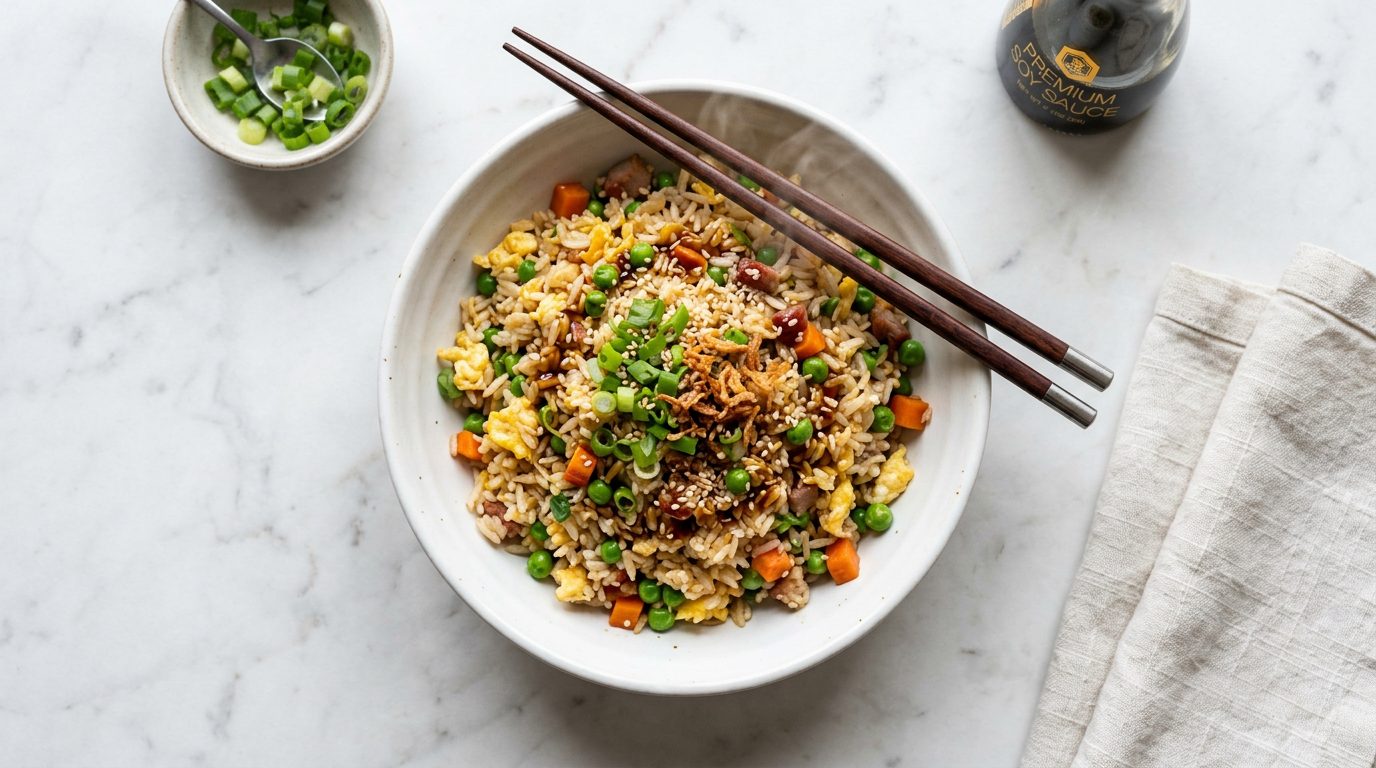
Why This Fried Rice Recipe Works Better Than Most
The Day-Old Rice Secret (And the Shortcut When You Have None)
Every experienced Chinese home cook will tell you the same thing: never make fried rice with freshly steamed rice. The reason is simple physics. Fresh rice holds water inside its starch granules. When those wet grains hit a screaming-hot wok, they do not fry — they steam each other, clumping into gummy masses that stick to your pan and turn mushy by the time they reach the table.
Day-old jasmine rice, refrigerated overnight, loses surface moisture and firms up. Each grain becomes its own individual unit, ready to pick up color and flavor from the wok without gluing itself to its neighbors. According to food science research from Serious Eats, surface dryness — not age per se — is the real factor at play. A night in the fridge achieves this naturally.
No day-old rice? Spread freshly cooked rice across a sheet pan in a single layer, fan it for 45–60 minutes at room temperature, then refrigerate for 30 more minutes. This mimics the drying effect of overnight storage and gives you workable grains in under 90 minutes. We have used this shortcut repeatedly in recipe testing and the results are nearly identical.
Wok Hei: The Smoky Flavor You Cannot Buy
Wok hei (鑊氣) translates literally as ”breath of the wok” — that faintly smoky, caramelised quality you taste in restaurant fried rice but can never quite reproduce at home. Professional wok burners output 100,000 BTU or more; a standard home stove produces roughly 7,000–12,000 BTU. That gap is real, and it matters.
What compensates at home is technique: a smaller batch size (never crowd the wok), maximum burner heat, and a preheated wok or heavy carbon-steel pan. We always preheat our wok for 90 seconds before adding oil. The moment oil shimmers and begins to smoke, that is your signal to add rice. Work fast, keep everything moving, and toss rather than stir.
You will not perfectly replicate a Cantonese restaurant kitchen — no home cook can. But with the right technique, you will get a fried rice with genuine depth and a slight smokiness that still beats anything sitting in a foam container under a heat lamp for twenty minutes.
Why Jasmine Rice Beats All Other Varieties Here
Not all rice is created equal for stir-frying. Short-grain varieties like sushi rice contain higher amylopectin starch, which makes them sticky by design — excellent for onigiri, poor for fried rice. Long-grain jasmine rice, grown predominantly in Thailand, has a lower starch-to-water ratio and dries to firmer, more distinct grains after refrigeration.
Thai jasmine rice also carries a floral aroma from its natural 2-acetyl-1-pyrroline compound — the same molecule found in pandan leaves and popcorn — that perfumes the whole dish as it fries. That background fragrance is one reason a great chao fan smells different from plain boiled rice even when no additional aromatics are present.
If jasmine rice is unavailable, long-grain white rice works. Avoid brown rice unless you specifically want a nuttier, denser result — it requires adjusting the cook time and does not take wok heat the same way. We tested basmati as a substitute and found the grains too dry and thin; they absorbed soy sauce unevenly and produced a flat result.
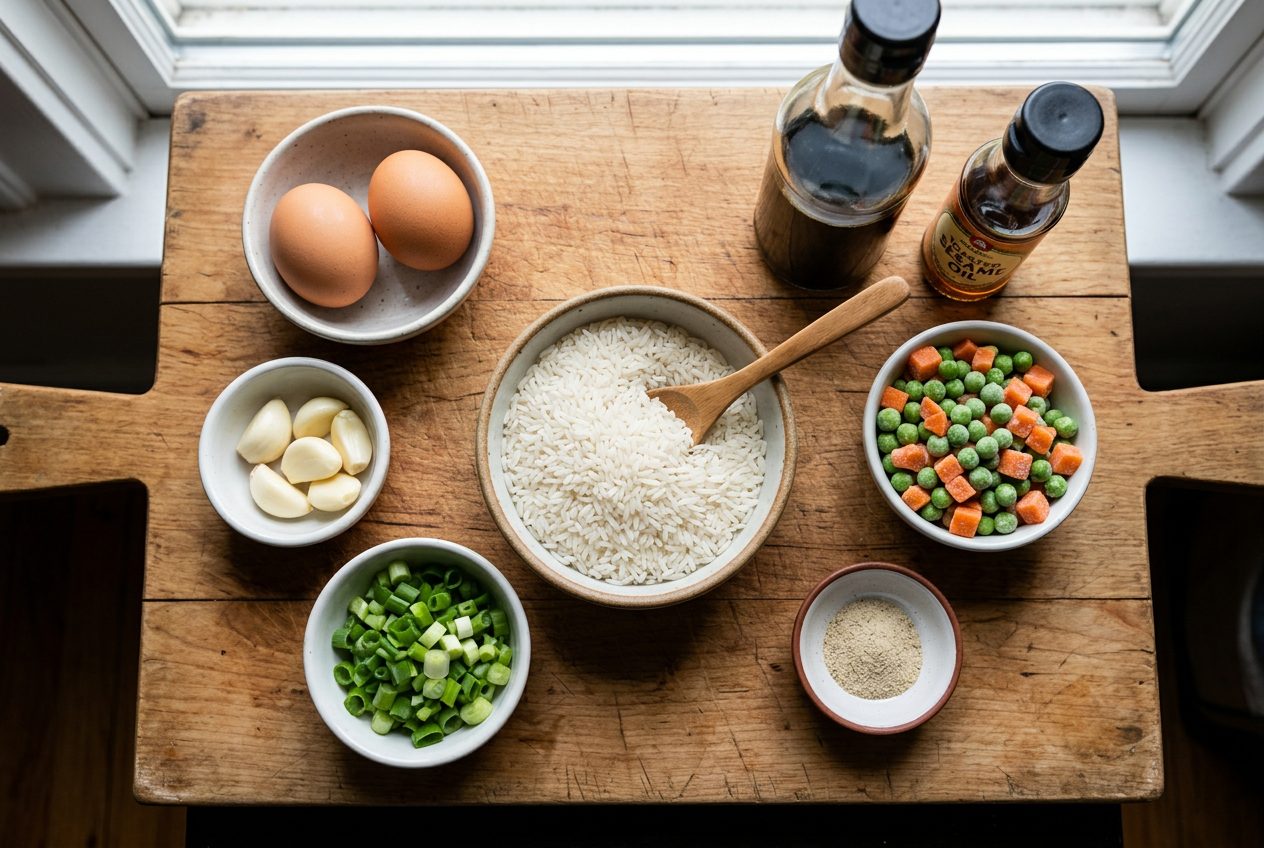
Ingredients for the Best Fried Rice
The Base: Rice and Eggs
These two ingredients form the backbone. For four servings, you need 4 cups of cooked and chilled jasmine rice — roughly 1.5 cups dry before cooking. The rice should be cold and separated, not in a solid clump from the container. Break it apart with your hands before it hits the wok; trying to break up cold clumps with a spatula after the fact only tears and mashes the grains.
Three large eggs give this recipe richness without overwhelming the rice. We scramble them lightly beaten with a pinch of white pepper and add them in the final 90 seconds of cooking — pulled off heat while they are still slightly underdone. Residual wok heat finishes them into soft, silky curds rather than the dry, bouncy eggs that plague fried rice made with pre-scrambled additions at the start.
Some cooks coat the rice grains in raw beaten egg before adding to the wok — a technique called ”gold and silver” (金包银) in Cantonese cooking — which creates a different, more coated texture. Both approaches are valid; we prefer the separate scramble method for clarity of flavor.
Aromatics: Garlic and Green Onions
Four minced garlic cloves go in first, right after the oil begins to smoke. They have about 30 seconds before they burn, so the rice must be ready to go in immediately after them. Burned garlic in fried rice is irreversible — it turns bitter and acrid and no amount of soy sauce will save the dish. Have everything prepped and within arm’s reach before you light the burner.
Green onions (scallions) play a dual role here. Half goes in with the garlic and vegetables for a cooked, mellow allium note. The other half gets scattered raw at the finish for a bright, sharp contrast. This split-application technique appears in virtually every serious Chinese fried rice preparation — we have seen it in restaurant kitchens from Taipei to the Cantonese roast shops of San Francisco’s Richmond District.
White onion diced fine can substitute for scallion greens in the cooked portion if that is what you have on hand. Red onion adds a slight sweetness that some cooks prefer in a more Western-influenced variation. In the original chao fan tradition, the scallion is standard; any substitution changes the aromatic profile, not the technique.
The Sauce Combination: Soy, Sesame, and White Pepper
Light soy sauce — not regular soy, not dark soy — delivers salt and umami without staining the rice an unappetizing muddy brown. We use 3 tablespoons for four servings, added directly to the rice in the wok rather than pre-mixed. This lets you adjust to taste as you go. If you have oyster sauce, one tablespoon stirred in alongside the soy sauce adds a rounded, slightly sweet depth that elevates the whole dish significantly.
Toasted sesame oil is added off heat, after the wok leaves the flame. It is a finishing oil, not a cooking oil — its delicate nutty flavor compounds degrade rapidly at frying temperatures. Half a teaspoon is enough to scent the entire dish. More than a teaspoon and it starts to taste perfumed rather than savory.
White pepper is the ingredient most home cooks omit but should not. It provides a warm, musky heat very different from the sharp bite of black pepper — earthier, more complex, with a faint floral note. A quarter teaspoon added to the finished rice (and another pinch to the eggs) is what gives this dish that slightly mysterious warmth you notice in good takeout fried rice but cannot always identify.
Easy Fried Rice Recipe — Step by Step
Full Ingredient List
| Ingredient | Amount | Notes |
|---|---|---|
| Day-old cooked jasmine rice | 4 cups | Cold, broken apart by hand |
| Large eggs | 3 | Lightly beaten with a pinch of white pepper |
| Vegetable oil (or neutral oil) | 3 tablespoons | Divided — 1 tbsp for eggs, 2 tbsp for rice |
| Garlic cloves, minced | 4 | Fresh; not jarred |
| Green onions (scallions) | 4 stalks | Sliced thin; white and green parts separated |
| Frozen peas and carrots | 1 cup | No need to thaw; straight from frozen |
| Light soy sauce | 3 tablespoons | Adjust to taste |
| Oyster sauce (optional) | 1 tablespoon | Highly recommended — adds umami depth |
| Toasted sesame oil | ½ teaspoon | Added off heat at the very end |
| White pepper | ¼ teaspoon | For rice; plus a pinch for eggs |
Instructions
Prep time: 10 minutes | Cook time: 15 minutes | Total: 25 minutes | Servings: 4
- Prep everything first. Have your cold rice broken apart, garlic minced, scallions sliced, eggs beaten, and soy sauce measured and within arm’s reach. Once the wok heats up, this dish moves fast — there is no time to pause and chop.
- Heat the wok. Place a wok or large carbon-steel skillet over your highest burner setting. Let it heat for 90 seconds until the surface begins to smoke slightly. Add 1 tablespoon of vegetable oil and swirl to coat.
- Scramble the eggs. Pour in the beaten eggs. Stir gently for about 60 seconds until just set but still slightly wet — do not fully cook through. Transfer to a plate and set aside.
- Cook the aromatics and vegetables. Add the remaining 2 tablespoons of oil. Add the white parts of the scallions and the garlic; stir constantly for 30 seconds. Immediately add the frozen peas and carrots. Stir-fry for 2 minutes until the vegetables are heated through and the garlic is golden but not brown.
- Add the rice. Add all the cold rice to the wok at once. Press it flat against the wok surface with a spatula, then let it sit undisturbed for 60 seconds to develop some color on the bottom. Toss and stir, then press again. Repeat this press-and-toss cycle for 3–4 minutes total.
- Season. Pour the light soy sauce and oyster sauce (if using) over the rice. Add the white pepper. Toss vigorously for 1 minute until the sauce coats every grain evenly.
- Return the eggs. Add the scrambled eggs back to the wok, breaking them into bite-size pieces as you toss them through the rice. Cook for 30 seconds.
- Finish and serve. Remove the wok from heat. Drizzle with toasted sesame oil and scatter the green parts of the scallions over the top. Toss once more and serve immediately in warm bowls.
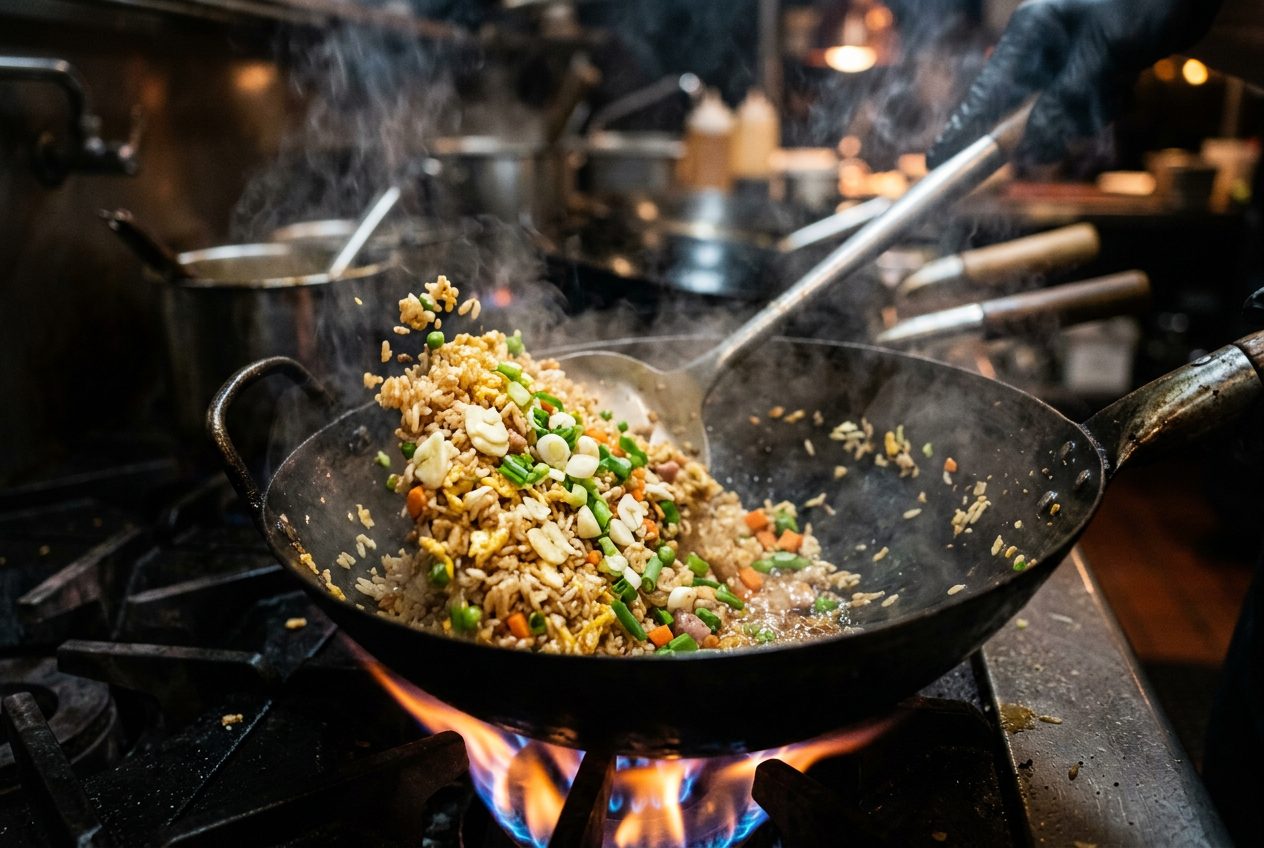
Pro Tips for Perfect Fried Rice Every Time
Managing Heat: The Single Most Important Variable
If there is one lesson to take from every Chinese cook who has ever made fried rice, it is this: high heat is not optional. The entire Maillard reaction that creates flavor — the browning of proteins and sugars under intense heat — only begins reliably above 300°F (149°C). A wok at maximum home burner output will hover around 500–600°F once properly preheated. A wok at medium heat produces steamed, gummy rice.
Cook in batches if your wok is smaller than 14 inches. Adding too much cold rice drops the pan temperature dramatically. A single layer of rice that re-heats in 3–4 minutes beats a packed wok that never regains heat and takes 10 minutes while turning to paste. Think of it the way a good sear works on a steak: crowding kills the crust.
If you do not own a wok, a 12-inch cast-iron skillet is the best substitute. Its mass holds heat well even when cold rice hits it. A stainless-steel pan works acceptably. Non-stick pans are the worst option — they cannot safely handle the temperatures needed and tend to develop hot spots that scorch rather than fry.
The Cold Rice Principle in Practice
We have made this recipe with rice straight from the fridge, rice left on the counter for two hours, freshly cooked rice spread on a pan, and even day-old rice that was then frozen. The refrigerated-overnight rice consistently outperformed the others in our tests — not by a dramatic margin, but noticeably in texture and in how well each grain accepted the soy sauce without going mushy.
The science behind this is straightforward. When cooked rice cools, the starch undergoes retrogradation — the gelatinized starch chains re-crystallize into a firmer structure. This firmed starch resists absorbing water during subsequent cooking, which is exactly what you want when those grains hit a wet, sauced, high-heat environment.
One practical note: if you cook rice in a rice cooker with the automatic warm function, the rice will be too warm and slightly sticky to use directly. Let it cool fully on a tray, then refrigerate uncovered for at least 2 hours before using. Covering it traps steam and keeps moisture in the grains — the opposite of what you want.
Variations: Chicken, Shrimp, Tofu, and Fully Vegetarian
This base recipe is deliberately protein-flexible. The technique does not change — only the protein changes and when you add it. Here is how we handle the four most common variations:
| Protein | Prep | When to Add | Cook Time in Wok |
|---|---|---|---|
| Chicken (diced breast or thigh) | Marinate 15 min in soy sauce + cornstarch | Before garlic; cook until golden | 4–5 minutes |
| Shrimp (medium, peeled) | Pat dry; season with white pepper | After garlic; cook until pink | 2–3 minutes |
| Firm tofu (diced) | Press dry; toss in cornstarch | Before garlic; fry until golden crust forms | 5–6 minutes |
| Egg only (fully vegetarian) | Beat 4 eggs instead of 3 | Standard scramble method | 60–90 seconds |
For chicken fried rice, thigh meat holds up better than breast under wok heat — it stays moist while breast meat can dry out in the 30-second gap between adding protein and adding rice. For shrimp fried rice, the wok cooking technique of adding aromatics first is even more important, because shrimp pick up garlic fragrance extremely quickly at high heat.
A fully vegetarian version with extra egg and a handful of diced firm tofu is, in our view, the most satisfying meatless fried rice you can make. The tofu absorbs the soy sauce and sesame oil beautifully, and its slightly firm texture provides a contrast to the rice that vegetables alone do not.
Storage, Reheating, and Meal Prep
How Long Does Fried Rice Keep?
Fried rice stores well in an airtight container in the refrigerator for up to 3 days. The flavor actually deepens slightly on day two as the soy sauce and sesame oil distribute more evenly through the rice. Beyond 3 days the texture starts to degrade — the grains dry out and the eggs turn rubbery when reheated.
For food safety: rice is one of the higher-risk foods for bacterial growth (specifically Bacillus cereus) if left at room temperature for more than 2 hours. The US FDA and the UK Food Standards Agency both recommend cooling cooked rice quickly — ideally spreading it out thin — and refrigerating within 1 hour of cooking. Never leave a pot of fried rice on the counter overnight.
Make-ahead note: you can cook the vegetables and aromatics ahead of time and refrigerate separately from the rice. When ready to serve, reheat the wok, add everything together, and finish with eggs and sauce in under 10 minutes. This is a practical strategy for weeknight meal prep that cuts active cooking time in half.
Can You Freeze Fried Rice?
Yes — fried rice freezes better than most people expect. Portion it into individual servings in freezer-safe bags, press flat to remove air, and freeze for up to 2 months. The flat shape allows faster, more even thawing. The egg-and-rice combination holds up reasonably well through the freeze-thaw cycle; the vegetables soften slightly but remain palatable.
To reheat from frozen: microwave on high in 90-second increments, stirring between each, until steaming throughout. Alternatively, reheat from frozen in a wok with a splash of water over medium-high heat — the steam loosens the grains and revives the texture far better than a microwave alone. Add a few drops of soy sauce and sesame oil at the end to restore seasoning that fades during freezing.
We would not recommend freezing a version that contains shrimp — the texture after thawing becomes rubbery and the flavor dull. Chicken, tofu, and egg-only versions freeze with noticeably better results. If you are making a large batch specifically for the freezer, leave the shrimp out and add fresh shrimp when reheating.
Best Ways to Reheat Without Ruining the Texture
The single worst way to reheat fried rice is on low heat in a covered pot. This traps steam, which returns moisture to the grains and undoes all the work the original wok session put into drying them out. Reheat in an open wok or skillet over high heat, moving constantly, for 2–3 minutes. A teaspoon of oil added to the pan before the rice goes in prevents sticking and restores some of the original crisp texture.
Microwave reheating works in a pinch. Cover loosely (not sealed) to prevent spattering while allowing some steam to escape. Two minutes on high for a single serving, stirring once at the midpoint. It will not have the wok-fried texture of the original, but it will be hot, seasoned, and fully acceptable for a weekday lunch.
One trick we use often: reheat in the wok and add one fresh egg toward the end. Crack it over the hot rice, stir quickly, and it refreshes the whole dish — new protein, a slightly richer texture, and the impression of something that was just cooked rather than leftover. A few drops of fresh sesame oil and a scatter of raw scallion greens complete the revival.
What to Serve with Fried Rice
Classic Chinese Pairings
In a traditional Chinese meal structure, fried rice functions as a starchy staple alongside shared dishes — it is never a standalone main in the way it tends to be framed in Western Chinese-American restaurants. At a Cantonese family table, chao fan would sit alongside a braised pork belly, a steamed fish with ginger and scallion, and a simple stir-fried green vegetable like leafy Chinese broccoli (gai lan).
For a weeknight meal built around this recipe, we find three accompaniments work particularly well: a quickly marinated cucumber salad dressed with rice vinegar and chili oil, a bowl of hot and sour soup, or simple steamed dumplings. Each adds a contrast — cool/acidic, warming/broth-based, or dense/chewy — that balances the richness of the rice without competing with its flavors.
Chili oil on the side is worth mentioning separately. A spoonful of good chili crisp stirred into a bowl of finished fried rice adds both heat and additional savory complexity from the fried garlic and shallots in the oil. It is one of the most popular customizations we encounter from readers who make this recipe repeatedly.
Western Adaptations That Work
Fried rice is one of the most adaptable dishes in any cooking tradition. The base technique — dried rice, high heat, soy sauce, sesame oil — accommodates almost any protein or vegetable you have on hand. This is why it originated historically as a way to use up leftover rice and yesterday’s proteins: it was never meant to be precious about its ingredients.
Some Western-influenced variations we have tested and enjoyed: diced kimchi added with the vegetables for a Korean-Chinese fusion take with real fermented depth; a handful of frozen edamame in place of peas for more protein and a slightly nuttier flavor; Portuguese-style chourico sausage sliced thin for a smoky, paprika-tinged version that is unusual but genuinely satisfying.
One line we do not cross: cheese. The idea of parmesan fried rice occasionally circulates on social media and we have seen the recipe. We have also tested it. The lactose in dairy curdles under wok heat and creates a greasy coating on the rice grains that obscures every other flavor. Stick with the sesame-soy-allium flavor axis and find your variations within that framework.
Sauces and Condiments to Serve Alongside
This recipe is seasoned to be eaten as-is, but condiment preferences vary widely. For heat, we offer sriracha and a small dish of fresh sliced chilies in soy sauce on the side — individual control matters when cooking for a group. For extra umami, a side dish of additional oyster sauce with a few drops of sesame oil for dipping fried items alongside the rice rounds out the meal.
Japanese-style kewpie mayonnaise, despite being a non-Chinese condiment, has become a widely accepted addition to fried rice across East and Southeast Asia. Its richness and acidity balance the saltiness of soy sauce. A squeeze of it over a hot bowl of this fried rice adds a creamy, tangy element that is undeniably good, even if purists will look away.
For a complete table condiment spread: chili oil, light soy sauce, rice vinegar, and sliced fresh chilies cover every direction — heat, salt, acid, and brightness — and let every person at the table season their own bowl. It costs almost nothing and transforms a weeknight fried rice into something that feels genuinely considered.
Frequently Asked Questions
Can you use fresh rice for fried rice?
Yes, but you need to dry it first. Spread freshly cooked rice on a rimmed sheet pan in a thin layer and let it cool at room temperature for 30–45 minutes, then refrigerate uncovered for another 30 minutes. This removes enough surface moisture to prevent the grains from steaming and clumping in the wok. The result is slightly less chewy than overnight rice but very workable. If you are in a real hurry, fan the rice aggressively for 20 minutes and proceed — the texture will be softer but the flavor will be the same.
What is the best rice for fried rice?
Thai jasmine rice is the standard choice in Chinese and Southeast Asian kitchens for good reason: its long, distinct grains dry to a firm texture after refrigeration, hold their shape under high wok heat, and carry a subtle floral aroma that enhances the finished dish. Long-grain white rice is a solid substitute. Basmati works in a pinch but dries out unevenly. Avoid short-grain varieties like Japanese sushi rice or Korean rice — their high starch content causes clumping that no amount of technique can fully overcome.
What is the secret to restaurant-quality fried rice?
Three things working together: cold, dry rice (so grains fry rather than steam); maximum heat (to drive the Maillard reaction and achieve some wok hei); and restraint with the sauce (soy sauce should season the rice, not pool in the bottom of the wok). Most home cooks fail on at least two of these. Get all three right and the gap between home and restaurant narrows considerably. The right cooking vessel — a 14-inch carbon-steel wok — makes all three easier to achieve.
Can you freeze fried rice?
Yes. Portion into individual freezer bags, press flat, and freeze for up to 2 months. Egg-and-vegetable or chicken versions freeze well; shrimp versions do not — the shrimp texture degrades noticeably after thawing. Reheat from frozen in a hot wok with a splash of water and a few drops of fresh soy sauce and sesame oil, or microwave in 90-second increments until steaming throughout. The texture will not be identical to fresh, but it reheats to a fully satisfying result.
What gives Chinese fried rice its flavor?
The flavor of authentic Chinese fried rice comes from three intersecting sources: wok hei (the faint smokiness from high-heat cooking), the combination of light soy sauce and oyster sauce (salt plus umami plus sweetness), and the aromatics — garlic and scallion — that bloom in hot oil before the rice is added. White pepper adds an earthy warmth that is distinct from black pepper and very much part of the traditional flavor profile. Toasted sesame oil, added off heat, provides a nutty finish that ties all the other elements together.
Is fried rice healthy?
This recipe as written provides a reasonable balance of carbohydrates, protein, and fat per serving — approximately 380–420 calories for a 1.5-cup portion, depending on whether you add protein. The sodium content from soy sauce is the main nutritional consideration, at around 900–1,100mg per serving. You can reduce this by switching to low-sodium soy sauce and halving the quantity, using the oyster sauce as your primary seasoning instead. The vegetables (peas, carrots, scallions) add fiber and micronutrients. As a complete meal with added protein, it is nutritionally solid and far less processed than packaged or restaurant versions.