Last updated: March 13, 2026
Tea smoking is one of the oldest and most distinctive cooking techniques in Chinese cuisine, a method that perfumes meat, poultry, fish, eggs, and even tofu with a layered aroma that no marinade or sauce can replicate. The technique — known in Mandarin as zhangcha (樟茶) when camphor and tea leaves are combined, or simply xun (熏) when the focus is on smoke — lives at the intersection of seasoning, preserving, and finishing. Done well, it produces food with a glossy mahogany skin, a quietly bitter top note from tannins, a sweet base from sugar that has caramelized inside the wok, and a clean, woodsy depth from tea that lingers without overpowering the protein itself.
This guide walks through everything a home cook needs to tea smoke confidently: the history and regional variations of the technique, the equipment and aromatic blends that make it work, a complete step-by-step process, a troubleshooting table of common mistakes, three full recipe templates (duck, chicken, eggs), advanced finishing tricks borrowed from professional Sichuan and Cantonese kitchens, and answers to the questions that always come up the first time someone fills a wok with smoke and closes the lid.
What Is Tea Smoking? A Quick Overview of the Technique
Tea smoking is a hot-smoking method that uses a tight-lidded vessel — traditionally a wok, today often a wok, Dutch oven, or stovetop smoker — lined with foil and packed with a smoldering mixture of dry tea leaves, raw rice, and sugar. The food sits on a rack above the smoking material. Once the mixture begins to smoke, the lid goes on and the food is bathed in an enclosed aromatic atmosphere for anywhere from five minutes (for delicate fish) to forty minutes (for a whole duck).
Crucially, tea smoking is almost never the only step in a recipe. It is a flavor stage, not a cooking method in the way that braising or roasting are. Most classic preparations follow a three-step rhythm: cure (salt, spices, and aromatics), steam or poach to cook the protein fully, and then smoke to finish with color, scent, and lacquer. A final pass in hot oil or a quick high-temperature roast often follows to crisp the skin.
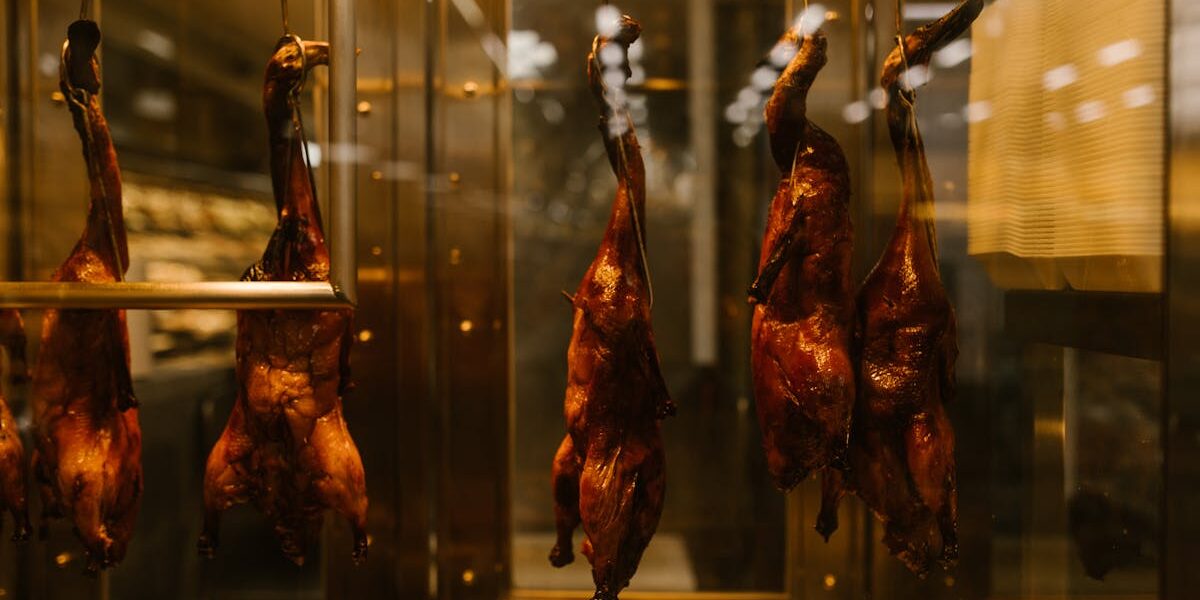
The most famous dish in the canon is Sichuan camphor-tea-smoked duck (zhangcha ya), a banquet centerpiece from Chengdu that is brined, steamed, smoked over camphor wood and jasmine tea, and finally deep-fried for shattering skin. But the technique is far broader than one dish. Cantonese kitchens smoke whole chickens and pomfret. Hunanese cooks smoke pork belly into the famous la rou. Beijing-style smoked eggs are a banquet appetizer. Taiwanese tea eggs are not technically smoked, but the visual and aromatic family resemblance is unmistakable, and modern Taiwanese chefs have revived smoke as a finishing tool for everything from squab to tofu skin.
A Brief History: From Imperial Sichuan to the Modern Kitchen
Smoke as a preservation technique is ancient across China — the cured pork of Hunan, the smoked fish of Anhui, and the air-dried duck of Nanjing all share roots in a pre-refrigeration past where smoke meant survival through winter. Tea smoking specifically, however, is a later refinement. Tea cultivation became widespread in Sichuan and the Yangtze basin during the Tang dynasty (618-907 CE), and once tea was plentiful, cooks began folding it into the smoking process not for preservation but for aroma. The earliest written references to tea-smoked duck appear in Qing dynasty cookbooks from the Chengdu region, where camphor-wood-burning braziers were already standard equipment for finishing roasted meats.
By the late nineteenth century, zhangcha ya had become a signature dish of formal Sichuan banquets, served alongside other showpiece preparations like dry-fried green beans and twice-cooked pork. The dish migrated with Sichuan cooks during the twentieth century, first to Chongqing and Beijing, then to Hong Kong and Taipei, and finally to Chinese restaurants worldwide. Today, tea smoking has been adopted enthusiastically by chefs working outside the Chinese tradition entirely: contemporary American, Nordic, and Australian kitchens use the technique on salmon, scallops, butter, and even ice cream bases.
Why Tea? The Science of What Smoke Actually Does
Smoke is not a single substance. It is an aerosol of hundreds of compounds — phenols, carbonyls, organic acids, and fine particulates — produced when plant material is heated to the point of incomplete combustion. The composition of that aerosol depends entirely on what is burning. Hardwoods like hickory and oak release strong, savory phenols dominated by guaiacol and syringol; fruitwoods like apple and cherry yield gentler, sweeter notes; herbs and spices contribute volatile aromatics. Tea leaves, because they are partially fermented and rich in polyphenols, produce smoke that is uniquely floral and slightly tannic, with a faint bitterness that balances the sweetness of caramelized sugar.
The classic Chinese smoking blend — tea, rice, sugar — is engineered to deliver three flavor layers at once. The rice provides bulk fuel and a clean, neutral background smoke. The sugar caramelizes rather than burns, releasing a sweet, almost molasses-like vapor that coats the food and produces the signature mahogany color. The tea is the perfume. Black tea (red tea in Chinese terminology) gives the deepest, most rounded aroma; oolong is more floral; green tea is grassy and sharp; pu-erh is earthy and slightly funky. Many cooks add citrus peel, star anise, cinnamon, bay leaves, or Sichuan peppercorn to the mix, but the rice-sugar-tea ratio is the workhorse.
Crucially, the smoke does not cook the food in any meaningful way at the temperatures involved — it deposits flavor and color on the surface. This is why pre-cooking is essential for any protein thicker than a fillet: smoke sits on the outside, while the inside reaches temperature through steam, poaching, or roasting. Treating tea smoking as a finishing technique rather than a primary cooking method is the single most important conceptual shift for cooks coming from a Western barbecue background.
Equipment: What You Need (and What You Don’t)
Tea smoking is famously low-tech. A cook with a wok, a tight-fitting lid, and a roll of heavy-duty aluminum foil already owns ninety percent of the kit. The remaining ten percent is a steaming rack tall enough to lift the food clear of the smoking material at the bottom. Here is the full setup, with notes on substitutions.
- A carbon-steel wok is the traditional vessel because it tolerates high direct heat and its sloping sides funnel smoke around the food. A 14-inch flat-bottomed wok is the most practical size for a home stove. If you don’t own one, see our guide on the best woks for home cooking. A heavy cast-iron Dutch oven or a deep stockpot will also work; the trade-off is slightly less even smoke distribution.
- A tight lid matters more than the vessel. Any smoke that escapes is flavor lost and an odor problem for your kitchen. If your lid is loose, a wrap of foil along the rim creates a workable seal.
- Heavy-duty aluminum foil lines the inside of the wok in two overlapping sheets, with extra hanging over the rim to fold over the smoking material once you remove the food. This single step does more to keep your wok seasoned and your stove clean than any other. If you have a beloved well-seasoned wok, foil also protects the patina from sugar burn.
- A round steaming rack — metal, bamboo, or even three balls of crumpled foil — raises the food at least two inches above the smoking material so the protein never makes direct contact with the smoldering mix.
- A powerful vent hood or open window. Tea smoking is genuinely smoky for the first two to three minutes. Plan ahead.
- A digital thermometer is useful for confirming the internal temperature of larger proteins like whole birds, since the smoke can mask doneness cues you might rely on visually.
One piece of equipment you do not need is a dedicated smoker. Outdoor pellet smokers, kettle grills, and bullet smokers all run too cool and too long for the technique — tea burns out fast at low temperatures and produces acrid smoke instead of the aromatic burst you’re after. Tea smoking is a hot, fast technique. The whole indoor session lasts five to fifteen minutes for most foods.
The Classic Tea Smoking Blend (and Variations)
The base ratio that nearly every Chinese cookbook recommends is straightforward: equal parts uncooked long-grain rice, brown or white sugar, and loose-leaf tea, with optional aromatics added by feel. For a single duck or chicken, that translates to roughly ½ cup of each. For eggs or fish, ¼ cup of each is plenty.
| Blend | Tea | Aromatics | Best for |
|---|---|---|---|
| Classic Sichuan | Black tea (Keemun or Lapsang Souchong) | Camphor leaves (or bay), Sichuan peppercorn, star anise | Duck, pork belly, beef shank |
| Cantonese light | Oolong (Tieguanyin or Da Hong Pao) | Dried tangerine peel, cinnamon stick | Chicken, pomfret, squab |
| Hunan smoky | Pu-erh or Lapsang Souchong | Bay leaves, fennel seed, dried chili | Pork belly, sausage, tofu |
| Floral | Jasmine green tea | Orange peel, white peppercorn | Eggs, scallops, salmon, butter |
| Sweet earthy | Earl Grey or Lapsang | Brown sugar (doubled), cinnamon, clove | Pork shoulder, lamb, ice cream base |
Avoid herbal infusions and very fine matcha-style powders — they burn fast, give off acrid smoke, and clump rather than smolder. Loose-leaf tea is mandatory; the contents of a tea bag will smoke but produces less aroma per gram. If you can only find bagged tea, slit the bags open and use the leaves directly. Tea quality matters less than freshness; an old bag of Lapsang Souchong from the back of the pantry is a perfect candidate to use up, since the smoke will mask any staleness.
Step-by-Step: How to Tea Smoke at Home
The following sequence works for any protein from eggs up to a four-pound bird. Time and temperature scale with thickness; the underlying choreography is the same.
- Cure or season the food. Most recipes call for a dry rub of salt, sugar, and aromatic spice (typically Sichuan peppercorn, star anise, and ginger) rubbed onto the protein and rested for at least four hours, ideally overnight, in the refrigerator. For eggs, peel hard-boiled eggs and brine them in soy sauce, dark soy, and aromatics. For fish, a thirty-minute salt cure is plenty.
- Pre-cook to nearly done. For poultry and pork, steam over high heat until the internal temperature reaches 160°F / 70°C — about 45 minutes for a whole chicken, 60 minutes for a duck, 90 minutes for pork belly. For fish, poach in court bouillon. For eggs, the hard-boil is the cook step. Pat the surface completely dry before smoking. Any surface moisture will dilute the smoke deposit and produce a streaky, dull finish instead of the lacquered mahogany you want.
- Prepare the wok. Line the inside of a wok with two overlapping sheets of heavy-duty foil, leaving four to five inches of foil hanging over the rim on all sides. Mound the smoking mixture in the center of the foil. Place a round metal steaming rack on top, at least two inches above the mixture.
- Pre-heat over high heat. With the lid off, set the wok over high heat until the mixture begins to smoke actively — usually two to four minutes. You will see thin wisps first, then a steady column. Do not skip this step. Starting with cold smoking material under a closed lid gives you a long, smoldering smoke that turns bitter.
- Add the food and seal. Quickly place the dry, pre-cooked food on the rack. Cover with the lid. Fold the overhanging foil up and over the rim to seal any gaps. Reduce heat to medium.
- Smoke. The active smoking window depends on the food: eggs and thin fish fillets, five minutes; chicken parts or thick fish, eight to ten minutes; whole chicken, twelve to fifteen minutes; whole duck or pork belly, fifteen to twenty minutes. Resist the urge to lift the lid. Each peek vents flavor and color.
- Turn off heat and rest. Cut the heat and let the wok sit covered for another five to ten minutes — the residual smoke continues to deposit color and aroma while the temperature drops.
- Optional finish. Whole birds and pork belly benefit from a final crisp: a quick deep fry at 375°F / 190°C for two to three minutes, or a 475°F / 245°C oven for ten to twelve minutes. This is the step that produces the shattering, glassy skin that defines banquet-style zhangcha duck.
- Carve and serve. Tea-smoked food is best served warm, not piping hot — the aromatic notes are easier to perceive when the protein has cooled slightly. Cut against the grain for whole birds; halve eggs lengthwise; flake fish gently.
Common Mistakes and How to Fix Them
| Mistake | What happens | Fix |
|---|---|---|
| Wet food going into the smoker | Dull, streaky, gray-brown color instead of glossy mahogany; soggy texture | Pat fully dry, then air-dry uncovered in the fridge for 30-60 minutes before smoking |
| Lid not sealed | Kitchen fills with smoke; weak flavor; uneven color | Use foil overhang folded over the rim, or weight the lid with a heavy can |
| Smoking material starts cold | Long smolder produces acrid, bitter, ashtray-like notes | Always pre-heat the wok until active smoke appears before adding food |
| Skipping pre-cook | Outside is dark, inside raw; smoke can’t cook through | Steam, poach, or roast to nearly done before smoking |
| Using too much sugar | Smoking material catches fire instead of smoldering; sticky, burnt taste | Stick to equal parts rice, sugar, tea; reduce sugar in humid kitchens |
| Tea bags only, contents inside | Smoke is weak and short-lived; bags can ignite | Cut open bags; use loose leaves directly on the foil |
| Over-smoking | Bitter, ashy aftertaste; food smells like a campfire | Time your sessions; for most foods 8-15 minutes is plenty |
| Reusing the foil mixture | Charred residue gives off acrid smoke on round two | Bundle and discard after each session; line fresh |
| No vent or open window | Smoke alarms; lingering smell in the house for days | Run the hood on high before pre-heating; crack a window |
| Skipping the final crisp on whole birds | Skin is soft and rubbery despite great color | Finish in hot oil or a hot oven for shatter-crisp texture |
Practice Exercises to Build Your Smoking Skills
Tea smoking rewards repetition more than reading. The variables — tea blend, smoke time, food thickness, lid seal — only become intuitive once you have run them a few times in your own kitchen, on your own stove, with your own equipment. The following progression takes a cook from beginner to confident in three weekend sessions.
- Exercise 1: Smoked hard-boiled eggs. Peel six hard-boiled eggs, brine them for one hour in ¼ cup soy sauce, 2 tablespoons dark soy, 1 tablespoon sugar, a star anise, and a splash of Shaoxing wine. Pat dry. Smoke for five minutes over a basic black-tea-and-rice blend. Compare results: too pale? Smoke another two minutes next time. Too bitter? Reduce sugar in the brine and shorten the smoke. Eggs are cheap, fast, and respond visibly to small changes, which makes them the perfect calibration vehicle.
- Exercise 2: Smoked chicken thighs. Rub four bone-in, skin-on chicken thighs with 2 teaspoons salt, 1 teaspoon sugar, ½ teaspoon ground Sichuan peppercorn, and rest overnight. Steam 25 minutes, pat dry, smoke 10 minutes. This is the workhorse exercise — thighs are forgiving of overshoots in either direction and the skin gives you immediate feedback on color development.
- Exercise 3: Tea-smoked salmon. A two-pound side, salt-cured for 30 minutes, patted dry, then smoked over a jasmine-tea blend for six to eight minutes. The cure firms the flesh and the smoke perfumes without overpowering. Slice thin and serve at room temperature on rice with a squeeze of citrus. This exercise teaches restraint — with delicate proteins, less is always more.
Keep notes after each session: time, tea, aromatics, lid seal, weather (humid days behave differently from dry ones), and your subjective rating. Within five or six sessions, you will have built a personal cheat sheet for the foods and aromatics you cook most often.
Recipe 1: Sichuan Tea-Smoked Duck (Zhangcha Ya)
This is the dish that built the technique’s reputation. The full traditional version uses camphor wood, which is hard to find outside of specialty importers; bay leaves and an extra spoon of black tea fill the same aromatic role at home with no compromise on flavor.
- For the cure: One 4-5 lb whole duck, 2 tablespoons kosher salt, 1 tablespoon sugar, 1 tablespoon Sichuan peppercorn (toasted and ground), 2 star anise (crushed), 1-inch piece ginger (sliced), 4 scallions (smashed), 2 tablespoons Shaoxing wine.
- For the smoke: ½ cup uncooked long-grain rice, ½ cup brown sugar, ½ cup loose black tea (Keemun or Lapsang Souchong), 4 bay leaves, 1 tablespoon Sichuan peppercorn, 2 star anise.
- For the finish: Neutral oil for deep-frying (about 6 cups), or hot oven at 475°F / 245°C.
- Rinse the duck and pat dry. Rub inside and out with the cure mixture, stuff the cavity with the ginger and scallions, splash with Shaoxing wine, and refrigerate uncovered on a rack for 12-24 hours. This is the single most important step for flavor depth and skin texture; the long air-dry is what allows the skin to crisp later.
- Rinse off the cure, pat dry, and steam the duck over high heat for one hour. A wok with a steaming rack works perfectly. The duck should be cooked through but not falling apart. Lift out carefully, drain the cavity, and pat the skin completely dry.
- Line a wok with two layers of heavy-duty foil, mound the smoking mixture in the center, and set a rack two inches above. Pre-heat over high heat with the lid off until smoke billows actively, three to four minutes.
- Lay the duck breast-up on the rack, cover, fold the foil overhang to seal, reduce heat to medium, and smoke for 15 minutes. Turn off the heat and let sit, covered, for another 10 minutes.
- Heat oil in a clean wok to 375°F / 190°C. Lower the duck in (a wire spider helps) and fry until the skin is deep mahogany and crackling, two to three minutes per side. Alternatively, roast in a 475°F / 245°C oven for 12-15 minutes.
- Rest 10 minutes. Carve and serve with steamed mantou buns, hoisin sauce, and shredded scallion — or, in the most traditional service, with thin pancakes and a sweet bean paste.
Recipe 2: Cantonese Tea-Smoked Chicken
Lighter than the Sichuan version, this Cantonese-style preparation uses oolong tea and dried tangerine peel for a floral, citrusy smoke that suits chicken better than the heavier black-tea blend. Often served at room temperature as part of a cold-cut platter.
- For the cure: One 3-4 lb whole chicken, 1½ tablespoons kosher salt, 2 teaspoons sugar, 1 teaspoon white pepper, 1-inch piece ginger (sliced), 3 scallions (smashed), 1 tablespoon Shaoxing wine.
- For the smoke: ½ cup uncooked rice, ½ cup brown sugar, ½ cup loose oolong tea, 2 strips dried tangerine peel, 1 small cinnamon stick.
- Rub the chicken inside and out with the cure ingredients, stuff with ginger and scallion, splash with Shaoxing wine, and refrigerate uncovered for 8-12 hours.
- Steam for 40-45 minutes until an instant-read thermometer reads 165°F / 74°C in the thickest part of the thigh. Cool to lukewarm on a rack and pat completely dry.
- Set up the wok as above and pre-heat the smoking mixture until actively smoking.
- Place the chicken on the rack, seal, and smoke for 12 minutes over medium heat. Turn off, rest 8 minutes covered.
- Brush the skin lightly with sesame oil, then either serve directly (skin will be tender) or finish in a 450°F / 230°C oven for 8-10 minutes for crisp skin.
- Chop through the bone Cantonese-style into bite-sized pieces and serve with ginger-scallion oil and steamed jasmine rice.
Recipe 3: Tea-Smoked Eggs
The fastest, cheapest, most reliable way to get hooked on tea smoking. Smoked eggs are excellent on rice porridge, in a bowl of ramen, sliced over salads, or as a stand-alone snack with cold beer. They keep for a week in the refrigerator and travel well.
- For the brine: 6-8 large eggs, ¼ cup light soy sauce, 2 tablespoons dark soy, 1 tablespoon sugar, 1 cup water, 1 star anise, 1 small cinnamon stick, 1 piece of dried tangerine peel, 1 black tea bag (or 1 tablespoon loose).
- For the smoke: ¼ cup uncooked rice, ¼ cup brown sugar, ¼ cup loose black tea, optional pinch of Sichuan peppercorn.
- Hard-boil the eggs for nine minutes, shock in ice water, and peel carefully.
- Bring the brine ingredients to a simmer, then cool to room temperature. Add the eggs and refrigerate at least four hours, ideally overnight. The longer the brine, the deeper the color and savor.
- Remove eggs, pat dry, and air-dry on a rack for 20 minutes.
- Set up the wok with foil and smoking mixture, pre-heat to active smoke.
- Arrange eggs on the rack, seal, smoke over medium for five to six minutes. Turn off heat, rest five minutes covered.
- Slice in half lengthwise to reveal the yolk and serve over rice porridge with a swirl of homemade chili oil and a sprinkle of scallions.
Pairings and Service: How to Build a Meal Around Smoked Food
Tea-smoked dishes are intensely flavored at the surface and comparatively quiet at the center. That asymmetry shapes how they should be plated and what should share the table with them. The most successful pairings provide either a contrasting texture, a palate-cleansing acidity, or a starchy, neutral landing pad that lets the smoke shine.
- Starches. Plain jasmine rice is the default; choosing the right rice variety matters more than people think. Steamed mantou buns are the traditional partner for smoked duck. Soft, fresh wheat-flour pancakes — the same kind used for Peking duck — turn a smoked bird into an interactive course.
- Pickled vegetables. A small dish of quick pickles — cucumber, daikon, or carrot dressed with rice vinegar and a pinch of sugar — resets the palate between bites. The bright acid cuts through the lingering smoke.
- Greens. Stir-fried gai lan, choy sum, or pea shoots with garlic provide a vegetal counterpoint that the heavy smoke benefits from. See our guide to mastering the stir-fry for technique.
- Soup. A clear, gentle soup — winter melon and pork rib, or a simple egg-drop — works better than a strongly seasoned one. The soup’s job is to refresh, not compete.
- Sauces. Tea-smoked food rarely needs a sauce, but a small bowl of hoisin sauce for duck, or a Sichuan-style chili dipping sauce for chicken, gives diners an option without forcing it.
- Drinks. A light oolong or a green tea served alongside reinforces the aromatic theme. For wine, a low-tannin red — pinot noir or gamay — pairs beautifully with smoked duck.
Advanced Tips from Professional Kitchens
Once the basic technique is reliable, several refinements separate competent home cooks from the kind of tea-smoked food served in serious Sichuan restaurants. Most cost nothing extra; they are matters of timing, sequencing, and attention.
- Double-smoke for depth. For whole birds, run two short smoke sessions of eight minutes each, with a five-minute rest in between, instead of one long session. The intermediate rest lets the surface cool slightly, which allows the second round of smoke to deposit on top of the first rather than pushing it aside. The result is a more layered, complex aroma.
- Brush with maltose syrup before the final crisp. A thin coat of maltose-and-vinegar wash — the same finish used on Cantonese roast duck — gives the skin a glassy, lacquered shine after the deep fry. One tablespoon of maltose dissolved in a tablespoon of hot water with a teaspoon of rice vinegar is enough for a whole bird.
- Reverse-sear small proteins. For scallops and shrimp, smoke them raw for three to four minutes, then sear in a screaming-hot pan with a touch of oil. The smoke perfumes the interior while the sear builds the crust.
- Use smoked butter as a finishing fat. Smoke a stick of butter on a piece of parchment for five minutes (the parchment prevents melting into the foil). The resulting smoked butter is a stealth finishing weapon on noodles, vegetables, popcorn, and seafood.
- Cold-rest before slicing. Whole smoked birds slice more cleanly if they rest fully covered at room temperature for 20-30 minutes after the final crisp. The skin firms slightly and the juices redistribute. This is especially important for tea-smoked duck destined for thin-pancake service.
- Pair the tea to the protein. A simple heuristic: black tea for red meat and duck; oolong for chicken and pork; green or jasmine for fish, shellfish, and dairy. Within those families, fine-tune by aromatic — Lapsang Souchong leans into smoky-meaty pairings, while Da Hong Pao’s mineral-floral notes flatter scallops and butter.
- Smoke things you wouldn’t think to smoke. Cream, salt, sugar, ice cream base, mayonnaise, and even cocktail rims can take a five-minute tea smoke. Treat smoke as a seasoning that goes into other dishes rather than as a destination in itself.
Tea Smoking in Other Asian Cuisines
While Sichuan owns the most famous tea-smoking dish, the technique appears in adapted forms across East and Southeast Asia. Recognizing these variations builds intuition for how the method scales and where its boundaries lie.
- Hunan smoked pork (la rou). A traditional dry-cured, cold-smoked product hung over a kitchen hearth burning pine needles, citrus peel, and tea twigs for weeks at a time. The home tea-smoking technique is a fast approximation: cure the pork belly heavily, steam, then tea-smoke for 30 minutes, and the result is a passable weeknight version of a process that historically took two months.
- Cantonese smoked fish. Pomfret, sea bass, or yellow croaker are quick-cured, steamed briefly, and finished with a five-minute oolong-and-tangerine-peel smoke. Often served cold as part of a cold platter at banquets.
- Taiwanese smoked goose. A specialty of the Yunlin region, brined in fennel-spiced broth, then smoked over sugar, tea, and rice in a clay pot. The Taiwanese style leans heavier on sugar than Sichuan, producing a more candy-like crust.
- Japanese ibushi-gakko. Though usually associated with smoked-and-pickled daikon from Akita, the Japanese smoking tradition rarely uses tea — oak and cherry are preferred. Tea smoking proper is not classical Japanese, but modern Tokyo chefs have absorbed the Chinese technique enthusiastically, especially for cocktail-focused yakitori-style kitchens.
- Modern global adaptations. Australian, Scandinavian, and American chefs use tea smoking on quail, salmon, butter, and even chocolate ganache. Treating the technique as a universal tool rather than as a Chinese-only method is consistent with the way it has always traveled.
Storage, Make-Ahead, and Leftovers
Tea-smoked foods keep remarkably well, thanks to the combination of pre-cure (salt), pre-cook (heat), and surface smoke (antimicrobial phenols). They are excellent make-ahead dishes for entertaining.
- Whole birds. Smoke and rest, but skip the final crisp until just before service. Refrigerate the smoked bird wrapped loosely in parchment (plastic wrap traps moisture and softens the skin) for up to three days. Bring to room temperature, then deep-fry or oven-crisp to finish.
- Eggs. Keep in their brine in the refrigerator for up to one week. Pat dry before smoking again if a stronger smoke flavor is desired on day three or four.
- Fish. Best within 24 hours of smoking. Refrigerate covered. Serve cold or briefly warmed; never microwave, which destroys the surface aroma.
- Pork belly and other red meats. Vacuum-seal and refrigerate for up to a week, or freeze for up to three months. Reheat gently in a covered skillet with a splash of water and a final hot-pan sear.
- Smoking residue. Bundle the foil immediately after smoking, while still hot, and discard outdoors if possible — the smell lingers in indoor trash for hours. Never reuse the smoking mixture; the second burn is invariably acrid.
Frequently Asked Questions
Will tea smoking set off my smoke alarm?
Sometimes, especially if you don’t pre-run the vent hood or your kitchen is small. The first two minutes of pre-heating produce the most smoke; once the lid is on and sealed, smoke leakage drops dramatically. Run the hood on high before starting, crack a window, and consider temporarily moving (not disabling) any battery-powered smoke detector in an adjacent room.
Can I tea smoke without a wok?
Yes. A heavy cast-iron Dutch oven with a tight lid works well; so does a deep stainless stockpot lined with foil. The wok’s advantage is that its sloping sides funnel smoke around the food more evenly, but the technique works in any sealed vessel that fits a rack two inches above smoldering material.
Is tea smoking the same as cold smoking?
No. Cold smoking happens below 85°F / 30°C and is used to flavor cured products without cooking them. Tea smoking is hot smoking — the wok runs at 250-400°F / 120-200°C — but for short enough periods that the smoke is primarily a flavoring step, with cooking done before or after in a separate process.
What tea works best if I only have one kind?
Black tea — any reasonable-quality loose-leaf black tea or even broken-leaf supermarket black tea — is the most versatile. It pairs with everything from eggs to duck and produces a clean, balanced smoke with good color. Lapsang Souchong, which is itself smoke-dried over pine, gives the most assertive flavor and is a great gateway choice for cooks who want unmistakable smokiness.
Can I tea smoke vegetables or tofu?
Absolutely. Pressed firm tofu, drained well and patted dry, takes a beautiful smoke in five to seven minutes — especially after a brief soy-and-Shaoxing brine. Mushrooms, cauliflower florets, and even halved cabbages can be steamed first and then briefly smoked. For more on tofu prep, see our guide on crispy tofu.
Does the smoke add carcinogens?
Any combustion produces small amounts of polycyclic aromatic hydrocarbons (PAHs). The short smoking times used in this technique, plus the fact that the food is held above (not in contact with) the smoldering material, keep PAH levels low compared to long, hot wood smoking or open-flame grilling with dripping fat. For occasional home cooking, the exposure is comparable to or lower than that from a typical barbecue meal.
My smoke turned bitter. What went wrong?
Three likely culprits: smoking material started cold (long smolder = acrid), too much sugar (caught fire and burned), or smoke time was too long for the protein. The fix is in the troubleshooting table above — pre-heat to active smoke, stick to the 1:1:1 rice-sugar-tea ratio, and time your sessions.
How do I clean my wok afterward?
If you lined with foil properly, the wok itself should be untouched — just discard the foil bundle and wipe the interior with a paper towel. If sugar burned through onto the metal, soak with hot water and a small amount of baking soda, then wipe and re-season with a thin layer of neutral oil over medium heat. Avoid abrasive scrubbing on a carbon-steel wok.
Can I scale up for a dinner party?
The wok comfortably handles one whole duck or two chickens at a time. For larger crowds, smoke in batches; the technique is fast enough (15-20 minutes per session) that running two or three rounds back to back is realistic. Hold finished birds warm in a low oven (170°F / 75°C) until ready to crisp and serve.
What’s the difference between tea smoking and Chinese red braising?
Different goals, different methods. Red braising is a wet-cooking technique using soy sauce, sugar, and aromatics to cook food slowly in liquid; tea smoking is a dry finishing technique using aromatic smoke to flavor already-cooked food. The two often appear in the same meal — red-braised pork belly alongside tea-smoked eggs is a classic Sichuan-Hunan combination — but they sit at opposite ends of the wet-dry spectrum.
Final Thoughts: Why Tea Smoking Belongs in Every Asian Cook’s Repertoire
Tea smoking sits in a sweet spot most home techniques never reach: low equipment cost, short execution time, dramatic visual results, and a flavor profile that genuinely cannot be reproduced by any other method. A bag of tea, a cup of rice, a cup of sugar, and a few feet of foil are enough to transform an ordinary hard-boiled egg into a banquet appetizer in fifteen minutes. The same setup, scaled up, produces a duck worthy of a Chengdu wine-house menu. And once the rhythm of cure, cook, smoke, crisp is in the body — once it stops feeling like a recipe and starts feeling like a default move — the technique opens up to ingredients and flavor combinations Chinese tradition never imagined: smoked butter for pasta, smoked sugar for cocktails, smoked oil for everything.
The barrier to most cooks is psychological, not practical. Smoke inside a kitchen feels like a fire hazard, and the first run is genuinely smoky for two or three minutes. But the technique has been a household method in Sichuan and Hunan for centuries, in apartments far smaller and less ventilated than the average modern kitchen. Pre-heat the hood, crack a window, line the wok well, and the rest is just timing. After three or four sessions, the worry vanishes and what remains is one of the most rewarding techniques in the entire Chinese repertoire — a method that delivers banquet-quality flavor with almost no effort, almost no equipment, and almost no time.
Start with the eggs. They cost a dollar, take twenty minutes start to finish, and convert skeptics on the first bite. From there, the whole world of Chinese tea-smoking — and everything cooks worldwide have built on top of it — is open.

Mei Lin Chen
Mei Lin Chen is an Asian food writer and recipe developer. Melbourne-raised and London-based, she has spent over a decade exploring the rice paddies, hawker stalls, and home kitchens of South-East and East Asia. Her recipes balance traditional technique with everyday practicality.