Last updated: March 07, 2026
Kerala food is the cuisine of India’s southwestern coast, a 360-mile stretch of palm-fringed backwaters, monsoon-soaked spice gardens, and Arabian Sea fisheries that have been feeding traders, sailors, and pilgrims for more than two thousand years. If you have ever tasted a coconut-rich fish curry, a feather-light steamed rice cake, or a banana leaf piled with twenty different vegetable preparations, you have brushed against Kerala cuisine. The state grows nearly all of India’s black pepper, the spice that drew Roman, Arab, Chinese, Portuguese, Dutch, and British merchants to its harbors and rewrote global trade. That long history of contact is on every plate: Hindu vegetarian temple food sits beside Syrian Christian beef stews, Mappila Muslim biryanis, Jewish Cochin pastels, and Konkani prawn curries. Kerala food is, in short, the most layered regional cuisine in India and one of the most coconut-, curry-leaf-, and seafood-driven cooking traditions on earth.
This guide walks through everything a curious cook needs to understand Kerala cuisine: its three culinary regions, the spice-trade history that shaped it, the pantry of coconut, curry leaves, and tamarind that anchors every recipe, ten-plus must-try dishes from puttu to karimeen pollichathu, the techniques that define it (tempering, slow-coconut-milk reduction, banana-leaf steaming), how Kerala compares to neighboring South Indian cuisines, and a practical meal-planning section so you can build a Kerala-style dinner at home. Whether you are planning a trip to Kochi, building a Sadya for Onam, or just trying to recreate the appam your favorite restaurant makes, this is your starting point. For broader context on the subcontinent, see our complete guide to Indian cuisine.
What Is Kerala Food? A Coastal South Indian Cuisine Defined by Coconut and Spice
Kerala cuisine is the regional cooking of Kerala state, a narrow ribbon of land squeezed between the Western Ghats mountains and the Arabian Sea. The state grows along a vertical spice belt: cardamom and pepper in the highland plantations of Idukki and Wayanad, rice and coconut in the midland laterite plains, and seafood from the lagoon-and-canal network of the coastal backwaters. Three distinct geographies, three distinct culinary registers, all unified by four ingredients that appear in nearly every Kerala recipe: coconut, curry leaves, mustard seeds, and red chilies.
Unlike the wheat-and-dairy cooking of North India, Kerala food is built on rice and coconut. Coconut shows up in four forms in a single meal — fresh grated, milk pressed from the meat, oil rendered from copra, and dried slivers toasted as a garnish. Curry leaves are not optional flavor: they are the aromatic backbone, sizzled in hot oil at the start of nearly every dish. Black pepper, ginger, turmeric, mustard seed, and dried red chili are the spice quartet, with cardamom and clove appearing more often in Muslim-influenced cooking. The cuisine is by turns sour (from tamarind, kokum, and the smoked black mango called kudampuli), creamy (from thickened coconut milk), and pungent (from raw mustard oil and freshly cracked pepper).
The other defining feature: Kerala is one of the few Indian states with a deep meat-eating tradition alongside an equally deep vegetarian one. Hindu Nair and Namboodiri Brahmin households built the elaborate vegetarian Sadya feast, while Syrian Christians (whose roots in Kerala go back to the first century CE) cook beef, duck, and pork. Mappila Muslims along the Malabar coast brought biryanis, pathiris, and ghee-rich sweets from their centuries of Arab trade. The result is one of the few cuisines in the world where a temple offering of unsalted coconut-and-jaggery payasam shares a kitchen tradition with a Portuguese-influenced vinegar pork vindaloo cousin.
A Brief History of Kerala Cuisine: Two Thousand Years of Spice Trade
Kerala’s culinary history is inseparable from black pepper. By the first century BCE, Roman ships were sailing into the port of Muziris (modern-day Kodungallur) to load pepper, cardamom, and ginger; Pliny the Elder complained that Roman gold was bleeding east into India to pay for it. Tamil Sangam-era poetry from the same period describes feasts of rice, fish, ghee, and toddy on the Malabar coast. By the seventh century, Arab merchants had established permanent settlements, intermarrying with locals and creating the Mappila Muslim community whose descendants still cook the world’s best biryani-style ghee rice.
The Syrian Christian community traces itself to the apostle Thomas, who legend says landed at Muziris in 52 CE. Whatever the historical truth, Kerala had a thriving Eastern Christian community a millennium before any European reached India. When Vasco da Gama landed at Kappad beach in 1498, he found pepper, cinnamon, and a Christianity older than Catholicism. The Portuguese brought chilies, cashews, pineapples, and tapioca from the Americas — ingredients so fundamental to modern Kerala food that it is hard to imagine the cuisine without them. Tapioca (kappa) became the staple starch of the working class; the chili replaced black pepper as the primary heat source in everyday cooking.
The Dutch displaced the Portuguese in the 1600s, the British took over in the late 1700s, and each occupation left culinary traces — from Anglo-Indian railway curry to Cochin Jewish pastels (savory pastries) to the British-introduced tea estates of Munnar. Modern Kerala cuisine is the slow accumulation of all of these layers, now refined by Gulf migration in the 1970s and 80s, which sent millions of Keralites to work in Dubai and Saudi Arabia and brought home Arab-influenced kuzhi mandi rice and shawarma street food.
The Three Culinary Regions of Kerala: Malabar, Travancore, and Kochi
Kerala is not a single culinary region but three overlapping ones. Each has its own staples, signature dishes, and dominant religious-cultural influence. Understanding these distinctions is the difference between ordering at a generic ”South Indian” restaurant and knowing what to look for at a Thalassery beef-fry stall versus a Kottayam toddy shop.
Malabar (Northern Kerala)
Stretching from Kasaragod down through Kannur, Kozhikode (Calicut), and Malappuram, the Malabar coast is the heartland of Mappila Muslim cuisine. This is where you find the legendary thalassery biryani — a fragrant, short-grained kaima rice (also called jeerakasala) layered with chicken or mutton, fried onions, ghee, and a restrained spice blend that is closer to Yemeni mandi than to Hyderabadi biryani. Other Malabar specialties include pathiri (a delicate rice flatbread), kallummakkaya nirachathu (mussels stuffed with spiced rice), erachi pathil (meat-stuffed rice cakes), and a vast repertoire of ghee-soaked sweets like ari pathiri and kalathappam. Coconut oil is used liberally; pepper and fennel dominate the spice blends; bananas and jackfruit appear in savory dishes more often than in the south.
Travancore (Southern Kerala)
Travancore covers Thiruvananthapuram (the state capital), Kollam, Pathanamthitta, and parts of Alappuzha and Kottayam. It is the heartland of Hindu Nair and Brahmin vegetarian cooking, and the birthplace of the Sadya — the 26-dish banana-leaf vegetarian feast served at weddings and the Onam festival. Travancore food leans sweeter, milder, and more vegetable-focused than the rest of Kerala. Signature dishes include avial (a thick, coconut-and-yogurt mixed vegetable curry), olan (white pumpkin and cowpeas in thin coconut milk), erissery (pumpkin and red beans), and an array of payasam (sweet milk puddings) that close every Sadya. Inland Kottayam is the unofficial capital of Syrian Christian cooking, where dishes like kappa-meen curry (tapioca with red fish curry), beef ularthiyathu, and duck mappas live.
Central Kerala (Kochi and the Backwaters)
The central region around Kochi (Cochin), Ernakulam, and Thrissur is the cosmopolitan crossroads — historically the meeting point of Jewish, Konkani, Goud Saraswat, Anglo-Indian, and Portuguese-Catholic cooking. The waterway-laced backwaters of Alappuzha and Kumarakom produce karimeen (pearl spot fish), a freshwater fish at the heart of the iconic karimeen pollichathu — fish marinated in red chili and turmeric, wrapped in a banana leaf, and pan-roasted until the leaf chars and perfumes the flesh. This is also the home of toddy shops (kallu shaap), informal taverns where the fermented coconut palm sap is drunk alongside spicy beef, duck, and snail dishes.
Essential Kerala Pantry: Ingredients Table
| Ingredient | Malayalam Name | Role in Kerala Cooking | Where to Use It |
|---|---|---|---|
| Coconut (fresh, milk, oil) | Thenga / Velichenna | Primary fat, thickener, and flavor base | Curries, stews, chutneys, sweets, frying medium |
| Curry leaves | Kariveppila | Aromatic tempering herb | Sizzled in oil at the start or finish of nearly every dish |
| Black mustard seeds | Kaduku | Tempering spice for nutty pungency | Tadka for curries, dals, and pickles |
| Dried red chilies | Unakka mulaku | Heat and color | Tempering, ground masalas, fish curry |
| Black pepper | Kurumulaku | Native to Kerala, the original heat source | Pepper-fry meats, kashayams, fish recipes |
| Turmeric | Manjal | Color, earthy bitterness, antimicrobial | Marinades for fish and meat, curries |
| Tamarind | Puli | Sour element for sambar and meen curry | Sambar, meen vevichathu, rasam |
| Kudampuli (Malabar tamarind) | Kudampuli | Smoked sour fruit specific to Kerala fish curry | Meen vevichathu, fish stews |
| Cardamom | Elakkai | Floral aromatic, grown in Kerala highlands | Biryani, payasam, masala chai |
| Cumin and fennel | Jeerakam / Perumjeerakam | Warming spice for masalas | Biryani, kashayam tea, meat curries |
| Coriander seeds | Mallika | Body and citrus undertone in masalas | Roasted ground masala for fish and chicken curry |
| Asafoetida (hing) | Kaayam | Sulfurous-onion flavor, vegetarian alternative | Sambar, dal, tempered vegetables |
| Fenugreek seeds | Uluva | Bitter, maple-like depth in fish curry | Meen vevichathu, sambar, pickle masala |
| Shallots | Cheriya ulli | Sweeter, more concentrated than yellow onion | Sambar, meat curry, theeyal |
| Tapioca | Kappa | Starchy staple introduced by Portuguese | Kappa biriyani, kappa-meen curry, snacks |
| Jaggery | Sharkara | Unrefined cane sugar with caramel flavor | Payasam, sweet pachadi, ada pradhaman |
| Banana leaves | Vazha ila | Steaming wrapper, serving plate | Sadya, pollichathu, ela ada |
| Ghee | Neyyu | Clarified butter for rich dishes | Biryani, payasam, drizzled on rice |
Two of those ingredients deserve closer attention. Coconut milk is so central that no Kerala cook would mistake the canned product for the real thing — fresh thick first-press milk goes into the final stage of a stew, while watery second-press milk simmers vegetables. Our deep dive on coconut milk in Asian cooking covers the difference. Curry leaves are non-negotiable too; you cannot substitute bay leaf or cilantro. See the complete guide to curry leaves for sourcing and storage.
10+ Must-Try Kerala Dishes
1. Appam with Stew (Vellappam and Ishtu)
Appam is a fermented rice-and-coconut pancake with a thick, spongy center and lacy, crisp edges, cooked in a small wok-shaped pan called an appachatti. The batter is fermented overnight with toddy or yeast and a dash of cooked rice; the resulting bowl-shaped bread is the perfect vehicle for ishtu — a Syrian Christian ”stew” of chicken, mutton, or vegetables simmered in a delicate first-press coconut milk gravy seasoned only with whole pepper, cardamom, clove, ginger, and curry leaves. There is no chili, no turmeric, no fried onion. The whole dish is white, fragrant, and quietly extraordinary, traditionally eaten on Christmas morning.
2. Puttu and Kadala Curry
Puttu is steamed rice-and-coconut log, made by layering coarse roasted rice flour and grated coconut in a cylindrical bamboo or metal mold called a puttu kutti and steaming it. It looks like white pillars with snow on top. The classic accompaniment is kadala curry — black chickpeas in a roasted coconut and shallot gravy darkened with toasted coriander and red chili. Together they are the working breakfast of Kerala, served in tea shops, lunch homes, and on every train platform from Kasaragod to Kanyakumari.
3. Sadya: The Onam Banana-Leaf Feast
The Sadya is not a dish but an architectural arrangement: a banana leaf laid lengthwise in front of each diner, with up to 28 separate vegetarian preparations placed in a precise order. Pickles and pappadam at the top, dry vegetables and pachadis on one side, curries on another, rice in the center, ghee poured over, and a series of three or four payasams to close. Core dishes include avial (mixed vegetables in coconut-yogurt), olan (ash gourd in thin coconut milk), thoran (vegetables stir-fried with grated coconut), erissery, sambar, rasam, kalan, kichadi, and pulissery. Eaten with the right hand. Eaten in silence at first, then with mounting joy. Sadya is the most refined vegetarian feast in India and the centerpiece of the Onam harvest festival.
4. Kerala Fish Curry (Meen Vevichathu / Kottayam-Style)
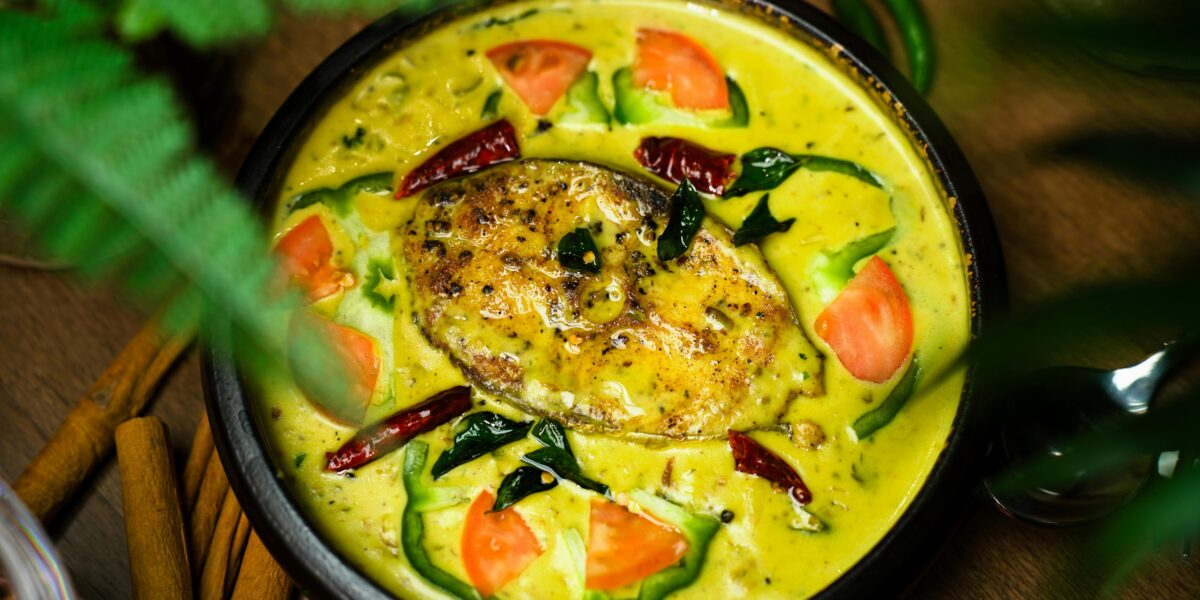
The most photographed dish in Kerala food: a brick-red fish curry, cooked in an earthen claypot (manchatti), with kingfish or sardines or seer fish suspended in a thin gravy of roasted coriander, fenugreek, kashmiri red chili, and the dark, smoky kudampuli that gives the curry its sharp, brooding sour edge. There is no coconut milk in true Kottayam-style meen curry — only the souring fruit, chili, ginger, garlic, shallot, and curry leaves. The curry is always cooked the day before; the flavor matures overnight, and Keralites insist it is better on day two and best on day three.
5. Karimeen Pollichathu
Pearl spot fish, scored on both sides, marinated in red chili, turmeric, garlic, ginger, and lime, then wrapped in a banana leaf and cooked on a tawa until the leaf blackens and perfumes the flesh. This is the signature dish of the Kerala backwaters, served on every houseboat between Alappuzha and Kumarakom. The banana leaf imparts a subtle grassy, smoked aroma you cannot replicate any other way.
6. Beef Ularthiyathu (Kerala Beef Fry)
Slowly braised beef cubes, cooked with coconut slivers, black pepper, fennel, curry leaves, and shallots until the gravy reduces and clings to the meat in a glossy, dark, spice-encrusted layer. This is Syrian Christian and Mappila comfort food — eaten with parotta (a flaky, multi-layered flatbread of Tamil Muslim origin that dominates Malabar street food) or with kappa (mashed tapioca). Few cuisines treat beef as carefully as Kerala’s; the slow rendering of fat into the spice paste is closer to a Cantonese red-braise than to a North Indian curry.
7. Thalassery Biryani
The Mappila Muslim biryani of northern Kerala, distinguished from Hyderabadi or Lucknowi versions by three things: the use of short-grained kaima/jeerakasala rice instead of basmati, a restrained spice blend (no garam masala, no saffron), and a ”dum” finish where the partially cooked rice and the chicken or mutton masala are layered, sealed, and finished over coals on top of a flat lid. The result is fragrant rather than fiery, with a distinct sweetness from caramelized onions and a generous quantity of ghee. If you’ve only had Hyderabadi biryani, see our chicken biryani recipe for the dum technique that the Thalassery version refines.
8. Avial
The vegetarian centerpiece of any Sadya: a thick, almost-dry mixed vegetable preparation made with raw banana, drumstick, yam, ash gourd, snake gourd, carrot, and beans, bound with a coarse paste of coconut, cumin, and green chili, and finished with raw coconut oil and curry leaves. The trick is the vegetables remain distinct, just barely cooked, and the dish is brightened with sour curd or raw mango. Avial is one of the few dishes shared across all three of Kerala’s regions and across every religious tradition.
9. Kappa (Tapioca) and Meen Curry
Boiled tapioca, mashed with grated coconut, turmeric, green chili, and curry leaves, served alongside a fiery red sardine curry. This is the iconic toddy shop combination — a working-class meal that became a mark of authentic central Kerala identity. The starchy, gentle tapioca cools the burn of the curry; the coconut bridges them. Eat with your right hand, ideally on a banana leaf, ideally with a glass of slightly fermented kallu (palm wine).
10. Idiyappam (String Hoppers) with Egg Curry
Idiyappam is a steamed rice noodle nest, made by extruding a soft rice flour dough through a sevanazhi press onto a small banana leaf disk and steaming it. The result is a delicate, almost ethereal tangle of rice strings. The classic pairing is egg roast or egg curry — hard-boiled eggs simmered in a coconut milk and shallot gravy. It is also delicious for breakfast with a sprinkle of grated coconut and a drizzle of sweetened coconut milk.
11. Parippu Curry and Pradhaman
Parippu is a simple dish of split mung dal cooked with turmeric, then finished with a tempering of mustard seed, dried red chili, garlic, and curry leaves in pure coconut oil. It is the first course poured over rice at every Sadya, with a spoonful of ghee. The closing course is pradhaman — a payasam (sweet pudding) made from jaggery, coconut milk, and a starch (rice ada, broken wheat, mung dal, or jackfruit pulp). Palada pradhaman, made with thin rice ada flakes, is the most refined; chakka pradhaman, made with reduced jackfruit, is the most prized.
12. Pazham Pori (Banana Fritters)
Tea-shop staple: ripe, fragrant nendran bananas (a stubby Kerala plantain) sliced lengthwise, dipped in a turmeric-and-rice-flour batter, and deep-fried in coconut oil until the outside is crisp and dark and the inside is meltingly sweet. Eaten at four in the afternoon with a glass of strong, milky chai. Cousins include parippu vada (savory lentil fritter), uzhunnu vada (urad dal donut), and bonda (deep-fried potato dumpling).
Essential Kerala Cooking Techniques
Tempering (Thaalichathu / Tadka)
Tempering is the percussion of Kerala cooking. A small ladle of coconut oil is heated until it shimmers, then mustard seeds are dropped in; when they pop, dried red chili, curry leaves, and sometimes shallots and asafoetida follow, and the whole sizzling oil is poured over the finished curry, dal, or yogurt-based pachadi. The technique is identical in concept to Indian tadka — see our complete guide to spice tempering — but Kerala’s exclusive use of unrefined coconut oil instead of ghee or mustard oil gives it a distinct flavor. Tempering is sometimes done at the start of a dish (to bloom the spices into the gravy) and sometimes at the very end (to perfume the surface).
Coconut Milk Layering
The defining technique of Kerala curries: coconut is grated and pressed three separate times. The first press, with minimal water, yields thick ”first milk” (onnam paal) — rich, sweet, and unstable. The second press yields medium milk; the third yields a thin, watery liquid. A proper Kerala stew or molagootal cooks vegetables or meat in the thinnest milk first, simmering until tender; the thicker milk is added near the end on low heat (high heat will split it into curd and oil); the first-press milk is added at the very end, sometimes off the heat. This layered cooking is what makes a Kerala stew silky rather than soupy.
Roasting Coconut for Theeyal
For a small group of dishes — most famously theeyal (a tamarind-based shallot or vegetable curry) and varutharacha curries — fresh coconut is dry-toasted in a heavy pan with whole spices until it is the color of dark chocolate. The toasted mixture is ground to a paste with water and forms the base of the curry. The result is deep, smoky, and almost meaty in flavor, very different from the bright white coconut gravies of stew or aviyal.
Banana Leaf Cooking and Serving
Banana leaves are used three ways in Kerala: as a steamer wrapper (ela ada, pollichathu), as a serving plate (Sadya, lunch homes), and as a final flavor agent (a leaf is laid over a finished biryani pot before sealing). The leaf imparts a faint, grassy, almost vanilla note to anything cooked inside it, and the wrapping seals in moisture more efficiently than aluminum foil. Real banana leaves can be ordered frozen from Indian and Southeast Asian grocers; rinse and pass briefly over an open flame to make them pliable before wrapping.
Steaming in Bamboo and Metal Molds
Several iconic Kerala breakfast items — puttu, idiyappam, ela ada — are not boiled or fried but steamed in custom molds. Puttu uses a cylindrical bamboo or aluminum tube placed over a kettle of boiling water; idiyappam uses a hand press onto small banana leaf disks. The technique is closer to Chinese dim sum steaming than to North Indian roti-making, and reflects Kerala’s centuries of contact with maritime Asia. For broader steaming methodology, our complete guide to bamboo steaming covers the underlying principles.
Slow Meat Roasting (Ularthiyathu)
Ularthiyathu is a dry-fry technique where meat is cooked in a small amount of water until tender, then the lid is removed and the cooking continues until all liquid evaporates and the spice paste fries onto the surface of the meat. Coconut slivers added at this stage caramelize. The technique works for beef, chicken, duck, and pork, and it is what gives Kerala ”fries” their dry, intense, almost-charred crust without any actual deep-frying.
Kerala vs. Other South Indian Cuisines: Comparison Table
| Cuisine | Primary Fat | Staple Starch | Souring Agent | Iconic Dish | Religious-Cultural Lean |
|---|---|---|---|---|---|
| Kerala | Coconut oil | Rice, tapioca, rice noodles | Kudampuli, tamarind, raw mango | Meen curry, appam-stew, Sadya | Hindu, Syrian Christian, Mappila Muslim balance |
| Tamil Nadu | Sesame oil, ghee | Rice (idli, dosa) | Tamarind | Idli-sambar, dosa, Chettinad chicken | Strong Hindu vegetarian, Chettiar non-veg tradition |
| Karnataka (Udupi) | Coconut oil, ghee | Rice, ragi | Tamarind, kokum | Bisi bele bath, Mangalorean fish curry | Hindu (Saraswat Brahmin), Mangalore Catholic |
| Andhra Pradesh | Sesame oil, peanut oil | Rice | Tamarind | Gongura mutton, Andhra biryani, pulihora | Hindu majority, intensely spicy profile |
| Telangana / Hyderabadi | Ghee, neutral oil | Long-grain basmati rice | Tomato, tamarind | Hyderabadi biryani, haleem, mirchi ka salan | Indo-Persian Muslim courtly cuisine |
The biggest single distinction: Kerala uses coconut as a fat, a thickener, AND a flavor; most other South Indian cuisines use coconut more sparingly, often as a garnish or in select dishes. Tamil and Andhra cuisines lean on tamarind and dal; Kerala leans on coconut milk and the regional kudampuli. And while every South Indian cuisine has a vegetarian tradition, only Kerala has a co-equal Christian and Muslim non-vegetarian tradition with the institutional depth to rival the Hindu vegetarian one.
Building a Kerala Meal at Home: Planning and Pairings
A Kerala home meal almost always centers on a starch and is balanced across four flavor categories: a wet curry, a dry vegetable, something fried or crisp, and something sour or pickled. Below are three menu templates, scaling from a weeknight dinner to a small celebratory meal.
Weeknight Kerala Dinner (3 dishes, 60 minutes)
- Starch: Steamed Kerala matta rice (parboiled red rice) or basmati. See our guide to rice for Asian cooking.
- Wet curry: Meen vevichathu (Kerala fish curry) using kingfish or salmon
- Vegetable: Cabbage thoran — finely shredded cabbage stir-fried with mustard seed tempering, grated coconut, green chili, and curry leaves
- Side: Pappadam (lentil wafers) and a small bowl of mango pickle
Weekend Kerala Brunch
- Bread: Appam (made with fermented batter — start the night before)
- Curry: Chicken stew (ishtu) with potatoes, carrots, ginger, and first-press coconut milk
- Side: Coconut chutney with green chili and ginger
- Drink: Sulaimani — a clear lemon-cardamom tea typical of Malabar
Sadya-Inspired Vegetarian Feast (8 dishes)
- Plain rice, served on banana leaf
- Parippu (mung dal with ghee)
- Sambar (toor dal with vegetables and tamarind)
- Avial (mixed vegetables with coconut)
- Beans thoran (green beans with coconut)
- Pulissery (cucumber-yogurt curry)
- Pappadam and banana chips
- Palada pradhaman (rice flake payasam) for dessert
Drinks to Pair
Kerala’s signature beverages are coconut water (straight from the green nut), sambharam (a salted, gingered buttermilk), nannari sherbet (sarsaparilla syrup), and kashayam — an Ayurvedic decoction of dried ginger, pepper, tulsi, and coriander seed. For alcoholic pairings, kallu (palm toddy) is the traditional match for fish and beef but is hard to find outside Kerala; off-dry rieslings and gewurztraminers stand up to coconut-rich curries surprisingly well.
Where to Buy Kerala Ingredients in the US
Most Indian grocery stores carry the Kerala essentials, though the specifically Malabari items can be harder to find. Here is a sourcing checklist:
- Coconut oil: Look for unrefined, virgin, cold-pressed — Parachute Gold and KLF Nirmal are authentic Kerala brands. Avoid refined ”cooking” coconut oil.
- Curry leaves: Buy fresh from Indian groceries; freeze on the stem in a zip-top bag. Dried leaves lose 90% of their aroma. See our curry leaves guide.
- Kudampuli: Sold dried in small black slabs, often labeled ”Malabar tamarind” or Garcinia cambogia. Soak before use.
- Matta rice: Parboiled red rice with a nutty bite, available as ”Kerala matta” or ”Palakkadan matta.”
- Kaima/jeerakasala rice: The short-grain biryani rice; ”Kaima” is the brand name to look for.
- Banana leaves: Frozen, in 1-pound packs, at most Indian and Southeast Asian groceries.
- Tapioca (kappa): Frozen cubed cassava is the easiest format; thaw and boil.
- Jaggery: Buy unrefined dark ”achu” jaggery from Kerala if possible — softer and more aromatic than the harder North Indian variety.
Kerala Festivals and the Foods That Anchor Them
Kerala’s festival calendar is built around food, and understanding the festivals helps explain why certain dishes exist. Onam, the ten-day August-September harvest festival celebrating the mythical King Mahabali, centers on the Sadya. Vishu, the Malayali New Year in mid-April, opens with a kanji (rice porridge) breakfast and a Vishu kanji feast at lunch. Christmas brings appam-stew and plum cake to Syrian Christian homes. Eid al-Fitr in Mappila households means biryani, ney pathiri (ghee rice flatbreads), and irachi puttu (meat-stuffed steamed rice cakes). Easter centers on duck mappas and kozhikatta (sweet rice dumplings filled with coconut and jaggery). Each of these dishes carries the culinary signature of its community: the Hindu Sadya is dairy-rich, the Christian feast is meat-and-coconut-milk-heavy, the Mappila feast leans on ghee, dried fruit, and warming spice.
Health, Ayurveda, and Kerala Food
Kerala is the global home of Ayurveda — the traditional Indian system of medicine that classifies foods by their effect on the three doshas (vata, pitta, kapha). Many everyday Kerala dishes have Ayurvedic logic baked into them. Avial pairs cooling vegetables with warming coconut and cumin; the ginger-pepper kashayam drunk with a meal supports digestion; turmeric in fish marinades is an antimicrobial that also aids absorption of iron. Coconut oil, recently demonized then rehabilitated by Western nutrition science, has been the dominant Kerala fat for two thousand years. The traditional Kerala diet is naturally low in dairy (coconut takes the role of cream), high in fiber (vegetables, lentils, parboiled rice), and rich in fermented foods (idli, dosa, appam batter, pickles, buttermilk). It maps closely to the modern Mediterranean-and-fiber-rich diet pattern that nutritionists increasingly recommend.
Frequently Asked Questions About Kerala Food
Is Kerala food spicy?
Less than Andhra or Tamil Chettinad cooking, but more than North Indian Mughlai cuisine. Kerala’s heat comes from black pepper as much as from chili — a more aromatic, slow-building heat. Many Kerala dishes (stew, avial, olan, payasam) have no chili at all. Fish curries and beef fries are the spicy outliers; everyday vegetarian fare is moderate.
Is Kerala food gluten-free?
Most of it, yes. The traditional starches are rice (in countless forms), tapioca, and lentils. Wheat shows up only in parotta, chapati, and a few Mappila Muslim breads. A celiac visitor can safely order virtually anything off a Kerala lunch menu — appam, puttu, idiyappam, dosa, idli, and Sadya are all rice-based.
Is Kerala food vegetarian or non-vegetarian?
Both, equally. Roughly 55% of Keralites are Hindu, 26% Muslim, and 18% Christian, and the cuisine reflects all three. The Hindu (especially Brahmin) tradition is rigorously vegetarian; Christian and Muslim food culture is heavily meat- and seafood-centric. Most Kerala restaurants and home menus include both, side by side.
What is the difference between Kerala food and South Indian food?
”South Indian food” in restaurant English usually means Tamil-style idli, dosa, and sambar. Kerala food is one of the four South Indian regional cuisines (alongside Tamil, Karnataka, and Andhra) and is distinguished by its much heavier coconut use, its kudampuli souring, its Christian and Muslim subtraditions, and its breakfast vocabulary of appam, puttu, and idiyappam — none of which are Tamil staples.
Can I substitute regular tamarind for kudampuli?
You can, but the result is not a Kerala fish curry — it is a generic tamarind fish curry. Kudampuli has a smoky, almost-leathery sourness from being smoked over a wood fire as it dries. If you cannot find it, the second-best substitute is regular tamarind plus a tiny pinch of smoked paprika. The fish curry will still be good; it just will not be Kottayam.
What is the difference between appam, dosa, and idli?
All three are fermented rice batters but with different consistencies and cooking methods. Idli is steamed (thick puffy disks). Dosa is poured thin onto a hot tawa and crisped (crepe-like). Appam is poured into a small wok and rotated to coat the sides — it has a thick spongy center and lacy crisp edges, and the batter includes coconut milk and sometimes toddy.
Why does Kerala food use so much coconut?
Geography and ecology. Kerala’s name itself derives from ”kera” (coconut tree) and ”alam” (land); the state is one giant coconut grove. Every household has access to coconuts, coconut oil is shelf-stable in tropical heat, and grated fresh coconut adds richness without dairy in a region where cattle are less central than they are in North India. Two thousand years of culinary practice has refined coconut into a fat, a thickener, a flavor base, and a garnish — sometimes all four within a single dish.
What is a typical Kerala breakfast?
Hot breakfast is non-negotiable in Kerala, and the rotation includes puttu and kadala curry, appam and stew, idiyappam and egg curry, idli and chutney, dosa and sambar, and pathiri (rice flatbread) and chicken curry in Malabar. All of these are eaten with a glass of strong, sweet, milky tea or, on the Christian side, sometimes with coffee.
Is Kerala food healthy?
The traditional diet is one of the healthier eating patterns in India: high vegetable and lentil content, fiber-rich parboiled rice, fish as the primary protein, fermented batters that aid digestion, no refined sugar in everyday cooking (jaggery instead), and coconut oil as the primary fat. Modern restaurant versions often use more oil and salt than home cooking does. Sadya feast dishes are the lightest expression of Kerala cuisine; Mappila biryanis and ghee-laden Christmas breads are the richest.
Where is the best place to eat Kerala food?
In Kerala itself: Kayees Rahmathulla (Kochi) for biryani, Paragon (Kozhikode) for Malabari seafood, Dhe Puttu (Kochi) for breakfast, and any toddy shop in Alappuzha for kappa-meen. In the US, look for Kerala-specific restaurants in New York’s Floral Park, Houston, the Chicago suburbs, and Edison NJ — most ”South Indian” restaurants in the US are Tamil or Andhra. Real Kerala food still requires a specialist.
Final Thoughts: Why Kerala Cuisine Deserves a Permanent Place in Your Kitchen
Kerala food rewards patience and a small but specific pantry. Once you have coconut oil, curry leaves, mustard seeds, dried red chili, kudampuli, and matta rice, you can cook nearly any everyday Kerala dish without leaving the kitchen for special equipment. The cuisine’s range is extraordinary: a meat-eater can cook beef ularthiyathu and thalassery biryani; a vegetarian can build a 12-dish Sadya; a pescatarian has thirty fish preparations to work through. The flavors are bright, layered, and unmistakably their own — coconut milk pulled silk-thin over chicken stew, the ozone snap of a kudampuli fish curry, the sweet earth of slow-toasted theeyal.
Start with appam and stew. Then move to a Kerala fish curry. Then attempt a small Sadya for a birthday. Then, when you are ready, take on Thalassery biryani — and you will understand why Kerala food has been seducing traders, sailors, and cooks from Rome to Riyadh for two thousand years. For complementary techniques and ingredients, our guides on turmeric, ginger, coconut milk, and spice tempering will fill in the deeper background. The pepper coast is waiting.

Mei Lin Chen
Mei Lin Chen is an Asian food writer and recipe developer. Melbourne-raised and London-based, she has spent over a decade exploring the rice paddies, hawker stalls, and home kitchens of South-East and East Asia. Her recipes balance traditional technique with everyday practicality.