Last updated: March 06, 2026
Off the southern coast of the Korean peninsula, an oval volcanic island rises from the East China Sea like a green dome capped with snow. This is Jeju, South Korea’s largest island and the country’s most distinctive culinary region. While mainland Korean cuisine has become global shorthand for fermented chilies, sizzling barbecue, and rice-cake stews, Jeju’s kitchen tells a quieter, brinier, more elemental story — one written by women divers, lava-rich soil, wind-stunted millet, and a temperate ring of coastline that yields some of the most prized seafood in Asia. In 2026, as American and global diners chase what restaurant analysts call ”hyper-regional authenticity,” Jeju has emerged from the shadow of Seoul to become one of the most searched cuisines on Google in the first quarter of the year.
Jeju cooking is not Korean cuisine in miniature. It is Korean cuisine reorganized around scarcity, salt, and the sea. There is little of the elaborate banchan parade you find in Jeonju, none of the royal-court delicacy of Seoul, and only the lightest dusting of the gochujang-based heat that defines the southern provinces. In its place: black pork from pigs raised on volcanic terraces, abalone harvested by free-diving grandmothers known as haenyeo, buckwheat noodles ground from highland grain, and tangerines so sweet they are eaten as candy. This guide is a complete introduction — history, regions, ingredients, must-try dishes, techniques, meal planning, and answers to the questions American home cooks ask most about Jeju food.
A Brief History of Jeju Cuisine
Jeju’s culinary identity was forged by isolation. For most of recorded history, the island was a place apart — first the independent kingdom of Tamna, which paid tribute to mainland dynasties for over a thousand years before being absorbed by Goryeo in 1105, then a Joseon-era place of political exile where disgraced scholars were sent to die slowly under heavy skies. Volcanic basalt soil drains too quickly to hold paddy water, so rice — the heartbeat of the Korean mainland — was historically a luxury reserved for ancestral rites and weddings. In its place, islanders cultivated barley, buckwheat, foxtail millet, and sweet potato, and they turned to the surrounding ocean for protein.
The defining figures of Jeju’s food culture are the haenyeo, the women sea divers who have harvested abalone, conch, sea urchin, and seaweed without breathing equipment for centuries. UNESCO inscribed haenyeo culture on its list of Intangible Cultural Heritage in 2016, recognizing not only the diving itself but the matrilineal economy it supported. On Jeju, women fed the village; men minded the children, mended nets, and tended pigs. That inversion of mainland gender norms shaped recipes that emphasize raw and lightly cooked seafood, salt-fermented condiments that travel well into the deep cold of an underwater workday, and one-pot meals that could be reheated when divers came home blue-lipped and shivering.
The twentieth century reshaped the island again. The April 3 Incident of 1948 devastated villages and disrupted food traditions, while postwar tangerine cultivation — introduced by returning Japanese-educated farmers in the 1960s — turned Jeju into Korea’s citrus capital and lifted thousands of families out of poverty. Tourism began in earnest in the 1970s, then exploded after low-cost airlines opened routes from Seoul, Beijing, and Tokyo in the 2000s. Today Jeju draws more than fifteen million visitors a year, and its restaurants — once humble dockside shacks selling braised mackerel — have become destinations in their own right.
The Three Geographies of Jeju Food
Jeju is small — about 73 kilometers east to west and 41 north to south — but its food culture splits cleanly along three vertical bands defined by Hallasan, the dormant 1,950-meter volcano at the island’s center.
The Coastal Ring
The coastline is the realm of the haenyeo and the small fishing fleets that work the shallows. Here you find the island’s most famous dishes: raw conch sliced on the beach, parrotfish grilled over briquettes, abalone porridge simmered with the green guts of the mollusk for color and depth. Northern coastal villages around Jeju City lean toward saltier, more deeply fermented preparations because of historic trade with the mainland. Southern coastal towns like Seogwipo, with calmer water and a milder climate, favor lighter raw preparations and citrus-accented sauces.
The Mid-Mountain Belt
Between roughly 200 and 600 meters of elevation, the island’s gentle slopes hold pasture, citrus groves, and traditional black pig pens. This is where Jeju’s most celebrated land protein, the heukdwaeji black pig, is raised on a diet that historically included acorns and barley. The mid-mountain belt is also tea country — Jeju’s volcanic soil and frequent fog produce a green tea with a distinctively sweet, vegetal finish that has become a global ingredient in everything from latte syrups to ice cream.
The Hallasan Highlands
Above the citrus line, the climate turns alpine. Buckwheat, foxtail millet, and wild greens dominate. Many of the island’s vegetarian temple dishes originate here, drawing on the herbs that grow wild around Buddhist monasteries clinging to the volcano’s lower slopes. Highland buckwheat is what gives Jeju its distinctive cold buckwheat noodles and the pancakes called bingtteok, soft crepes wrapped around lightly seasoned daikon.
Essential Jeju Ingredients
An American cook approaching Jeju cuisine for the first time will recognize many staples from the broader Korean pantry — soy sauce, sesame oil, garlic, scallions — but the island’s distinctive products are worth seeking out. The table below summarizes what defines a Jeju kitchen, what each ingredient contributes, and where to find a workable substitute when the genuine article is hard to source overseas.
| Ingredient | Korean Name | What It Is | Best Substitute Outside Korea |
|---|---|---|---|
| Black Pork | Heukdwaeji | Heritage pig with darker, more marbled flesh | Berkshire or Kurobuta pork shoulder |
| Wild Abalone | Jeonbok | Single-shelled mollusk from cold coastal rocks | Live or frozen Pacific abalone; canned in a pinch |
| Hallabong Tangerine | Hallabong | Bumpy hybrid citrus with intense floral sweetness | Sumo Citrus or a mix of mandarin and pomelo |
| Highland Buckwheat | Memil | Stone-ground flour with a nutty, slightly bitter taste | Japanese soba flour or any buckwheat flour |
| Sea Conch | Sora | Top shell with firm, sweet flesh, often eaten raw | Live whelk or sashimi-grade scallop |
| Salted Fermented Shrimp | Saeujeot | Tiny shrimp cured in sea salt for months | Bottled saeujeot from Korean grocers; bagoong |
| Pickled Fish Innards | Jeotgal | Concentrated salted seafood used as a seasoning | Anchovy fish sauce thinned with miso paste |
| Fermented Skate | Hongeo | Skate cured until it develops an ammoniated funk | No real substitute — buy small portions to try |
| Brown Seaweed | Mojaban | Crunchy harvested seaweed used in cold soups | Fresh wakame or rehydrated kelp |
| Volcanic Sea Salt | Cheonilyeom | Coarse salt evaporated from Jeju seawater | French gray salt (sel gris) or Sicilian sea salt |
| Mountain Mugwort | Ssuk | Aromatic herb used in soups and rice cakes | Frozen mugwort from a Korean grocer |
| Jeju Cabbage | Bomdong | Loose-leafed winter cabbage with a tender bite | Savoy cabbage or napa cabbage hearts |
Several of these ingredients overlap with mainland Korean cooking but are used differently on Jeju. Saeujeot, for instance, is a workhorse seasoning across the peninsula, but on Jeju it is more often used as a stand-alone dipping sauce for boiled black pork rather than as a fermentation aid for kimchi. If you are stocking a pantry for the first time, our guide to how to make kimchi covers the core fermented vocabulary, while gochugaru and doenjang sit at the foundation of any Korean-style kitchen.
Twelve Must-Try Jeju Dishes
The dishes below are the ones a visitor to Jeju is most likely to encounter on a week-long eating itinerary, ordered roughly from the most accessible to the most adventurous. Each is a window into the island’s geography and history.
1. Heukdwaeji Gui — Grilled Black Pork
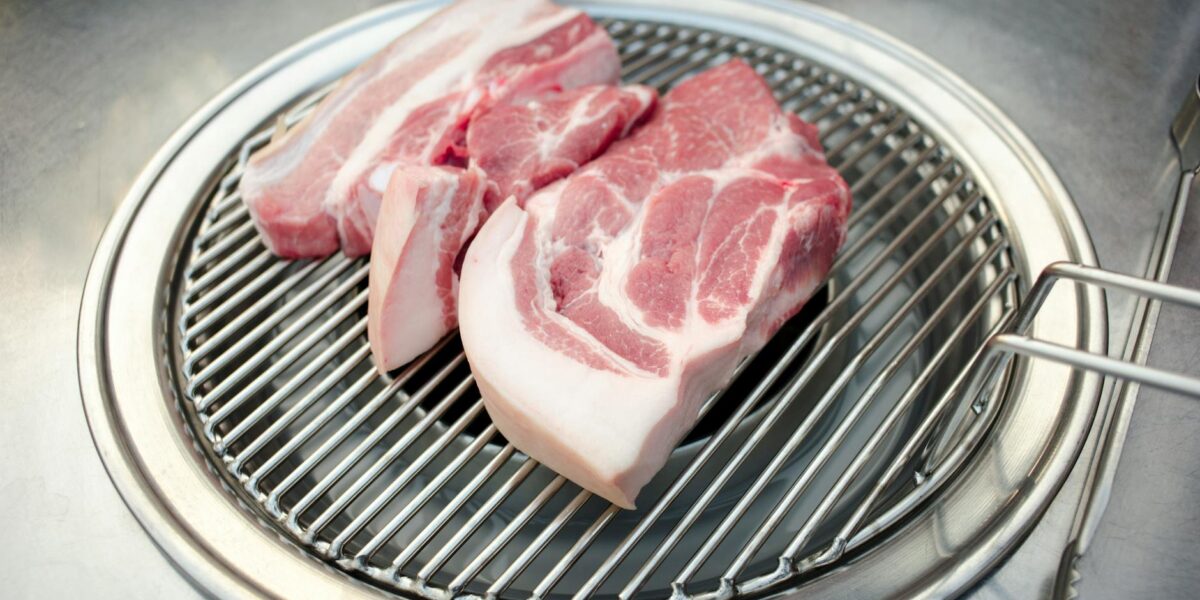
Thick discs of black pork belly and shoulder are grilled tableside over wood charcoal or a heavy iron plate. Unlike mainland samgyeopsal, Jeju black pork is served with a trio of distinctive condiments: melchijeot (anchovy sauce) for dipping, myeolchi-aekjeot for brushing, and a slick of fermented shrimp paste rather than ssamjang. The ritual is the same — wrap a piece of pork in a lettuce leaf with raw garlic, sliced chili, and a smear of paste — but the flavor is darker, sweeter, and more porcine than what most diners experience at a Koreatown restaurant. If you want to try an at-home version, our Korean BBQ at home guide walks through the basic setup; just substitute Berkshire or Kurobuta pork.
2. Jeonbokjuk — Abalone Porridge
Soft-cooked rice porridge tinted celadon green with the abalone’s chopped innards, garnished with thin slices of the shellfish itself and a drizzle of toasted sesame oil. Jeonbokjuk is breakfast food, hangover cure, and convalescent meal in one, and a steaming earthenware bowl of it on a windy spring morning is one of the great culinary experiences in Asia. The technique is closely related to standard Korean and Chinese rice porridge — see our congee recipe for the foundational method.
3. Galchi-jorim — Braised Hairtail
Silver hairtail (cutlassfish) is layered with sliced daikon, gochugaru, soy sauce, and a generous fistful of grated garlic, then simmered until the radish turns translucent and the fish flakes apart. Jeju hairtail is famously fatty because it feeds in nutrient-dense waters around the island, and a properly braised galchi-jorim has a deeply savory broth that islanders mop up with rice. It is a perfect winter dish.
4. Okdom-gui — Grilled Tilefish
Pink tilefish, called okdom on the island, is split, salted, and grilled until the skin crisps and the flesh stays moist. It is often served whole, head and all, with nothing more than a wedge of hallabong tangerine. Islanders consider okdom the equal of any sashimi-grade fish and have lobbied to have it recognized as a Geographic Indication product within Korea.
5. Memil Guksu — Cold Buckwheat Noodles
Stone-ground buckwheat noodles served cold in a clear, slightly sweet broth made from anchovies and dried kelp, garnished with toasted seaweed flakes and a quail egg. The texture is chewier and more brittle than mainland naengmyeon, and the dish is a summer staple. Highland buckwheat carries a faint smokiness that is unmistakable when you taste it side by side with Japanese soba.
6. Bingtteok — Buckwheat Crepes with Daikon
Thin, pale-gray buckwheat crepes are wrapped around shredded daikon that has been blanched and seasoned with sesame oil, salt, and scallion. Bingtteok looks unassuming, but the contrast between the slightly bitter wrapper and the sweet, faintly peppery filling is delightful. It is one of the few traditional Jeju snacks that can be made entirely vegan, and it travels well on hikes.
7. Mom-guk — Brown Seaweed Soup with Pork
An only-on-Jeju soup made from mojaban, a crunchy brown seaweed harvested from rocks at low tide, simmered with chunks of pork belly until the broth turns silky and the seaweed softens to the texture of cooked pasta. Mom-guk was historically served at weddings and ancestral rites; many islanders still associate the smell with celebrations.
8. Hwaedeopbap — Raw Fish Rice Bowl
Thinly sliced raw fish — usually flounder, snapper, or whatever came in that morning — piled on warm rice with shredded lettuce, perilla leaves, sesame seeds, and a generous squeeze of chogochujang, a sweet-tart sauce of gochujang thinned with vinegar. Diners mix everything together at the table. The closest American analog is poke, but the texture is firmer and the dressing more assertive.
9. Seongge-guk — Sea Urchin Soup
A clear broth made by simmering seaweed and just enough fresh sea urchin gonad to turn the soup faintly orange. The flavor is delicate, briny, and surprisingly clean — nothing like the rich tongue-coating sweetness of urchin sushi. It is one of the most refined dishes in the haenyeo repertoire and a reminder that island cuisine is not always loud.
10. Dombe-gogi — Boiled Black Pork on a Wooden Board
Whole pork shoulder is simmered with ginger and bay leaves until tender, then sliced and presented on a wooden cutting board (dombe) with shrimp paste, raw garlic, and a small dish of mustard greens. The technique is similar to Chinese white-cut pork and rewards patience: the meat should be cool enough to slice cleanly but warm enough that the fat is still soft. It is the dish that taught a generation of Korean chefs to respect plain boiled meat. The braising principle echoes our master stock guide, but Jeju cooks keep the broth simple.
11. Galchi-hoe — Hairtail Sashimi
Truly fresh hairtail is sliced thin and eaten raw with a chogochujang dipping sauce. The flesh is firm, faintly sweet, and dissolves on the tongue. Because hairtail is fragile and bruises easily, galchi-hoe is almost impossible to find off the island; even Seoul restaurants struggle to keep it on their menus.
12. Hallabong Sorbet and Tea Cake
Hallabong tangerines — recognizable by the small bump on top and the sweetness reminiscent of mango — appear in nearly every Jeju dessert. The most popular preparations are a smooth sorbet served at cafés along the coast and small tea cakes flavored with green tea grown on the island’s western slopes. Together they have made Jeju a serious destination for café culture.
Cooking Techniques That Define Jeju
Jeju cooks rely on a small handful of methods that prize freshness over elaboration. Three are worth understanding before you start cooking from the island’s repertoire.
Charcoal Grilling
Most Jeju barbecue is cooked over hardwood lump charcoal or, in more upscale restaurants, Japanese-style binchotan. The high, dry heat sears the surface of black pork in seconds and leaves the interior juicy. Mainland Korean barbecue often uses gas griddles for ease; on Jeju, charcoal is the default, and the smoke is part of the seasoning. If you want to recreate the technique at home, our guide to binchotan charcoal covers the basics of high-heat ember grilling.
Salt Curing and Jeotgal Fermentation
Salted seafood — anchovies, shrimp, oyster, even fish entrails — is fermented for months in earthenware crocks until it deepens into a dark, savory liquid. The technique long predates refrigeration on the island and remains the source of the deep umami in everything from soup bases to dipping sauces. Jeju jeotgal tends to be saltier and less sweet than mainland versions.
Live-Catch Cookery
Many Jeju seafood dishes are prepared minutes after the catch comes ashore. Abalone, conch, and flounder are routinely sold and cooked while still alive, which preserves a sweetness that is impossible to replicate after even a few hours of refrigeration. This emphasis on freshness over preparation is what most defines the island’s seafood and is why a bowl of jeonbokjuk in Jeju City tastes nothing like one served in Los Angeles.
Jeju Versus the Korean Mainland
Visitors who arrive on Jeju expecting a familiar Korean meal often find themselves pleasantly disoriented. The table below lays out the key differences between the island’s cuisine and the food most American diners associate with Korea.
| Element | Mainland Korea | Jeju Island |
|---|---|---|
| Staple Grain | Short-grain rice | Buckwheat, barley, millet, sweet potato (rice was historically scarce) |
| Signature Protein | Beef (bulgogi, galbi) | Black pork and wild seafood |
| Heat Level | Medium to high, gochujang-driven | Mild to medium, salt and ferment-driven |
| Banchan Count | Six to twelve small dishes | Three to five, often featuring seaweed and seafood |
| Soup Base | Anchovy and kelp dashi | Same dashi plus distinctive brown seaweed broths |
| Cooking Fat | Vegetable oil, sesame oil | Pork fat, sesame oil, perilla oil |
| Iconic Condiment | Ssamjang (mixed bean paste) | Melchijeot (anchovy fish sauce) |
| Common Dessert | Patbingsu, hotteok | Hallabong sorbet, omija tea |
| Drinking Culture | Soju, makgeolli | Hallasan-brand soju and tangerine wine |
| Holiday Centerpiece | Tteokguk (rice cake soup) | Mom-guk (brown seaweed and pork soup) |
None of these contrasts is absolute — Jeju cooks make perfectly good bibimbap and japchae, and many islanders eat bulgogi at home — but the table captures the broad shape of an unmistakably regional cuisine.
The Haenyeo Kitchen
No discussion of Jeju food is complete without the haenyeo. These free-diving women, most of them now in their sixties and seventies, descend up to twenty meters without tanks, holding their breath for a minute or more, prying abalone and conch from rocks with a sickle-shaped tool called a bitchang. They surface with a distinctive whistle, the sumbisori, that releases carbon dioxide in a single sharp exhalation. Their daily catch determines what is served in the small restaurants that cluster around the island’s diving villages.
Haenyeo cooking is intensely seasonal. In spring, the divers focus on sea urchin and the brown seaweed used for mom-guk. In summer, conch and small octopus dominate. Autumn is the peak season for hairtail and abalone. In winter, when the water is too rough for diving, the women pivot to onshore work — preparing salted seafood, gathering mountain greens, and tending citrus groves. A meal prepared in a haenyeo kitchen will always reflect the calendar, and the menus at proper Jeju restaurants change every two or three weeks accordingly.
The haenyeo population has declined sharply since the 1960s, when it numbered roughly 26,000, to fewer than 3,500 active divers in 2026. Provincial authorities have launched scholarship programs and started a haenyeo school in Hado-ri to train a new generation, but the work is dangerous and the income modest. American food writers traveling to Jeju in 2025 and 2026 have repeatedly noted that the survival of the cuisine depends on the survival of the divers themselves.
Building a Jeju Pantry at Home
Stocking an American kitchen for Jeju cooking does not require obscure equipment. A heavy cast-iron skillet, a stoneware donabe or Korean ttukbaegi, a sharp fish knife, and a small charcoal grill cover most needs. The essential pantry investments are different. The list below covers what is worth seeking out from a well-stocked Korean grocer or specialty importer like Umamicart.
- Anchovy fish sauce (myeolchi-aekjeot) for soup bases and braises.
- Salted shrimp (saeujeot) as a finishing condiment for boiled pork.
- Korean coarse sea salt for grilling fish and curing vegetables.
- Toasted sesame oil — see our complete guide to sesame oil for grades and uses.
- Perilla oil for finishing soups and stir-frying greens.
- Dried anchovies and kelp for stock; the pairing also forms the foundation of dashi.
- Buckwheat flour for noodles and crepes.
- Short-grain Korean rice — see our roundup of the best rice for Asian cooking.
- Hallabong tangerines or Sumo Citrus when in season.
- Frozen mugwort and perilla leaves for soups and wraps.
Live abalone is the hardest item to source outside Korea, but well-stocked Asian seafood markets in Los Angeles, San Francisco, Honolulu, and the New York metropolitan area now carry farmed Pacific abalone year-round. Frozen Korean abalone is widely available online and works well in porridges and braises, if not in raw preparations.
A One-Week Jeju Meal Plan
If you want to eat your way around the island without leaving your kitchen, the schedule below offers a sensible progression from familiar to adventurous. Each day pairs a main with one or two simple sides and suggests a beverage.
Day 1 — Welcome with Black Pork
Grilled Berkshire pork belly served with raw garlic, sliced chili, lettuce wraps, and saeujeot. Cold buckwheat noodles on the side. Beer or hallabong-flavored highball.
Day 2 — Comforting Porridge
Abalone porridge for breakfast or a light dinner, garnished with sesame oil, soy sauce, and a sprinkle of toasted seaweed. Pickled radish on the side. Brewed barley tea.
Day 3 — Braised Fish
Galchi-jorim with daikon, served over short-grain rice. Stir-fried spinach with sesame oil. Cucumber kimchi. Cold makgeolli.
Day 4 — Vegetarian Day
Bingtteok with daikon filling. Buckwheat noodles in cold anchovy and kelp broth. Mountain mugwort soup with miso. Green tea.
Day 5 — Raw Fish Bowl
Hwaedeopbap with sashimi-grade flounder or snapper, dressed at the table with chogochujang. Egg drop soup as a starter — see our egg drop soup recipe for a quick version. Hallasan soju.
Day 6 — Boiled Pork Feast
Dombe-gogi: simmered pork shoulder, sliced thin, served with shrimp paste and mustard greens. Steamed cabbage wedges. Bowl of brown seaweed soup. Tangerine wine.
Day 7 — Celebration Soup
Mom-guk with pork belly and brown seaweed, served with rice and a generous selection of banchan. Hallabong sorbet for dessert. Aged green tea.
Where Jeju Cuisine Is Heading
The story of Jeju food in the second half of the 2020s is the story of a regional cuisine going global without losing its sense of place. Three currents are particularly worth watching.
First, Korean American chefs in Los Angeles and New York have begun building entire menus around Jeju ingredients rather than treating them as garnishes. Restaurants like Wol in Williamsburg and Heukdwaeji House in Koreatown LA dedicate substantial space to abalone and black pork preparations and source as much as possible from Pacific abalone farmers and Berkshire pork producers in California and Iowa.
Second, Jeju green tea and hallabong tangerine are now showing up well outside Korean restaurants. Specialty cafés in Brooklyn and Portland feature hallabong syrup as a fall and winter latte flavor, and several artisan ice cream shops have begun importing Jeju green tea powder for their summer menus. The pattern echoes the early-2010s ascent of Japanese matcha.
Third, the haenyeo themselves are becoming culinary ambassadors. Documentary films, cookbooks, and even a Netflix series released in late 2025 have introduced American audiences to the women who have sustained Jeju’s seafood culture for generations. The result has been a sharp increase in interest in not just the food but the philosophy behind it: seasonal, low-waste, intensely place-based.
Frequently Asked Questions About Jeju Cuisine
Is Jeju cuisine spicy?
Generally, no. Compared with the cuisines of southern mainland Korea — particularly Jeolla and Gyeongsang provinces — Jeju cooking is mild. Heat tends to come from raw garlic and sliced fresh chili added at the table rather than from heavy doses of gochujang or gochugaru. The exception is hwaedeopbap, where the chogochujang dressing can pack a serious kick.
What is Jeju black pork and why is it different?
Heukdwaeji is a heritage breed indigenous to the island, raised in smaller herds and on a more varied diet than mainland pork. The meat is darker in color, more deeply marbled, and slightly chewier in texture. American Berkshire and Kurobuta pork share many of these qualities and are the closest substitutes available outside Korea.
Can I make Jeju dishes without seafood?
Yes. The mountain and highland traditions of Jeju are largely vegetarian, drawing on buckwheat, mugwort, mountain greens, daikon, and tofu. Bingtteok, buckwheat noodles in vegetable broth, and braised tofu with chili are all entirely plant-based, and the island’s Buddhist temple food scene is one of the most refined in Korea.
How do I source live or fresh abalone in the United States?
California has a thriving farmed abalone industry; producers like Monterey Abalone Company and American Abalone Farms ship live mollusks across the country. Frozen Korean abalone is widely available at Korean and Japanese supermarkets and works well for porridges, braises, and grilled preparations. For raw applications, insist on live or sashimi-grade product.
What drinks pair best with Jeju food?
Jeju produces its own soju (the Hallasan brand is the most famous), a clear, slightly sweet rice spirit that pairs well with grilled black pork. Tangerine wine, made from local hallabong, is excellent with raw fish and lighter seafood. For non-alcoholic options, barley tea and roasted corn tea are the daily drinks of choice.
Is Jeju seafood sustainable?
The haenyeo system is one of the world’s most studied examples of sustainable artisanal fishing. Divers operate within strict community quotas, observe seasonal closures for each species, and avoid harvesting young or spawning animals. Industrial fishing in the waters around Jeju is a different matter and faces the same pressures as fisheries elsewhere in East Asia. Look for restaurants and importers who name their suppliers.
How does Jeju cuisine differ from Okinawan cuisine?
Both are island cuisines built around pork and seafood, and both feature a deep purple sweet potato as a staple. The differences lie in seasoning: Okinawa leans on dashi, awamori, and brown sugar, while Jeju uses anchovy fish sauce, soju, and citrus. Jeju cooking is also more deeply linked to Korean fermentation traditions, while Okinawan cooking carries clear Chinese influences from centuries of trade with Fujian.
Can I visit Jeju and eat well without speaking Korean?
Yes. Jeju City and Seogwipo have an unusually high concentration of restaurants with photographic menus and English-speaking staff thanks to decades of tourism from mainland China and Japan. The further you travel into rural fishing villages, the more rewarding the food becomes — and the more useful a translation app or a Korean-speaking friend will be.
What is the best season to visit Jeju for food?
October and November are generally considered the best months. The water is still warm enough for haenyeo to dive, hairtail and abalone are at peak fattiness, and the hallabong harvest begins in early November. Spring is a close second, with mountain greens and the first sea urchin of the year. Summer is hot and humid; winter is rough at sea but excellent for braises and soups.
Are there any Jeju restaurants in the United States?
A small but growing number, mostly clustered in Los Angeles, New York, and Honolulu. Most operate as black pork specialists, with the occasional pop-up dedicated to abalone or tangerine-driven dessert menus. Wol in Brooklyn, Heukdwaeji House in Koreatown LA, and Sumbisori in Honolulu are widely recommended starting points. Expect menus to evolve quickly as the regional category matures.
Closing Thoughts
Jeju is a small island with a large culinary identity, and that identity is finally getting the international audience it deserves. Cooking from Jeju at home is not about recreating restaurant dishes plate for plate — sourcing live abalone and grilling over wood charcoal in an apartment kitchen is impractical at best — but about adopting the island’s sensibility: minimal seasoning, maximum freshness, deep respect for what the sea and the land happen to give you. Start with a porridge, move on to a braise, and eventually you will find yourself thinking like a haenyeo: paying attention to seasons, valuing simple flavors, and treating every meal as a small celebration of place. There is no better way to understand the Korean kitchen at its most honest.

Mei Lin Chen
Mei Lin Chen is an Asian food writer and recipe developer. Melbourne-raised and London-based, she has spent over a decade exploring the rice paddies, hawker stalls, and home kitchens of South-East and East Asia. Her recipes balance traditional technique with everyday practicality.