Last updated: March 03, 2026
Balinese food is the most distinctive regional cuisine in Indonesia, born on a small Hindu island surrounded by Muslim-majority neighbors and shaped by daily temple offerings, volcanic soil, and the steady drumbeat of religious ceremony. While the rest of the archipelago leans on beef, chicken, and fish, Bali built its food culture around babi (pork), aromatic spice pastes called basa, and a philosophy that food must be beautiful and balanced before it ever reaches a human mouth — because the gods eat first. The result is one of the most spice-forward, ritualistic, and pork-loving cuisines in Southeast Asia, and it tastes like nothing else in the region.
If you have only ever eaten Balinese food at a beach club in Seminyak, you have barely scratched the surface. Real Balinese cooking is a slow, communal affair: a whole pig turning over coals for six hours, a duck wrapped in banana leaf and buried in embers overnight, twenty hands chopping the same pile of shallots for tomorrow’s ceremony. This guide covers the history, the regions, the ingredients, the dishes, the techniques, and the meal structure that make Balinese cuisine unique — plus how to start cooking it at home in a US or global kitchen using ingredients you can actually source.
What Makes Balinese Cuisine Different from the Rest of Indonesia
Bali is one of more than 17,000 islands in Indonesia, but it is the only province where the majority religion is Hindu — about 87 percent of the island’s roughly 4.4 million people. That single fact rewires the entire kitchen. In Java, Sumatra, and most of the rest of the country, pork is rare or absent because of Islamic dietary laws. In Bali, pork is the centerpiece of celebration: babi guling (suckling pig), babi kecap (pork in sweet soy), urutan (pork sausage), and pork lard rendered down to fry shallots and finish dishes with a savory crackle.
Beyond pork, Balinese cooking is defined by its spice pastes. Where Thai cuisine pounds curry pastes for soups and Indian cooking blooms whole spices in oil, Balinese cooks build everything on basa genep — the "complete spice paste" of shallots, garlic, ginger, galangal, turmeric, candlenut, chilies, and shrimp paste. This paste is the foundation under nearly every savory dish on the island. The cuisine also leans harder on raw, sharp condiments than its Indonesian neighbors: sambal matah, a raw shallot-lemongrass-chili relish, is to Bali what fish sauce is to Vietnam — present at every table, every meal.
Finally, Balinese food is inseparable from religion. Every morning, families place small woven palm trays called canang sari at shrines, gates, and intersections, each holding a tiny portion of rice, flowers, and incense. Larger ceremonies demand lawar (ritual minced-meat salad), satay lilit, and elaborate offerings prepared communally in temple kitchens. The food you eat at a Balinese family home is, in a literal sense, leftovers from the gods.
A Short History of Balinese Food
Balinese cuisine traces back to the migration of Hindu-Javanese aristocracy from the Majapahit Empire in the 15th and 16th centuries, when Islam was spreading across Java and the Hindu courts retreated east to Bali. They brought with them temple cooking traditions, Sanskrit-rooted ritual, and a sophisticated spice-paste cookery that fused with the island’s own animist food customs. Many modern Balinese ceremonial dishes — lawar, bebek betutu, the structure of formal feasts — descend directly from these Hindu-Javanese kitchens.
The next major influence came from Chinese traders, who arrived in Bali centuries before European contact and introduced wok cooking, soy sauce, noodles, and the sweet-and-sour flavor profile now common in babi kecap. Indian Ocean spice routes brought turmeric, coriander, cumin, and pepper into the everyday pantry. Portuguese and later Dutch colonists added chilies (originally from the Americas), tomatoes, and eventually the kerosene stoves that began replacing wood fires in the 20th century.
For most of its history, Balinese food was hyper-local — what you ate depended on which village you lived in, which temple your family served, and what was harvested that week from the rice terraces and nearby forests. Tourism, which exploded after the 1970s and again after the 2000s, professionalized the cuisine and pushed dishes like babi guling and nasi campur Bali into the international spotlight. Today, warung (small family restaurants) like Ibu Oka in Ubud are pilgrimage sites, and a new generation of Balinese chefs is taking the cuisine into fine-dining territory in Canggu, Seminyak, and abroad.
The Regions of Bali and How They Cook Differently
Bali is small — about 5,780 square kilometers, roughly the size of Delaware — but it has surprisingly distinct regional cooking. The island divides loosely into highland (Bali Aga and the central mountains), south coast (Denpasar, Kuta, Sanur, Jimbaran), east coast (Karangasem, Amed), north coast (Buleleng, Lovina), and west (Negara). Each region pulls from different ingredients and traditions.
South Bali is the tourist heart and the home of polished restaurant Balinese cooking — nasi campur at Warung Wardani in Denpasar, grilled seafood with sambal matah at the Jimbaran beach grills, refined babi guling in Ubud. Spice pastes here tend to be milder and rounder, calibrated for international palates but still recognizably Balinese.
North Bali (Buleleng), around Singaraja and Lovina, was the colonial capital under the Dutch and developed a slightly different palate — more fermented, more pungent, more pork-and-organ-forward. Dishes like siobak Singaraja (Chinese-influenced sliced pork with fermented bean sauce) and blayag (rice cakes with chicken curry) are northern signatures rarely found in the south.
East Bali (Karangasem), home to the mother temple of Besakih on the slopes of Mount Agung, leans into highly ceremonial cooking. The most elaborate bebek betutu and lawar in Bali come from this region. East Balinese cooks also make heavy use of jukut (vegetable preparations) using ferns, banana flower, and young jackfruit foraged from the volcano slopes.
The Bali Aga villages — Tenganan, Trunyan, Pedawa, Sidatapa — are the "original Balinese," pre-Majapahit communities who maintain ancient food customs. Their cooking is starker and more austere: bamboo-smoked pork, palm-wine fermented vegetables, and ceremonial dishes using ingredients (such as buffalo, occasional turtle) that mainstream Hindu Bali has phased out. Bali Aga cooking is the closest living link to what Balinese food might have looked like a thousand years ago.
Essential Balinese Ingredients (and Where to Find Them in the US)
Balinese cuisine demands a long pantry. The good news is that the ingredients overlap heavily with Thai and broader Indonesian cooking, so most are findable at any reasonably stocked Asian grocer or online from Indonesian specialty stores. Use the table below as your shopping list before you start any major Balinese cook.
| Ingredient | Indonesian Name | Role in Balinese Cooking | US Substitute (if needed) |
|---|---|---|---|
| Shallots | Bawang merah | Base of every spice paste; fried for crispy garnish | Small French shallots; do not substitute red onion 1:1 |
| Garlic | Bawang putih | Spice paste base; fried as garnish | Standard supermarket garlic works fine |
| Galangal | Lengkuas / laos | Sharp, piney aromatic in basa genep | Frozen galangal beats dried; ginger is a poor swap |
| Lesser galangal | Kencur | Funky, almost camphor-like; defines lawar | Hard to source; omit or use a tiny pinch of galangal |
| Turmeric (fresh) | Kunyit | Color and earthy bitterness in pastes | Use 1 tsp ground turmeric per 1 inch fresh root |
| Candlenut | Kemiri | Thickens spice pastes, adds richness | Macadamia nuts or raw cashews (toasted) |
| Lemongrass | Sereh | Bottoms in pastes; tops as skewers for satay lilit | Fresh lemongrass widely available |
| Kaffir lime leaf | Daun jeruk purut | Aromatic in pastes, salads, soups | Frozen leaves; never substitute regular lime zest |
| Salam leaf | Daun salam | Indonesian bay leaf, in braises and rice | Bay laurel works in a pinch but flavor differs |
| Bird’s eye chilies | Cabe rawit | Heat in pastes and sambal | Thai bird chilies; serranos in a pinch |
| Long red chilies | Cabe merah besar | Color and mild heat | Fresno or red Anaheim chilies |
| Shrimp paste | Terasi | Funky umami base in nearly every paste | Toast before use; Thai kapi is a close swap |
| Palm sugar | Gula merah / gula Bali | Caramel sweetness in pastes and sambals | Coconut palm sugar; brown sugar in a pinch |
| Sweet soy sauce | Kecap manis | Sweetness and depth in stir-fries and marinades | ABC or Bango brand widely sold |
| Coconut (grated, milk, oil) | Kelapa, santan | Lawar, gulai-style braises, rice cooking | Frozen grated coconut; full-fat canned coconut milk |
| Tamarind | Asam jawa | Sour notes in sauces and sambals | Tamarind paste in jars or blocks |
| Banana leaves | Daun pisang | Wrapping for betutu, pepes, and steamed dishes | Frozen banana leaves at any Asian or Latin grocer |
For deeper dives on individual ingredients, see our guides on lemongrass, turmeric, galangal, shrimp paste (terasi), kecap manis, coconut milk, kaffir lime leaves, and tamarind paste.
Basa Genep: The Mother Spice Paste of Balinese Cooking
If you cook only one thing from this guide, make a batch of basa genep. This single paste is the gateway to roughly two-thirds of the savory Balinese repertoire. The name means "complete spices," and it lives up to it — depending on the family recipe, the paste contains 12 to 20 ingredients pounded down into a fragrant red-orange slurry. Once made, it keeps for a week refrigerated and freezes well for months.
A basic basa genep includes: shallots, garlic, fresh turmeric, galangal, ginger, kencur (lesser galangal), candlenut, long red chilies, bird’s eye chilies, lemongrass (white parts only), shrimp paste, coriander seed, white pepper, palm sugar, salt, and a finishing splash of coconut oil. Traditionally everything is pounded in a stone mortar called a batu boreh until it forms a coarse, slightly chunky paste. A food processor works fine for home cooks — just pulse rather than puree, and finish by sautéing the paste in coconut oil over medium-low heat for 15 to 20 minutes until the raw shallot smell disappears and the paste turns deep red-brown and glossy. That long, slow fry is non-negotiable; it is what transforms harsh raw aromatics into the sweet, perfumed base that defines Balinese flavor.
From this single paste you can build babi kecap, ayam betutu, sayur urab, lawar, the marinade for satay lilit, and a stock for nasi campur. Many Balinese families make a giant batch every Sunday and live off it all week. If you are serious about learning Balinese cooking, this is the discipline.
10+ Must-Try Balinese Dishes
1. Babi Guling (Spit-Roasted Suckling Pig)
The undisputed king of Balinese cuisine. A whole young pig is rubbed inside and out with basa genep mixed with extra turmeric and stuffed with cassava leaves, then skewered on a bamboo pole and turned over coconut-husk coals for four to six hours. The skin lacquers to a glass-like crackle while the meat inside steams in its own spiced juices. Served with rice, lawar, blood sausage (urutan), crispy skin, and a bowl of broth, babi guling is the dish people fly to Bali for. Ibu Oka and Pak Malen in Ubud are the temples; do not order it "to go" — the skin softens within minutes.
2. Bebek Betutu / Ayam Betutu (Slow-Cooked Spiced Duck or Chicken)
A whole duck (or chicken) is rubbed inside and out with a turbocharged basa genep, wrapped first in betel leaves and then in multiple layers of banana leaves, sealed in a clay pot, and either steamed for six to eight hours or buried in rice husk embers overnight. The result is meat so tender it falls off the bone with a chopstick, perfumed end to end with toasted spice. Betutu is special-occasion food; in central Bali, families order it days in advance from neighborhood specialists.
3. Sate Lilit (Minced Satay on Lemongrass Skewers)
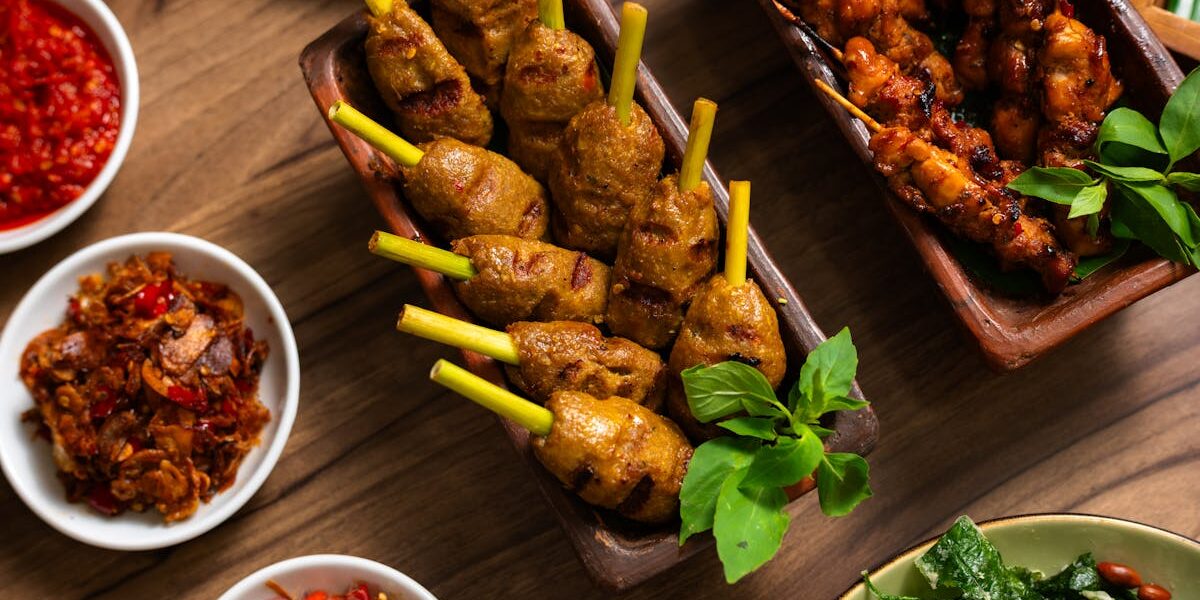
Bali’s signature satay. Instead of cubed meat on bamboo, finely minced fish, chicken, or pork is mixed with grated coconut, basa genep, palm sugar, and lime zest, then molded by hand around the bottom of a fresh lemongrass stalk and grilled over coconut-husk coals. The lemongrass perfumes the meat from the inside as it cooks, and the coconut keeps the texture juicy. Eaten as part of a ritual platter or as street-food snacks. (See our chicken satay guide for a comparison with the more familiar Javanese style.)
4. Lawar (Ceremonial Minced-Meat and Vegetable Salad)
The most ritually loaded dish in Bali. Lawar combines finely chopped vegetables (long beans, jackfruit, banana flower), grated coconut, minced meat (usually pork), basa genep, kaffir lime leaf, and sometimes — in its most traditional form — a small amount of fresh blood that turns the dish a deep red and adds an iron tang. There is also lawar putih (white lawar) without blood for everyday eating. Each village has its own version, and during temple ceremonies the men of the community will gather pre-dawn to chop lawar together, a ritual called mebat. It is the dish that most resists touristification.
5. Nasi Campur Bali (Balinese Mixed Rice)
The everyday vehicle for tasting Balinese cuisine. A mound of white rice on a plate is surrounded by small portions of five to ten dishes: shredded babi guling, lawar, satay lilit, sayur urab (vegetable salad), fried tempeh or tofu, half a hard-boiled egg, peanut crackers, and always a fierce dollop of sambal. At a warung you point to what you want; at a family meal everything appears at once. This is how Balinese people actually eat lunch.
6. Babi Kecap (Pork in Sweet Soy Sauce)
The Chinese-Balinese crossover dish. Pork belly is browned in coconut oil, then braised slowly with basa genep, kecap manis, garlic, ginger, and a splash of water until the sauce reduces to a sticky, mahogany glaze that clings to every piece. Served over rice with cucumber and sambal matah on the side. Comfort food in any Balinese home.
7. Sambal Matah (Raw Shallot and Lemongrass Relish)
If Balinese cooking has a single must-try condiment, this is it. Thinly sliced shallots, lemongrass (tender white parts only), bird’s eye chilies, garlic, kaffir lime leaf, a squeeze of lime juice, salt, a pinch of toasted shrimp paste, and a final glug of hot coconut oil that wilts everything just barely. Sharp, fragrant, fiery, and indispensable — eat it on grilled fish, over rice, with anything fried. Once you taste a fresh batch, the jarred Western chili pastes start to feel embarrassing.
8. Ikan Bakar Jimbaran (Jimbaran-Style Grilled Fish)
The Jimbaran beach grills are a sunset institution: rows of plastic tables in the sand, charcoal grills behind them, and cooks brushing whole snapper, mahi-mahi, lobster, prawns, and squid with a basa-genep marinade thinned with kecap manis and tamarind. Served with rice cooked in banana leaf, sambal matah, and a wedge of lime. The smell of the smoke alone is worth the trip.
9. Sayur Urab (Spiced Vegetable and Coconut Salad)
The everyday vegetable course. Blanched long beans, spinach, bean sprouts, and grated raw cabbage are tossed with toasted grated coconut, basa genep, kaffir lime, palm sugar, and lime juice. Bright, sharp, and essential to balance the richness of pork dishes. A staple in nasi campur and ceremonial spreads alike.
10. Tum Ayam (Steamed Spiced Chicken Parcels)
Bali’s answer to a tamale. Minced chicken (or pork) is mixed with basa genep, grated coconut, salam leaf, and kaffir lime, wrapped in banana leaves into small palm-sized parcels, secured with bamboo pins, and steamed for an hour. Each parcel is a self-contained burst of flavor. A common ceremonial offering and a favorite warung lunch.
11. Rujak Bali (Spicy Fruit Salad)
The street-snack queen. Unripe mango, pineapple, jicama, papaya, watermelon, and starfruit are tossed with a thick dressing of palm sugar, tamarind, shrimp paste, bird’s eye chili, and salt. The contrast — sweet, sour, salty, fiery, all at once — is electric and oddly addictive. Ubiquitous outside temples and schools, sold from glass-front pushcarts in plastic bags.
12. Bubur Mengguh (Northern Balinese Chicken Porridge)
A specialty of Buleleng in the north. Coconut-rich rice porridge is topped with shredded poached chicken, peanuts, fried shallots, kacang panjang (long beans), and a fragrant chicken broth with basa genep. Often served at religious ceremonies as a hearty pre-dawn meal. Comforting, warming, and unmistakably regional.
13. Jaja Bali (Traditional Sweet Snacks)
Balinese desserts are not a separate course but a constellation of small sweet snacks made primarily from rice flour, palm sugar, and coconut. Highlights include klepon (green pandan rice balls filled with molten palm sugar), laklak (small pancake-like coconut cakes drizzled with palm syrup), jaja batun bedil (rice flour dumplings in palm sugar coconut soup), and bubuh injin (black rice pudding). Most jaja are made fresh in the predawn hours and sold from temple-front stalls by mid-morning.
Core Balinese Cooking Techniques
Balinese cooking centers on a handful of techniques, most of which translate well to a home kitchen even without specialized equipment. Master these and you can build out the entire repertoire.
Mortar-and-Pestle Pounding (Ulekan)
Every spice paste in Balinese cooking starts here. The traditional tool is a wide flat stone mortar with a stubby pestle, used not to puree but to bruise and crush ingredients so they release oils into each other. The texture stays slightly coarse, which matters — a perfectly smooth puree (the food processor trap) loses the layered chew that makes a Balinese paste sing. If you use a processor, pulse to a rough paste, never blend smooth, and add a tablespoon of coconut oil to help it move.
Blooming the Spice Paste (Numis Basa)
Once your basa is pounded, it must be cooked — slowly, in plenty of coconut oil, over medium-low heat — until the raw sharpness vanishes and the paste turns several shades darker. This step is identical in importance to Indian tadka or French mirepoix. Skip it and your dish will taste raw and acrid; do it right and you have a foundation that perfumes the whole pot.
Banana Leaf Wrapping (Pepes / Tum)
Banana leaves are Bali’s parchment paper. Wrapping food before steaming or grilling locks in moisture, perfumes the contents with a faint grassy-tea aroma, and acts as a natural serving vessel. Frozen leaves at US Asian groceries work fine; thaw, wipe clean, and pass over an open flame for a few seconds to make them pliable before folding.
Charcoal Grilling Over Coconut Husk (Bakar)
Coconut-husk coals burn hotter and impart a sweeter, more aromatic smoke than mesquite or hardwood. They are the secret behind Jimbaran’s grilled fish and authentic satay lilit. Coconut charcoal is increasingly available in the US through specialty hookah and grilling suppliers; if you cannot source it, regular hardwood lump charcoal still beats gas. The technique is the same: a hot bed of coals, a light brush of marinade as you grill, and constant turning to prevent the sugar in kecap manis from burning.
Spit-Roasting (Mepanggang)
Babi guling is the showpiece of this technique. A whole small pig (8 to 12 kilos) is skewered on a bamboo pole and turned by hand over coconut coals for hours, basted constantly with coconut water and the rendered juices. At home, a large rotisserie oven or a charcoal grill with a rotisserie attachment can approximate the result with a small suckling pig (sourced from a Latin or specialty butcher).
Long Steaming and Ember-Burying (Betutu)
Bebek betutu uses one of two methods: traditional ember-burying in rice-husk fires for 8 to 12 hours, or modern double-steaming in a clay pot over a long simmer. The home cook’s path is the second: spice the duck or chicken aggressively, wrap in banana leaf, place in a covered pot with an inch of water, and steam over the lowest possible flame for six hours. The texture is the goal — meat that surrenders to the lightest pressure.
Balinese vs. Other Indonesian and Southeast Asian Cuisines
If you have cooked Thai or broader Indonesian food before, the table below should help you place Balinese cuisine on your existing flavor map. The differences are real but not unbridgeable — the techniques transfer, the pantry overlaps, and the leap is mostly about which spice paste sits at the center of the dish.
| Trait | Balinese | Javanese | Padang (Sumatran) | Thai |
|---|---|---|---|---|
| Religious profile | Hindu — pork-forward | Muslim-majority — no pork | Muslim — beef and goat heavy | Buddhist — broad protein use |
| Signature spice base | Basa genep (turmeric/galangal/shrimp paste) | Bumbu kuning (turmeric forward, sweeter) | Bumbu rendang (chili and coconut heavy) | Curry pastes (galangal/lemongrass/lime leaf) |
| Sweetness | Moderate, palm sugar driven | Very sweet (kecap manis everywhere) | Minimal sweetness | Balanced sweet/sour |
| Heat level | Medium to hot | Mild | Very hot | Variable, often hot |
| Coconut use | Heavy (milk, oil, grated) | Moderate | Very heavy | Heavy in curries |
| Signature condiment | Sambal matah (raw) | Sambal terasi (cooked) | Sambal lado mudo | Nam pla prik / nam jim |
| Iconic dish | Babi guling | Gudeg, soto ayam | Rendang | Pad thai, green curry |
| Eating style | Mixed-rice plate (nasi campur) | Mixed-rice plate | Spread of small dishes | Shared central dishes |
For deeper context on neighboring cuisines, see our broader guide to Indonesian cuisine and our Thai recipes hub.
How a Balinese Meal Is Structured
Balinese eating breaks several Western assumptions. There are no real courses; there is no formal dinner ritual; and there is no dessert at the end. Instead, food rolls out across the day in three or four small unceremonious meals built around nasi (rice) and whatever was cooked at dawn.
Breakfast (sarapan) is light — usually nasi jinggo, a small parcel of rice with a few toppings wrapped in banana leaf and bought from a roadside warung. Many Balinese also eat bubur ayam (chicken porridge) or simply yesterday’s leftovers cold over fresh rice.
Lunch and dinner are essentially the same meal: a plate of nasi campur with five to ten small portions arranged around it. There is no first or second course. Diners eat with the right hand or a spoon and fork (never a knife — meat is pre-chopped). Sambal sits at every table, and you take as much or as little heat as you want.
Snacks (jajan) happen all day. Rujak after school. Klepon mid-morning. Pisang goreng (fried banana) with afternoon coffee. Sweet snacks are eaten between meals, not after them.
Ceremonial meals are a different beast entirely. After a temple ceremony or family ritual (a tooth-filing, a cremation, the 105-day birthday), the entire community gathers and eats from communal platters of lawar, satay, betutu, rice, and fruit. These meals can stretch for hours and are the single best way for an outsider to experience the cuisine in its full ritual context — though they are not, as a rule, open to tourists.
Drinks: Coffee, Arak, Tuak, and Brem
Bali grows excellent coffee — both highland Arabica from the slopes of Kintamani and lowland Robusta. Traditional Balinese coffee is kopi tubruk: coarsely ground beans steeped directly in hot water with a heap of sugar, no filter, drunk slowly while the grounds settle. Kopi Bali brands exported abroad usually mean this style.
The local alcohols are arak (clear distilled palm or rice liquor, sometimes infused with herbs and fruits), tuak (mild palm wine drunk fresh, often the same day it is tapped), and brem (sweet rice wine, used both as a drink and as an ingredient in lawar and ceremonial offerings). Arak is the strongest and most popular; mind the source, as illegally distilled batches have caused poisoning incidents.
Non-alcoholic options include young coconut water served in the shell (es kelapa muda), es campur (a shave-ice dessert with palm sugar syrup, jelly, and fruit), and an avalanche of fresh tropical juices.
Building a Balinese Home Pantry: A Starter Plan
You do not need to import anything from Indonesia to start cooking real Balinese food. Here is a practical four-week ramp from zero to confident.
Week 1: Pantry stocking. Order or buy: kecap manis (Bango or ABC), shrimp paste, palm sugar, candlenuts (or macadamias), tamarind paste, ground coriander, and frozen banana leaves. From the produce aisle: shallots, garlic, fresh ginger, fresh turmeric, lemongrass, fresh red and bird’s eye chilies, kaffir lime leaves (frozen if needed). Pick up canned full-fat coconut milk and a bag of jasmine rice.
Week 2: Make basa genep. Pound or pulse a half-batch using the recipe in this guide. Bloom it in oil. Use it three ways: stir-fry pork or chicken with kecap manis (babi/ayam kecap), toss it through cooked long beans and grated coconut for sayur urab, and rub it on chicken thighs to grill or pan-sear.
Week 3: Add sambal matah. Master the raw chili-shallot-lemongrass relish. Make a fresh batch every two days and put it on everything — eggs, grilled fish, fried tofu, even tacos. This single condiment is the gateway drug; once you cannot live without it, you are halfway to the cuisine.
Week 4: Tackle a centerpiece. Make tum ayam (steamed banana-leaf chicken parcels) — it teaches wrapping, steaming, and paste use all at once. Or, for a Sunday project, build a full nasi campur Bali plate at home: rice, ayam betutu (steamed instead of buried), sayur urab, sambal matah, fried shallots, peanut crackers, and a slice of cucumber. You now have the cuisine in miniature on one plate.
Eating Balinese in Bali: Where to Go
If you are headed to the island, here is a tight shortlist of warungs and institutions worth the detour. None are secrets, but all are the genuine article.
- Ibu Oka (Ubud) — the most famous babi guling on the island. Get there before noon or it is gone.
- Warung Babi Guling Pak Malen (Seminyak) — Ibu Oka’s main rival; arguably crisper skin.
- Warung Wardani (Denpasar) — a 50-year-old institution for nasi campur Bali in the local capital.
- Bumbu Bali (Tanjung Benoa) — chef Heinz von Holzen’s school and restaurant, the best place for an outsider to see ceremonial dishes done well.
- Jimbaran beach grills (Jimbaran) — the sunset seafood institution, dozens of warungs along the sand.
- Warung Men Tempeh (Buleleng) — for northern-style nasi ayam Buleleng.
- Locavore NXT (Ubud) — fine-dining Balinese, foraged and fermented.
- Warung Mak Beng (Sanur) — single-menu fried fish soup that has fed Sanur since 1941.
Frequently Asked Questions About Balinese Cuisine
Is Balinese food spicy?
Most cooked Balinese dishes are medium-spicy by Southeast Asian standards — assertive but not punishing. The real heat comes from the sambal you add at the table. Sambal matah and sambal embe both deliver serious chili kick, so newcomers should taste a small amount first. Dishes like babi guling and bebek betutu carry their flavor more from the depth of basa genep than from raw chili heat.
Is Balinese food vegetarian-friendly?
Surprisingly yes, despite the cuisine’s pork reputation. Hindu Bali has a strong tradition of vegetable preparations like sayur urab, gado-gado, jukut undis (red bean stew), and tempeh and tofu in dozens of forms. The catch: nearly every spice paste contains shrimp paste (terasi), so strict vegetarians and vegans need to specify tanpa terasi (without shrimp paste) and verify. Tourist-area restaurants in Ubud and Canggu have built robust vegan menus that adapt the cuisine well.
What is the difference between Balinese and Indonesian food?
Balinese cuisine is one of dozens of regional Indonesian cuisines, distinguished by Hindu religious culture, heavy pork use, the basa genep spice paste, and a bigger emphasis on raw condiments and ceremonial cooking. Pan-Indonesian dishes you will find on a Balinese menu — nasi goreng, mie goreng, gado-gado, sate ayam — exist in Bali but are not specifically Balinese. The truly Balinese dishes are babi guling, bebek betutu, lawar, sate lilit, sambal matah, and sayur urab.
Can I make basa genep without kencur (lesser galangal)?
Yes. Kencur is the hardest ingredient to source outside Indonesia, and the paste still works without it. Add a tiny extra knob of fresh ginger and a few extra coriander seeds to compensate for the missing earthy-camphor note. Your basa will lean a little more Thai and a little less distinctly Balinese, but it remains highly usable.
Is babi guling really cooked over coconut husks?
Yes — coconut-husk charcoal burns slower and cooler than wood charcoal, which is essential for a four- to six-hour roast that crisps the skin without scorching it. Coconut wood and palm wood are also used. The aromatic smoke is part of the flavor signature, similar to how mesquite defines Texas barbecue.
What is the best entry-point Balinese dish for a beginner cook?
Sambal matah and ayam betutu (chicken version, steamed). Sambal matah requires no cooking and teaches you the flavor profile in 10 minutes. Ayam betutu is forgiving, hands-off, and demonstrates the basa genep paste in its most generous form. From there, sate lilit and sayur urab are the natural next steps.
Is Balinese food healthy?
Mixed. The vegetable preparations, fresh sambals, fish, and rice base are nutritionally excellent. The downsides are heavy use of coconut oil (saturated fat), pork belly, palm sugar, and white rice. Nasi campur is a balanced plate by design — small portions of many things, with a vegetable course in every meal — so eaten that way, the cuisine sits closer to a Mediterranean balance than to American takeout food.
Why does Balinese food taste so different from Thai food, when the ingredients overlap?
Two main reasons. First, balance: Thai cuisine builds dishes around four-corner balance (sweet, sour, salty, spicy) often with fish sauce as the salt; Balinese cuisine pushes deeper toward earthy and umami via shrimp paste, candlenut, and toasted spices. Second, fat: Thai cooking uses thinner coconut sauces and quick stir-fries; Balinese cooking leans on long-cooked basa genep blooms in coconut oil, producing a richer, more deeply layered base flavor. Same pantry, different grammar.
Where can I buy real Balinese ingredients in the US?
Most major-city Asian groceries (H Mart, 99 Ranch, Hong Kong Supermarket, Patel Brothers) cover the basics. For Indonesian-specific items like Bango kecap manis, ABC sambal, terasi, and frozen pandan, look for Indo Food Mart and Toko Indonesia online retailers, plus Indonesian community grocers in Los Angeles, San Francisco, New York, and Houston. Amazon stocks shelf-stable items like kecap manis, palm sugar, and tamarind paste reliably.
What are jaja Bali and when are they eaten?
Jaja are traditional Balinese sweet snacks, made primarily from rice flour, palm sugar, and coconut. They are eaten between meals (with morning coffee or as afternoon snacks) and offered in temples as part of canang sari and larger ceremonies. They are not a dessert course in the Western sense — Balinese meals do not end with sweets. Klepon, laklak, and bubuh injin are the most internationally accessible.
The Bigger Picture: Why Balinese Food Matters
Balinese cuisine occupies a genuinely unusual place in world food: a Hindu enclave in Muslim Indonesia, a tourism magnet that has nonetheless preserved most of its ritual cooking, a small island whose food culture has outsized global recognition. The cuisine rewards both casual exploration (a plate of nasi campur Bali at a beach warung) and a lifetime of study (the regional lawar variations alone could fill a book). For home cooks, it offers an unfamiliar but accessible entry into Southeast Asian flavor — most of the pantry is Thai-adjacent, the techniques translate well, and the central spice paste, basa genep, is a single skill that unlocks dozens of dishes.
The next time you cook Asian at home, try this: instead of reaching for a Thai green curry paste or a Sichuan chili crisp, pound a small batch of basa genep, bloom it in coconut oil, fry up some pork belly with kecap manis, and top the bowl with a tablespoon of fresh sambal matah. That single dinner is more Balinese than anything you can order on a menu in most US cities — and once you taste it, the gap between "Indonesian food" and the very specific cuisine of Bali snaps into focus.
For more deep-dive cuisine guides on the Indonesian archipelago and beyond, see our complete guides to Indonesian recipes, Malaysian cuisine, Peranakan / Nyonya food, and our Thai recipes hub. And if you are ready to start cooking Balinese-adjacent dishes tonight, our nasi goreng, rendang, and chicken satay recipes are the perfect on-ramp.

Mei Lin Chen
Mei Lin Chen is an Asian food writer and recipe developer. Melbourne-raised and London-based, she has spent over a decade exploring the rice paddies, hawker stalls, and home kitchens of South-East and East Asia. Her recipes balance traditional technique with everyday practicality.