Last updated: March 15, 2026
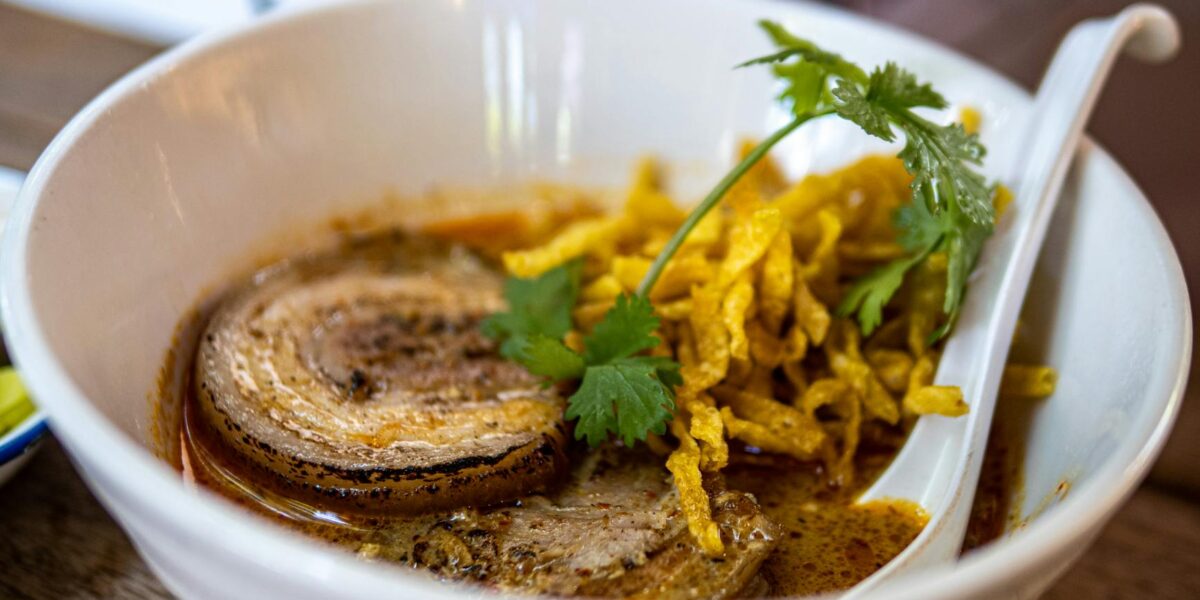
Khao Soi is one of those dishes that stops you mid-bite. A bowl of rich, coconut curry broth ladled over soft egg noodles, topped with a tangle of crispy fried noodles, tender chicken, and a squeeze of fresh lime. It is the signature dish of Northern Thailand — a recipe shaped by centuries of cultural exchange between Thai, Burmese, and Chinese communities in the Chiang Mai region. If you have never tried it, imagine the best qualities of a Thai curry and a noodle soup combined into one deeply satisfying bowl.
This khao soi recipe walks you through every step of making authentic Khao Soi Gai (chicken khao soi) at home, from building the aromatic curry paste to achieving the perfect balance of creamy, spicy, and tangy flavors. The entire dish comes together in about 45 minutes, and the results rival anything you would find at a noodle stall in Chiang Mai’s night market.
What Is Khao Soi?
Khao Soi (also spelled Kao Soi or Khao Soy) is a Northern Thai coconut curry noodle soup that originated in the Lanna Kingdom, the region centered around present-day Chiang Mai and Chiang Rai. The name translates loosely to ”cut rice” — a reference to the hand-cut noodles that were once central to the dish.
The dish is a beautiful example of culinary cross-pollination. It draws influence from the Burmese ohn no khao swe (coconut noodle soup), Chinese Muslim (Chin Haw) egg noodle traditions, and the bold Thai curry paste techniques of the region. The result is something uniquely Northern Thai: a rich coconut curry broth enriched with a complex spice paste, poured over fresh egg noodles, and topped with crispy deep-fried noodles for contrast.
What makes khao soi special compared to other Thai curries is its layered texture. The soft noodles absorb the creamy broth while the fried noodle nest on top provides crunch. Alongside the bowl, you will find a plate of condiments — pickled mustard greens, sliced shallots, fresh lime wedges, and often a spoonful of chili oil — that let you customize every bite.
The History and Origins of Khao Soi
Khao Soi’s origins trace back to the Yunnanese Chinese Muslim traders (Chin Haw) who migrated southward through Myanmar and into Northern Thailand along ancient trade routes. These traders brought egg noodle-making techniques and the tradition of spiced, broth-based noodle soups with them.
As these communities settled in the Lanna Kingdom during the 19th century, the dish evolved. Thai cooks incorporated coconut milk — abundant in the region — along with local aromatics like lemongrass, galangal, and shrimp paste. The Burmese influence is evident in the use of turmeric and the practice of topping the soup with crispy fried noodles, a technique also seen in Burmese mohinga.
Today, khao soi is considered the defining dish of Chiang Mai. It appears on virtually every restaurant menu and noodle cart in the city, and it has become one of the most sought-after Thai dishes by international food travelers. Despite its growing global popularity, it remains far less common outside of Thailand than southern Thai dishes like green curry or pad Thai.
Essential Ingredients for Khao Soi
The secret to an excellent khao soi lies in the quality of a few key ingredients. Here is what you need and why each component matters.
For the Khao Soi Curry Paste
The curry paste is the soul of this dish. While you can use store-bought Thai red curry paste in a pinch, making the paste from scratch elevates the flavor dramatically.
| Ingredient | Amount | Notes |
|---|---|---|
| Dried red chilies (guajillo or Thai) | 8-10 | Seeded and soaked in hot water for 15 minutes |
| Shallots | 4 medium | Roughly chopped |
| Garlic cloves | 6 | Peeled |
| Lemongrass stalks | 2 | Tender white part only, sliced |
| Fresh galangal | 1-inch piece | Peeled and sliced |
| Fresh ginger | 1-inch piece | Peeled and sliced |
| Ground coriander | 1 tablespoon | Toasted for deeper flavor |
| Ground cumin | 1 teaspoon | Toasted |
| Ground turmeric | 1 teaspoon | Gives the broth its golden color |
| Curry powder | 1 tablespoon | Madras-style preferred |
| Shrimp paste | 1 teaspoon | Optional; omit for vegetarian version |
For the Coconut Curry Broth
| Ingredient | Amount | Notes |
|---|---|---|
| Coconut milk | 2 cans (800 ml) | Full-fat, shake well before opening |
| Chicken broth | 2 cups (480 ml) | Low-sodium preferred |
| Bone-in chicken thighs | 1.5 lbs (680 g) | Skin-on for richer flavor |
| Fish sauce | 2-3 tablespoons | Adjust to taste |
| Palm sugar or brown sugar | 1 tablespoon | Balances the heat and acidity |
| Soy sauce | 1 tablespoon | Light soy sauce preferred |
| Vegetable oil | 2 tablespoons | For frying the paste |
For Serving
| Ingredient | Amount | Notes |
|---|---|---|
| Fresh egg noodles (ba mee) | 1 lb (450 g) | Thick, round or flat wheat egg noodles |
| Vegetable oil for frying | 1 cup | For crispy noodle topping |
| Pickled mustard greens | 1/2 cup | Chopped, available at Asian grocery stores |
| Shallots | 4 | Thinly sliced |
| Fresh limes | 4 | Cut into wedges |
| Fresh cilantro | 1/2 cup | For garnish |
| Chili oil or crispy chili flakes | To taste | For extra heat |
Step-by-Step Khao Soi Recipe
This recipe serves 4 generous bowls and takes approximately 45 minutes from start to finish.
Step 1: Make the Khao Soi Curry Paste
Start by soaking the dried red chilies in hot water for 15 minutes until softened. Drain and squeeze out excess water. Add the softened chilies, shallots, garlic, lemongrass, galangal, ginger, coriander, cumin, turmeric, curry powder, and shrimp paste to a food processor or mortar and pestle. Blend until you achieve a smooth, thick paste. If using a food processor, you may need to add 1-2 tablespoons of water to help the blade catch. The paste should be fragrant and deeply golden-orange in color.
If you prefer a shortcut, combine 3 tablespoons of store-bought Thai red curry paste with 1 tablespoon of curry powder and 1 teaspoon of ground turmeric. This approximation captures the core flavor profile, though the homemade version will always have more depth and complexity.
Step 2: Prepare the Crispy Noodle Topping
Take about one-quarter of your egg noodles (roughly 4 ounces) and separate them into loose strands. Heat 1 cup of vegetable oil in a wok or deep skillet over medium-high heat until it reaches 350 degrees Fahrenheit (175 degrees Celsius). You can test readiness by dropping a single noodle strand into the oil — it should sizzle and puff immediately.
Fry the noodles in small batches for 30-45 seconds, turning once, until golden and crispy. Remove with a slotted spoon and drain on paper towels. Season with a pinch of salt while still hot. These crispy noodles can be prepared up to 2 hours ahead and stored uncovered at room temperature.
Step 3: Build the Coconut Curry Broth
Heat 2 tablespoons of vegetable oil in a large pot or Dutch oven over medium heat. Open the cans of coconut milk without shaking them. Scoop the thick cream from the top of both cans — about 1/2 cup total — and add it to the pot. Cook, stirring occasionally, for 2-3 minutes until the cream begins to separate and become slightly oily. This step, called ”cracking” the coconut cream, releases the fat and creates a richer base for frying the paste.
Add all of the curry paste to the cracked coconut cream and stir continuously for 3-4 minutes. You want the paste to become very fragrant and darken slightly in color. The oil from the coconut cream should begin to pool around the edges of the paste — this is the sign that the paste is properly fried.
Pour in the remaining coconut milk and chicken broth. Stir well to combine, scraping up any bits from the bottom of the pot. Add the fish sauce, palm sugar, and soy sauce. Stir until the sugar dissolves completely.
Nestle the bone-in chicken thighs into the broth. Bring the mixture to a gentle boil, then reduce the heat to low and simmer, partially covered, for 20-25 minutes. The chicken should be cooked through and tender enough to pull easily from the bone.
Step 4: Shred the Chicken
Remove the chicken thighs from the broth and transfer them to a cutting board. Allow them to cool for a few minutes, then remove and discard the bones and skin. Shred the meat into generous, bite-sized pieces using two forks. Return the shredded chicken to the broth and stir to combine. Taste the broth and adjust seasoning — you may want more fish sauce for salt, more sugar for balance, or a squeeze of lime for acidity.
Step 5: Cook the Egg Noodles
Bring a large pot of water to a rolling boil. Cook the remaining egg noodles according to package directions, usually 2-3 minutes for fresh noodles. Drain well and divide among four large bowls.
Step 6: Assemble and Serve
Ladle the hot coconut curry broth and shredded chicken over the noodles in each bowl. Top generously with a nest of crispy fried noodles. Arrange the condiments alongside: pickled mustard greens, sliced shallots, lime wedges, fresh cilantro, and chili oil. Serve immediately while the crispy noodles still have their crunch.
The proper way to eat khao soi is to squeeze lime juice over the bowl first, then add pickled greens and shallots to taste. Crush some of the crispy noodles into the broth as you eat — they will soften and thicken the soup slightly, creating yet another textural dimension.
Tips for the Best Khao Soi
Use full-fat coconut milk. Light coconut milk will produce a thin, watery broth that lacks the luxurious body khao soi is known for. Full-fat coconut milk is non-negotiable here. Brands like Aroy-D and Mae Ploy consistently deliver thick, rich cream.
Do not skip the cracking step. Frying the curry paste in separated coconut cream is what gives khao soi its depth. If you dump everything in at once, the paste will not bloom properly, and the broth will taste flat by comparison.
Toast your dry spices. Toasting coriander and cumin in a dry skillet for 1-2 minutes before grinding them releases essential oils and adds a smoky, more complex flavor to the paste.
Bone-in chicken thighs are essential. The bones add gelatin and richness to the broth as the chicken simmers. Boneless thighs will work in a pinch, but reduce the simmer time to 15 minutes to avoid overcooking.
Fresh egg noodles make a real difference. Dried egg noodles are an acceptable substitute, but fresh noodles have a chewier, more supple texture that pairs better with the creamy broth. Look for fresh ba mee or wonton noodles at Asian grocery stores.
Fry the noodle topping properly. The oil must be hot enough (350 degrees Fahrenheit) or the noodles will absorb oil and turn greasy instead of puffing up light and crispy. Work in small batches and do not walk away — they go from golden to burnt in seconds.
Khao Soi Variations
Beef Khao Soi
Replace chicken thighs with 1.5 lbs of beef shank or chuck, cut into 1-inch cubes. Increase the simmer time to 1 hour (or 25 minutes in a pressure cooker) until the beef is fall-apart tender. Beef khao soi is common in Chiang Mai and delivers a heartier, more robust bowl.
Vegetarian and Vegan Khao Soi
For a vegetarian version, replace the chicken with extra-firm crispy tofu and swap chicken broth for vegetable broth. Omit the shrimp paste from the curry paste and replace the fish sauce with soy sauce or mushroom sauce. Add roasted mushrooms and steamed bok choy for extra substance. The coconut curry base carries the dish beautifully even without meat.
Shrimp Khao Soi
Use 1 lb of large shell-on shrimp instead of chicken. Add the shrimp during the last 5 minutes of simmering — they cook quickly and turn rubbery if overdone. Shell-on shrimp contribute extra flavor to the broth as they cook.
Instant Pot Khao Soi
Use the saute function to crack the coconut cream and fry the paste. Add all broth ingredients and chicken, then pressure cook on high for 12 minutes with a 10-minute natural release. This method intensifies the broth flavor and makes the chicken incredibly tender.
What Makes Khao Soi Different from Other Thai Curries
If you are familiar with Thai red curry or massaman curry, you might wonder how khao soi fits into the broader Thai curry landscape. There are several important distinctions.
First, khao soi uses curry powder as a key ingredient in its paste — something almost unheard of in southern Thai curries. This is a direct nod to the Indian and Burmese spice trade influence on Northern Thai cuisine. The curry powder contributes a warm, toasty flavor that sets khao soi apart from the brighter, more herbaceous curries of central and southern Thailand.
Second, khao soi is always served as a noodle soup, not over rice. The egg noodles are integral to the dish, and the dual-texture noodle approach (soft underneath, crispy on top) is unique to khao soi. Southern Thai curries are almost always paired with steamed jasmine or sticky rice.
Third, the condiment plate is different. While southern Thai curries might come with cucumber relish or fresh herbs, khao soi is traditionally served with pickled mustard greens (phak dong), raw shallots, and lime wedges. These specific accompaniments are calibrated to cut through the richness of the coconut broth.
The Condiment Plate: Why It Matters
In Northern Thailand, khao soi without its condiment plate is considered incomplete. Each element plays a specific role in balancing the rich, spicy broth.
Pickled mustard greens (phak dong): These tangy, slightly crunchy greens cut through the richness of the coconut milk. They add an acidic, fermented note that brightens every spoonful. Look for them jarred at Asian grocery stores, usually near the pickled vegetables section.
Raw shallots: Thinly sliced shallots provide a sharp, pungent bite that contrasts the creamy broth. Their mild heat complements the curry spices without overwhelming them.
Lime wedges: A generous squeeze of fresh lime is essential. The acid lifts the entire bowl, preventing the coconut broth from feeling heavy. Add lime gradually and taste as you go.
Chili oil or dried chili flakes: For those who want extra heat, a drizzle of chili oil or a sprinkle of crushed dried chilies adds a welcome layer of spice.
Choosing the Right Noodles for Khao Soi
The noodle choice matters more than you might think. Traditional khao soi calls for fresh egg noodles — specifically the thick, round or wide flat type sold at Asian grocery stores as ”ba mee” or sometimes labeled as ”egg noodles for stir fry.” These are different from thin wonton noodles or ramen-style noodles, though either of those will work as substitutes.
Here is a quick guide to noodle options:
| Noodle Type | Texture | Best For | Availability |
|---|---|---|---|
| Fresh ba mee (Thai egg noodles) | Chewy, bouncy | Most authentic choice | Asian grocery stores |
| Fresh wonton noodles | Thin, silky | Good substitute, slightly different texture | Asian grocery stores |
| Dried egg noodles | Firm, dense | Pantry-friendly option | Most supermarkets |
| Fresh ramen noodles | Springy | Modern twist | Asian grocery stores, some supermarkets |
| Rice noodles | Soft, slippery | Gluten-free alternative | Widely available |
Whatever noodle you choose, cook them separately and drain well before adding to the bowl. Overcooked, waterlogged noodles will dilute the broth and turn the dish soggy.
Nutritional Information
The following nutritional values are approximate and based on one serving (one-quarter of the recipe) of chicken khao soi with crispy noodle topping and condiments.
| Nutrient | Amount Per Serving | % Daily Value |
|---|---|---|
| Calories | 685 kcal | 34% |
| Total Fat | 38 g | 49% |
| Saturated Fat | 22 g | 110% |
| Cholesterol | 135 mg | 45% |
| Sodium | 1,240 mg | 54% |
| Total Carbohydrates | 52 g | 19% |
| Dietary Fiber | 4 g | 14% |
| Sugars | 8 g | – |
| Protein | 36 g | 72% |
| Vitamin A | 15% DV | 15% |
| Vitamin C | 12% DV | 12% |
| Calcium | 8% DV | 8% |
| Iron | 25% DV | 25% |
Khao soi is a rich, substantial dish thanks to the coconut milk and egg noodles. If you are looking to reduce calories, use light coconut milk (though the texture will suffer) or reduce the noodle portion and add more vegetables. The protein content is excellent, making this a satisfying one-bowl meal.
How to Store and Reheat Khao Soi
Storing the broth: The coconut curry broth with shredded chicken stores beautifully. Transfer it to an airtight container and refrigerate for up to 4 days, or freeze for up to 3 months. The flavors actually deepen overnight as the spices continue to meld.
Storing the noodles: Keep cooked noodles separate from the broth in a sealed container. Toss them with a small amount of oil to prevent sticking. They will keep in the refrigerator for 2-3 days.
The crispy noodles: These are best made fresh and do not store well — they lose their crunch within a few hours. Make a new batch when reheating leftovers. It takes less than 5 minutes.
Reheating: Warm the broth gently in a saucepan over medium heat. Reheat the noodles by dipping them in boiling water for 30 seconds, then drain and add to the bowl. Top with freshly fried crispy noodles and condiments. Avoid microwaving if possible — stovetop reheating preserves the broth’s silky texture far better.
Meal prep tip: Khao soi is excellent for meal prep. Make a large batch of the curry broth and chicken on Sunday, then cook fresh noodles and fry crispy noodles for each serving throughout the week. The broth reheats in minutes, making weeknight dinners effortless.
Where to Find Khao Soi Ingredients
Most khao soi ingredients are available at well-stocked Asian grocery stores. Here is what to look for and where to find it:
Fresh egg noodles: Found in the refrigerated section of Asian grocery stores, usually near the tofu and wonton wrappers. If unavailable, dried egg noodles from the noodle aisle work as a backup.
Pickled mustard greens: Sold jarred or in vacuum-sealed packs. Look for them labeled as ”pickled mustard greens,” ”sour mustard,” or ”phak dong.” They are usually in the condiment or canned vegetable aisle.
Lemongrass and galangal: Available fresh in the produce section of most Asian grocery stores. In a pinch, frozen lemongrass and galangal work well in curry pastes. Dried versions are not recommended — they lack the essential oils that give the paste its brightness.
Shrimp paste: A little goes a long way. Look for Thai-style shrimp paste (kapi) in small jars in the condiment aisle. One jar will last for dozens of recipes.
Fish sauce: Any quality Thai fish sauce will work. Squid brand, Tiparos, and Red Boat are all excellent choices.
Frequently Asked Questions
What does khao soi taste like?
Khao soi has a rich, creamy coconut base with warm curry spice flavors — think turmeric, coriander, and cumin — balanced by the brightness of lime and the tang of pickled greens. It is simultaneously rich and refreshing, spicy and comforting. The flavor profile is warmer and more aromatic than southern Thai curries, with a depth that comes from the curry powder and dry-roasted spices.
Is khao soi spicy?
As written, this recipe produces a moderately spicy bowl — the coconut milk tempers the heat significantly. You can adjust the spice level by using fewer dried chilies in the paste (start with 4-5 for mild) or adding more chili oil at the table for extra heat. The condiment plate lets each person customize their spice level.
Can I use store-bought curry paste?
Yes. Use 3 tablespoons of Thai red curry paste combined with 1 tablespoon of curry powder and 1 teaspoon of ground turmeric. Mae Ploy and Maesri are reliable brands. The homemade paste will taste more complex, but the shortcut version still produces an excellent bowl.
What can I substitute for egg noodles?
For gluten-free khao soi, use rice noodles (pad Thai-width) or rice vermicelli. The texture will be different — slippery rather than chewy — but the flavor combination works well. For the crispy topping, fry rice vermicelli instead; it puffs dramatically and adds an airy crunch.
Is khao soi the same as Burmese ohn no khao swe?
They are close relatives but not identical. Both feature coconut milk and egg noodles, but ohn no khao swe typically uses a simpler spice base (fewer dry spices, no curry powder) and is topped with crispy chickpea fritters rather than fried noodles. Khao soi’s paste is more complex, incorporating the dry-roasted spice blends that define Northern Thai cooking.
Can I make khao soi ahead of time?
Absolutely. The curry broth and chicken can be made 1-2 days in advance and refrigerated. In fact, overnight resting improves the flavor. Cook the noodles and fry the crispy topping fresh when ready to serve. The curry paste itself can be made up to a week ahead and stored in the refrigerator, or frozen for up to 3 months.
What should I serve alongside khao soi?
Khao soi is a complete meal on its own, but it pairs well with Thai papaya salad (som tum) for a lighter contrast, fresh spring rolls, or a simple cucumber salad dressed with rice vinegar and sesame seeds.
How do I make khao soi less rich?
Replace one can of coconut milk with additional chicken broth. This produces a lighter, brothier version while maintaining the curry flavor. You can also serve the dish with extra lime wedges and pickled greens — their acidity counterbalances the coconut richness effectively.
Why Khao Soi Deserves a Place in Your Rotation
Khao Soi is the kind of recipe that rewards you every time you make it. The first time, you will be impressed by how achievable restaurant-quality results are at home. The second time, you will start adjusting the spice level and condiments to your taste. By the third time, you will have the process memorized and wonder how you ever lived without it.
It is a dish that bridges traditions — Chinese noodle craft, Burmese coconut soups, Indian spice blends, and Thai curry expertise — into something greater than the sum of its parts. And unlike many complex dishes, it translates beautifully to the home kitchen. No specialized equipment is required. No obscure techniques. Just good ingredients, a solid curry paste, and 45 minutes of your time.
If you enjoy exploring Thai recipes beyond the usual pad Thai and green curry, khao soi is the natural next step. It opens the door to the rich, underexplored culinary traditions of Northern Thailand — a cuisine that deserves far more attention than it currently receives in the West. Start with this recipe, and you will understand why Chiang Mai locals consider khao soi their city’s greatest edible treasure.

Mei Lin Chen
Mei Lin Chen is an Asian food writer and recipe developer. Melbourne-raised and London-based, she has spent over a decade exploring the rice paddies, hawker stalls, and home kitchens of South-East and East Asia. Her recipes balance traditional technique with everyday practicality.