Last updated: March 24, 2026
Hyderabadi food is one of the most distinctive regional cuisines of India, born from a four-century collision between Mughal courtly cooking, Persian techniques, Telugu spice traditions, and the seafaring trade culture of the Deccan plateau. The result is a kitchen that smells like saffron, slow-cooked goat, fried onions, and curry leaves all at once. If you have ever eaten Hyderabadi biryani, you have already met the cuisine at its most famous, but the city of Hyderabad and the wider Telangana region produce dozens of dishes that almost never appear outside the subcontinent: sour-tamarind mirchi ka salan, smoky bagara baingan, slow-pounded haleem, milky-sweet double ka meetha, and street-corner Irani chai poured from kettles that have not been turned off in decades.
This guide walks through where Hyderabadi cooking comes from, the pantry that defines it, the dishes you have to know, the techniques that make it sing, and how it differs from the better-known Mughlai, Punjabi, and South Indian cuisines that share its borders. By the end you will be able to plan a Hyderabadi meal at home, shop the right ingredients, and understand why a single plate of biryani in Hyderabad can take twelve hours to build.
A Short History of Hyderabadi Cuisine
The story starts in 1591, when Muhammad Quli Qutb Shah founded the city of Hyderabad on the banks of the Musi River. The Qutb Shahi dynasty was Persianate in language, taste, and bureaucracy, and the early court kitchens drew heavily on Iranian rice traditions, kebabs, sherbets, and dried fruit. When the Mughals annexed the Deccan in 1687, a second wave of culinary influence arrived: Mughlai dum cooking, layered pulaos, korma-style gravies, and the use of saffron, almonds, and rosewater. The defining moment came in 1724, when Asaf Jah I, the first Nizam of Hyderabad, declared independence from the weakening Mughal empire and established the Asaf Jahi dynasty that would rule until 1948.
For more than two centuries, the Nizams ran one of the wealthiest princely states in the world, and their khansamas (royal cooks) developed a private cuisine that fused Mughal grandeur with the local Deccan pantry. The kitchens absorbed Telugu sourness (tamarind, raw mango, curry leaves), Telangana fire (red chilies, peanuts, sesame), Marathwada wheat dishes, and the cool dairy of the cattle-rich plateau. By the nineteenth century the Nizams had also welcomed waves of Iranian and Arab traders who settled in the old city, and their cafe-style flatbreads, slow-cooked stews like haleem, and milky tea folded permanently into the Hyderabadi everyday meal.
When the state was integrated into independent India in 1948, the royal kitchens scattered. The cooks went into business. Today most of what people eat in Hyderabad — the biryani in the bus station, the dosti rotis at a wedding, the haleem during Ramadan — descends directly from recipes once developed for the Nizam’s table. That is why Hyderabadi food still feels formal and considered even at its most casual.
The Regions and Sub-Styles Within Hyderabadi Food
Hyderabadi is often used as shorthand for everything cooked in the city, but the cuisine has internal layers worth understanding before you shop or order.
Nizami / Asaf Jahi cuisine is the courtly tradition: dum biryani, kachche gosht ka korma, shahi tukda, badam ki jali, sheermal. It uses dairy, dried fruit, saffron, and slow heat. Portion sizes are restrained and the seasoning is built in delicate layers.
Old City (Charminar) Muslim cuisine is the everyday descendant of the courtly food, served in the densely packed neighborhoods around the Charminar monument. This is where you find the kebabs, the bheja fry (brain), the paya (trotter soup), the Irani chai, and the famous late-night haleem during Ramadan.
Telangana / rural Hyderabadi cuisine is the Telugu-Hindu countryside tradition that fed the wider state. It is built on jowar (sorghum) and bajra (millet) rotis, sakinalu (rice-flour snacks), pachadi chutneys, palakura pappu (spinach dal), and gongura (sour-leaf) curries. It is hotter, more sour, and far more vegetable-driven than the city cuisine.
Irani cafe cuisine arrived with Zoroastrian Iranian immigrants in the late nineteenth and early twentieth century. Their cafes introduced Hyderabadi diners to baked goods, biscuits like Osmania, bun-maska, kheema pao, and the strong sweet milk-tea now considered inseparable from the city.
Hyderabadi Hindu Brahmin and Marwari cuisine developed in parallel: vegetarian, ghee-rich, slightly sweet, and built around the dal-rice-roti-pickle template common across western India but stamped with local sourness and tempering.
What Makes Hyderabadi Food Different from Other Indian Cuisines
It is easy to lump Hyderabadi food in with the broader category of Indian cuisine, but the differences matter. Compared with the wheat-dominant, dairy-heavy cooking of Punjab, Hyderabadi food is rice-first and uses far more tamarind and curry leaves. Compared with the saffron-and-yogurt cooking of Kashmir, it is hotter and earthier. Compared with the coconut and fish-led cuisines of Kerala and Bengal, it is drier, meatier, and built on slow-roasted onions and bone-in goat.
The most useful one-line description: Hyderabadi food is what happens when Persian rice technique meets a Telugu spice rack. Saffron, ghee, and yogurt come from the Mughal-Persian side. Tamarind, peanuts, sesame, curry leaves, and dried red chilies come from the Telangana side. Almost every signature dish balances those two pantries.
The Hyderabadi Pantry: Essential Ingredients
Hyderabadi cooking depends on a fairly tight pantry. You do not need rare imports — most of the list below is available at any well-stocked Indian or pan-Asian grocery — but the proportions and freshness matter. Buy whole spices, grind small batches, and treat the souring agents (tamarind, lime, raw mango) as actively as you would salt.
| Ingredient | Role in Hyderabadi cooking | Notes for buying and storage |
|---|---|---|
| Basmati rice (aged, long-grain) | The foundation of biryani, pulao, and bagara khana | Look for 1121 or aged 2 years on the bag; rinse and soak 30 min before cooking |
| Bone-in goat (mutton) | Primary meat for biryani, korma, paya, haleem | Ask for a mix of leg, shoulder, and rib; bones are essential for flavor |
| Yogurt (full-fat, set) | Marinade base, gravy thickener, raita | Whisk until smooth before adding to hot pans to prevent splitting |
| Saffron (Kashmiri or Iranian) | Biryani layering, sweet dishes, special-occasion pulao | Bloom in warm milk for 10 min; a pinch goes a long way |
| Fried onions (birista) | Sweetness and color in biryani, korma, haleem | Slice very thin, fry slowly in ghee until deep brown; drain on paper |
| Ghee | Frying medium, finishing fat for rice and sweets | Use clarified butter rather than oil for authentic flavor |
| Tamarind paste | Sourness in mirchi ka salan, bagara baingan, dal | Soak block tamarind in hot water and strain, or buy good-quality paste |
| Peanuts (raw, skin-on) | Ground into mirchi ka salan and bagara baingan gravies | Roast lightly before grinding for nuttier flavor |
| Sesame seeds (white) | Ground into salan gravies, sprinkled on sweets | Toast in a dry pan until they pop, then grind |
| Coconut (dry or fresh) | Thickener in salan, garnish for sweets | Dry coconut is more common in city cooking than fresh |
| Curry leaves | Tempering for dals, salans, and rice | Buy fresh if possible; freeze for long storage |
| Green chilies (long, mild) | Mirchi ka salan, tadka, marinades | Use Bhavnagari or Anaheim for salan; bird’s eye for heat |
| Dried red chilies (Guntur, Byadgi) | Heat and color in marinades and gravies | Guntur is hot; Byadgi is mild and red — blend for balance |
| Whole garam masala | Cinnamon, cardamom (green and black), cloves, bay, mace | Fry whole in ghee at the start of biryani and korma |
| Turmeric | Background warmth and color | Use small amounts; Hyderabadi food is not as turmeric-heavy as South Indian |
| Mint and coriander leaves | Layered into biryani, blended into chutneys | Buy bunches together; use stems in marinades |
| Rose water and kewra (screwpine) water | Aromatic finishers for biryani and sweets | Use sparingly — a few drops only |
| Khus khus (white poppy seeds) | Thickener for korma and salan | Soak and grind to a paste |
Must-Try Hyderabadi Dishes
This is the working menu. Make any three of these and you will have a recognizably Hyderabadi meal on the table; make all of them and you have a wedding banquet.
1. Hyderabadi Dum Biryani
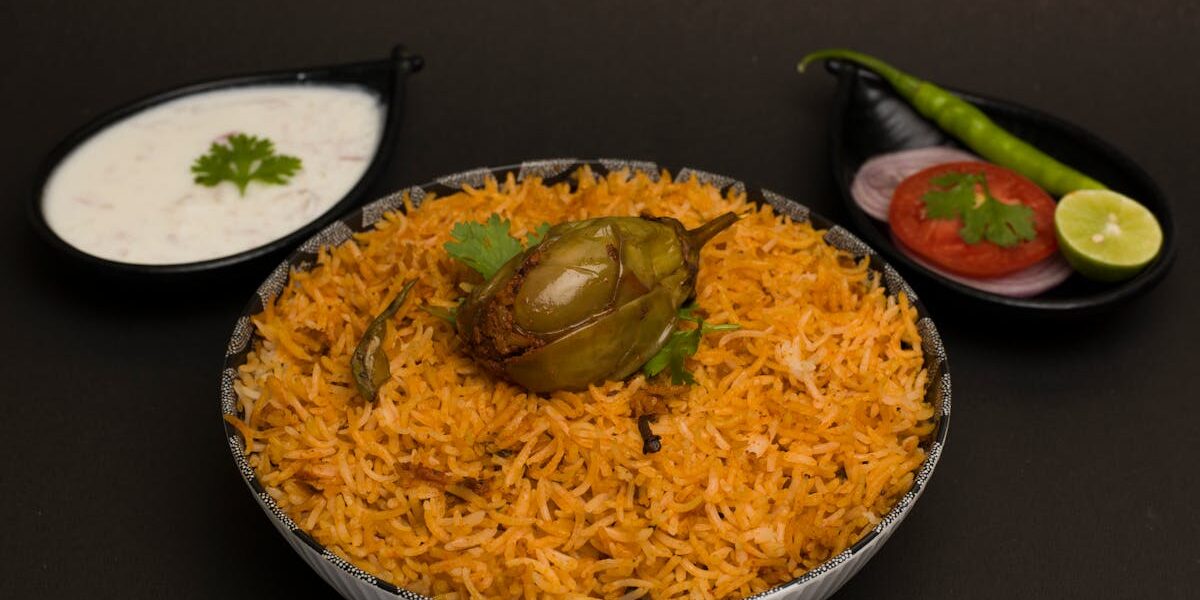
The dish that put the city on the world food map. Hyderabadi biryani is made in the kachchi (raw-meat) style: marinated raw goat is layered with par-cooked basmati, fried onions, mint, saffron milk, and ghee, sealed under a dough lid, and finished over slow heat. The meat and rice cook together in their own steam, producing the long, distinct grains and deeply spiced gravy that define the city’s most famous export. Pair it with mirchi ka salan and a thin raita. If you want to understand the technique end-to-end, our chicken biryani recipe walks through the same dum-style layering using chicken, which is more forgiving for a first attempt.
2. Mirchi Ka Salan
The mandatory companion to biryani. Long mild green chilies are slit and stuffed, then simmered in a thick gravy of ground peanuts, sesame, coconut, tamarind, and dried red chili paste. The result is sour-sweet-nutty rather than aggressively hot, and it cuts through the richness of the rice better than any other side. Without mirchi ka salan, a Hyderabadi biryani plate feels incomplete.
3. Haleem
A slow-cooked porridge of wheat, lentils, and shredded meat (usually goat or beef) cooked for six to twelve hours until everything dissolves into a thick, glossy paste. Originally from the Arab world, haleem became Hyderabadi during the Asaf Jahi period and is now the city’s defining Ramadan iftar food. Served with fried onions, lime, mint, and ginger julienne. In 2010 Hyderabadi haleem received a Geographical Indication tag from the Indian government — the first non-vegetarian dish in India to be protected this way.
4. Bagara Baingan
Small purple eggplants are slit, briefly fried, and simmered in a salan-style gravy of peanuts, sesame, coconut, tamarind, and a tempering of curry leaves and mustard seeds. The dish is the city’s most loved vegetarian preparation and is often served alongside biryani, plain bagara khana (lightly spiced rice), or sheermal flatbread.
5. Bagara Khana (Everyday Spiced Rice)
When biryani is too much work, the city makes bagara khana — a one-pot lightly spiced basmati cooked with whole garam masala, ginger-garlic, and a temper of curry leaves. It is the everyday rice of Muslim Hyderabadi households and the natural partner to dalcha or mirchi ka salan.
6. Dalcha
A sour lentil-and-mutton stew built on chana dal (split chickpea), tamarind, bottle gourd or raw mango, and bone-in goat. Dalcha is the workhorse of Hyderabadi home cooking — economical, deeply flavored, and often eaten with bagara khana for a complete meal. It is closer in spirit to a Telugu pulusu than to a North Indian dal.
7. Pathar Ka Gosht
Stone meat — thin slices of marinated mutton cooked on a slab of heated granite or basalt. The hot stone sears the outside while the residual marinade of papaya, yogurt, and spices keeps the inside tender. It is one of the oldest preparations still in regular use in the old city and is a useful reminder that Hyderabadi food is not all about long-simmer dum cooking.
8. Tala Hua Gosht
A dry-fried mutton with caramelized onions, ginger, garlic, dried red chilies, and curry leaves. It is the Hyderabadi equivalent of a high-flavor dry curry — perfect with roti or as a side to a rice meal — and a beloved Eid lunch.
9. Hyderabadi Marag (Mutton Shorba)
A clear, peppery mutton broth served at weddings and on cold mornings. It uses bone-in cuts simmered with whole spices, ginger, garlic, and a splash of coconut milk for body. Marag is the city’s preferred soup, drunk before a rich meal to wake up the palate.
10. Double Ka Meetha
The city’s signature dessert. Slices of bread are fried in ghee, soaked in saffron-and-cardamom syrup, and finished with thickened, sweetened milk (rabri), nuts, and a drop of kewra water. The name comes from the local word for sliced bread (double roti). It is dense, sweet, and unforgettable, and along with khubani ka meetha is the standard end to a Hyderabadi banquet.
11. Khubani Ka Meetha
Dried apricots are soaked overnight, simmered with sugar until jammy, and served warm with chilled custard or fresh cream. The pits are cracked open and the almond-like kernels are scattered on top. It is a clear inheritance from the Persian-Iranian side of the kitchen and one of the few Indian desserts built around dried stone fruit.
12. Sheermal and Lukhmi
Sheermal is a saffron-and-milk-enriched flatbread baked in a tandoor — slightly sweet, lightly burnished, and the traditional partner to nihari or paya. Lukhmi is a small square fried pastry stuffed with spiced mince, served as a wedding starter alongside marag. Together they bookend a formal Hyderabadi meal.
13. Irani Chai and Osmania Biscuits
Not a dish so much as an institution. Strong tea brewed with milk powder and condensed milk is served in small cups at Irani cafes like Nimrah and Subhan, alongside the slightly salty, cardamom-laced Osmania biscuit. It is the four o clock ritual that holds the old city together.
Hyderabadi Cooking Techniques You Need to Know
Hyderabadi cuisine looks elaborate from the outside, but it is built on a small set of repeatable techniques. Master these five and almost every dish in the canon is within reach.
Dum Cooking (Sealed-Pot Slow Steaming)
The single most important technique in the Hyderabadi kitchen. The pot is sealed with dough (or a tight foil-and-lid combination), placed over very low heat or a tawa (flat griddle) to diffuse the flame, and left to cook in its own captured steam. Biryani, korma, nihari, and most slow-cooked dishes depend on it. Our complete dum cooking guide walks through how to seal, time, and rest a dum pot at home without a charcoal fire.
Bhuna (Slow-Frying the Masala Base)
Onions, ginger-garlic paste, tomatoes, and spices are cooked in ghee until the oil separates and the masala turns dark and glossy. This is the foundation of every rich gravy. In Hyderabadi cooking, bhuna often goes further than in other regions: cooks will fry the masala until it almost burns, then deglaze with yogurt or stock to capture that browned flavor.
Tadka (Tempering)
Whole spices, dried red chilies, curry leaves, and sometimes mustard seeds are bloomed in hot ghee or oil and poured over a finished dish. Hyderabadi salans, dals, and even rices are routinely finished with a tadka. If you have not done this before, our tadka technique guide shows you the timing — it is the difference between a dull dal and one that sings.
Birista (Slow-Fried Onions)
Onions are sliced paper-thin, fried slowly in ghee or oil until deeply browned and crisp, then drained. Birista provides the sweetness, color, and aroma of Hyderabadi biryani, korma, and haleem. Cooks make it in large batches and store it for a week. Do not skip this step or try to substitute store-bought fried shallots — the slow caramelization is what gives the dishes their character.
Khoya / Rabri Reduction
Whole milk is reduced slowly in a wide pan, scraped off the sides repeatedly, and concentrated into either khoya (solid) or rabri (thickened with floating skin layers). This is the dairy foundation of double ka meetha, shahi tukda, and many wedding sweets. Patience is the only skill required.
Hyderabadi vs. Other Indian Regional Cuisines
A short comparison helps if you have cooked from one of the better-known regional Indian traditions and want to know what is different about Hyderabad.
| Cuisine | Staple grain | Dominant fat | Souring agent | Signature meat dish | Heat level |
|---|---|---|---|---|---|
| Hyderabadi | Aged basmati rice | Ghee | Tamarind, raw mango | Kachche gosht ki biryani | Medium-high |
| Punjabi | Wheat (naan, roti) | Ghee and butter | Yogurt, lemon | Butter chicken, tandoori meats | Medium |
| Kashmiri | Rice | Mustard oil and ghee | Yogurt, dried cockscomb | Rogan josh, gushtaba | Medium (warming, not fiery) |
| Bengali | Rice | Mustard oil | Mustard, lime, tamarind | Macher jhol (fish curry) | Low-medium |
| Kerala | Rice (raw, parboiled) | Coconut oil | Tamarind, kokum, raw mango | Meen moilee, beef fry | Medium-high |
| Goan | Rice | Coconut oil and ghee | Vinegar, kokum, tamarind | Vindaloo, xacuti | High |
| Awadhi (Lucknow) | Aged basmati | Ghee | Yogurt, kewra | Galouti kebab, dum biryani | Low (perfumed, not hot) |
The headline difference is the souring agent. Hyderabadi cooking leans hard on tamarind in a way that Awadhi (the other great dum-biryani tradition) does not. The result is that Hyderabadi food tastes more savory-tart, while Awadhi food tastes more floral-creamy. Both are correct; they are simply different aesthetics built around the same technique.
Hyderabadi Biryani: Why It Is Famous
It is worth stopping on biryani for a moment because the dish itself accounts for a huge portion of global searches related to Hyderabadi food. There are two main biryani styles in India: pakki (cooked) and kachchi (raw). In pakki biryani — common in Kolkata, Lucknow, and most North Indian cities — the meat is fully cooked before being layered with rice. In kachchi biryani — the Hyderabadi style — raw marinated meat goes straight into the pot under the rice. The cooking has to be perfectly timed so that the meat is tender at exactly the moment the rice is done.
This is harder than it sounds, which is why traditional Hyderabadi biryani relies on long marination (often overnight) and a precise ratio of par-cooked to raw rice. The marinade is acidic enough (yogurt, papaya, lime) to tenderize the meat during the cook, the rice releases just enough steam to braise it, and the seal traps everything. When it works, you lift the lid and the meat falls off the bone, the rice grains are separate and stained gold and white in pockets, and the gravy at the bottom is a concentrated jus you scoop with your fingers.
Hyderabadi biryani also has a famous accompaniment ritual. The plate is always served with mirchi ka salan, a thin onion-cucumber raita, and often a wedge of lime and pickled chilies. Eating biryani without salan is, in the city, a small social misstep.
Building a Hyderabadi Meal at Home: Menu Planning
The simplest way to think about Hyderabadi menus is in three tiers: everyday, festive, and banquet. The structure helps you decide how much to cook and what to pair with what.
Everyday Hyderabadi Meal (Weeknight Dinner)
- Bagara khana (lightly spiced rice)
- Dalcha (chana dal and mutton stew) or tomato cut (a quick sour-spiced tomato gravy)
- A simple vegetable like tala hua karela (dry-fried bitter gourd) or aloo methi
- Raita and onion salad with lime
- Fresh fruit (papaya or mango) for dessert
This is a sensible 60-minute meal once you have your fried onions and spice mixes prepped.
Festive Meal (Weekend or Eid Lunch)
- Hyderabadi mutton or chicken dum biryani
- Mirchi ka salan
- Bagara baingan
- Onion-cucumber raita
- Sheermal or naan — see our naan technique guide for the home stovetop method
- Double ka meetha or khubani ka meetha
Banquet (Wedding-Style)
- Marag (mutton broth) and lukhmi as starters
- Kachche gosht ki dum biryani as the centerpiece
- Patthar ka gosht or shikampuri kebabs
- Mirchi ka salan, bagara baingan, dum ka murgh
- Sheermal, roomali roti, ulta tawa paratha
- Hyderabadi double ka meetha, khubani ka meetha with cream, qubani-stuffed gulab jamun
- Paan and Irani chai to close
Hyderabadi Street Food and Cafe Culture
Beyond the formal cuisine, Hyderabad has a deep cafe and street-food culture worth knowing about. The Irani cafes of the old city pour the famous chai-Osmania combination, but they also serve kheema pao (spiced mince with bread rolls), bun maska (buttered brioche), khari biscuit, and dil khush (a sweet coconut-stuffed bun). At street level, the city is known for lukhmi sold from carts, fried chicken pakoras, mutton samosas, and gola chaat (a tamarind-yogurt-shaved-ice savory snack).
During Ramadan, the streets around Charminar transform: dozens of haleem stalls fire up enormous copper cauldrons, and a single neighborhood can produce a thousand kilos of haleem in a night. The smell — wheat, slow goat, ghee, and fried onions — is one of the city’s true sensory signatures.
Vegetarian Hyderabadi Cooking
The popular image of Hyderabadi food is meat-heavy, but the city has a substantial vegetarian tradition rooted in its Telugu, Marwari, and Brahmin communities. Bagara baingan is the headline dish, but the wider repertoire is rich: tamatar ki kut (a sour tomato gravy bound with chickpea flour), mirchi ki kheema (minced green chili kheema with onions and spices), khatti dal (a sour-tempered toor dal finished with curry leaves and dried red chilies), pesarattu (mung-bean dosa from the Telugu side), and gongura pachadi (sour-leaf chutney).
If you are cooking vegetarian, the Hyderabadi pantry actually gives you an advantage: tamarind, peanuts, sesame, coconut, and curry leaves carry enormous flavor on their own without any meat in the pot. A bagara khana with khatti dal and bagara baingan is a complete, satisfying meal that uses no meat at all.
How Hyderabadi Food Travels: The Diaspora and the US Market
Hyderabadi cuisine has traveled with one of the most globally distributed Indian diasporas. Cities like Edison (New Jersey), Plano (Texas), the Bay Area, Toronto, Sydney, and the Gulf all have multiple Hyderabadi biryani restaurants today, and the chain Paradise — founded as a single Irani cafe in 1953 — now has more than a hundred outlets globally. In the US, Hyderabadi biryani has become a recognized restaurant category in itself, distinct from Indian biryani or Pakistani biryani, and a generation of Telugu-speaking IT migration to the United States since 2000 has accelerated that recognition.
For home cooks outside India, the practical implication is that almost everything you need to cook authentic Hyderabadi food is now available online or at any well-stocked Indian grocery. Even kewra water, dried apricot kernels, and aged basmati can be ordered with two-day shipping. The cuisine is no longer a regional secret — it is a globally accessible kitchen you can build at home.
Tools That Make Hyderabadi Cooking Easier
You do not need specialized equipment to cook Hyderabadi food, but a small set of tools makes the work meaningfully easier.
- Heavy-bottomed pot (handi or Dutch oven): Essential for dum cooking. A 5–7 quart enameled Dutch oven works perfectly for biryani for six people.
- Flat tawa or griddle: Used under the biryani pot to diffuse heat during the dum stage. A cast-iron skillet does the same job.
- Mortar and pestle: For freshly pounded ginger-garlic and whole-spice work. A stone version is best for tough spices like cardamom and clove.
- Spice grinder: A small electric coffee grinder dedicated to spices saves hours over a manual mortar for batch work.
- Fine-mesh sieve: For straining tamarind pulp and saffron milk.
- Wide non-stick pan: For reducing milk into rabri without scorching.
- Mandoline or sharp knife: For slicing onions thin enough for birista. Uniform thickness is what produces even browning.
Common Mistakes When Cooking Hyderabadi Food at Home
Most disappointing home biryanis fail in predictable ways. A short list of the worst offenders, with fixes.
- Under-marinating the meat. Hyderabadi kachchi biryani needs the marinade to do the tenderizing. Six hours is the minimum; overnight is better. Skipping this leaves you with chewy mutton.
- Over-cooking the rice before layering. Par-boil basmati to about 70% done — when a grain is just bendable but still has a firm core. The dum stage finishes the cooking.
- Rushing the birista. Fried onions for biryani must be slowly browned in ghee until deep mahogany. Pale onions give you a pale biryani.
- Not sealing the pot. If steam escapes, the rice dries and the meat does not braise. Use a dough seal, or layer foil under the lid and weigh it down.
- Lifting the lid during dum. Do not check. Set the timer, trust it, and rest the pot 15 minutes after the heat is off before opening.
- Adding too much water. Hyderabadi biryani is a dry-bottomed dish — the rice should be fluffy, not pilaf-wet. The meat marinade plus a small amount of saffron milk is enough.
- Skipping the salan. Mirchi ka salan is not optional. It provides the moisture and tartness the biryani’s dry style needs.
Hyderabadi Food and Health
Hyderabadi food is rich — ghee, fried onions, and bone-in meat are central — but the cuisine is not as one-dimensionally heavy as it can appear. The everyday template (rice, dal, vegetable, raita) is balanced and largely vegetable-and-legume based. The big celebratory dishes (biryani, haleem, double ka meetha) are meant for special occasions, not nightly meals, and the city’s food culture clearly distinguishes between everyday and festive eating.
Where home cooks tend to go wrong nutritionally is in over-applying festive techniques to everyday food: using a cup of ghee in a daily dal, or making biryani for four people from two kilos of meat. Scaling back the fat and meat in routine cooking — while keeping the spice complexity — gets you closer to how Hyderabadi families actually eat.
Frequently Asked Questions About Hyderabadi Food
Is Hyderabadi food the same as South Indian food?
No. Hyderabad sits in the Deccan, geographically in southern India, but its cuisine is a Muslim courtly tradition built on rice, slow-cooked meat, dum technique, and Persian aromatics. South Indian cuisine — the food of Tamil Nadu, Andhra, Karnataka, and Kerala — is generally rice-and-lentil-based, vegetarian-leaning, lighter on dairy, and dominated by sambar, rasam, dosa, idli, and coconut. Hyderabadi food shares the Telugu sourness (tamarind, curry leaves, peanuts) but its meat techniques, breads, and sweets are Mughlai-Persian. Think of Hyderabadi as a hybrid: Mughlai bones, Deccan soul.
What is the difference between Hyderabadi and Lucknowi (Awadhi) biryani?
Hyderabadi biryani is kachchi — raw marinated meat is cooked under the rice. Lucknowi biryani is pakki — the meat is cooked first, then layered with rice. As a result Hyderabadi biryani is more intense and slightly drier, with a stronger gravy at the bottom and a savory-tart character from yogurt and tamarind notes in the masala. Lucknowi biryani is more delicate, perfumed, and pilaf-like, with a creamier finish and gentler heat. Both are excellent; they are simply different schools.
Is all Hyderabadi food spicy?
Not in the chili-burn sense. Hyderabadi food is heavily spiced (lots of whole spices, layered marinades, aromatic herbs) but the chili heat is medium rather than aggressive. Mirchi ka salan looks fiery but is actually quite mild — the long green chilies used in it are sweet, not hot. The sweets and many vegetarian dishes have no heat at all. Telangana rural food is hotter than city Hyderabadi food.
Can I make Hyderabadi biryani without a tandoor or charcoal?
Yes. Dum cooking only requires sealed slow heat, which any heavy pot on a low stovetop flame (with a tawa underneath to diffuse) will provide. Many home cooks finish biryani in a 300F oven instead, which is even more controllable. The traditional charcoal-on-the-lid technique adds a faint smoky aroma but is not essential — a small drop of liquid smoke or a brief smoking with a hot coal in a bowl can mimic it.
What is the difference between Hyderabadi and Pakistani biryani?
Hyderabadi biryani is kachchi (raw-meat dum), uses no potato or tomato in the gravy, and is rice-forward. Pakistani biryani — especially Karachi or Sindhi style — is typically pakki (precooked meat), often includes potatoes and tomatoes, uses prepared spice mixes (Shan-style masala), and is wetter and more aggressive in chili heat. They share Mughlai roots but evolved separately after 1947. Our Pakistani cuisine guide covers the Karachi tradition in detail.
What rice is best for Hyderabadi biryani?
Long-grain aged basmati. The 1121 varietal — extra-long grain, aged at least 12–24 months — is the standard for restaurant biryani. Aging dries the grain so it absorbs less water and stays separate after cooking, which is essential for the layered look of a good biryani. Avoid jasmine, sushi, or short-grain rices; they clump and turn mushy under dum. Our broader guide to choosing rice walks through how to pick aged basmati at the store.
What is the role of papaya in Hyderabadi marinades?
Raw green papaya contains papain, a natural enzyme that breaks down tough connective tissue. A spoonful of grated raw papaya in a goat marinade tenderizes the meat dramatically during a long marination. It is the secret that allows kachchi-style biryani to use raw meat without producing a chewy result. If you cannot find raw papaya, kiwi or pineapple juice works in a pinch, but use sparingly — too much and the meat turns mushy.
Is Hyderabadi food the same as Mughlai food?
They share a parent. Mughlai is the broad imperial cuisine that grew out of the Mughal court kitchens of Delhi and Agra, and it spread south with the empire. Hyderabadi cuisine is one of Mughlai’s regional descendants, but it absorbed enough Telugu, Iranian, and Arab influence over two and a half centuries of Asaf Jahi rule to become its own thing. Calling Hyderabadi food Mughlai is roughly like calling Cajun food French — technically related but missing the local layer that makes it distinctive.
What is the best season for Hyderabadi cuisine in the city?
Ramadan, full stop. The city’s old quarter transforms into an open-air iftar market for a full month, and haleem — only widely sold during this period — becomes the entire reason to be in Hyderabad. Winter (November–February) is also excellent for outdoor eating and for slow-cooked dishes like nihari and paya. Summer is hot and the city eats lighter — bagara khana, khatti dal, and curd-based dishes dominate.
What is the most underrated Hyderabadi dish?
Tomato cut. It is a five-ingredient sour-spiced tomato gravy — tomatoes, green chilies, garlic, mustard seed, curry leaves — that takes 15 minutes and tastes like the platonic ideal of a weeknight Hyderabadi dinner over plain rice. Almost no restaurant outside India serves it, but every Hyderabadi household makes it. If you want to taste what daily Hyderabadi home cooking really feels like, start there rather than with biryani.
Where to Go Next
If this guide has you ready to cook, three places are worth starting. Build a classic dum-style biryani first — the technique is the foundation for half the cuisine. Learn the dum-sealing method in detail so you can adapt it to korma and nihari. And get comfortable with tadka, because every dal, salan, and vegetable in the Hyderabadi kitchen ends with a tempering of hot ghee, spices, and curry leaves poured over the top. Once those three are second nature, the rest of the cuisine — from haleem to double ka meetha — is just a series of variations.
Hyderabadi food is what happens when a Persian court spent four centuries in a Telugu kitchen. It is the proof that a cuisine becomes great not by staying pure but by absorbing everything it can. Cook it once at home and you will understand why the people of Hyderabad still talk about a single plate of biryani the way other cities talk about football clubs.

Mei Lin Chen
Mei Lin Chen is an Asian food writer and recipe developer. Melbourne-raised and London-based, she has spent over a decade exploring the rice paddies, hawker stalls, and home kitchens of South-East and East Asia. Her recipes balance traditional technique with everyday practicality.