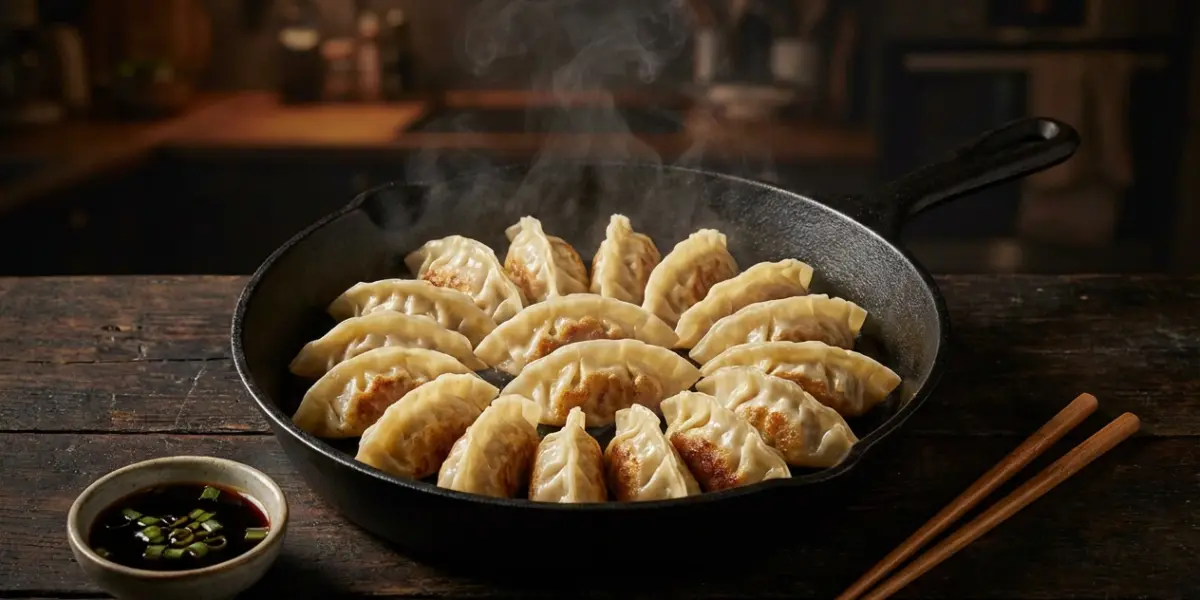
Gyoza are Japan’s answer to the dumpling — thin-skinned, expertly pleated parcels of seasoned pork and cabbage that are pan-fried to a golden crisp on one side and steamed to tender perfection on the other. They are a staple of Japanese home cooking and ramen shop menus alike, beloved for their contrast of textures: a shatteringly crisp bottom, a soft, slightly chewy skin, and a juicy, flavourful filling. Once you master the folding technique and the two-step pan-fry-steam method, you’ll have a recipe you return to again and again.
What Is Gyoza?
Gyoza (餃子) are directly descended from Chinese jiaozi, introduced to Japan during the early 20th century, primarily through Japanese soldiers who encountered the dish in China during wartime. What Japan did with the concept was characteristically its own: the wrappers were made thinner and more delicate, the filling was adjusted to local palates — lighter on garlic and ginger, with a pronounced cabbage sweetness — and the cooking method was refined into the now-iconic yaki-gyoza style, where the dumplings are first pan-fried in a hot skillet to develop a golden crust, then steam-cooked under a lid with a splash of water until the filling is cooked through and the wrappers turn silky.
The result is a dumpling that is distinctly Japanese in character, even if its Chinese origins are clear. Chinese jiaozi tend to be boiled or steamed, and the skins are somewhat thicker. Japanese gyoza are thinner-skinned, crisper, more aggressively seasoned with sesame oil, and served with a soy-rice vinegar-chilli oil dipping sauce that would be unfamiliar at a Chinese dinner table.
Gyoza have become a cultural institution in Japan. Utsunomiya city in Tochigi Prefecture is famous as the gyoza capital of Japan, with an extraordinary concentration of gyoza restaurants. At home, making gyoza is a communal activity — families often gather around the kitchen table to fold hundreds of dumplings together before a celebration or as a weekend cooking project. Learning to pleat gyoza properly takes practice, but the results are deeply rewarding, and even imperfect gyoza taste incredible.
Ingredients
For the Filling
- 300g (10.5 oz) ground pork (around 20% fat — avoid extra-lean, which will be dry)
- 200g (7 oz) napa cabbage (about 4–5 large leaves), very finely chopped
- 3 spring onions (scallions), finely minced
- 2 cloves garlic, minced to a paste
- 1 tablespoon fresh ginger, grated on a fine microplane
- 1.5 tablespoons soy sauce
- 1 tablespoon sesame oil
- 1 tablespoon sake (or dry sherry)
- 1 teaspoon sugar
- 1/2 teaspoon white pepper (or black pepper)
- 1/4 teaspoon salt
For the Wrappers
- 40–45 round gyoza wrappers (store-bought, 8–9cm / 3–3.5 inch diameter) — OR make your own (see below)
For Homemade Wrappers (Optional)
- 200g (1.5 cups + 2 tbsp) all-purpose flour, plus extra for dusting
- 100ml (6.5 tbsp) just-boiled water
- 1/4 teaspoon salt
For Cooking
- 2–3 tablespoons neutral oil (vegetable, canola, or sunflower)
- 60–80ml (1/4–1/3 cup) water, per batch
For the Dipping Sauce
- 3 tablespoons soy sauce
- 2 tablespoons rice vinegar
- 1 teaspoon chilli oil (la-yu / rayu), or to taste
Key Ingredient Notes
- Gyoza wrappers: Japanese gyoza wrappers are thinner and slightly drier than Chinese dumpling wrappers. Look for wrappers labelled ”gyoza skins” at Japanese or Asian grocery stores. Chinese dumpling wrappers are thicker and work as a substitute, but the texture will differ.
- Ground pork: Fat content matters enormously in gyoza. A filling made from very lean pork will be dry and crumbly. Standard ground pork from the supermarket (typically 15–20% fat) is ideal.
- Napa cabbage: The cabbage must be treated before use. Chop it very finely, toss with a pinch of salt, and let it sit for 10 minutes. Then squeeze out every drop of liquid you can. Wet cabbage will make the filling watery and the wrappers soggy.
- La-yu (chilli oil): Japanese chilli oil is available at Japanese grocery stores and is milder and more sesame-forward than Chinese chilli oil. Either works for the dipping sauce — adjust to your heat preference.
How to Make Gyoza
- Prepare the cabbage. Finely chop the napa cabbage into pieces no larger than 5mm. Toss with a pinch of salt and set aside in a colander for 10 minutes. The salt will draw out excess moisture. After 10 minutes, take handfuls of cabbage and squeeze firmly over the sink to expel as much water as possible. The drier, the better.
- Make the filling. Combine the ground pork, squeezed cabbage, minced spring onions, garlic, grated ginger, soy sauce, sesame oil, sake, sugar, white pepper, and salt in a large bowl. Mix well, using your hands or chopsticks, in one direction (clockwise or counter-clockwise) for about 2–3 minutes until the filling becomes cohesive and slightly sticky. This develops the proteins and gives the filling a pleasant, slightly springy texture when cooked. Taste a small amount by microwaving a teaspoon of filling for 20 seconds — adjust seasoning if needed.
- Make homemade wrappers (if doing so). Stir the salt into the hot water until dissolved. Add this water to the flour in a bowl, mixing with a fork or chopsticks until it comes together. Knead for 5–7 minutes on a lightly floured surface until smooth and elastic. Cover with a damp cloth and rest for 20 minutes. Roll the dough into a long cylinder and cut into 40–45 equal pieces. Roll each piece into a circle about 8–9cm (3–3.5 inches) in diameter, slightly thinner at the edges than the centre.
- Set up your wrapping station. Have your wrappers, a small bowl of water, and a lined baking tray ready. Keep unused wrappers covered with a damp cloth to prevent them drying out.
- Pleat the gyoza. Place one wrapper flat in the palm of your non-dominant hand. Spoon a rounded teaspoon (about 12–15g) of filling into the centre — do not overfill. Dip a finger in water and run it along the outer half of the wrapper (the half furthest from you). This is the sealing edge. Fold the wrapper in half to create a semicircle, but do not press the full edge closed yet.
- Create the pleats. Hold the sealed centre point between your thumb and index finger. Working from the centre outward, use your other index finger and thumb to create small folds — pinch a small fold on the front layer only, pressing it against the flat back layer. Aim for 4–5 pleats on each side of centre, which gives you a crescent-shaped dumpling with a distinctive pleated top. Press each pleat firmly to seal. The back of the dumpling should be smooth; only the front is pleated. Set finished gyoza flat-side down on the tray and curve them slightly into a crescent shape.
- Cook in batches. Heat a heavy-bottomed flat-based pan (a cast iron or non-stick skillet works best) over medium-high heat. Add 1 tablespoon of oil. When the oil is shimmering and hot, carefully place the gyoza flat-side down in the pan. Do not crowd them — leave a little space between each. You will likely need to cook in 2–3 batches. Fry undisturbed for 2–3 minutes until the bottoms are deeply golden and starting to crisp.
- Steam the gyoza. Once the bottoms are golden, quickly pour 60–70ml (about 1/4 cup) of water into the pan — it will spit and steam aggressively, so stand back. Immediately cover the pan tightly with a lid. Reduce heat to medium. Steam for 4–5 minutes until all the water has evaporated and the gyoza wrappers are cooked through and translucent.
- Crisp the bottoms again. Once the water has fully evaporated, remove the lid and let the gyoza cook for another 1–2 minutes on medium-high to re-crisp the bottoms. Drizzle a few drops of sesame oil around the edge of the pan at this point if desired. The bottoms should be deeply golden brown and slightly crispy.
- Remove from the pan. Slide a spatula under the gyoza carefully to release them. If they are sticking, a gentle shaking of the pan will usually free them. Serve immediately, crisp-side up, with the dipping sauce on the side.
Tips for the Best Gyoza
- Squeeze the cabbage dry. This cannot be overstated. Excess moisture in the cabbage is the most common reason gyoza wrappers become soggy or burst during cooking. Take time to squeeze, and squeeze again.
- Mix the filling in one direction. Stirring the filling in one consistent direction develops the proteins in the pork and creates a cohesive, bouncy texture in the finished dumpling. Haphazardly mixed filling tends to be crumbly.
- Don’t overfill. A heaped teaspoon of filling is enough. Overfilling makes pleating difficult and causes the gyoza to burst during cooking. Under-filling is better than overfilling.
- Use a flat-bottomed pan. The flat bottom ensures every gyoza makes even contact with the oil for a uniformly crisp base. A wok or pan with curved sides will give uneven results.
- Freeze for later. Gyoza freeze beautifully raw. Arrange them in a single layer on a baking sheet and freeze until solid (about 1–2 hours), then transfer to a freezer bag. Cook directly from frozen — just add 2–3 extra minutes of steam time with the lid on. Making a large batch and freezing half is one of the most satisfying things you can do in an Asian kitchen.
Variations
Chicken Gyoza
Substitute the pork with 300g (10.5 oz) ground chicken thigh meat (not breast — it will be too dry). Add an extra teaspoon of sesame oil and a small amount of grated shiitake mushroom to compensate for the lower fat content and add umami depth. Season with the same marinade as the pork version.
Shrimp and Pork Gyoza
A classic variation found in many Japanese gyoza restaurants. Replace 100g (3.5 oz) of the ground pork with finely chopped raw prawns (roughly 8–10 medium prawns). The shrimp adds a sweet, bouncy texture to the filling. Chop the prawns so that some pieces are very fine and some are slightly larger, giving the filling varied texture.
Vegetarian Gyoza
Replace the pork with a combination of finely chopped firm tofu (pressed well to remove moisture), shiitake mushrooms, glass noodles (pre-soaked and finely chopped), and napa cabbage. Season with soy sauce, sesame oil, ginger, and garlic. The tofu provides protein and absorbs the seasoning well. An egg beaten into the filling helps bind it if you are not fully vegan.
What to Serve With Gyoza
- Gyoza dipping sauce: The classic combination of soy sauce, rice vinegar, and la-yu (Japanese chilli oil) is the canonical accompaniment. Each person mixes it to their preferred heat level. Ponzu (citrus soy sauce) is a lighter, more aromatic alternative.
- Ramen: In Japan, gyoza are the default side dish at ramen restaurants. A bowl of tonkotsu, shoyu, or miso ramen alongside a plate of crispy gyoza is one of the great comfort food combinations in Japanese cuisine.
- Steamed rice and miso soup: For a simple, satisfying home meal, serve gyoza with a bowl of plain steamed rice and a bowl of miso soup. The combination is light enough to let the gyoza shine as the centrepiece.
- Japanese cucumber salad: A quick sunomono (cucumber salad) dressed with rice vinegar, soy sauce, and a little sugar provides a refreshing, acidic contrast to the richness of the pork filling and sesame oil.
Storage and Reheating
Cooked gyoza are best eaten immediately while the bottoms are still crispy. If you have leftovers, allow them to cool completely and store in an airtight container in the refrigerator for up to 2 days. To reheat, place in a lightly oiled pan over medium heat and fry until the bottoms are crispy again, adding a small splash of water and covering briefly to heat through the filling.
Raw, uncooked gyoza freeze exceptionally well and this is the preferred way to preserve them. Arrange raw gyoza in a single layer on a parchment-lined baking sheet without letting them touch. Freeze for 1–2 hours until solid, then transfer to a freezer bag or airtight container. They will keep for up to 3 months. Cook directly from frozen — do not thaw first. Follow the same pan-fry-and-steam method, but extend the steaming time by 2–3 minutes and check that the filling is cooked through before serving.
When making a large batch, consider cooking only what you plan to eat and freezing the rest raw. A well-stocked freezer full of homemade gyoza means a restaurant-quality meal is always 15 minutes away.