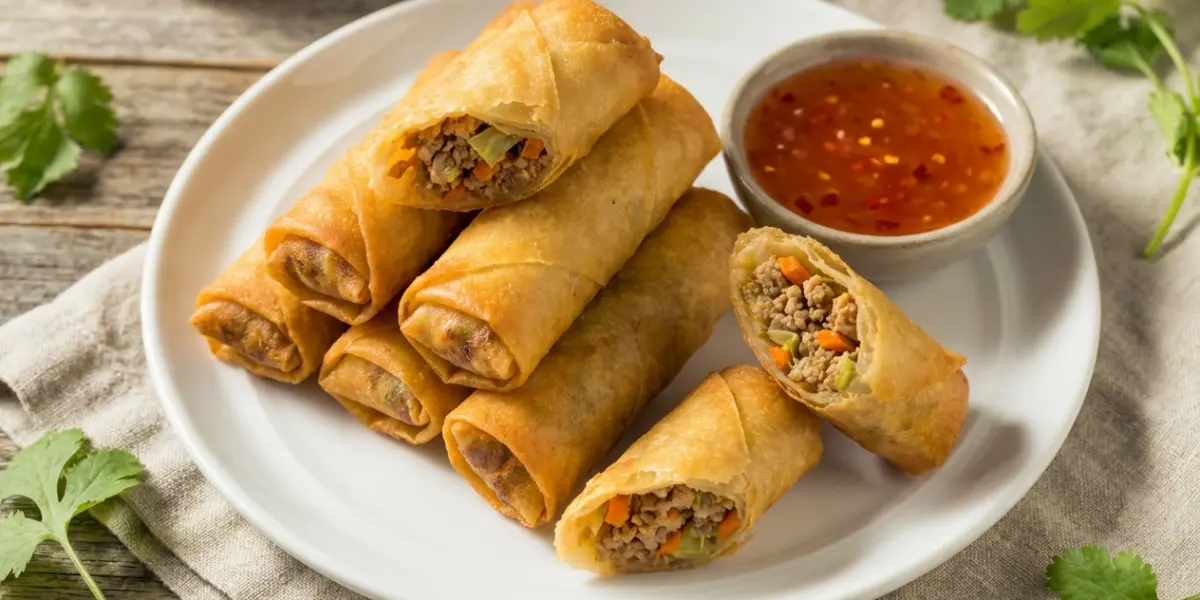
Lumpia is the Filipino spring roll — crispy, golden, and filled with a savory mixture of pork, vegetables, and aromatics that has made it the centerpiece of every Filipino celebration table. Whether fried until shatteringly crisp or served fresh wrapped in rice paper, lumpia is a dish that disappears within minutes of hitting the table.
What Is Lumpia?
Lumpia came to the Philippines through Chinese traders and immigrants, descended from the same family of dishes as Chinese spring rolls and Vietnamese chả giò. Over centuries, Filipino cooks adapted the recipe to local tastes, making it distinctly their own — thinner wrappers, a finer filling, and a technique that produces an exceptionally crispy shell when fried.
The two main forms are lumpia shanghai (fried, finger-sized rolls filled entirely with ground pork and aromatics) and fresh lumpia (lumpiang sariwa), which uses soft wrappers filled with stir-fried vegetables and sometimes shrimp or pork, served at room temperature with a sweet garlic sauce. The fried version is by far the more popular at parties and family gatherings. A batch of two to three dozen disappears fast.
The filling is seasoned simply — garlic, onion, carrots, and a touch of soy sauce — and bound with egg so it holds together inside the wrapper. Authentic lumpia uses thin, wheat-based spring roll wrappers (not the thicker egg roll wrappers). The thin wrappers blister and crisp beautifully in hot oil, producing the characteristic snap when you bite through.
Ingredients
For the filling (makes approximately 30 rolls):
- 500g (1.1 lbs) ground pork (not too lean — 80/20 fat ratio works best)
- 1 medium carrot, finely grated
- 3 spring onions (scallions), finely sliced
- 4 cloves garlic, minced
- 1 small yellow onion, finely diced
- 2 tbsp soy sauce
- 1 tsp sesame oil
- 1 tsp ground black pepper
- 1 egg, beaten (for binding)
- 1 tsp salt
For assembly and frying:
- 30 sheets thin spring roll wrappers (25 cm / 10-inch squares), thawed if frozen
- 1 egg, beaten (for sealing)
- Neutral oil for deep frying (canola, vegetable, or sunflower)
For dipping:
- Sweet chilli sauce, or banana ketchup, or a mixture of soy sauce and calamansi juice
Ingredient notes: Thin spring roll wrappers are sold frozen in most Asian supermarkets — look for the 25cm square variety, not the thicker egg roll wrappers. Let them thaw fully before separating or they will tear. The ground pork should have some fat — lean pork produces a dry, crumbly filling.
How to Make Lumpia
- Make the filling: In a large bowl, combine the ground pork, grated carrot, spring onion, garlic, diced onion, soy sauce, sesame oil, black pepper, salt, and beaten egg. Mix thoroughly with your hands until everything is evenly combined. Do not overmix or the pork will become dense.
- Test the seasoning: Fry a small teaspoon of filling in a pan. Taste it and adjust salt, pepper, or soy sauce before rolling the full batch. This step prevents an entire batch of under-seasoned rolls.
- Set up your rolling station: Separate the spring roll wrappers carefully and lay them out. Have the beaten egg ready in a small bowl with a pastry brush or your finger for sealing. Keep unused wrappers covered with a damp cloth to prevent drying.
- Position the wrapper: Place one wrapper on your work surface in a diamond orientation (corner pointing toward you). Place 2 tablespoons of filling in a compact log shape across the lower third of the wrapper, leaving 3 cm (1 inch) of space on each side.
- Roll tightly: Fold the bottom corner up over the filling and tuck it snugly underneath. Fold both side corners in toward the center. Roll forward firmly, keeping the roll tight. Brush the top corner with beaten egg and seal.
- Repeat until all the filling is used. Place finished rolls seam-side down on a tray. At this point they can be refrigerated for up to 24 hours or frozen for 3 months.
- Heat the oil: Pour oil into a heavy-bottomed pot to a depth of 8 cm (3 inches). Heat to 175°C (350°F). Use a thermometer — oil that is too cool produces greasy rolls; too hot burns the wrapper before the filling cooks through.
- Fry in batches: Carefully lower 6–8 rolls into the hot oil. Do not crowd the pot. Fry for 4–5 minutes, turning once, until deep golden brown and crispy.
- Drain and serve: Remove with a slotted spoon or spider strainer and drain on a wire rack or paper towels. Serve immediately with dipping sauce.
Tips for the Best Lumpia
- Roll tightly, no air pockets. Air inside the roll expands during frying and can burst the wrapper. Press the filling firmly as you roll and keep the roll snug at every step.
- Chill the rolls before frying. Refrigerating assembled lumpia for 30 minutes helps the filling firm up, making them easier to handle and less likely to open during frying.
- Maintain oil temperature. Check the oil temperature between batches. It drops when cold rolls go in. Let it return to 175°C before adding the next batch.
- Freeze for parties. Lumpia freeze exceptionally well before frying. Lay them on a baking sheet, freeze until solid, then transfer to a bag. Fry directly from frozen, adding 1–2 minutes to the cooking time.
- Thin wrappers only. Thick egg roll wrappers produce a doughy texture, not the paper-thin crisp shell that makes lumpia distinctive. The right wrappers look almost translucent before frying.
Variations
Lumpiang Sariwa (Fresh Lumpia): Use soft, crepe-like wrappers instead of fried ones. Fill with stir-fried heart of palm, shrimp, pork, and vegetables. Fold and serve at room temperature, drizzled with a sweet soy-garlic sauce thickened with cornstarch. A much lighter preparation, popular at formal Filipino gatherings.
Lumpiang Togue (Bean Sprout Lumpia): The filling is primarily bean sprouts stir-fried with pork, tofu, and carrots. The high moisture content means these must be fried immediately after rolling. A common everyday version sold as street food throughout the Philippines.
Banana Lumpia (Turon): A sweet dessert variation filled with sliced saba banana and jackfruit, rolled in brown sugar before frying. The caramelized sugar creates a golden, lacquered shell. Technically a different dish but shares the same wrapper and technique.
What to Serve With Lumpia
- Banana ketchup — the classic Filipino dipping sauce, sweeter than tomato ketchup and distinctly Filipino
- Sweet chilli sauce — widely available and a crowd-pleasing alternative
- Pancit noodles — lumpia and pancit are the classic party pairing in Filipino cuisine
- Steamed jasmine rice — for a complete meal rather than a snack or party food
Storage and Reheating
Fried lumpia are best eaten within 30 minutes of frying. They lose crispness quickly as they cool. To reheat, place in an air fryer at 190°C (375°F) for 3–4 minutes or on a wire rack in a 200°C (400°F) oven for 8–10 minutes. Do not microwave — they will turn soggy. Unfried assembled lumpia keep in the refrigerator for up to 24 hours and in the freezer for up to 3 months. Fry directly from frozen without thawing.