Last updated: March 27, 2026
Gujarati cuisine is one of India’s most distinctive regional traditions, instantly recognizable for its sweet-savory balance, its dazzling vegetarian range, and its disciplined thali structure. Coming from the western Indian state of Gujarat, this is a food culture shaped by merchant trade routes, Jain and Vaishnav vegetarianism, hot coastal weather, semi-arid farmland, and centuries of frugal home cooking that elevated humble flours, lentils, and vegetables into some of the most refined plant-based food on the subcontinent. Where Punjabi food leans on butter, cream, and tandoor smoke, and Hyderabadi food revolves around layered biryanis and Mughal richness, Gujarati cooking moves in the opposite direction — light, lifted, gently sweetened, slightly sour, and built around grains and pulses rather than meat.
For Americans and global home cooks, Gujarati food is having a quiet moment. Dhokla has become a familiar snack on brunch tables. Thepla travels in lunchboxes from Mumbai to Manhattan. Khaman, khandvi, and undhiyu are showing up on Indian restaurant menus that used to default to a generic North Indian template. This guide walks through the history, regions, essential pantry, must-try dishes, signature techniques, a comparison with other Indian cuisines, meal planning tips for a complete Gujarati thali, and the questions home cooks ask most often. If you are new to Indian regional cooking, start with our broader Indian food guide first; if you already know your way around tadka and tamarind, dive straight in.
A Short History of Gujarati Cuisine
Gujarat sits on the western edge of India, jutting into the Arabian Sea with the longest coastline of any Indian state. For more than two thousand years, this geography turned the region into a maritime crossroads. Gujarati merchants traded with Egypt, the Persian Gulf, the Swahili Coast, Indonesia, and southern China long before European colonial powers arrived. Spices, dried fruits, sugar, peanuts, and grains all moved through Gujarati ports, and the food culture absorbed influences from each route while keeping its own clear identity.
The deepest single influence is religious. Jainism, founded in the region, mandates strict vegetarianism and avoids root vegetables that uproot whole plants. Vaishnav Hindu traditions across Gujarat also emphasize ahimsa, or non-violence toward animals. The combined effect was that an enormous share of the population — and almost all of the powerful merchant class — ate without meat, fish, eggs, or sometimes onions and garlic. Cooks responded by developing an extraordinary repertoire of dishes built on legumes, gram flour, dairy, grains, and seasonal vegetables. The result is arguably the most sophisticated vegetarian cuisine in the world, comparable in depth to the temple cooking of Tamil Nadu but with a very different flavor compass.
Climate matters too. Much of Gujarat is semi-arid, with searing summers, heavy monsoon, and a short cool season. Hot weather rewards lighter, slightly sweet foods that cool the body; jaggery and sugar in dal and shaak are partly a physiological response to heat and salt loss. Long agricultural seasons gave the cuisine its love affair with green vegetables in winter — culminating in undhiyu, the slow-cooked winter casserole — while the dry stretches encouraged preserved foods like pickles, papad, and dried gourds. Trade brought peanuts from the Americas via Portuguese routes; today Gujarat is one of India’s largest peanut producers, and groundnut oil is the default cooking fat across the state.
The cuisine also reflects social structure. Merchant households developed a portable food culture for long journeys — theplas, khakhras, sukha nashta — that could survive heat and travel. Temple kitchens refined satvik cooking with restrained spicing and abundant ghee. Farming communities built hearty winter dishes around millet rotla and seasonal greens. Royal households in Kutch and Saurashtra layered in Rajput and Sindhi influences, sneaking in some non-vegetarian dishes at the margins. The Gujarati thali we recognize today is essentially a portrait of this entire society on one plate.
The Regions of Gujarat and How They Cook
Gujarati cuisine is not monolithic. Locals will quickly tell you that Surti food is different from Kathiawadi food, and that Kutchi cooking shares as much with Sindh as with the rest of Gujarat. Understanding these regional differences is the fastest way to make sense of the menu in any serious Gujarati restaurant.
Surti Cuisine (South Gujarat)
Centered on the city of Surat, this is the richest, most indulgent style. Surti food leans into ghee, dairy, and green chilies, with a famous love of winter vegetables. The flagship dish, undhiyu, comes from here — a slow-cooked medley of green beans, purple yam, sweet potato, baby eggplant, raw banana, methi muthia, and surti papdi beans, traditionally cooked upside down in an earthenware pot buried in hot embers. Surti khaman is fluffier and more lemony than the Ahmedabad version. Locho (a Surti steamed gram-flour snack), ponkh (tender green millet kernels eaten only for a few winter weeks), and the city’s famous Surti Ghari sweets all come from this lush southern district.
Kathiawadi Cuisine (Saurashtra Peninsula)
The Saurashtra peninsula in western Gujarat produces a more rustic, more aggressively spiced style. Kathiawadi food uses bold red chili, garlic, and sesame, with less sugar than central or southern Gujarat. Dishes like sev tameta nu shaak (tomatoes simmered with crunchy chickpea sev), ringna no oro (smoky mashed eggplant), and bajra rotla with garlic chutney and white butter are defining classics. Lasaniya bataka — potatoes drowned in red chili and garlic — captures the regional palate: punchy, oil-slicked, and unapologetic. The peninsula’s dry climate and pastoralist heritage also produced excellent dairy, and Kathiawadi households are famous for thick chaas, fresh white butter, and crumbly khoya.
Kutchi Cuisine (Kutch District)
Kutch, the vast arid district bordering Pakistan’s Sindh province, has its own distinct cooking. Bajra (pearl millet) and jowar (sorghum) replace wheat as everyday grains. Kutchi dabeli — a spiced potato mix in a soft bun with peanuts, pomegranate, and chutneys — is one of India’s great street snacks. Khichdi-kadhi is the universal comfort food, and lola (millet flatbread with green garlic and ghee) is a winter classic. Because Kutchis include sizeable Muslim and Memon communities, the region also has a small but rich tradition of non-vegetarian dishes that you will not find elsewhere in Gujarat.
Central and North Gujarati Cuisine
Ahmedabad, Vadodara, and the surrounding districts represent the cuisine most outsiders associate with Gujarat: light, sweet, varied, and built around the classic thali. Steamed snacks like dhokla and khaman, the rolled chickpea snack khandvi, the layered methi thepla, and a wide range of mildly sweetened dals come from this belt. Sweet shops here perfected mohanthal, sutarfeni, ghughra, and mohanthal-style cardamom fudges. This is the Gujarati food most likely to land on an Indian buffet in Chicago or London, and most likely to ease an outsider into the cuisine.
Essential Gujarati Ingredients (Pantry Table)
Building a Gujarati pantry is more about technique-ready staples than rare imports. Most ingredients are also useful across the broader Indian repertoire, and many overlap with our guides to curry leaves, turmeric, and tamarind. The table below covers the workhorses you will use again and again.
| Ingredient | Gujarati Name | Role in the Cuisine | Notes for Home Cooks |
|---|---|---|---|
| Gram flour | Besan / Chana no lot | Backbone of dhokla, khandvi, khaman, kadhi, and many farsan snacks | Buy fresh; old besan turns bitter. Sift before batter use. |
| Wheat flour | Ghau no lot | Used for rotli, thepla, bhakhri, puris | Stone-ground atta gives the right chew. |
| Pearl millet | Bajra | Winter staple for rotla, lola | Best used freshly milled; toasts beautifully on a hot tava. |
| Sorghum | Jowar | Alternative grain for rotla and khichdi | Gluten-free; high in fiber. |
| Toor dal | Tuver dal | Daily dal base across Gujarat | Soak 30 minutes; pressure cook with turmeric and ghee. |
| Moong dal | Mag ni dal | Used for khichdi, light dals, sprouted salads | Yellow split moong cooks in 20 minutes. |
| Peanuts | Singdana | Add crunch and richness to shaak, undhiyu, and chutneys | Roast and skin them yourself for the best flavor. |
| Jaggery | Gud | The signature sweetener in dal, kadhi, and chutneys | Look for organic, dark, mineral-rich blocks. |
| Tamarind | Aamli | Provides sourness in chutneys, dal, and undhiyu | Soak pulp in warm water; strain for a smooth paste. |
| Kokum | Kokum | Coastal souring agent for kadhi-like drinks and curries | Tastes brighter and less astringent than tamarind. |
| Cumin seeds | Jeeru | Anchor of nearly every tadka | Whole seeds, bloomed in hot oil or ghee. |
| Mustard seeds | Rai | Pop in hot oil at the start of a tadka | Use black or brown mustard; yellow is for pickling. |
| Asafoetida | Hing | Adds umami depth in onion-and-garlic-free Jain cooking | Buy compounded hing; a pinch goes a long way. |
| Turmeric | Haldi | Color, earthiness, anti-bacterial role in dals | Fresh turmeric pickled in lemon is a winter delicacy. |
| Green chili and ginger | Mari and adu | Pounded together for ginger-chili paste in many shaaks | Make a small batch fresh weekly. |
| Curry leaves | Mitho limdo | Tadka aromatic for kadhi, dal, and shaak | Frozen leaves work in a pinch; dried ones lose almost all flavor. |
| Ghee | Ghee | Finishing fat for dal, thepla, and sweets | Homemade cultured ghee tastes nuttier than store-bought. |
| Yogurt | Dahi | Base of kadhi, marinades, and chaas | Full-fat is essential for stable cooking. |
| Sev and gathiya | Sev / Gathiya | Crunchy garnishes and standalone snacks | Buy fresh from an Indian grocer; staleness ruins them. |
10+ Must-Try Gujarati Dishes
Below is a working short list. Each dish is a doorway into a wider category, so think of them as anchors rather than the whole menu. Together they give you a strong overview of the cuisine, from morning snacks through dinner sweets.
1. Dhokla
Steamed, savory sponge cakes made from fermented gram flour and rice batter, finished with a quick tadka of mustard seeds, sesame, green chili, and curry leaves. Dhokla is light, springy, and gently tangy from the natural fermentation. The Khaman variation skips the rice and uses pure besan with a leavening boost — fluffier, brighter yellow, more lemony. Both are eaten as breakfast, tea-time snack, or part of a thali, always with green chutney and a sweet date-tamarind chutney.
2. Khandvi
Possibly the most technically demanding everyday dish in Indian cooking. Gram flour and yogurt are whisked smooth, then cooked relentlessly on the stovetop until the mixture transforms from a thin slurry into a satin-smooth, just-set paste. It is then spread paper-thin on the back of trays, allowed to cool, sliced into ribbons, and rolled into tight bite-size spirals. Topped with mustard seeds, sesame, fresh coconut, and cilantro, khandvi is silky, tangy, and savory all at once — a great test dish for a confident home cook.
3. Thepla
A thin, soft, slightly spicy flatbread made with whole wheat flour, fresh fenugreek leaves (methi), yogurt, and warming spices. Theplas keep for days at room temperature, which is why every Gujarati grandparent packed them for train journeys, plane trips, and overseas visits to grandchildren. Eat fresh with ghee and chunda (sweet mango pickle), or pack with masala chai for the road.
4. Undhiyu
Gujarat’s grand winter casserole. Surti papdi beans, baby eggplant, purple yam, sweet potato, raw banana, and methi muthia dumplings are layered in an earthenware pot with green garlic, ginger, chili, fresh coconut, peanuts, and sesame masala, then slow-cooked until everything is tender and intermingled. Traditionally cooked upside down (undhu = inverted) in pit ovens, the home version uses a heavy pot or pressure cooker. Served at weddings, Uttarayan kite festivals, and big family gatherings.
5. Gujarati Kadhi
A pale yellow yogurt soup thickened with gram flour, lightly sweetened with jaggery, and finished with a tadka of curry leaves, cumin, mustard, ginger, and cinnamon. The combination of sour yogurt, sweet jaggery, and aromatic tadka creates Gujarat’s signature flavor in a single dish. It is thinner and sweeter than Punjabi kadhi, which loads up on pakoras and turns deep gold. Ladle generously over white rice or khichdi.
6. Khichdi
Mung dal and rice cooked together to a soft, soothing porridge. In Gujarat, khichdi-kadhi is the universal comfort dinner: a bowl of plain khichdi topped with ghee, paired with hot kadhi, papad, and pickle. Some households add seasonal vegetables for vagharelu khichdi (tempered khichdi). It is the dish every Gujarati cook makes when someone is sick, tired, or just home from a trip.
7. Shrikhand
Strained yogurt is whipped with sugar and cardamom until silky, then finished with saffron and slivered nuts. Shrikhand is Gujarat’s most famous dessert, traditionally eaten with hot puris during festivals. The cousin matho is similar but lighter and less sweet, and aamrakhand uses Alphonso mango pulp during mango season.
8. Fafda-Jalebi
The classic Gujarati weekend breakfast. Fafda is a long, crisp gram-flour cracker spiced with ajwain and pepper, deep-fried in groundnut oil and served with raw papaya chutney, fried green chilies, and besan kadhi. Jalebi is the famous saffron-scented sugar-syrup spiral, eaten hot. Together they are a sweet-savory ritual on Sunday mornings across Ahmedabad and Surat.
9. Handvo
A savory baked or pan-cooked cake made from fermented rice and lentil batter studded with grated bottle gourd, carrots, and peas, then crisped with a sesame-mustard-curry leaf tadka on top. Handvo is one of those dishes that proves how inventive vegetarian cooking can be — the texture sits somewhere between dense bread, polenta, and savory cake, and it keeps brilliantly the next day.
10. Sev Tameta nu Shaak
A Kathiawadi classic: ripe tomatoes simmered with mustard, cumin, asafoetida, turmeric, jaggery, and red chili, finished with crunchy chickpea sev sprinkled on top just before serving. The sev softens slightly in the gravy, creating a contrast between crisp and saucy. Quick to make, deeply satisfying, and a great example of how Gujarati cooks turn pantry basics into a complete dish in 15 minutes.
11. Bajra Rotla with White Butter
The rural Gujarat dinner: thick, slightly nutty pearl millet flatbreads patted out by hand and cooked over an open flame, served with cold homemade white butter, jaggery, and a green garlic chutney. It is winter food, energy-dense and warming, eaten by farmers and now by every fashionable Mumbai chef revisiting Indian heritage grains.
12. Methi na Gota
Fluffy fritters of besan, chopped fresh fenugreek leaves, ajwain, and crushed black pepper, deep-fried into crisp golden rounds. A staple of Gujarati monsoon afternoons, eaten hot with masala chai, raw papaya chutney, and fried green chilies. They are similar in spirit to pakoras but lighter and lacier.
13. Dabeli
A Kutchi street food sensation. Soft pav buns are split and stuffed with spiced potato mash, sweet date-tamarind chutney, garlic chutney, masala peanuts, pomegranate seeds, and crunchy sev. The combination of sweet, sour, spicy, crunchy, and creamy in one bite explains why dabeli stalls now pop up everywhere from Surat to San Francisco.
14. Mohanthal
A fudgy, grainy sweet made from besan, ghee, milk, sugar, and cardamom, cut into diamonds and studded with slivered almonds and pistachios. Mohanthal is a temple sweet associated with Lord Krishna, and a Diwali staple in Gujarati homes. It captures the patient, ghee-heavy side of the cuisine that balances out the lighter steamed snacks.
Core Techniques: How Gujarati Cooks Build Flavor
Gujarati food rewards a small set of techniques used very precisely. None of them are exotic, but the discipline around timing, temperature, and ratio is what separates a great cook from a passable one.
Tadka (Vaghar)
Called vaghar in Gujarati, the spice tempering technique is the soul of the cuisine. Hot oil or ghee is bloomed with mustard seeds, cumin, asafoetida, curry leaves, dried chili, and sometimes sesame, then poured over a dal or stirred into a vegetable. It usually happens at the very start or the very end of cooking. The fat carries fat-soluble aromas straight into the dish. We cover the general method in our tadka technique guide; in Gujarat, expect a softer, sweeter, curry-leaf-forward version compared to the chili-heavy South Indian tadka.
Steaming
Where Cantonese cooks steam fish and dumplings, Gujarati cooks steam batters. Dhokla, khaman, muthia, patra, and idada all rely on multi-tiered steamers that gently cook fermented or alkalized gram-flour mixtures into airy sponges. The key is full steam before the batter goes in, a steady flame, and total restraint — opening the lid early collapses the rise.
Fermentation
Many Gujarati snacks rely on natural lacto-fermentation of rice-and-dal batters, often overnight. The sourness deepens the flavor, the rise creates the texture, and the gut-friendly bacteria make the food easier to digest. Hot Gujarati summers ferment batters in four to six hours; cool winter kitchens need overnight or longer with a warm bath. Yogurt fermentation for dahi, chaas, and shrikhand is another daily ritual.
Balancing Sweet, Sour, Salt, Heat
The signature Gujarati flavor profile is a four-way balance: jaggery for sweetness, tamarind or yogurt for sourness, salt for grounding, green chili and ginger for heat. Almost every dal, kadhi, shaak, and chutney is built around this matrix. Outsiders often think Gujarati food is ”just sweet” because they taste only the jaggery; the magic is what surrounds it.
Layering Ghee
Ghee shows up multiple times in a single meal — in the dal, on top of the khichdi, brushing the rotli, drizzled into the shrikhand. It is both a cooking fat and a finishing element. Good homemade ghee makes a Gujarati meal taste twice as expensive as it actually is.
Hand-Rolled Flatbreads
Gujarati flatbreads come thin and many. Rotli is the daily wheat round, rolled paper-thin and puffed straight on the flame. Thepla is rolled with spiced dough. Bhakhri is thicker, biscuit-like, dry-cooked. Rotla is the rustic millet round patted by hand. Each has a slightly different dough hydration and tava (griddle) temperature. The skill is in the rolling — Gujarati grandmothers can produce a perfectly round, evenly thin rotli in under a minute.
How Gujarati Cuisine Compares to Other Indian Regional Cuisines
One of the fastest ways to understand Gujarati food is to put it next to its neighbors. Indian regional cuisines vary as dramatically as European ones do — comparing Punjabi food to Tamil food is like comparing French food to Greek food. The table below positions Gujarati cuisine in that broader landscape.
| Cuisine | Dominant Flavor | Signature Fat | Vegetarian / Non-Veg | Hero Dishes | Defining Technique |
|---|---|---|---|---|---|
| Gujarati | Sweet, sour, mildly spiced | Groundnut oil and ghee | Mostly vegetarian | Dhokla, undhiyu, kadhi-khichdi | Steaming, vaghar, fermentation |
| Punjabi | Robust, smoky, buttery | Butter, ghee, mustard oil | Mixed, dairy and meat heavy | Butter chicken, dal makhani, sarson da saag | Tandoor and slow simmer |
| Hyderabadi | Aromatic, layered, rich | Ghee | Strong meat tradition | Biryani, haleem, mirchi ka salan | Dum cooking |
| Kashmiri | Fragrant, mild, fennel-forward | Mustard oil and ghee | Lamb-heavy | Rogan josh, yakhni, dum aloo | Slow simmer in shallow degchi |
| Bengali | Pungent, mustardy, gently sweet | Mustard oil | Fish and meat alongside veg | Maacher jhol, shorshe ilish, mishti doi | Bhapa steaming and panch phoron |
| Tamil | Sour, spicy, lentil-forward | Sesame and coconut oil | Strong vegetarian tradition | Dosa, sambar, rasam, chettinad chicken | Idli batter fermentation, podi |
| Kerala | Coconut-rich, peppery, coastal | Coconut oil | Seafood-heavy | Appam, fish moilee, puttu | Coconut milk braising |
| Goan | Tangy, smoky, Portuguese-influenced | Coconut oil | Seafood and pork | Vindaloo, sorpotel, xacuti | Vinegar marination |
Notice how Gujarati cuisine is the only one in this table built almost entirely around vegetarian dishes with a sweet undertone. That single positioning — vegetarian, sweet-savory, light — explains everything about the menu, the cooking fats, and the structure of the thali. Cooks looking for non-vegetarian regional Indian cuisine should look toward our guides on Punjab, Hyderabad, Bengal, Goa, or Kerala.
The Gujarati Thali: Architecture of a Meal
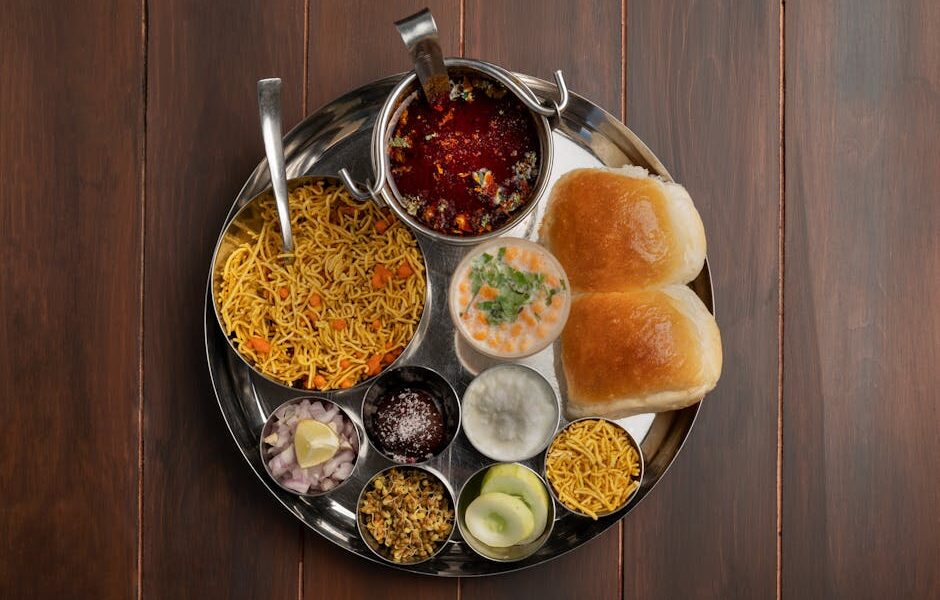
If French cuisine has the seven-course menu and Japanese cuisine has kaiseki, Gujarat has the thali. A traditional Gujarati thali is a circular metal platter holding many small bowls (vatkis) of dals, vegetables, sweets, and accompaniments around a central pile of rice and rotlis. Servers walk through the dining hall continuously refilling each bowl until you tap the rim to signal ”enough.” This is feast eating disguised as everyday food.
The structure is not random. Each component plays a role, and the order in which you eat them moves you through sweet, sour, salty, bitter, and astringent in sequence — what Ayurvedic dietary tradition calls a balanced meal. A typical thali might include the following elements.
| Component | Examples | Role in the Meal |
|---|---|---|
| Farsan (Snacks) | Dhokla, khaman, khandvi, patra, methi muthia | Opening bites with chutneys |
| Shaak (Vegetables) | Sev tameta, ringna no oro, undhiyu, dudhi chana | Main savory bowls |
| Dal and Kadhi | Toor dal with jaggery, Gujarati kadhi | Liquid components for rice |
| Rice | Plain steamed, khichdi, or jeera rice | Carb base mid-meal |
| Rotli and Thepla | Whole wheat rotli, methi thepla, bajra rotla | Breads for shaak and dal |
| Pickles and Chutneys | Chunda, methia keri, green chutney, date-tamarind chutney | Sharp accents on the side |
| Salad and Raita | Kachumber, kakdi raita, sprouted moong salad | Cool, raw, palate-cleansing |
| Sweet | Shrikhand, mohanthal, basundi, doodhpak, ghughra | Eaten early in the thali, not at the end |
| Papad and Fryums | Roasted urad papad, masala papad | Crunch and salt |
| Drinks | Chaas, masala chai, sherbet | Digestive close |
Eating the thali in the right order matters. Many families start with a small portion of the sweet alongside the snack and a sip of dal, then move through the shaaks with rotli, then the rice and dal or kadhi, and close with chaas (savory buttermilk). The sweet first is a Gujarati signature — it sets the mood and signals that this is celebratory eating, not subsistence.
Meal Planning Tips for Home Cooks
Cooking a complete Gujarati thali from scratch is an all-day project. But you can capture the spirit with a much smaller spread, especially if you plan ahead and lean on a few make-ahead components. Here are the strategies experienced Gujarati cooks use to put real food on the table fast.
Plan around a single dal and a single shaak
The everyday Gujarati dinner is not a 12-bowl thali. It is one dal, one shaak, rotli, rice, pickle, and a glass of chaas. Pick a quick toor dal with jaggery and lemon, a 15-minute sev tameta nu shaak, store-bought ajwain papad, and you have a real Gujarati meal on a Tuesday night in 40 minutes.
Use the freezer for theplas and muthias
Theplas freeze beautifully. Make a double batch on a Sunday, cool fully, stack with parchment between each, and freeze in zipper bags. Reheat on a dry tava with a dab of ghee. Methi muthia steam and freeze the same way and are the secret weapon for ”instant” undhiyu on a weeknight.
Pre-mix your spice masalas
Gujarati cooks often keep three or four ready-mixed masalas: a dhana-jeera (coriander-cumin) blend, a tea masala, a sambhar masala for dals, and a sandwich masala for chaat. A jar of fresh dhana-jeera in your fridge speeds up almost every shaak you will make.
Pressure cook in parallel
Almost every Gujarati kitchen runs a multi-tier pressure cooker: dal in the bottom, rice in the middle, vegetables in the top. Twenty minutes of unattended cooking gives you three of the four main components. Add a quick vaghar and you are done.
Keep ferments going
A daily quart of homemade yogurt makes kadhi, chaas, shrikhand, and marinades all possible. Once you are in the rhythm of setting yogurt every night, your kitchen unlocks an entire branch of the cuisine.
Don’t fear jaggery
Cooks new to Gujarati food often skip the jaggery, thinking it makes the dish too sweet. It does not — in proper proportion, a pinch of jaggery rounds out the salt and sour, exactly the way a Vietnamese cook uses palm sugar in a dipping sauce or a Thai cook uses gula melaka. Trust the recipe; you will be glad you did.
A starter week-long plan
For a home cook trying Gujarati cuisine for the first time, here is a manageable seven-day plan that introduces you to most of the core techniques without burning you out.
| Day | Main Dish | Pair With | Technique Practiced |
|---|---|---|---|
| Monday | Toor dal with jaggery and lemon | Plain rice, papad | Vaghar tempering |
| Tuesday | Sev tameta nu shaak | Hot rotli | Quick stovetop shaak |
| Wednesday | Khaman dhokla | Green chutney | Steaming and tempering |
| Thursday | Methi thepla | Chunda, plain yogurt | Spiced flatbread rolling |
| Friday | Gujarati kadhi with vagharelu khichdi | Pickle, papad | Yogurt-besan emulsion |
| Saturday | Undhiyu with puris | Jalebi for dessert | Slow vegetable braise |
| Sunday | Fafda-jalebi breakfast, full thali dinner | Shrikhand, chaas | Multi-component meal planning |
Gujarati Snacks, Sweets, and Street Food
The category Gujaratis call farsan — savory snacks — is arguably the deepest in all of India. Stop by any sweet shop in Ahmedabad or Vadodara and you will see two long counters: one of glossy mithai (sweets), one of crisp, golden farsan in massive heaps. A short tour:
- Khakhra — paper-thin, double-baked flatbread, eaten as a cracker with tea, dipped in chutneys, or topped like a bruschetta.
- Patra — colocasia leaves smeared with a tangy gram flour paste, rolled, steamed, sliced, and pan-fried until crisp.
- Muthia — steamed savory dumplings of besan, flour, and fenugreek, served plain or tempered with mustard seeds and sesame.
- Chevda — a savory mix of fried lentils, peanuts, flattened rice, raisins, and spices. The Bombay variant is famous worldwide.
- Ganthia and Fafda — chickpea-flour fritters in thick (ganthia) and ribbon (fafda) forms.
- Bhungra Bateta — Surat’s hollow puris stuffed with spiced potato, much like pani puri’s golgappa cousin.
- Lilva Kachori — winter kachori stuffed with fresh pigeon pea kernels.
On the sweet side, Gujarati mithai is wide and gloriously buttery. Mohanthal, basundi, doodhpak, ghari, sutarfeni, ghughra, and the seasonal mango-pulp-laced aamras define the dessert table. During festivals like Diwali and Navratri, sweet shops display dozens of varieties at once, and home cooks compete to produce the lightest mohanthal of the season.
Festivals and the Gujarati Food Calendar
The Gujarati year is built around food rituals. Each festival has signature dishes, and many of them are eaten only during that festival.
- Uttarayan (mid-January) — kite-flying festival paired with undhiyu, jalebi, and til chikki (sesame brittle).
- Holi — bhang, dahi vada, and homemade gujiya pastries.
- Navratri (autumn) — nine nights of fasting and dance with fariyali snacks like sabudana khichdi, sweet potato halwa, and singoda flour rotli.
- Diwali — mohanthal, magas, ghughra, chivda, and a major sweet-shop season.
- Janmashtami — milk-based satvik foods for Krishna, including basundi and panjiri.
- Paryushan (Jain festival) — strict vegetarian, no-root-vegetable cooking for eight days, an excellent showcase of the cuisine’s purity.
Even the wedding food calendar is structured. A traditional Gujarati wedding includes specific snack platters in the morning, an elaborate thali at lunch, and a sweet-heavy dinner buffet — each managed by a guild of specialist caterers who have been doing the same thing for three generations.
Health, Nutrition, and Why Gujarati Food Travels Well
Modern nutritionists tend to like Gujarati food. The cuisine is built around legumes, fermented foods, whole grains, and fresh vegetables, with relatively small amounts of dairy and oil per dish. The fermentation in dhokla, idada, and handvo makes minerals more bioavailable. Sprouted moong salads are a daily protein source. Bajra and jowar deliver fiber and slow-release energy in a way refined wheat cannot.
The cuisine does have a sugar load — between jaggery in dal, sweeteners in chutneys, and dedicated mithai — and the deep-fried farsan are unapologetically rich. Traditional Gujarati households balance this with active daily life, generous water and chaas intake, and ritual fasting days that reset the system. For Western home cooks, the trick is to scale the sweet snacks down to occasional treats and let the steamed, fermented, and vegetable-forward dishes carry the weekly rotation.
One reason the cuisine has spread so successfully is that it travels. Thepla, khakhra, theli (small bundles of farsan), and chevda were designed for merchant journeys — they last days at room temperature, do not depend on refrigeration, and rehydrate well with chai. Gujarati communities have been the largest diaspora group from India to the UK, East Africa, and North America, and the cuisine moved with them intact.
Tools You Actually Need
You do not need a Gujarati grandmother’s kitchen to cook this food, but a few specialized tools make a real difference.
- Multi-tier steamer or dhokla stand — for dhokla, khaman, idada, muthia, and patra. A stainless tiered steamer or even a tall pot with a trivet works.
- Heavy iron tava — for rotli, thepla, bhakhri, and rotla. An induction-friendly cast iron griddle is ideal.
- Pressure cooker — a small Indian-style pressure cooker is faster and cheaper than any Western multi-cooker for dal and rice.
- Hand mortar (khalbatto) — for ginger-chili paste and fresh garam masala bursts.
- Sev maker — optional but fun for homemade gathiya and bhungra.
- Wide kadai — for deep-frying gota, fafda, and ghughras.
Frequently Asked Questions
Is all Gujarati food sweet?
No. Outsiders often taste the jaggery first and call the cuisine sweet, but most Gujarati dishes are sweet-sour-salty-spicy in balance, with the sweetness held in check by tamarind, yogurt, salt, and chili. Kathiawadi food in particular skips most sweetening in favor of strong garlic and red chili, and Kutchi food sits in between.
Is Gujarati cuisine always vegetarian?
Mostly, but not exclusively. The dominant Hindu and Jain populations are strict vegetarian, and most published Gujarati cookbooks reflect that. Smaller Muslim, Memon, Parsi, and coastal Hindu communities cook fish, eggs, and meat — particularly in Kutch and along the Saurashtra coast. The vast majority of restaurant menus you’ll meet outside Gujarat are vegetarian.
What is the difference between dhokla and khaman?
Traditional dhokla is made from a fermented rice-and-chana dal batter; it is paler, slightly chewier, and gently tangy. Khaman is pure gram flour with citric acid and a leavening agent like fruit salt; it is brighter yellow, fluffier, and quicker to make. Most snack shops in India simply call both ”dhokla” today, but to a Gujarati grandparent they are very different.
How is Gujarati kadhi different from Punjabi kadhi?
Gujarati kadhi is thin, pale yellow, sweetened with jaggery, and tempered with curry leaves, cinnamon, cloves, and cumin — no pakoras. Punjabi kadhi is thick, deep golden, savory, loaded with onion pakoras, and finished with red chili. They share a yogurt-and-gram-flour base but are otherwise opposite in personality.
Can I make Gujarati food without onion and garlic?
Absolutely — much of the cuisine was designed exactly that way. Jain Gujarati cooking avoids all root vegetables including onion, garlic, potato, carrot, and ginger root. Cooks compensate with asafoetida, fennel, ginger powder, green chili, cilantro, and fresh herbs. The result is bright and full-flavored, not flat. If anything, Jain Gujarati cooking is some of the most technically interesting plant-based food anywhere.
What is undhiyu and is it hard to make at home?
Undhiyu is a slow-cooked Surti winter vegetable casserole with green beans, eggplant, yam, potato, raw banana, and methi muthia dumplings cooked in a green coconut-peanut-cilantro masala. The traditional pit-oven version is restaurant territory, but a great home version is very achievable in a heavy pot or pressure cooker. Make the methi muthia and masala ahead, then layer everything and slow-cook until tender. We pair it with biryani in our larger biryani guide for festive Indian dinners.
What’s the easiest Gujarati dish to start with?
Methi thepla. It uses widely available ingredients (whole wheat flour, fenugreek, yogurt, ginger, chili, turmeric), needs no special equipment, keeps for days, and tastes great with everything from chunda pickle to scrambled eggs. From there, move to dhokla and Gujarati kadhi.
Where can I find Gujarati food in the United States?
Look for restaurants advertising ”Gujarati thali” or ”unlimited Gujarati lunch” in cities with large Indian diasporas — Edison NJ, Jackson Heights, Iselin, Schaumburg IL, Bellevue WA, Cupertino, Houston’s Hillcroft, Atlanta’s Decatur, and southern California’s Artesia. Gujarati-run sweet shops carry the full farsan range; ask for what’s fresh that day.
Is Gujarati food good for diabetics?
The everyday cooking (dal, shaak, bajra rotla, sprouted moong salad, fermented dhokla) is very friendly to blood sugar management. The mithai and deep-fried farsan are not. Treat the sweets and fried snacks as occasional festive food, lean on the steamed and grain-forward dishes, and your weekly rotation will be remarkably balanced.
Why is sweet served at the start of a Gujarati meal?
Tradition says it greets the guest, signals abundance, and stimulates digestion. Practically, eating a little sweet at the start works as a palate primer — by the time you reach the savory courses, the contrast is sharper. It’s a structural feature of the thali, not an afterthought.
How spicy is Gujarati food?
Generally mild to moderate compared to Andhra, Sichuan, or Thai food, with notable exceptions. Kathiawadi cooking can be hot, and almost every meal includes a small bowl of fresh green chili-ginger paste or a wedge of fried green chili for diners who want more heat at the table.
What’s the best Gujarati cookbook for a beginner?
Tarla Dalal’s classic Gujarati volumes are the most accessible starting point in English. For deeper coverage, look at the family-style cookbooks now coming out of London and New York’s Gujarati diaspora. Once you have basic tadka comfort, our recipe guides and the broader Indian food guide on this site will tie the regional picture together.
Final Thoughts
Gujarati cuisine is one of the great vegetarian food cultures of the world. It is light without being thin, sweet without being cloying, frugal without being austere, and ritualized without being rigid. The thali architecture, the steamed snacks, the disciplined balance of jaggery and tamarind, and the central role of fermented gram flour together produce a body of food that is genuinely unlike anything else in India — and that translates beautifully to a Western home kitchen with very little extra equipment.
If this is your first deep dive into Gujarati food, start with the easy classics: a methi thepla on Sunday, a Gujarati kadhi-khichdi for a quiet weeknight, and a steamed dhokla for a weekend brunch. Layer in the spice work via our tadka guide, refresh your understanding of regional Indian context with our Punjabi and Kerala guides, and you’ll have a working command of one of the most generous food cultures in Asia within a couple of months. Eat well, taste the balance, and don’t fear the jaggery.

Mei Lin Chen
Mei Lin Chen is an Asian food writer and recipe developer. Melbourne-raised and London-based, she has spent over a decade exploring the rice paddies, hawker stalls, and home kitchens of South-East and East Asia. Her recipes balance traditional technique with everyday practicality.