Last updated: March 05, 2026
Bengali food is one of the great rice-and-fish cuisines of the world, born along the rivers and coast of the historic region of Bengal that today spans the Indian state of West Bengal and the country of Bangladesh. It is a cuisine of pungent mustard oil, tempered five-spice (panch phoron), the silver flash of hilsa fish, slow-simmered mutton curries, and a sweet course so refined that the city of Kolkata is often called the dessert capital of South Asia. If most Western diners think of ”Indian food” as a single curry-house menu of butter chicken and naan, Bengali cooking is the cuisine that quietly proves how varied the subcontinent really is — lighter, more delicate, more dependent on freshwater fish and seasonal greens than almost any other regional Indian style.
This complete guide walks you through the history, geography, ingredients, signature dishes, techniques, and meal traditions of Bengali cuisine. Whether you want to plan an authentic Bengali dinner, stock a Bengali pantry, or simply understand what makes a fish curry from Dhaka different from a fish curry from Chennai, you will find what you need below. Along the way we will link to recipes you can cook tonight and to ingredient guides for the building blocks every Bengali kitchen depends on, including turmeric, fresh ginger, and the foundational technique of tadka spice tempering.
What Is Bengali Food?
Bengali food is the regional cuisine of the Bengal region — historically a single cultural and linguistic area divided in 1947 into West Bengal (now part of India) and East Bengal (now Bangladesh). It is built on a few non-negotiable foundations: long-grain rice as the daily starch, freshwater and saltwater fish as the main protein, mustard oil as the dominant cooking fat, and a vegetable course at every meal. The flavor profile leans clean and aromatic rather than heavy. Where North Indian Punjabi cooking relies on cream, butter, and tomato gravies, Bengali cooking favors mustard, poppy seed, and fresh green chilies, often with very little onion or garlic in the more traditional dishes.
The cuisine is also defined by its sense of order. A traditional Bengali meal is served in courses, each with its own purpose — bitter to wake the palate, then leafy greens, then dal and vegetables, then fish, then meat, then a sour palate cleanser, and finally sweets. This sequence is so specific that it has shaped the entire structure of home cooking in the region. Few cuisines anywhere put as much thought into the order in which food is eaten.
A Short History of Bengali Cuisine
Bengal’s cuisine reflects more than two thousand years of layered influence. The Ganges and Brahmaputra deltas made the region one of the most fertile rice-growing zones in Asia, and Buddhist monastic traditions in the early centuries of the common era encouraged vegetarian cooking that still echoes through the bitter starters and elaborate vegetable dishes of a Bengali meal. Hindu Vaishnava traditions later codified the strict separation of fish and vegetable courses, while Muslim Mughal influence — especially during the 16th to 18th centuries — introduced the slow-cooked meats, biryanis, and rich kormas that now stand alongside the lighter river fish dishes.
European trade reshaped Bengal again. Portuguese settlers in the 16th century brought chilies, potatoes, tomatoes, and the technique of acid coagulation that would become the basis of the region’s iconic chhana (fresh cheese) sweets. The British, who made Calcutta (now Kolkata) the capital of their Indian empire from 1772 to 1911, popularized baking, the use of sweet wheat puff pastries, and the chop and cutlet — Western-style fried snacks that became a Bengali street-food obsession. The 1947 partition split Bengal in two, and again in 1971 when Bangladesh gained independence. Today, ”Bengali cuisine” refers to a shared culinary identity that spans the two political entities, with notable regional differences explored below.
The Two Bengals: Ghoti vs Bangal Cooking
The most important regional distinction within Bengali food is the divide between the cooking of Ghotis (people from West Bengal, in India) and Bangals (those whose families originally came from East Bengal, now Bangladesh). The two styles share most ingredients and dishes, but they treat sweetness, spice, and oil very differently.
Ghoti cooking, centered on Kolkata, is famously sweet. Sugar finds its way into everything from dal to chicken curry, and dishes are built around delicate balance. Bangal cooking, the cuisine of Dhaka, Sylhet, and the eastern delta, is sharper and more pungent. It uses more raw mustard oil, more green chili, more dried fish, and far less sugar. A Ghoti family preparing a fish curry might add a teaspoon of sugar to round out the gravy; a Bangal family from Dhaka would consider that a serious cooking error. Both styles are authentic. Both are beloved. The friendly rivalry between them — sometimes joked about as football fans of East Bengal Club versus Mohun Bagan — is a real and visible part of Bengali cultural life.
Essential Bengali Ingredients
A serious Bengali pantry is built around a small number of indispensable ingredients. The table below lists the most important ones, what they are used for, and how to substitute them when you cannot find an exact match.
| Ingredient | Bengali name | Role in the cuisine | Substitute (if unavailable) |
|---|---|---|---|
| Mustard oil | Sorshe tel | Primary cooking fat; sharp, pungent flavor essential to fish dishes | Cold-pressed canola plus a pinch of mustard powder (acceptable, not ideal) |
| Panch phoron | Pãch phoron | Five-seed tempering blend used to start vegetable curries and dals | Make at home: equal parts cumin, fennel, fenugreek, nigella, mustard |
| Mustard seeds (yellow and black) | Sorshe | Ground into paste for shorshe baata fish curries | None — central to the cuisine |
| Poppy seeds (white) | Posto | Ground to a paste for vegetable dishes; thickening agent | Cashew paste (different but workable) |
| Hilsa fish | Ilish | The national fish of both Bengals; eaten roasted, steamed, or in curry | Mackerel or shad (closest in oily texture) |
| Rohu / Catla / Bhetki | Rui / Katla / Bhetki | Everyday freshwater fish for daily curries | Carp, tilapia, or any firm freshwater fish |
| Bay leaf (Indian) | Tej pata | Aromatic in pulao, biryani, and meat dishes | Mediterranean bay leaf (different flavor but acceptable) |
| Fresh green chilies | Kacha lonka | Heat and freshness; eaten raw with meals | Serrano or bird’s-eye |
| Mustard paste | Sorshe baata | Wet ground mustard with green chili and salt | Make fresh; jarred is a poor substitute |
| Fenugreek seeds | Methi | Tempering and pickle blends | None reliable |
| Kalonji (nigella seeds) | Kalo jeere | Tempering, pickles, fish curries | None reliable |
| Chhana / paneer | Chhana | Fresh cheese for sweets like rosogolla and sandesh | Make at home with milk and lemon juice |
| Gur (date palm jaggery) | Notun gur / khejur gur | Winter sweetener for puddings and sandesh | Regular jaggery or dark muscovado sugar |
| Mustard greens, spinach, amaranth | Saag / shaak | Daily leafy greens course | Spinach plus mustard greens |
| Basmati and Gobindobhog rice | Bhat | Daily rice; Gobindobhog is a fragrant short-grain variety | Basmati or any aromatic long-grain |
If you can stock just five things to start cooking Bengali food at home, choose mustard oil, panch phoron, yellow mustard seeds, fresh green chilies, and basmati rice. With those plus pantry staples like turmeric, salt, and sugar, you can already cook a respectable Bengali meal.
Panch Phoron: The Soul of Bengali Tempering
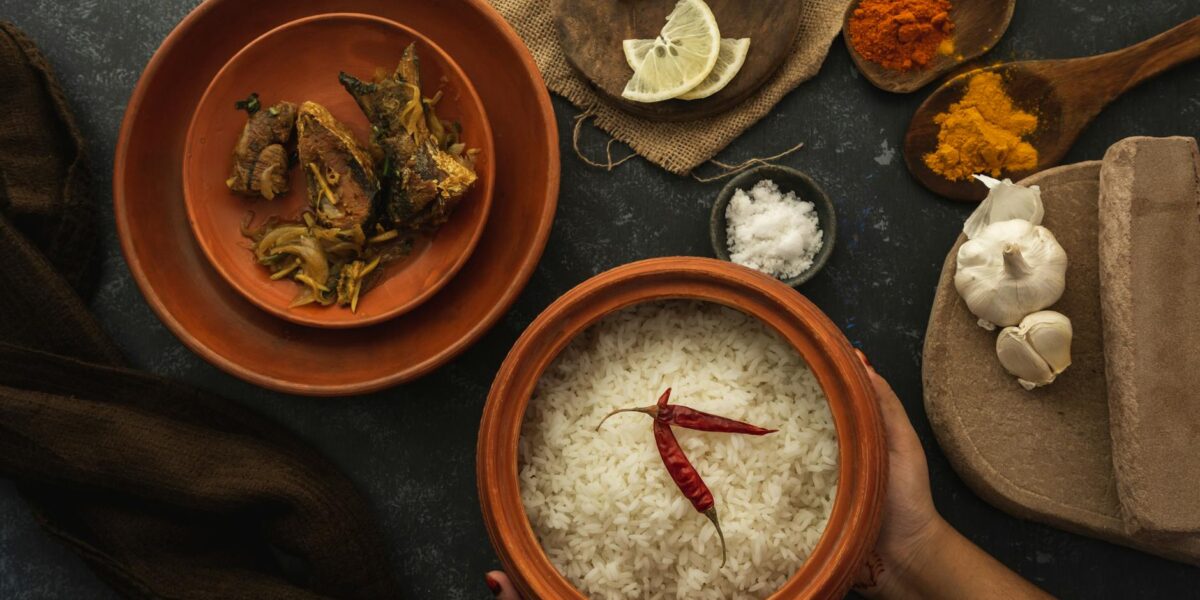
Almost every vegetable curry and dal in Bengal begins the same way: a small spoon of mustard oil heated until it just smokes, then a pinch of panch phoron — the five-seed blend of cumin, fennel, fenugreek, nigella, and black mustard — dropped in to crackle. This is the Bengali version of a tadka or tempering, and the logic of it is the same: hot oil extracts the lipid-soluble flavor compounds in whole spices and carries them through the dish. The technique is identical in principle to the spice tempering described in our complete guide to tadka, but the seed blend and the use of mustard oil mark it unmistakably Bengali.
Panch phoron literally means ”five spices” in Bengali. The five — cumin, fennel, fenugreek, nigella (kalonji), and black mustard — are always used whole, never ground. The ratio is traditionally equal parts by volume, although many Bangal cooks reduce the fenugreek (which is bitter) to roughly half a part. You can buy panch phoron pre-mixed in any South Asian grocery, but it takes thirty seconds to mix yourself, and a freshly mixed batch is noticeably more aromatic.
12 Must-Try Bengali Dishes
This list is not exhaustive — you could write a book on Bengali fish dishes alone — but it is a strong starting menu. Together these twelve dishes cover the range of Bengali home cooking from breakfast to feast.
1. Shorshe Ilish (Hilsa in Mustard Sauce)
The single most iconic Bengali dish. Hilsa fish steaks are gently cooked in a sauce of freshly ground yellow and black mustard seeds, green chili, turmeric, and mustard oil. The sauce is sharp, almost wasabi-pungent, and counterbalanced by the fatty richness of the fish. It is traditionally eaten with plain steamed rice and nothing else — anything more would distract.
2. Macher Jhol (Light Bengali Fish Curry)
The everyday fish curry of every Bengali home. Lightly fried fish steaks (rohu, catla, or any firm freshwater fish) are simmered in a thin, turmeric-yellow gravy with potato wedges, eggplant, green chili, and ginger. The point is delicacy: jhol means ”broth” or ”thin gravy,” and the dish is the opposite of a heavy North Indian curry. It is comfort food, eaten with mounded rice for lunch.
3. Kosha Mangsho (Slow-Cooked Goat Curry)
The Sunday meat dish of Bengal. Goat or mutton is slow-cooked with onion, ginger, garlic, yogurt, and warm spices until the gravy reduces to a thick, dark, almost dry coating. Kosha means ”well-cooked” or ”reduced,” and the technique is closer to a French daube than to a typical Indian curry. It is served with luchi (puffed bread) or basanti pulao on weekends and at major festivals.
4. Aloo Posto (Potatoes in Poppy Seed Paste)
A defining Bengali vegetable dish. Diced potatoes are simmered in a thick paste of ground white poppy seeds with green chili and a touch of mustard oil. The result is creamy, mild, slightly nutty, and one of the few dishes that Ghotis and Bangals make almost identically. It is a daily staple in many homes.
5. Cholar Dal (Bengal Gram with Coconut)
Split chana dal cooked with bay leaf, cinnamon, raisins, fried coconut chips, and a touch of sugar. This is the festival dal of Bengal, served with luchi at weddings and on holidays. Its mild sweetness is unmistakably Ghoti.
6. Luchi (Puffed Wheat Bread)
Bengal’s answer to puri. Luchi are small, palm-sized rounds of plain wheat-flour dough deep-fried until they puff into hollow balloons. Unlike puri, luchi is made with maida (refined flour, not whole wheat) and is paler and more delicate. It is the standard partner for cholar dal, kosha mangsho, and morning breakfast spreads.
7. Begun Bhaja (Fried Eggplant Slices)
Thick slices of eggplant rubbed with turmeric and salt and shallow-fried in mustard oil until the edges blister and the inside turns custard-soft. A Bengali meal almost always includes a bhaja course of fried vegetables, and begun bhaja is the standard. It is eaten right after the dal-and-rice course.
8. Shukto (Bittersweet Mixed Vegetable Stew)
The starter of a traditional Bengali meal. Shukto combines bitter gourd, drumsticks, sweet potato, eggplant, plantain, and other vegetables in a milky-pale gravy thickened with poppy seeds, mustard, and ginger paste. It is mildly bitter — bitter is believed to wake the palate and aid digestion — and is always eaten first, with white rice.
9. Chingri Malai Curry (Prawns in Coconut Milk)
One of the most loved dishes of Kolkata. Whole tiger prawns are cooked in coconut milk with cardamom, cinnamon, and a hint of sugar. The name ”malai” means ”cream,” but here it refers to the rich coconut cream rather than dairy. It is festival food — silky, slightly sweet, and a clear demonstration of how Bengali cooking treats luxury ingredients with restraint rather than heavy spice.
10. Kolkata Biryani
Bengal’s distinctive take on the Mughal biryani. Where Hyderabadi biryani is fiery and Lucknowi biryani is delicate, Kolkata biryani is famous for one thing: the potato. A whole peeled, parboiled, golden-fried potato is layered into the rice with the meat. The story goes that the deposed Nawab Wajid Ali Shah, exiled to Kolkata in the 19th century, was forced to economize and ordered his cooks to add potatoes to stretch the meat. The potato stayed, and now no Kolkata biryani is complete without it. The seasoning is gentler than other Indian biryanis, with rosewater, kewra, and saffron carrying the perfume.
11. Mishti Doi (Sweetened Yogurt)
Caramelized milk yogurt set in a clay pot. Whole milk is reduced with date palm jaggery (in winter) or regular sugar until it caramelizes, then a yogurt starter is stirred in and the pot is left overnight to set. The result is thick, faintly grainy, deep brown-orange, and one of the great desserts of South Asia. The clay pot wicks excess moisture, concentrating the texture further.
12. Rosogolla (Syrup-Soaked Cheese Balls)
The most famous Bengali sweet in the world. Soft balls of fresh chhana cheese are kneaded with semolina, rolled, and simmered in a light cardamom sugar syrup until they double in size and become spongy. Rosogolla holds geographical-indication status in India as a Bengali product, after a long and well-documented dispute with the neighboring state of Odisha over its origin. Eaten warm or cold.
Bengali Cooking Techniques
Bengali cuisine has a small, well-defined toolkit of cooking methods. Most meals are built from some combination of these.
Phoron (Tempering)
The starting move for nearly every Bengali pot. Mustard oil is heated to its smoke point and cooled slightly to mellow its raw bite, then whole spices — usually panch phoron, sometimes just cumin or just nigella — are added to bloom in the oil. The technique is shared with the rest of South Asia but distinguished by the use of mustard oil and the phoron blend.
Bhaja (Shallow Frying)
Thick slices of vegetable, fish, or paneer rubbed with turmeric and salt and shallow-fried in mustard oil until the edges crisp. Bhaja is its own course in a meal, eaten between the dal and the fish curry. The classic versions are begun bhaja (eggplant), aloo bhaja (matchstick potato), uchche bhaja (bitter gourd), and macher bhaja (fish).
Bhapa (Steaming in Banana Leaf)
The signature wet-cooking method for fish. Fish steaks are coated in a paste of mustard, green chili, mustard oil, and turmeric, wrapped in a folded banana leaf, and steamed over rice or in a covered pan. The leaf imparts a subtle grassy aroma and keeps the fish tender. Bhetki paturi (steamed bhetki fish in banana leaf) is the most famous example.
Kosha (Slow Reduction)
The reduction technique used for meat dishes like kosha mangsho. Meat is cooked low and long with onion paste, ginger, garlic, yogurt, and spices, with the lid off, until the gravy reduces, deepens in color, and clings to the meat. There is no equivalent of curry-house style runny gravy in traditional Bengali kosha cooking.
Jhol (Light Simmering)
The opposite of kosha — a thin, brothy gravy. Jhol cooking is fast, finishes in fifteen minutes, and is used for daily fish and vegetable curries. It is one reason Bengali cooking is, on average, lighter than the cooking of Punjab or Hyderabad.
Chhana Making
The technique that powers all Bengali sweets: whole milk is brought to a boil and curdled with lemon juice or whey, the curds are drained in cheesecloth, then kneaded by hand until smooth. Chhana is the same fresh acid-set cheese tradition we cover in detail in our guide to making paneer; the difference is that for sweets the cheese is kneaded much longer to achieve a softer, almost dough-like texture.
The Structure of a Traditional Bengali Meal
A formal Bengali meal is served as a sequence, not a buffet. Each course is eaten with rice and finished before the next is brought to the plate. This order is more than ceremony — it is a deliberate progression from bitter, to bland, to rich, to sour, to sweet, designed (in traditional thinking) to aid digestion and keep the palate alert.
- Shukto or tito (bitter): a bitter vegetable course, usually shukto or fried bitter gourd, to wake the digestion.
- Shaak (greens): a leafy greens preparation, often a simple stir-fry of mustard greens or spinach.
- Dal and bhaja: a lentil dal eaten with rice, paired with one or two fried vegetable sides.
- Sabzi (vegetable curry): a heavier vegetable preparation like aloo posto or chhanar dalna.
- Mach (fish): the central course of the meal, typically jhol or shorshe.
- Mangsho (meat, optional): served on Sundays or special occasions, usually goat or chicken.
- Chutney: a sweet-sour fruit chutney (tomato, mango, pineapple) acts as a palate cleanser.
- Doi-mishti (yogurt and sweets): finished with mishti doi and one or two sweets like rosogolla or sandesh.
- Paan: betel leaf with areca nut and sweet flavorings, the traditional digestif.
For everyday eating most Bengali families compress this into three or four courses, but the order — bitter, then greens, then dal, then fish, then sweet — is preserved even in casual meals.
Bengali Sweets: A Culture of Mishti
No discussion of Bengali food is complete without its sweets. Bengal is the only Indian region that turned dessert into a daily institution rather than a festival ingredient. Every neighborhood in Kolkata and Dhaka has at least one mishtir dokan (sweet shop), and the city of Kolkata alone has confectioners that have been operating continuously since the 1830s.
The defining ingredient is chhana, the fresh acid-set cow-milk cheese described above. Around 1860, a Kolkata confectioner named Nobin Chandra Das is credited with inventing the modern rosogolla by simmering chhana balls in sugar syrup; before that, chhana was used mostly for sandesh (a kneaded cheese fudge) and a few simpler sweets. The 19th-century invention of rosogolla is often considered the start of modern Bengali confectionery.
Other essential sweets include sandesh (chhana kneaded with sugar and shaped into discs, sometimes flavored with saffron, cardamom, or palm jaggery), rajbhog (a larger, saffron-infused rosogolla stuffed with nuts), pantua (a darker, fried cousin of the gulab jamun), and the seasonal nolen gurer sondesh — sandesh made with the year’s first batch of liquid date palm jaggery, a winter-only delicacy that drives a small annual food pilgrimage to Bengal.
Bengali Food Compared with Other Indian Cuisines
Comparing Bengali cooking with the more familiar regional Indian styles makes its character easier to grasp. The table below lays out the differences across cooking fat, flavor profile, signature carb, and protein focus.
| Cuisine | Cooking fat | Flavor profile | Daily carb | Main protein | Signature dish |
|---|---|---|---|---|---|
| Bengali | Mustard oil | Pungent, light, slightly sweet | Rice | Freshwater fish | Shorshe ilish |
| Punjabi (North Indian) | Ghee, butter | Rich, creamy, mild heat | Wheat (roti, naan) | Chicken, paneer, lamb | Butter chicken |
| Hyderabadi | Ghee | Spicy, layered, Mughal | Rice | Goat, chicken | Hyderabadi biryani |
| South Indian (Tamil) | Coconut oil, sesame | Tangy, hot, earthy | Rice, lentil crepes | Lentils, fish | Sambar with idli |
| Goan | Coconut oil | Vinegary, hot, Portuguese-influenced | Rice | Pork, seafood | Pork vindaloo |
| Gujarati | Vegetable oil, ghee | Sweet-sour, vegetarian | Wheat, lentils | Lentils, dairy | Dhokla |
| Kashmiri | Mustard oil, ghee | Saffron, fennel, dried | Rice | Lamb | Rogan josh |
The clearest contrasts are with Punjabi food (heavy, dairy-forward, wheat-based) and with South Indian Tamil food (rice-based but coconut-driven and ferment-rich). Bengali sits between them in heaviness but goes its own way with mustard, river fish, and a much sweeter palate. For an article-length comparison of one neighbor, see our complete guide to Indian cuisine, which surveys the whole subcontinent.
Building a Bengali Pantry at Home
If you are starting from a typical Western pantry, here is a practical sequence for stocking up. Buy in this order and you will be able to cook something useful at every step.
Tier 1 (essential)
Mustard oil (cold-pressed kachi ghani if possible), basmati rice, panch phoron, yellow mustard seeds, fresh ginger, fresh green chilies, turmeric powder, cumin seeds, fresh garlic, mustard oil. With these you can cook macher jhol, aloo posto, simple dal, and any vegetable bhaja.
Tier 2 (regular use)
White poppy seeds, black mustard seeds, kalonji (nigella), Indian bay leaf, green cardamom, cloves, cinnamon, ghee, plain whole-milk yogurt, jaggery (gur), red chili powder, and chickpea flour (besan).
Tier 3 (festival and specialty)
Saffron, kewra water, rose water, dried red chili (Kashmiri), dried mango powder (amchur), raisins, cashews, banana leaves (frozen, for paturi), and date palm jaggery (notun gur, available in winter only).
Meal Planning: A Sample Week of Bengali Cooking
If you want to live with this cuisine for a week instead of just cooking a single dish, here is a practical schedule for a beginner cook. Each day is built around a fish or vegetable centerpiece plus rice and a simple side.
- Monday: Macher jhol (light fish curry) with steamed rice and aloo bhaja (matchstick fried potatoes).
- Tuesday: Aloo posto (potatoes in poppy seed paste) with rice and a simple cucumber salad.
- Wednesday: Cholar dal (chana dal with coconut and raisins) with luchi for an evening meal.
- Thursday: Begun bhaja (fried eggplant) with masoor dal and rice.
- Friday: Bhapa shorshe machh (mustard-steamed fish in foil if you can’t find banana leaf) with plain rice.
- Saturday: Kosha mangsho (slow-cooked goat) with basanti pulao for a weekend feast.
- Sunday: Kolkata-style biryani with chicken and a whole potato per portion, finished with mishti doi.
This rotation gives you exposure to all five core techniques (phoron, bhaja, bhapa, kosha, jhol) and teaches you how Bengali meals balance protein, vegetable, and starch across a week. Lean into the rice — Bengalis eat much more rice per meal than most Western diners are used to, and the cuisine is structured around it.
Bengali Street Food and Snacks
Beyond the home meal, Bengal has a deep street-food tradition that is worth knowing about even if you cannot travel to Kolkata or Dhaka. The classics are puchka (the Bengali version of pani puri, with a tamarind-heavy water and a spicier potato filling than the Mumbai original), jhalmuri (puffed rice tossed with mustard oil, peanuts, raw onion, green chili, and cucumber, served in a paper cone), telebhaja (mustard-oil-fried fritters of onion, eggplant, or chana dal, eaten with muri), and the chop family — flat-fried croquettes of mashed potato, beetroot, fish, or mutton, breaded and deep-fried, that are the signature evening snack of Kolkata. The kathi roll, a paratha wrapped around skewered grilled meat with onion and chutney, was invented in Kolkata at the Nizam restaurant in the 1930s and has become Bengal’s most successful culinary export within India.
How to Eat a Bengali Meal
Traditional Bengali meals are eaten with the right hand, no utensils, sitting on the floor or at a low table. The rice is mounded in the center of the plate (or a banana leaf, on formal occasions), and small portions of each side dish are arranged around the rim in a specific order — bitter at the top, dal and ghee at lower-right, fish at lower-left, sweet at far right. The diner mixes a small amount of one side with rice at a time, eats that course, and only moves on when finished.
Even if you serve a Bengali meal at a Western table, two practices are worth keeping. First, do not mix everything together at once — the courses are designed to be tasted in sequence. Second, always finish with something sweet. Even a small spoon of mishti doi or a single rosogolla counts; the Bengali word ”doi-mishti” (yogurt-and-sweet) is essentially synonymous with ”the end of the meal.”
Common Mistakes When Cooking Bengali Food
The most common mistakes are easy to fix once you know about them.
- Using mustard oil cold: Raw, unheated mustard oil is harsh and slightly bitter. Always heat it until it just smokes, then cool it for ten seconds before adding spices. This mellows the pungent edge.
- Over-grinding mustard paste: If you grind mustard seeds too long, they release a sulfurous bitterness. Use a small mortar or pulse a blender briefly. Adding a pinch of salt and a green chili while grinding helps.
- Skipping the bitter course: Western cooks often consider shukto or fried bitter gourd unappealing and leave it out, but Bengali meals genuinely taste flatter without that opening bitter note.
- Using too much spice: Bengali curries are not heavily spiced. If you find yourself adding garam masala to every dish, you are cooking Punjabi food, not Bengali. Many traditional Bengali fish curries use only turmeric, salt, mustard, and chili.
- Adding garlic or onion to every dish: Plenty of Bengali fish and vegetable dishes have neither, especially in the more orthodox Hindu traditions. Don’t add them by reflex.
- Substituting basmati for everything: Basmati works, but the traditional Bengali aromatic rice is Gobindobhog, a short-grain variety with a popcorn-like fragrance. If you can find it, use it for biryani and special pulaos.
Where Bengali Food Fits in the Wider Asian Pantry
Bengali cooking shares a great deal with the rest of South Asia (rice, dal, curry leaves in some dishes, the basic tempering technique) but it is also striking how much of it would feel familiar to a cook in East or Southeast Asia. The reliance on freshwater fish parallels Lao, Cambodian, and southern Chinese cooking. The use of mustard oil and pungent fermented condiments (like the dried-fish shutki of Bangal cooking) lines up with the Southeast Asian fondness for shrimp paste and fermented fish — see our guide to shrimp paste for the parallels. The poached and steamed fish techniques have direct cousins in our guide to Asian steamed fish. And the tradition of fresh acid-set cheese in Bengali sweets is exactly the same chemistry as making Indian paneer (see our paneer guide).
Understanding Bengali food, in other words, opens doors to a much wider Asian palate than it might first appear. It is a hinge cuisine that connects the Indian subcontinent to the rice-and-fish food world that runs all the way east to Japan.
Frequently Asked Questions
Is Bengali food spicy?
Compared with Hyderabadi or Andhra cooking, no. Bengali food is moderately spiced, with most heat coming from fresh green chilies rather than dried red ones. The pungency many Westerners detect comes from raw mustard, not capsaicin. Within Bengal, Bangal (East Bengal / Bangladeshi) cooking is sharper, while Ghoti (West Bengal / Kolkata) cooking is sweeter and milder.
What is the difference between Bengali food and Bangladeshi food?
They are the same cuisine with regional accents. Bangladeshi food is the cuisine of the eastern (Bangal) tradition: more pungent, more dried fish, less sugar, more raw mustard oil. West Bengali (Ghoti) food, centered on Kolkata, is sweeter and uses more refined Mughal-influenced techniques. Hilsa, panch phoron, mustard oil, and rice are core to both.
Can I substitute olive oil for mustard oil?
Not really. Mustard oil’s pungency is essential to Bengali fish and vegetable cooking, and olive oil’s fruity character is wrong for the dishes. If you cannot find mustard oil, use a neutral cold-pressed canola or sunflower oil and stir in a quarter teaspoon of dry mustard powder per tablespoon of oil. The result is acceptable for everyday cooking but not for shorshe ilish.
Is Bengali food vegetarian?
It has a deep vegetarian tradition (Bengali Hindu Brahmin cooking is largely vegetarian, plus vegetable, dal, and bhaja courses are central to every meal), but most Bengalis are pescatarian and many eat goat and chicken. The cuisine is notable for the sheer variety of vegetable dishes — far more than most other Indian regional cuisines — even in households that also eat fish daily.
What rice do Bengalis eat?
For everyday meals, parboiled long-grain rice (sometimes called ”bhat” or ”siddho chal”) is most common. For festive meals, polao, biryani, and offerings to deities, the aromatic short-grain Gobindobhog is used. Many Bengali home cooks also keep basmati for guest meals. Plain steamed rice is the standard accompaniment to fish curry — fragrant rice would compete with the fish.
Why is Bengali food so sweet?
The Ghoti (West Bengal / Kolkata) tradition genuinely uses sugar in savory dishes — usually a teaspoon or so per pot of dal or curry — to balance the sharpness of mustard and chili. This is a regional preference, not a universal Bengali habit. Bangladeshi cooking is much less sweet. The famous Bengali sweets, on the other hand, are eaten by both groups and are the most refined dessert tradition in South Asia.
What is the most famous Bengali dish?
Internationally, rosogolla. Within Bengal, shorshe ilish (mustard hilsa). For Sunday lunch in any Kolkata household, kosha mangsho with basanti pulao. There is no single answer, which is part of what makes the cuisine interesting.
Can I find Bengali ingredients in the United States?
Most cities with a South Asian community have at least one grocery that stocks mustard oil, panch phoron, poppy seeds, and Indian bay leaf. Online, mustard oil and dry pantry items are easy to source; hilsa fish is harder, though frozen hilsa from Bangladesh is sometimes available in larger Indian supermarkets in the New York, New Jersey, Toronto, and Houston metro areas.
What do Bengalis eat for breakfast?
The classic Bengali breakfast is luchi with cholar dal or alur dom (a potato curry), often with sandesh on the side on weekends. Weekdays are simpler: muri (puffed rice) with milk and bananas, or paratha and an egg curry, or simply yesterday’s leftover rice eaten as panta bhat (fermented overnight rice with raw onion and green chili — a rural staple now enjoying a revival).
How is Bengali food different from ”curry”?
The British-Indian restaurant idea of ”curry” — a heavy, often cream-based gravy with a generic spice blend — is not how Bengalis cook. Bengali ”curries” are typically thinner (jhol) or drier (kosha or bhaja), use distinct spice combinations for each dish (mustard for fish, poppy seed for vegetables, panch phoron for dal), and rarely use a single garam masala for everything. Calling Bengali food ”curry” misses most of what is interesting about it.
Final Thoughts
Bengali cuisine rewards careful attention. It has a smaller working vocabulary of techniques than Sichuan or French cooking — five or six methods, a dozen ingredients — but it uses them with unusual precision. The same fish steak treated five different ways (jhol, kalia, paturi, shorshe, kosha) becomes five entirely different dishes, and a Bengali cook can read which is which from across the room by the color and consistency of the gravy alone. Once you start cooking it at home, the discipline becomes addictive.
Start with macher jhol and aloo posto. Stock mustard oil and panch phoron. Buy good rice. Add a sweet to every meal. Pay attention to the order in which the courses arrive on your plate. Within a few weeks of cooking this way, you will notice the rest of South Asian cooking opening up around you, because Bengal sits at the hinge of the rice-and-fish belt that runs from the Bay of Bengal east through Southeast Asia. There are few better places in the world to start exploring it.

Mei Lin Chen
Mei Lin Chen is an Asian food writer and recipe developer. Melbourne-raised and London-based, she has spent over a decade exploring the rice paddies, hawker stalls, and home kitchens of South-East and East Asia. Her recipes balance traditional technique with everyday practicality.