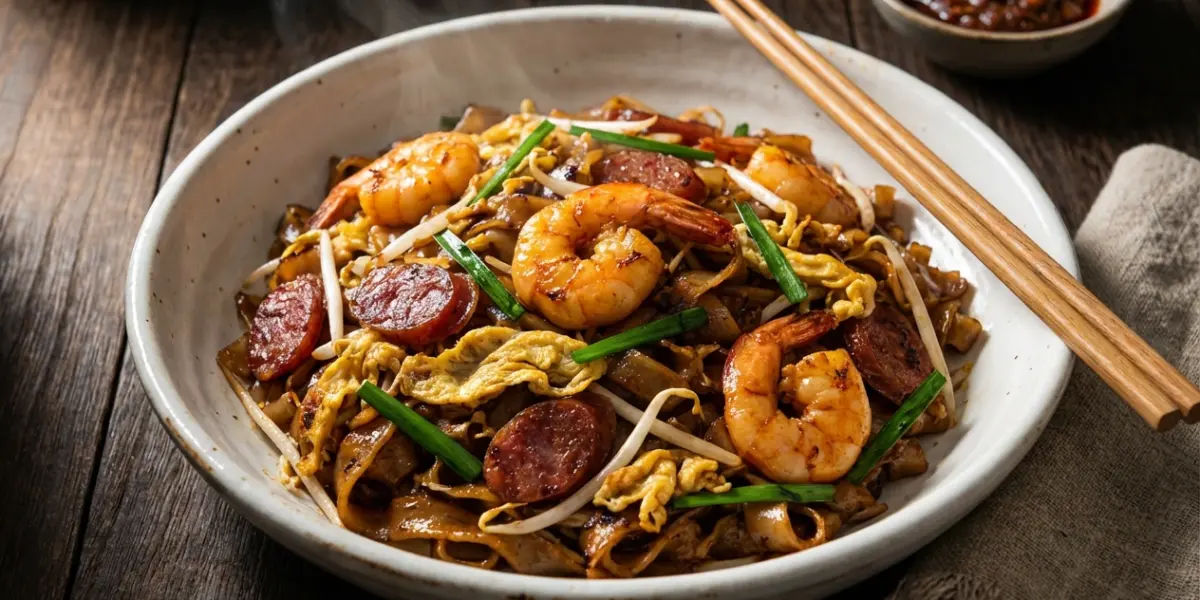
Char kway teow is one of the great street foods of the Malay Peninsula — broad, flat rice noodles stir-fried at ferocious heat in a searing-hot wok with prawns, Chinese lap cheong sausage, egg, bean sprouts, and a dark, complex sauce that coats every strand. A great plate of char kway teow is smoky, sweet, savoury, and slightly charred at the edges. It is also, famously, one of the most difficult dishes to replicate outside a hawker stall.
What Is Char Kway Teow?
The name means ”stir-fried flat rice noodles” in the Teochew dialect of Chinese — char means stir-fry and kway teow refers to the flat, wide rice noodles used in the dish. The dish originated among Chinese labourers in Penang and Kuala Lumpur in the early 20th century. It was cheap, calorie-dense, and fast to cook — a meal built for working people eating on the street. The hawkers who sold it were almost exclusively Chinese-Malaysian, usually from Hokkien or Teochew backgrounds, and they developed regional styles that persist today.
What separates char kway teow from other stir-fried noodle dishes is the wok hei — the ”breath of the wok,” that elusive smoky, slightly charred quality that comes from cooking in a screaming-hot wok over very high heat with good technique. Wok hei is the result of brief, intense contact between the noodles and a very hot wok surface, partial charring of the sauce, and the Maillard reactions that happen at extreme temperatures. It cannot be fully replicated on a home stove, but it can be significantly approximated with the right approach.
Penang char kway teow is considered the definitive version — made with cockles (blood cockles, specifically), dark soy sauce, and Chinese chives, and typically cooked in pork lard for extra richness. KL versions often skip the cockles and use more sweet soy sauce. In both cases, the dish is cooked in single portions — each plate prepared individually in a very hot wok to maximise wok hei.
Ingredients
Serves 2 (make in two batches — never scale up in the wok)
- 400g (14 oz) fresh flat rice noodles (kway teow / ho fun), at room temperature
- 150g (5 1/2 oz) medium prawns, peeled and deveined
- 2 links lap cheong (Chinese dried pork sausage), sliced diagonally 3mm thick
- 100g (3 1/2 oz) blood cockles (optional but traditional), blanched and shelled
- 2 large eggs
- 100g (3 1/2 oz) bean sprouts
- 4 stalks Chinese chives (garlic chives / kucai), cut into 4cm (1 1/2 inch) lengths
- 3 cloves garlic, minced finely
- 3 tablespoons neutral oil (or pork lard for authenticity)
For the Sauce
- 2 tablespoons dark soy sauce
- 1 tablespoon light soy sauce
- 1 tablespoon oyster sauce
- 1 teaspoon fish sauce
- 1 teaspoon sugar
- 1 tablespoon sambal belacan (or chili paste), or to taste
Note on key ingredients: Fresh flat rice noodles (kway teow) are sold at most Asian grocery stores in the refrigerated section, often in large slabs that need to be gently separated before cooking. Do not use them cold from the fridge — bring them to room temperature first or they will clump and break. Lap cheong (Chinese pork sausage) is available vacuum-packed at Asian supermarkets; it has a sweet, slightly fermented flavour that cannot be substituted. Chinese chives (flat-leafed garlic chives) have a pronounced garlicky flavour unlike mild Western chives. Blood cockles are traditional in Penang-style but can be omitted if unavailable.
How to Make Char Kway Teow
- Prepare everything in advance. Char kway teow cooks in under 5 minutes per portion and cannot pause. Have all ingredients cut, measured, and within arm’s reach before you turn on the heat. Mix the sauce ingredients together in a small bowl and set aside.
- Separate the noodles. If using refrigerated noodles, let them come to room temperature for at least 30 minutes. Gently pull the noodle slab apart into individual strands, taking care not to break them. If the strands resist, place the noodles in a colander and pour boiling water over them briefly — just enough to soften them — then drain well.
- Heat the wok intensely. Place a wok or heavy skillet over the highest heat your stove allows. Let it heat for at least 2 minutes until it is extremely hot — a drop of water should vaporise instantly on contact. Add 1.5 tablespoons of oil and swirl to coat.
- Fry the sausage and garlic. Add the sliced lap cheong and fry for 30 to 45 seconds until it starts to caramelise and render its fat. Add the minced garlic and stir for another 20 seconds until fragrant but not browned.
- Add the prawns. Add the prawns in a single layer and cook, without stirring, for 30 seconds. Flip them once and cook another 20 seconds. The prawns should be about 70% cooked at this point — they will finish cooking with the noodles.
- Add the noodles. Spread the noodles over the wok in an even layer. Pour the sauce mixture over the noodles. Let the noodles sit without stirring for 30 to 45 seconds — you want direct contact with the wok surface to develop char and wok hei. Then toss and fold everything together, working quickly.
- Push to the side and scramble the egg. Push the noodles to one side of the wok. Add the remaining oil to the empty side and crack in the eggs. Let the whites set for 20 seconds, then scramble briefly and fold the noodles over the eggs before they are fully set. Continue tossing — the partially-cooked egg will coat the noodles.
- Add the sprouts, cockles, and chives. Add the bean sprouts and, if using, the cockles. Toss for 30 seconds — the sprouts should retain some crunch. Add the Chinese chives in the final 15 seconds of cooking; they need very little heat.
- Taste and serve immediately. Taste for seasoning — it should be savoury, slightly sweet, and smoky. Transfer to a plate at once and serve immediately. Char kway teow waits for no one: the noodles begin to steam and lose their texture within minutes of leaving the wok.
Tips for the Best Char Kway Teow
- Cook in single portions. This is the single most important rule. Add more noodles than one serving and the wok temperature drops, the dish steams instead of stirs, and you lose all wok hei. If cooking for 4, make 4 separate batches one after another. This is how every hawker stall does it.
- Use pork lard if you can. Rendered pork lard gives authentic char kway teow its characteristic richness and helps develop wok hei faster than vegetable oil. If you render your own from pork fat strips, the crispy cracklings (pork croutons) can be scattered over the finished plate — a traditional Penang garnish.
- Do not move the noodles immediately after adding them. The rest period where noodles sit undisturbed on the hot wok surface is where char and wok hei develop. Resist the urge to stir.
- Get the noodles to room temperature. Cold noodles lower the wok temperature dramatically. This is non-negotiable for good wok hei on a home stove, where the heat recovery is slower than a commercial burner.
- Dark soy sauce matters. Dark soy sauce is thick, sweet, and almost molasses-like — it provides the signature deep brown colour and caramel sweetness. Do not substitute light soy sauce for dark, as they are not interchangeable in this recipe.
Variations
Penang-style with cockles and pork lard: The definitive version uses blood cockles (briefly blanched and shelled), pork lard instead of oil, and the lard cracklings scattered on top. The cockles are added at the very end and barely cooked — they should be slightly translucent in the centre, which is how Penang hawkers serve them. This version is richer and more complex than KL-style.
Vegetarian char kway teow: Omit the prawns, cockles, sausage, fish sauce, and oyster sauce. Use thick-sliced firm tofu, shiitake mushrooms, and substitute vegetarian oyster sauce and light soy sauce only. The wok hei technique still applies — high heat, single portions, letting the noodles char.
Char kway teow with XO sauce: A restaurant-style elevation where XO sauce (made from dried scallop, dried shrimp, and chilies) is stirred in alongside the regular sauce. It adds an extra layer of dried seafood richness that makes an already flavourful dish deeper still.
What to Serve With Char Kway Teow
- Satay: Grilled skewers of chicken or beef with peanut sauce make an excellent side to the rich, smoky noodles — a classic Malaysian hawker pairing.
- Popiah (fresh spring rolls): Their light, slightly sweet filling provides relief from the intensity of the stir-fry and eats well alongside without competing.
- Prawn fritters (cucur udang): Crispy prawn and vegetable fritters that complement the dish without adding more richness.
- Barley water or cendol: A cooling drink or dessert is traditional after char kway teow. The sweetness and chill balance the dark, heavy sauce nicely.
Storage and Reheating
Char kway teow does not store well — the noodles absorb moisture and soften, losing their texture. It is genuinely at its best eaten immediately off the wok. Leftovers can be stored refrigerated for up to 1 day in an airtight container, but expect significantly degraded texture. Reheat in a very hot wok or skillet with a splash of water to rehydrate, stirring quickly. Microwave reheating turns the noodles soft and is not recommended.
For meal prep purposes, it is better to prepare all the components (sliced sausage, peeled prawns, mixed sauce, separated noodles) and cook each portion fresh to order — the active cooking time is only 4 to 5 minutes once everything is prepped.