Soy sauce substitute options matter more than most cooks realise — whether you’re managing a soy allergy, cutting sodium, following a gluten-free diet, or simply staring at an empty bottle mid-recipe, knowing what to reach for can save the dish.
Last Updated: March 27, 2026
Key Takeaways
- Tamari is the closest 1:1 swap for most Asian recipes and is naturally wheat-free.
- Coconut aminos works for anyone avoiding soy entirely — it carries roughly 270–400 mg of sodium per tablespoon versus around 900 mg in regular soy sauce.
- Fish sauce delivers the deepest umami but is not suitable for vegetarians or vegans.
- No single substitute works equally well in every cooking context — match the swap to the method.
- A simple homemade version can be made in five minutes with pantry staples.
Why People Look for a Soy Sauce Substitute
Soy sauce is one of the oldest condiments in Asian cooking, traced back over 2,500 years to China. It does three things at once: it adds salt, it adds colour, and it delivers that deep savoury quality food scientists call umami. When you remove it from a recipe, you need to replace all three of those functions — not just one.
Understanding why you need the substitute shapes which one you should choose. The reasons split into four main camps, and each one points toward a different solution.
Soy Allergy and Soy-Free Diets
Soy is one of the nine major food allergens listed by the FDA, and soy allergy affects roughly 0.4% of children in the United States, according to data from the American College of Allergy, Asthma and Immunology. For this group, even trace amounts of soy can trigger a reaction, which means most mainstream soy sauce — including reduced-sodium versions and tamari — is off the table entirely.
People on elimination diets (such as the AIP protocol or certain anti-inflammatory plans) also cut soy as a group, not because of a diagnosed allergy but because legumes and fermented soy can be inflammatory for some individuals. For all of these people, the only truly safe options are soy-free alternatives like coconut aminos or a homemade broth-based substitute.
It is worth noting that many people who believe they have a soy allergy are actually reacting to the wheat in soy sauce — which brings us to the next reason.
Gluten Intolerance and Coeliac Disease
Standard soy sauce is brewed with wheat as well as soybeans. This means it contains gluten — typically enough to cause problems for the estimated 1% of the global population who have coeliac disease, as well as the larger group who experience non-coeliac gluten sensitivity. The Coeliac Disease Foundation confirms that regular soy sauce is not safe on a gluten-free diet.
Tamari is the standard workaround here. Most tamari is brewed with little or no wheat, though labels vary by brand — always look for certified gluten-free tamari if you are cooking for someone with coeliac disease. San-J and Kikkoman both produce tamari variants that are certified gluten-free.
Coconut aminos and Bragg’s Liquid Aminos are also gluten-free, making either a safe option for those who need wheat-free cooking without changing flavour profiles too dramatically.
High Sodium and Heart Health
One tablespoon of regular soy sauce contains approximately 902 mg of sodium — nearly 40% of the recommended daily limit set by the American Heart Association (2,300 mg/day, with an ideal target of 1,500 mg for most adults). If you use soy sauce frequently in Asian cooking, the sodium adds up fast.
Coconut aminos contains between 270 mg and 400 mg of sodium per tablespoon depending on brand — a meaningful reduction. Low-sodium soy sauce cuts sodium to around 575 mg per tablespoon. For people managing hypertension, both options are legitimate tools for maintaining flavour while reducing cardiovascular load.
The reduction is not trivial. Think of it like turning down the bass on a speaker: the music still plays, the rhythm still carries, but the rumble that vibrates the room is softened. You still get the savoury depth — just without the arterial pressure spike.
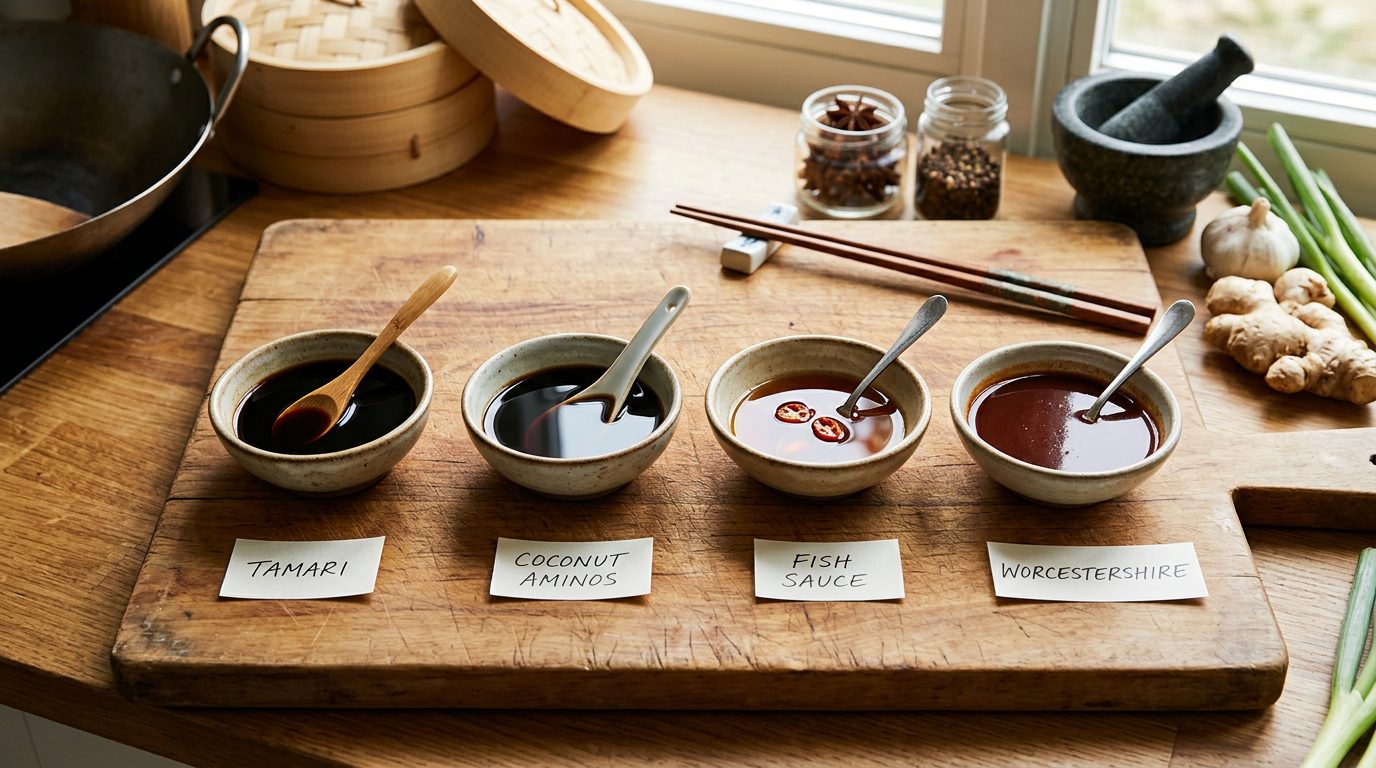
The 10 Best Soy Sauce Substitutes (With Ratios)
We have tested all of these swaps across real Asian recipes — stir fries, marinades, dipping sauces, braises, and soups. The table below gives you a quick reference, and each section below goes deeper into how to use each one properly.
| Substitute | Ratio (per 1 tbsp soy sauce) | Soy-Free | Gluten-Free | Vegan | Best Use |
|---|---|---|---|---|---|
| Tamari | 1:1 | No | Yes (check label) | Yes | All-purpose |
| Coconut Aminos | 1:1 + pinch of salt | Yes | Yes | Yes | All-purpose, soy-free |
| Liquid Aminos (Bragg’s) | 1:1 | No | Yes | Yes | Salads, mild dishes |
| Fish Sauce | ½ tbsp fish sauce + ½ tbsp water | Yes | Yes | No | Stir fry, marinades |
| Worcestershire Sauce | 1:1 (thin with water if needed) | No (may contain anchovies) | Check label | No | Marinades, Western-Asian fusion |
| Miso Paste | 1 tbsp miso + 1 tbsp water | No | Check label | Yes | Soups, braises, glazes |
| Oyster Sauce | 1:1 (reduce other salt) | No | Check label | No | Stir fry, noodles |
| Hoisin Sauce | ½:1 (it is sweet) | No | Check label | Yes | Dipping, glazes |
| Dried Mushroom Broth | 1–2 tbsp broth per 1 tbsp soy | Yes | Yes | Yes | Soups, vegan dishes |
| Dark Soy Sauce | ½:1 (dilute or use sparingly) | No | No | Yes | Colour and braising |
1. Tamari — The Closest Match
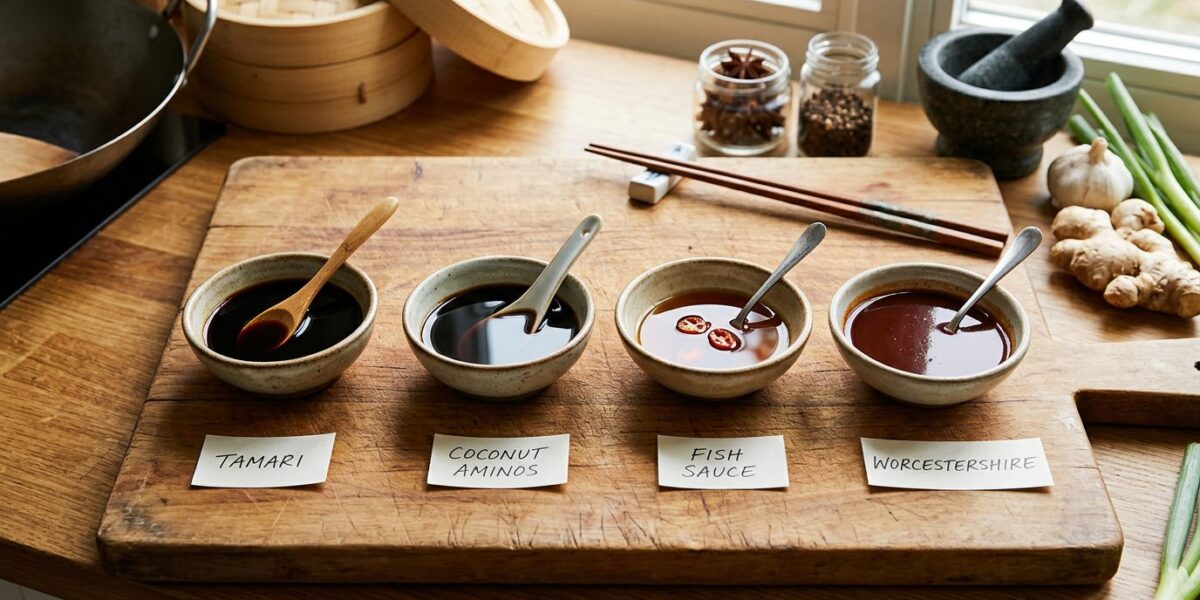
If we had to pick one substitute that behaves almost identically to soy sauce in a recipe, tamari wins without contest. It is made from soybeans in a process similar to soy sauce, but traditionally produced with no wheat or a very small amount — which is why it is the go-to in Japanese cooking for anyone avoiding gluten.
Flavour-wise, tamari is slightly richer and less salty than standard soy sauce, with a deeper, more rounded umami. This makes it excellent in dipping sauces, glazes, and marinades where complexity is welcome. In a stir fry, the difference from regular soy sauce is nearly undetectable once everything hits the wok.
Use it at a 1:1 ratio. Always check the label for wheat content — some domestic tamari brands do include small amounts of wheat, so look for the words ”gluten-free certified” if this is a dietary requirement rather than a preference.
2. Coconut Aminos — Best for Soy-Free Cooking
Coconut aminos is made by fermenting the sap of coconut blossoms with sea salt. It contains no soy and no wheat, making it the single safest swap for anyone with either allergy. It is also certified paleo and AIP-compliant, which is why it has become a fixture in health-focused kitchens over the last decade.
The trade-off is flavour. Coconut aminos is noticeably sweeter and milder than soy sauce — it lacks the sharp fermented edge and saltiness you expect. Most brands contain 270–400 mg of sodium per tablespoon compared to approximately 900 mg in regular soy sauce. To close the gap, add a small pinch of sea salt alongside the coconut aminos in recipes that depend on soy sauce’s salt contribution.
Use it at a 1:1 ratio with the salt adjustment. It works best in stir fries, fried rice, and marinades. In raw dipping applications, the sweetness can be more noticeable — balance it with a dash of rice vinegar or a few drops of fish sauce if you are not soy-free.
3. Fish Sauce — For Deep, Complex Umami
Fish sauce and soy sauce share the same core function — both are fermented, both are high in sodium, and both deliver glutamates (the compounds responsible for umami). But fish sauce is made from salted, fermented anchovies rather than soybeans, so it is both soy-free and gluten-free.
The flavour is more pungent and oceanic than soy sauce, particularly when used cold or raw. In hot cooking — stir fries, soups, curries — the fishy edge largely cooks off, leaving only a deep savoury note. Thai and Vietnamese cuisines use fish sauce as a primary seasoning in much the same way Chinese cooking uses soy sauce, which tells you everything about its utility as a substitute.
Use half a tablespoon of fish sauce diluted with half a tablespoon of water to replace one tablespoon of soy sauce. This prevents over-seasoning and softens the intensity. Fish sauce is not suitable for vegans or vegetarians — see dried mushroom broth (below) for a plant-based alternative with similar depth. For more on fish sauce varieties and brands, our complete fish sauce guide covers everything you need to know.
4. Worcestershire Sauce — The Pantry Emergency Option
Worcestershire sauce is a fermented condiment built on tamarind, malt vinegar, molasses, onion, garlic, and anchovies. It is nowhere near as close a match as tamari or coconut aminos, but it is the substitute most Western home cooks are likely to have on hand when soy sauce runs out mid-recipe.
The flavour profile is tangier and sweeter, with a more complex layering of sweet and sour against the savoury base. It works acceptably in marinades and sauces where soy sauce is one of several flavour components. It is less successful as a dipping sauce substitute or in dishes where soy sauce dominates the profile — teriyaki, for example, would taste wrong.
Use at a 1:1 ratio and reduce or omit any added sweetener in the recipe, as Worcestershire brings its own sweetness. Check labels carefully — most standard Worcestershire sauces contain anchovies (not vegan) and malt vinegar (not gluten-free). Lea and Perrins makes a widely available version; there are also vegan variants in health food shops.
5. Liquid Aminos (Bragg’s) — Gluten-Free and Soy-Based
Bragg’s Liquid Aminos is made by treating non-GMO soybeans with hydrochloric acid, which breaks down the protein chains into free amino acids — hence the name. The result is a liquid that tastes noticeably similar to soy sauce but is produced without fermentation, without wheat, and without chemical preservatives.
It is certified gluten-free and non-GMO, but it still contains soy, so it is not suitable for soy-free diets. The sodium content sits at around 160 mg per teaspoon (roughly 480 mg per tablespoon), making it a lower-sodium option than regular soy sauce though higher than coconut aminos.
The flavour is slightly thinner and less complex than soy sauce — it misses some of the fermented depth. It works well as a lighter seasoning in salads, grain bowls, and delicate sauces, but in bold stir fry applications it can feel a little flat. Use at a 1:1 ratio and consider adding a tiny splash of rice vinegar to compensate for the missing fermented tang.
6. Miso Paste — The Fermented Flavour Builder
Miso paste is the solid sibling of soy sauce — both are products of fermenting soybeans with a mould called koji, but miso keeps its paste texture while soy sauce is pressed into a liquid. This shared origin means miso delivers genuine fermented umami that other substitutes cannot fully replicate.
To use it as a soy sauce substitute, dissolve one tablespoon of white or yellow miso paste in one tablespoon of warm water to create a thin, pourable liquid. This works best in braises, ramen broth, miso glaze, and soups where a slightly thicker body is welcome. White miso is mildest and sweetest; red miso is saltier, more pungent, and closer to soy sauce in intensity.
Miso does contain soy and may contain wheat (depending on the type — rice miso is wheat-free, barley miso is not). It is, however, an excellent choice when you want fermented depth in a vegetarian or vegan dish. Our complete miso guide walks through every variety and its uses in full.
7. Oyster Sauce — Rich and Thick for Stir Fry
Oyster sauce is made from oyster extracts reduced and caramelised with salt and sometimes cornstarch. It shares soy sauce’s deep savoury character but layers on a sweetness and viscosity that soy sauce lacks. It is a natural fit in stir fry cooking, noodle dishes, and vegetable braises where a glossy, coating sauce is the goal.
Use it at a 1:1 ratio but reduce any other sweeteners in the recipe — oyster sauce is significantly sweeter than soy sauce. It is also thicker, so it can make sauces heavier than intended. In fried rice or anywhere you want a thin, penetrating seasoning, dilute it with a little water or chicken stock.
Oyster sauce is not suitable for vegetarians or vegans, and most brands contain gluten thickeners. Vegan oyster sauce made from mushrooms (usually shiitake or oyster mushrooms) is widely available and behaves almost identically. Our oyster sauce substitute guide goes further for anyone who needs to replace oyster sauce too.
8. Hoisin Sauce — For Dipping and Glazing
Hoisin sauce is a thick, sweet, bean-based sauce used across Chinese cuisine for dipping, glazing, and as a barbecue-style coating. Its sweet-savoury profile makes it a poor substitute in applications where you want the sharp, penetrating salt of soy sauce, but it shines when you need something for dipping spring rolls, glazing duck, or finishing a noodle dish.
Because hoisin is considerably sweeter and thicker than soy sauce, use about half the amount and balance it against acidity — a splash of rice vinegar brings it back toward the savoury centre. It is not a daily-driver soy sauce substitute, but used selectively it adds a dimension that most other swaps cannot match.
Most hoisin sauces contain soy and wheat, making them unsuitable for soy-free or gluten-free diets. They are, however, typically vegan. Our complete hoisin sauce guide covers varieties, brands, and how it is used across different regional Chinese dishes.
9. Dried Mushroom Broth — The Vegan Umami Bomb
Shiitake mushrooms contain glutamates, guanylates, and a range of savoury compounds that deliver genuine umami intensity. When you simmer dried shiitake mushrooms in water, the soaking liquid darkens and deepens into a broth that can match soy sauce’s savoury function in many vegetarian and vegan recipes.
The method is straightforward: soak 4–5 dried shiitake mushrooms in 250 ml of hot water for 30 minutes. The resulting liquid is your substitute — season it with a small pinch of salt and a few drops of rice vinegar for brightness. One to two tablespoons of this broth replaces one tablespoon of soy sauce.
This substitute is entirely soy-free, gluten-free, and vegan. It works best in soups, stews, braises, and plant-based stir fry dishes. Its main limitation is texture — it lacks the thick, coating body of soy sauce, and the flavour is earthier and less salty. Balance accordingly. The soaked mushrooms themselves can be sliced and added to the dish for additional depth and texture.
10. Dark Soy Sauce — When You Need Colour More Than Flavour
Dark soy sauce is not a substitute for regular soy sauce in the strictest sense — it is a different product that is thicker, less salty, and substantially darker in colour due to a longer fermentation and the addition of molasses or caramel. But it belongs in this list because many home cooks reach for it when they want the colour boost that soy sauce provides without making a dish too salty.
Use dark soy sauce at roughly half the volume of regular soy sauce — it will stain a dish very dark if overused and can introduce unwanted sweetness. It is most useful in Chinese braises (red-braised pork belly, for example), char siu, and stir fried noodle dishes where visual browning is part of the appeal.
Dark soy sauce contains both soy and wheat, so it is not appropriate for either allergy group. Think of it as a specialist tool in the substitution toolkit: reach for it when you want to deepen colour and add body to a braising liquid without a heavy salt hit.
Best Substitutes by Cooking Method
The right substitute depends not just on your dietary requirements but on what the soy sauce is doing in the recipe. A dipping sauce needs different qualities from a marinade. A stir fry operates differently from a long braise. Here is how we match substitute to method.
For Stir Fry
Stir fry is high heat, fast cooking, and the sauce hits a screaming-hot wok. You need a substitute that can withstand that heat without burning, that penetrates the proteins quickly, and that has enough salt to season the entire dish in seconds. Thin, liquid substitutes work best here.
Our top picks: tamari (1:1), coconut aminos with a pinch of salt (1:1), or fish sauce diluted with water (½ tbsp fish sauce + ½ tbsp water per 1 tbsp soy). All three handle high heat well and dissolve evenly across the ingredients. Avoid miso paste and hoisin sauce in stir fry unless the recipe specifically calls for a sticky coating sauce — both can burn on a hot wok surface.
In our testing, beef stir fry made with tamari was indistinguishable from the same dish made with regular soy sauce. Coconut aminos produced a slightly sweeter result — easily corrected by reducing any added sugar in the sauce by half. Our beef stir fry recipe uses regular soy sauce but any of the above swaps work without modification.
For Marinades
Marinades rely on soy sauce for salt penetration, colour development, and the Maillard reaction that creates the brown, caramelised crust on grilled or roasted proteins. A good substitute needs to provide all three — salt, colour, and sugar for browning.
Tamari and coconut aminos both work well at 1:1 in marinades. Fish sauce is excellent in teriyaki and Asian-inspired chicken marinades where a deeper savoury note is welcome. Worcestershire sauce is the best Western-pantry option for beef marinades — the tamarind and vinegar actually improve the depth of flavour for grilled meats.
For a longer marinade (overnight or beyond 4 hours), reduce the amount of any substitute by about 20% compared to soy sauce — alternatives tend to be either saltier (fish sauce) or sweeter (coconut aminos, hoisin) and prolonged exposure amplifies those qualities more than soy sauce’s neutral saltiness does.
For Dipping Sauces
Dipping sauces are served cold or room temperature, which means there is no cooking heat to round off sharp edges or mellow sweetness. The substitute you choose will be tasted exactly as it is, with nothing to hide behind.
Tamari is by far the best dipping sauce substitute — the flavour difference from regular soy sauce is minimal in a cold preparation. Coconut aminos works if you add a small amount of rice vinegar (about ½ teaspoon per tablespoon of coconut aminos) to sharpen its sweetness into a balanced profile.
Avoid fish sauce as a standalone dipping sauce substitute unless you are making a Vietnamese-style nuoc cham, where its pungency is expected and balanced by lime juice, garlic, and chilli. Hoisin works as a dipping sauce in its own right — for spring rolls, Peking duck pancakes, and Vietnamese pho garnishes — but it is a different sauce entirely, not a neutral swap.
For Sushi and Raw Fish Dishes
Soy sauce for sushi must be thin enough to dip without waterlogging the rice, salty enough to season raw fish, and neutral enough not to compete with the delicate flavour of the fish itself. This is one of the most demanding applications.
Tamari is the standard gluten-free swap at sushi restaurants in Japan and internationally. San-J tamari is one of the most common certified gluten-free versions used professionally. Coconut aminos can work in a domestic setting — the sweetness is less intrusive with cold, raw fish than it would be in a hot preparation — but we would not use it in a restaurant context.
Ponzu sauce is another option worth considering for sushi: it is a citrus-soy blend that doubles as a dipping sauce for sashimi and cold seafood dishes with a brighter, more acidic profile. Our ponzu sauce guide explains how to make it at home and the different styles available commercially.
How to Make a Homemade Soy Sauce Substitute
Sometimes you need a substitute and none of the bottled options are in the pantry. This five-minute recipe makes a passable soy sauce substitute from staples most kitchens already have. It will not fool a seasoned cook in a dipping sauce comparison, but in a stir fry, fried rice, or marinade it functions well enough to get a dish to the table.
Ingredients
- 4 tablespoons beef stock or dark mushroom broth (for vegan version)
- 1 tablespoon balsamic vinegar or rice vinegar
- ½ teaspoon blackstrap molasses
- ¼ teaspoon garlic powder
- ¼ teaspoon ground ginger
- ¼ teaspoon salt (adjust to taste)
- A few drops of Worcestershire sauce (optional, skip for vegan)
Method
- Combine all ingredients in a small saucepan over medium heat.
- Stir well and bring to a gentle simmer.
- Reduce heat and simmer for 3–4 minutes until the liquid darkens slightly and the flavours integrate.
- Taste and adjust salt as needed — the final mixture should be savoury and slightly sweet with a hint of tang.
- Cool and store in a sealed jar in the refrigerator for up to 5 days.
How It Performs
This homemade version delivers on the three core functions of soy sauce: salt, colour (the molasses and balsamic create a dark, glossy appearance), and savoury depth from the stock. The molasses adds the faint sweetness that characterises soy sauce without being cloying.
The balsamic vinegar contributes the mild acidity that cuts through richness in a way that straight stock cannot. Balsamic is a slightly unusual choice — most published recipes use white vinegar — but in our testing, balsamic produced a more complex, rounded result that is closer to the fermented character of real soy sauce.
Use this substitute at a 1:1 ratio in cooked dishes. It is not suitable for dipping raw fish and works better in applications where it will be cooked into the dish for at least 2–3 minutes. The shelf life is short compared to bottled alternatives, so make small batches when needed rather than keeping a large jar.
Soy Sauce Substitute for Specific Dietary Needs
Different dietary requirements narrow down the options further. Rather than scanning the full list each time, here is a consolidated reference for the most common dietary contexts we encounter in our kitchen.
Vegan and Vegetarian
Most soy sauce substitutes are vegan by default — the exceptions are fish sauce, Worcestershire sauce (which contains anchovies in most formulations), and oyster sauce. Every other option on our list is plant-based: tamari, coconut aminos, liquid aminos, miso paste, hoisin sauce, mushroom broth, and dark soy sauce are all suitable for vegan and vegetarian cooking.
For the deepest vegan umami, the combination of mushroom broth plus a small amount of miso paste is hard to beat. The glutamates from shiitake mushrooms and the fermented depth of miso together produce a flavour complexity that rivals fish sauce. This pairing is a particular asset in vegan ramen broths, hot pots, and braised tofu dishes.
Those preparing vegan versions of dishes that traditionally use soy sauce heavily — bibimbap, japchae, tteokbokki — will find that tamari at a 1:1 swap requires no other adjustments to the recipe. The dish comes out identical in all meaningful ways. Our easy tofu recipes use tamari throughout for exactly this reason.
Gluten-Free
The gluten-free options with no caveats are: coconut aminos, Bragg’s Liquid Aminos, fish sauce, and homemade mushroom broth. These are safe without label-checking for wheat content.
Tamari is gluten-free if certified — do not assume. Japanese domestic tamari typically contains no wheat, but exports and domestic brands vary. San-J, Kikkoman Tamari (the green cap bottle), and Eden Foods all produce certified gluten-free tamari. White rice miso and brown rice miso are gluten-free; barley miso (mugi miso) is not.
When cooking for someone with coeliac disease in a shared kitchen, the cross-contamination risk from non-certified products is real. In that context, we always recommend certified coconut aminos (Coconut Secret is one well-regarded brand) or certified tamari as the most practical and safest options.
Low Sodium
For meaningful sodium reduction, the ranked order from lowest to highest per tablespoon is: dried mushroom broth (variable, typically 50–150 mg with added salt), coconut aminos (270–400 mg), Bragg’s Liquid Aminos (approximately 480 mg), low-sodium soy sauce (approximately 575 mg), tamari (approximately 700–1000 mg depending on brand), and regular soy sauce (approximately 900 mg).
If sodium management is the primary goal, coconut aminos is the most practical bottled substitute. Mushroom broth is lower still but requires preparation and lacks the concentrated flavour intensity. In all cases, tasting and seasoning as you cook matters more than rigid ratios — reduce the amount used by 25% from the recipe amount and add salt separately to control overall sodium more precisely.
It bears repeating what the American Heart Association recommends: adults should target no more than 2,300 mg of sodium daily, with 1,500 mg as the ideal. A single tablespoon of regular soy sauce accounts for 60–90% of that 1,500 mg target, which is a striking illustration of why this matters in everyday Asian cooking.
Common Mistakes When Substituting Soy Sauce
Over years of testing these swaps, we have made every mistake worth making. Here are the ones that come up most often — and how to avoid them.
Using Too Much Coconut Aminos
Coconut aminos is sweeter than soy sauce, and its lower sodium content means cooks often add more to compensate for what seems like a missing salt hit. The result is a dish that is both too sweet and, paradoxically, still not salty enough. The fix is to add coconut aminos at the same volume as soy sauce and add a separate small pinch of sea salt — this decouples the seasoning function from the substitute and gives you independent control of both.
This mistake shows up most often in fried rice and noodle dishes, where soy sauce is added in volume. Start with the 1:1 ratio, taste, and add salt before reaching for more coconut aminos. Our easy fried rice recipe has a note on this exact adjustment in the method section.
The same logic applies, in reverse, to fish sauce: it is saltier and more pungent than soy sauce, so the instinct to add the same volume is a reliable route to an overseasoned dish. Always start with half the volume when using fish sauce as a substitute.
Not Accounting for Colour Differences
Soy sauce does more than flavour — it colours a dish. Regular soy sauce creates the rich brown hue in fried rice, the deep glaze on teriyaki chicken, and the dark, glossy coating on stir fry vegetables. Coconut aminos, liquid aminos, and mushroom broth are all significantly lighter in colour and will produce a noticeably paler dish.
If the visual appearance matters — for a dinner party, for a photo, for a dish where the caramelised colour is part of the expected experience — you have two options. Add a tiny amount (a few drops) of dark soy sauce to a lighter substitute to restore colour without significantly changing the flavour. Or add a small amount of molasses or caramel colour if you are avoiding soy entirely.
This is not vanity. In Maillard browning chemistry, colour and flavour are linked — the darker compounds created when amino acids and sugars react under heat are both what you see and what you taste. A pale substitute produces a paler flavour for the same reason it produces a paler appearance.
Assuming All Tamari Is Gluten-Free
This is the most consequential mistake in this list, particularly when cooking for someone with coeliac disease. Japanese domestic tamari is traditionally wheat-free, but this does not mean all tamari sold internationally is wheat-free. Several mainstream brands include small amounts of wheat in their tamari formulations to stabilise fermentation and adjust flavour — the Kikkoman standard (red cap) tamari-style soy sauce is one example.
The rule is simple: if gluten is a genuine health requirement rather than a preference, only use tamari that carries a certified gluten-free mark from a recognised certifying body. In the United States, look for the GFFS or GFCO marks. Do not rely on the word ”tamari” alone on the label as a guarantee.
Frequently Asked Questions
What can I use instead of soy sauce in fried rice?
Tamari is our first choice — use it at a 1:1 ratio with no other changes to the recipe. Coconut aminos works well too; just add a small pinch of sea salt alongside it to compensate for its lower sodium content and slightly sweeter flavour. Fish sauce (half the volume, diluted with water) is an excellent option if you are comfortable with the flavour profile. All three handle the high heat of a wok without any issues.
How do you make soy sauce if you don’t have any?
A quick homemade substitute can be made in about five minutes: combine four tablespoons of beef stock (or mushroom broth for vegan), one tablespoon of balsamic vinegar, half a teaspoon of molasses, and a quarter teaspoon each of garlic powder and salt. Simmer briefly until slightly reduced and darkened. The result will not taste exactly like soy sauce, but it performs the same functions — salt, colour, and savoury depth — well enough for cooked dishes like stir fries and marinades.
What sauce is the same as soy sauce?
No sauce is exactly the same as soy sauce — soy sauce is the product of a specific fermentation process that produces a unique combination of glutamates, salt, and organic acids. Tamari comes closest, as it shares the same fermentation base and behaves almost identically in most cooking applications. Coconut aminos and Bragg’s Liquid Aminos are functionally similar but have distinctly different flavour profiles. Think of tamari as a near-identical twin and the others as close relatives.
Is soy sauce OK for diabetics?
Soy sauce itself has a very low carbohydrate content — typically less than 1 gram of carbohydrates per tablespoon — and a glycaemic index near zero, which means it does not cause significant blood sugar spikes. The primary concern for diabetics with soy sauce is its high sodium content, which can compound cardiovascular risk factors that often accompany Type 2 diabetes. Low-sodium soy sauce or coconut aminos are better everyday choices for people managing both blood sugar and sodium intake. Always consult your healthcare provider for personalised dietary advice.
Can I use Worcestershire sauce instead of soy sauce?
Yes, in a pinch — use it at a 1:1 ratio in cooked dishes like marinades and stir fries. The flavour profile is different (tangier, more complex, slightly sweet from the tamarind and molasses base) but it performs the basic function of adding a savoury, dark seasoning. It is not appropriate for dipping sauces, sushi, or any dish where soy sauce is the dominant flavour, because the difference will be too noticeable. Most Worcestershire sauces contain anchovies and malt vinegar, so it is not vegan, not gluten-free, and not suitable for soy-sensitive people who are also reacting to the fish component.
What is the best soy sauce substitute for people with soy allergy?
Coconut aminos is the gold standard for soy-free cooking. It is made from coconut blossom sap, contains no soy and no wheat, and is certified safe for soy allergy in most dietary frameworks including AIP and paleo. Dried mushroom broth is the second option, particularly for vegan and vegetarian dishes that need umami depth without any allergen risk. Fish sauce is another soy-free option, though it is not suitable for vegetarians and has a more pungent flavour profile that requires adjustment.
Every kitchen runs out of soy sauce eventually — or finds itself cooking for someone whose dietary needs call for a different path to the same flavour destination. The best substitute is the one that fits both your pantry and your recipe: tamari for everyday cooking, coconut aminos for soy-free households, fish sauce when you want extra depth, miso when you want fermented complexity, and a quick homemade broth when the cupboard is nearly bare.

Mei Lin Chen
Mei Lin Chen is an Asian food writer and recipe developer. Melbourne-raised and London-based, she has spent over a decade exploring the rice paddies, hawker stalls, and home kitchens of South-East and East Asia. Her recipes balance traditional technique with everyday practicality.