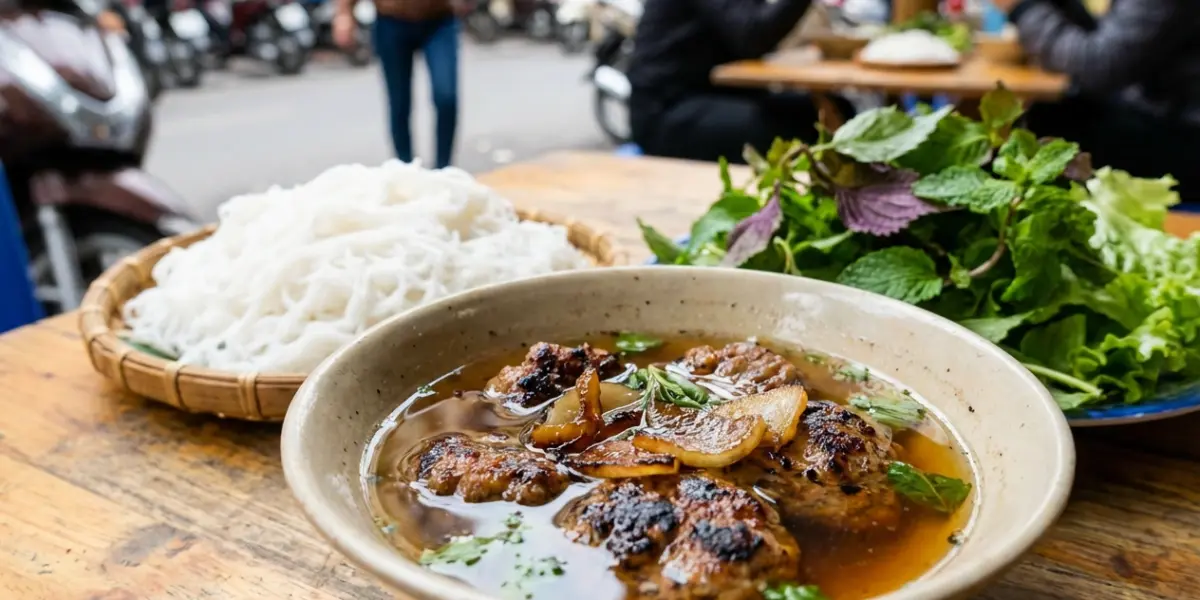
Bun cha is Hanoi’s defining dish — charcoal-grilled pork patties and sliced pork belly served in a warm, sweet-savory dipping broth alongside a plate of cold rice vermicelli, fresh herbs, and shredded papaya or green mango. It is the dish that Anthony Bourdain and Barack Obama shared at a plastic table in a Hanoi alley in 2016, and it is the dish that best captures what is distinctive and brilliant about northern Vietnamese cooking.
What Is Bun Cha?
Bun cha (pronounced ”boon cha”) translates loosely as noodles and grilled pork. It originated in Hanoi and remains strongly associated with the north — you will find it at every meal of the day in the city, most commonly at lunch, when charcoal grills set up on the pavement fill entire streets with smoke that signals the midday rush. The dish is not common in southern Vietnam, where the cuisine is sweeter and the approach to noodles is different.
The Bourdain-Obama moment in 2016, filmed for the CNN show ”Parts Unknown,” brought bun cha to global attention in a way few street food dishes have ever experienced. Bourdain chose the restaurant specifically for its authenticity and simplicity — two plastic stools, $6 beers, a charcoal grill visible from the sidewalk. The dish they ate was exactly what every other customer was having, which is precisely the point.
What makes bun cha distinctive within Vietnamese noodle cooking is its structure. Unlike pho, where the noodles and broth are combined in a single bowl, bun cha keeps everything separate. The dipping broth (nuoc cham pha) is warm and slightly sweet-sour, flavored with fish sauce, sugar, lime, garlic, and chili. You dip bundles of cold vermicelli and bites of grilled pork into the broth rather than eating it as a soup. The fresh herbs — perilla, mint, lettuce, bean sprouts — are eaten alongside and provide cleansing, aromatic contrast to the smoky, caramelized pork.
Ingredients
For the Grilled Pork
- 300g (10.5 oz) pork shoulder or pork neck, thinly sliced (about 3–4mm / ⅛ inch)
- 250g (9 oz) ground pork (for the patties — use pork with at least 20% fat)
- Marinade for both:
- 2 tablespoons fish sauce
- 1 tablespoon oyster sauce
- 1 tablespoon sugar
- 1 tablespoon honey
- 3 garlic cloves, minced
- 2 shallots, minced
- 1 teaspoon lemongrass, very finely minced (from the tender inner stalk)
- ½ teaspoon black pepper
- 1 tablespoon neutral oil
For the Dipping Broth (Nuoc Cham Pha)
- 360ml (1½ cups) warm water
- 60ml (¼ cup) fish sauce (use a good-quality Vietnamese brand like Phu Quoc or Three Crabs)
- 3 tablespoons sugar
- 2 tablespoons fresh lime juice or rice vinegar
- 2 garlic cloves, thinly sliced
- 2 fresh red or green chilies, thinly sliced
- 1 tablespoon rice vinegar (adds brightness and complexity)
For Serving
- 200g (7 oz) dried bun (rice vermicelli noodles) — cook according to packet directions
- Large handful of fresh perilla (tia to) or shiso leaves
- Large handful of fresh mint leaves
- Large handful of lettuce leaves, torn
- 100g (3.5 oz) bean sprouts
- 100g (3.5 oz) green papaya or green mango, shredded (optional but traditional)
- Fresh cilantro (coriander) leaves
- Extra lime wedges and chili slices for the table
Substitution notes: Perilla (tia to) is the key herb in bun cha — it has an anise-like, slightly minty flavor with a faint cinnamon note. It is found at Asian grocery stores and is worth seeking out. If unavailable, use a combination of Thai basil and mint as an approximation. For the pork shoulder slices, ask your butcher to slice it thin on a meat slicer, or freeze the pork for 30 minutes to firm it up for easier home slicing. Ground pork should have visible fat — lean ground pork produces dry, crumbly patties.
How to Make Bun Cha
Prepare the Pork (1–4 hours ahead, ideally overnight)
- Make the marinade: Combine fish sauce, oyster sauce, sugar, honey, minced garlic, minced shallots, lemongrass, black pepper, and oil in a bowl. Stir well until the sugar dissolves.
- Marinate the sliced pork: Toss the thinly sliced pork shoulder in half of the marinade. Cover and refrigerate.
- Make the pork patties: Combine the ground pork with the remaining half of the marinade. Mix well by hand for 1–2 minutes until the mixture becomes slightly sticky and cohesive — this mixing develops the protein structure and gives the patties a firm, bouncy texture. Wet your hands and form into small flat patties about 5cm (2 inches) in diameter and 1cm (⅓ inch) thick. You should get 10–12 patties. Place on a plate, cover, and refrigerate alongside the sliced pork.
Make the Dipping Broth
- Dissolve and combine: In a small saucepan, warm the water over low heat. Add the fish sauce, sugar, and rice vinegar. Stir until the sugar dissolves completely. Remove from heat and add the lime juice.
- Add aromatics: Add the sliced garlic and chili. Taste — the broth should be balanced between sweet, salty, sour, and slightly spicy. Adjust with more fish sauce (saltier), sugar (sweeter), or lime (more acidic) to your preference.
- Keep warm: The broth should be served warm, not hot — it should not cook the meat when you dip it in. Keep it in the saucepan over the lowest heat setting or pour into individual bowls just before serving.
Cook the Rice Vermicelli
- Soak and cook: Soak dried rice vermicelli in room-temperature water for 10 minutes to soften, then cook in boiling water for 2–3 minutes (or as directed on the packet) until tender but not mushy. Drain and rinse under cold water. The vermicelli should be served at room temperature — cold noodles against the warm dipping broth is intentional and correct.
Grill the Pork
- Set up the grill: Traditional bun cha uses a small tabletop charcoal grill. At home, use a cast-iron grill pan, an outdoor charcoal or gas grill, or a broiler set to its highest setting. The key is high direct heat to achieve caramelization. If using a cast-iron pan, heat it over high heat until smoking.
- Grill the patties: Cook the pork patties for 3–4 minutes per side without moving them. Resist the urge to press or flip early — you want a firm, caramelized crust with slightly charred edges. The sugar and honey in the marinade will create a dark, lacquered surface. The patties are done when cooked through with visible char marks.
- Grill the sliced pork: Cook the sliced pork shoulder for 2–3 minutes per side. The thin slices cook quickly and benefit enormously from a few charred edges. They should look caramelized, not grey.
- Rest briefly: Let the cooked pork rest for 2–3 minutes before serving — this allows the juices to redistribute and the marinade to set on the surface.
Prepare the Herb Plate
- Arrange the herbs: Wash and dry all fresh herbs. Arrange perilla, mint, lettuce, cilantro, and bean sprouts on a large plate. Add the shredded green papaya or mango if using. The herb plate should be abundant — herbs in bun cha are not a garnish, they are central to the eating experience.
Serve
- Set the table: Place the warm dipping broth in individual bowls (or a shared pot at the center). Arrange the grilled pork on a separate plate. Put the vermicelli on a separate plate or in a bowl. Set the herb plate alongside. Extra lime and chili on the table.
- How to eat: Add a couple of pieces of grilled pork to your dipping broth. Take a small bundle of vermicelli (use chopsticks or your fingers to gather it), dip it briefly into the broth, and eat with a piece of pork and whatever herbs appeal to you. The eating is exploratory and personal — there is no wrong combination.
Tips for the Best Bun Cha
- Overnight marinade transforms the pork. The fish sauce and sugar penetrate deeper with more time, and the sugars begin to caramelize on the surface of the meat more dramatically during cooking. Even 4 hours is better than 30 minutes, but overnight is the gold standard.
- Fat percentage in the patties is critical. Lean ground pork produces dry, hard patties that crack on the grill and have no succulence. Use ground pork from the shoulder or ask for a blend with at least 20% fat. The fat renders during grilling and keeps the patties moist and flavorful.
- The char is the point. Do not fear the dark edges on the pork. The Maillard reaction on the sugar-coated meat creates complex, slightly bitter caramel notes that balance the sweetness of the marinade and the sweetness of the dipping broth. Timid grilling produces uninteresting pork.
- Serve the broth warm, not hot. The dipping broth should be approximately 60–65°C (140–150°F) — warm enough to be comforting and to slightly warm the cold noodles, but not hot enough to cook the garlic and chili or lose its fresh bright quality.
- Use the full herb plate. The herbs are not decoration. Bun cha eaten without abundant fresh perilla and mint is a fundamentally incomplete experience. The bitterness of the perilla, the cool menthol of the mint, and the freshness of the cilantro balance every other element of the dish.
Variations
Bun Cha with Cha Gio (Fried Spring Rolls)
Many bun cha restaurants also serve small fried spring rolls (cha gio or nem ran) alongside the grilled pork, which are also dipped in the broth. Make small spring rolls with a filling of ground pork, glass noodles, mushroom, and shallot, fry until golden, and add to the spread. This is the most generous and celebratory version of the dish.
Bun Cha with Banh Cuon (Rice Rolls)
In some Hanoi variations, steamed rice paper rolls (banh cuon) stuffed with pork and mushroom are served alongside the bun cha instead of or in addition to the vermicelli. The silky, delicate rice rolls provide a textural counterpoint to the chewy vermicelli.
Grilled Beef Version (Bun Bo Nuong)
Replace the pork with thinly sliced beef short rib or beef shoulder marinated identically. Grill over the highest possible heat for 1–2 minutes per side — the beef should be medium to medium-rare with charred edges. Serve with the same dipping broth and herb plate.
What to Serve With Bun Cha
- Cha gio (Vietnamese fried spring rolls): The traditional accompaniment at Hanoi bun cha stalls. Dip the crispy rolls directly into the broth alongside the pork.
- Extra fresh herbs: More is always better — Vietnamese herb platters frequently include rau muong (water spinach), ngo gai (sawtooth herb), and diep ca (fish mint) in addition to the basic herbs. Each adds a different aromatic note.
- Bia hoi (Vietnamese draft beer): Light, fresh draught beer is the classic drink alongside bun cha at street stalls. A cold, light lager at home serves the same function.
- Iced Vietnamese coffee: After the meal, a glass of ca phe sua da (iced Vietnamese coffee with condensed milk) is the traditional close to a Hanoi lunch.
Storage and Reheating
All components of bun cha store separately. The grilled pork keeps refrigerated for up to 3 days. Reheat in a dry pan over medium-high heat for 2–3 minutes per side — this re-crisps the surface and revives the caramelization better than a microwave, which steams the pork and makes the surface soggy. The dipping broth keeps refrigerated for up to 1 week — reheat gently and retaste, adjusting lime juice if needed as the acidity mellows over time. Cooked vermicelli keeps refrigerated for up to 2 days; toss with a few drops of oil before storing to prevent clumping, and refresh under cold water before serving. Fresh herbs should be used the day they are bought.