Last updated: March 24, 2026
Hakka cuisine is one of the most soulful, underrepresented regional Chinese food traditions — a cooking style forged by centuries of migration, scarcity, and resilience. The Hakka people, whose name literally translates to ”guest families,” are a Han Chinese subgroup who migrated from the Central Plains of northern China to the mountainous south over more than a thousand years. They carried their cooking techniques with them, adapted to rugged highland farms, and turned preserved vegetables, fatty pork, and humble tofu into food that now feels deeply personal to anyone who has eaten at a Hakka kitchen table. If you have ever tried salt-baked chicken wrapped in paper, chewy abacus seeds stir-fried with minced pork, or a steaming clay pot of yong tau foo, you have already been initiated into the quiet, savory power of Hakka food.
In 2026, Hakka cuisine is having a well-deserved moment. As diners move past the big three of Cantonese, Sichuan, and Shanghai, regional Chinese cooking — especially Hakka, Chaoshan, and Fujian — is being rediscovered by a new generation of home cooks who crave hearty, fermentation-forward, preservation-driven flavors. This guide walks you through Hakka history, the ingredients that define it, the ten-plus dishes every cook should know, the techniques that tie it all together, and the cultural context that makes Hakka food feel like the ultimate comfort cuisine. Whether you are planning a Hakka-themed dinner party or simply looking for your next weeknight obsession, this is your complete starting point.
Who Are the Hakka People and Why Does Their Food Matter?
To understand Hakka cuisine, you have to understand the Hakka story. Most historians trace the Hakka back to ancient Han Chinese families who lived in the fertile Central Plains around the Yellow River. Beginning as early as the fourth century and continuing in waves through the Song, Yuan, Ming, and Qing dynasties, war, famine, and political upheaval pushed groups of these families southward. They settled in the mountainous border regions of Fujian, Jiangxi, and Guangdong, and later spread to Taiwan, Hong Kong, Southeast Asia, and the Americas. Today, there are an estimated 80 to 100 million Hakka people worldwide.
Because they arrived in already-occupied lowlands, Hakka farmers often had to cultivate rocky hillsides where rice paddies were impractical. They relied on dry-farmed grains, root vegetables, and pork raised on kitchen scraps. Their food culture evolved around three non-negotiable realities: long workdays in the fields, harsh weather, and no refrigeration. The result is a cuisine that prizes preserved vegetables, rendered animal fat, salt-cured proteins, and slow-cooked stews that can simmer while people are away working.
Hakka food matters because it is a living archive. Every dish tells a story about migration, thrift, and the way flavor can be coaxed out of the simplest ingredients. If Cantonese food is often described as the elegant cuisine of the coastal port cities, and Sichuan is the bold, layered cuisine of the spice-loving west, Hakka is the rustic, deeply savory cuisine of the mountains — food designed to warm tired bodies and stretch humble ingredients into feasts.
A Brief History of Hakka Cooking
Hakka cuisine developed through five rough historical phases, each leaving a lasting mark on the menu you will find in Hakka kitchens today.
Northern roots (pre-Tang era). The earliest Hakka ancestors cooked like other northern Han families — wheat noodles, stuffed dumplings, vinegar-based seasonings, and wheat flatbreads. You can still see these traces in Hakka stuffed tofu (which mimics the act of filling a dumpling wrapper) and in the strong affection for sticky-rice wine and aged vinegars.
The great migrations (fourth through thirteenth centuries). Successive waves of southward migration forced families to travel with what they could carry — salt, preserved greens, dried meats, and cured fish. On the road, preservation was survival, and the Hakka obsession with mui choi (dried mustard greens), red-braised pork, and salt-cured proteins took shape.
Settlement in the southern highlands (Song and Yuan dynasties). Once settled in hill country, the Hakka adopted local ingredients like taro, pumpkin, bamboo shoots, and wild ferns, but applied their northern techniques. The clay pot — which holds heat and can be buried in coals — became the signature cookware of the region.
Diaspora era (Qing through early twentieth century). As economic pressure grew, Hakka communities emigrated to Taiwan, Malaysia, Indonesia, the Caribbean, and later North America. Hakka cooks absorbed chilies, tropical herbs, and Southeast Asian aromatics, creating fusion branches like Malaysian Hakka yong tau foo and Indo-Caribbean Hakka chili chicken.
The modern revival (2010s to today). Food writers, restaurateurs, and younger Hakka chefs — particularly in Taipei, Hong Kong, Meizhou, and Toronto — have worked to restore Hakka food to the table after decades of being overshadowed by flashier regional cuisines. The 2026 hyper-regional food trend has only accelerated that rediscovery.
Hakka Regions: Where the Food Comes From
There is no single ”Hakka province.” Instead, Hakka cuisine lives in pockets across southern China and the broader diaspora. Each region developed its own dialect of the cuisine.
Meizhou, Guangdong. Often called the spiritual capital of Hakka culture, Meizhou is home to the most iconic versions of salt-baked chicken, stuffed tofu, and pork belly with preserved greens. The cooking here is rustic, generous with rendered lard, and deeply focused on pork.
Western Fujian. This region gave the world the massive earthen tulou communal houses and a cooking style heavy on dried bamboo, preserved vegetables, and rice wine lees. Expect lots of stewed pork, river fish, and sweet rice dishes.
Southern Jiangxi (Ganzhou). Hakka food here leans slightly spicier, with more use of chili and preserved radish. It shares some DNA with the cuisine of neighboring Hunan, though the flavor base is still preservation-forward rather than fresh-chili-driven.
Hong Kong and the New Territories. The walled Hakka villages north of Kowloon preserved an especially conservative version of Hakka cuisine well into the twentieth century. Poon choi, the towering communal ”basin feast,” is a Hong Kong Hakka tradition now enjoyed nationwide at Lunar New Year.
Hakka Taiwan. In Hsinchu, Miaoli, and the foothills of central Taiwan, Hakka food leaned into salt, fermentation, and the strong flavors of preserved mustard. Taiwanese Hakka cuisine is famous for its ”four stir-fries” and for lei cha, the pounded tea that has become a viral health drink on social media.
The Southeast Asian diaspora. In Malaysia and Singapore, Hakka migrants built yong tau foo into a national street food, while in Indonesia, Hakka braises influenced the region’s sweet-savory clay pot dishes. In India and the Caribbean, Hakka chefs invented an entire subgenre of ”Indo-Chinese” food built around chili chicken, Manchurian-style dishes, and hakka noodles — a cooking tradition that is Hakka in name and spirit, even as it has fused with other culinary traditions.
The Flavor Profile of Hakka Cuisine
If you are used to other southern Chinese cuisines, Hakka food will feel immediately familiar and subtly different. The five flavor pillars are:
- Salty. Hakka cooks use more salt than most other Chinese regional cuisines. Salt crusts, salt cures, and salt-heavy braises are a legacy of refrigeration-free travel.
- Rich and fatty. Pork belly, rendered lard, and fatty chicken cuts appear constantly. Fat carries flavor and, historically, provided much-needed calories.
- Deeply savory (umami). Preserved mustard greens, dried fish, fermented bean pastes, and soy sauce stack umami layers in nearly every dish.
- Mildly sour from fermentation. Mui choi and suan cai (sour fermented vegetables) bring a gentle, pickled brightness that cuts through fatty proteins.
- Aromatic rather than spicy. Hakka food is not typically hot; the aromatics come from ginger, rice wine, garlic, scallion, white pepper, and sometimes a touch of five-spice.
The cuisine is largely free of the numbing heat of Sichuan and the raw freshness of coastal Cantonese. Hakka dishes ask you to slow down and taste the depth built through long cooking and aged ingredients.
Essential Hakka Ingredients
Stock your pantry with the items below and you will be able to cook almost any Hakka dish in this guide. Many are shelf-stable and last for months, reflecting the preservation-first spirit of the cuisine.
| Ingredient | What it is | How Hakka cooks use it | Where to buy |
|---|---|---|---|
| Mui choi (mei cai) | Sun-dried, salt-pickled mustard greens | Rinsed and steamed with pork belly; tossed into clay pot rice | Asian grocery, vacuum packs |
| Dried shiitake mushrooms | Slow-dried caps with concentrated umami | Rehydrated for braises, stuffing fillings, and clay pot rice | Well-stocked pantries |
| Shaoxing wine | Aged Chinese rice wine | Deglazing, marinades, and a splash over steamed chicken | Bottled in most Asian markets |
| Dark soy sauce | Aged, molasses-thick soy sauce | Gives red-braises their mahogany color and silky mouthfeel | Any Asian grocery |
| Light soy sauce | Thinner, saltier everyday soy | Base seasoning for stir-fries and dipping sauces | Any Asian grocery |
| Preserved radish (cai po) | Salt-cured, sun-dried daikon | Tossed into omelets, stir-fried greens, and rice bowls | Vacuum pack or jar |
| Dried shrimp | Small, sun-dried salted shrimp | Bloomed and pounded into stuffings, soups, and seed-shaped abacus balls | Refrigerated aisle |
| Fermented bean curd (fu ru) | Cubes of tofu aged in brine and wine | Mashed into marinades and dipping sauces for blanched meats | Jars, shelf-stable |
| Taro root | Starchy tropical tuber | Steamed, mashed, or sliced into the classic abacus-seed dough | Produce section of Asian grocery |
| Pork belly | Layered fatty-lean cut | The workhorse protein of Hakka cooking | Butcher or Asian grocery |
| Tofu (firm and soft) | Fresh and cotton-style | Stuffed, simmered, pan-seared, and eaten plain with soy | Refrigerated tofu case |
| Lei cha herbs | Basil, mint, perilla, tea leaves | Pounded into the famous savory pounded-tea meal | Specialty Asian grocers or dried kits |
| Glutinous rice | Short-grain sticky rice | Stuffed into duck, steamed into cakes, and fermented into wine | Asian grocery rice aisle |
| Five-spice powder | Blend of star anise, fennel, clove, cinnamon, pepper | Dry-rubs for salt-baked chicken and roast pork | Spice aisle |
If you only buy three things to begin, start with a vacuum pack of mui choi, a bottle of Shaoxing wine, and a block of good firm tofu. With those three ingredients plus pork belly and soy sauce, you can cook at least half of the Hakka greatest hits.
12 Must-Try Hakka Dishes
These are the dishes that define Hakka cooking — the ones you will see on every traditional restaurant menu from Meizhou to Kuala Lumpur. Learn even half of them and you will have a Hakka repertoire that rivals most restaurant kitchens.
1. Salt-Baked Chicken (Yan Ju Gai)
The dish that launched Hakka cuisine into international fame. A whole chicken is rubbed with five-spice, sand ginger, and sometimes fermented bean curd, then wrapped in parchment or lotus leaves and buried in a mountain of hot rock salt. The salt radiates even heat without penetrating the meat, producing skin that is gold-yellow, flesh that stays incredibly juicy, and bones that slip out cleanly. Serve it torn into rustic chunks with a ginger-scallion dip.
2. Yong Tau Foo (Stuffed Tofu)
Tofu cubes are slit and stuffed with a mixture of minced pork, rehydrated dried fish, garlic, and white pepper, then pan-seared and simmered in a clay pot with a soy-based sauce. The dish traces back to the Hakka love of dumplings — with no wheat in the highlands, cooks reinvented the filling-plus-wrapper idea using tofu as the envelope. In Malaysia and Singapore, yong tau foo has become a build-your-own street food where customers pick from a counter of stuffed vegetables and tofu.
3. Mei Cai Kou Rou (Pork Belly with Preserved Mustard Greens)
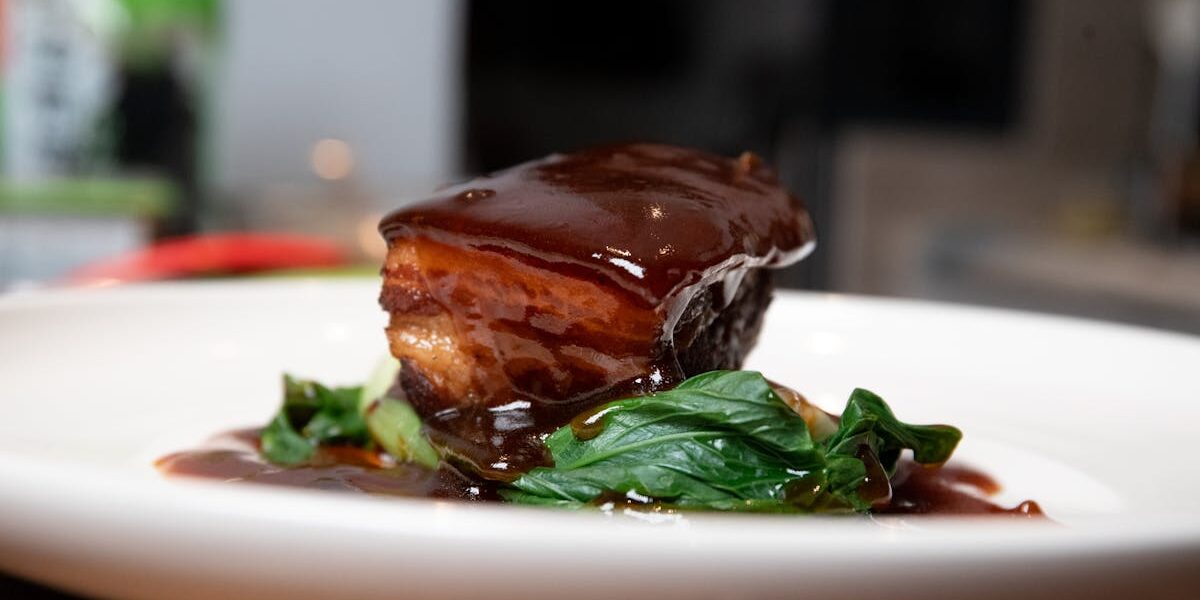
Arguably the most beloved Hakka dish of all. Layers of blanched, deep-fried, and sliced pork belly are packed into a bowl with rehydrated mui choi and a mahogany-colored sauce of dark soy, Shaoxing wine, and rock sugar. The whole thing steams for two to three hours until the fat has dissolved into silk and the mustard greens have soaked up the meat juices. Inverted onto a plate at the table, it is showstopper food at family banquets.
4. Suan Pan Zi (Abacus Seeds)
Tiny beads of taro-and-tapioca dough pinched into the shape of abacus counters, boiled until chewy, and then stir-fried with minced pork, dried shrimp, black mushrooms, and garlic. The name is a blessing — they symbolize wealth because they look like counters on the classic Chinese abacus. The texture is the whole point: a QQ-style bouncy chewiness that puts gnocchi to shame.
5. Lei Cha (Pounded Tea Rice)
A uniquely Hakka meal that looks more like a shamanistic ritual than dinner. Green tea leaves, basil, mint, perilla, toasted sesame seeds, peanuts, and grains are pounded in a ribbed earthenware mortar until they form a fragrant paste. The paste is diluted with hot water, then poured over a bowl of rice topped with tofu, leafy greens, radish, peanuts, and toasted rice. The result is herbal, nutty, grassy, and profoundly nourishing — the original savory super-bowl, centuries before the trend.
6. Hakka Stuffed Eggplant, Bitter Melon, and Chili
Cousins of yong tau foo. The same fish-and-pork filling is packed into halved eggplant, bitter melon, or mild long green chilies, then pan-fried and glossed with a thin oyster or soy-based sauce. Order a combination platter at any Hakka restaurant — the textural contrast between vegetable, filling, and sauce is the whole genre condensed into one plate.
7. Nian Gao (Hakka Sticky Rice Cake)
Where southern Chinese families typically eat sweet nian gao at Lunar New Year, Hakka nian gao is often made savory: grated white radish or taro is folded into rice flour batter along with bits of dried shrimp, mushroom, and five-spice pork, then steamed into slabs and pan-fried to crisp the edges. It is a dish that turns the bleakest pantry into a celebration.
8. Hakka Poon Choi (Basin Feast)
A layered one-pot feast, traditionally served in a wooden or metal basin at weddings, New Year celebrations, and village banquets in the New Territories of Hong Kong. The bottom layer is cabbage, radish, and pork skin to soak up juices; upper layers contain chicken, duck, prawns, fish maw, abalone, dried oysters, pork belly, and mushrooms. Everyone digs in with chopsticks from the communal basin — a tradition Hong Kongers say dates back to Song dynasty villagers feeding a fugitive emperor.
9. Yan Jiu Ji (Ginger and Rice Wine Chicken)
A close cousin of the famous Taiwanese three-cup chicken. In Hakka country, the ratio leans slightly heavier on rice wine and soy with a deeper mushroom note. Dark meat chicken is simmered in a covered clay pot with ginger, garlic, rock sugar, sesame oil, and a handful of Thai basil that is thrown in just before serving, where it wilts into the sauce and perfumes the whole dish.
10. Hakka Noodles (Ban Mian or Meizhou-Style)
Thick hand-cut or rolled wheat noodles tossed with lard, fried shallots, soy sauce, white pepper, and a generous scattering of minced pork and scallions. Some versions top the bowl with a savory soup of anchovy and pork bone; others stay dry. In the diaspora, ”Hakka noodles” in India refers to a completely different dish — stir-fried hot noodles with cabbage, carrots, and chili — that took on the name of the Chinese chefs who popularized it.
11. Ngiong Tew Foo Soup (Stuffed Tofu Clear Soup)
A lighter, soup-based version of yong tau foo in which the stuffed tofu, bitter melon, and fish balls are simmered in a pork-and-anchovy broth. Served with rice or rice noodles, it is the everyday Hakka answer to pho: deeply flavored stock, clean toppings, a swirl of chili sauce. You will find it at hawker centers across Kuala Lumpur, Penang, and Singapore.
12. Chicken in Rice Wine (Jiu Ji)
A confinement food classic offered to new mothers across Hakka communities. Chicken pieces are stir-fried with a mountain of ginger, then simmered in sweet-fragrant homemade rice wine and chicken stock until the alcohol mellows into a warming sauce. It is a dish that lives somewhere between soup and stew, and it is widely considered a restorative winter meal far beyond the postpartum tradition.
Core Hakka Cooking Techniques
Hakka cuisine relies on a handful of very learnable techniques. Master these and you can adapt almost any Hakka recipe without a cookbook.
Salt Baking
Coarse rock salt is heated dry in a wok or Dutch oven until blazing hot, then a parcel of seasoned chicken (wrapped in sand ginger powder, paper, and sometimes lotus leaves) is buried in the salt and covered. The salt conducts heat evenly and traps steam inside the parcel — so the chicken emerges as if it had been gently roasted and steamed at the same time. Importantly, the salt never touches the meat, so the dish is not actually salty.
Clay Pot Cooking
The unglazed or partially glazed clay pot is the unsung hero of Hakka kitchens. Its porous walls hold moisture and slowly radiate heat long after the burner is off, which is why braises and rice dishes finished in a clay pot develop a depth of flavor you cannot replicate in a stainless saucepan. Our full clay pot cooking guide walks through seasoning, shock-proofing, and everyday recipes.
Red Braising (Hong Shao)
Hakka red braises lean slightly salty and less sugary than their Shanghai cousins. The method — browning meat, deglazing with Shaoxing, adding dark soy and aromatics, then simmering — is covered in depth in our red braising guide. Mei cai kou rou and Hakka red-braised duck are the showpiece dishes of the style.
Stuffing
Yong tau foo is actually an umbrella term for the Hakka love of stuffing savory fillings into vegetables, tofu, and fish skin. The filling itself is usually a mix of minced pork (for richness), ground dried fish or shrimp (for umami), tapioca or cornstarch (for bounce), and white pepper (for aroma). Once you have the filling formula memorized, you can stuff almost anything hollow.
Steaming
Because many Hakka home kitchens rely on a single wok, steaming is the workhorse cooking method for everything from whole fish to rice cakes to mei cai kou rou. A cast-iron wok with a bamboo steamer is the traditional setup, though any tall lidded pot with a rack will do. See our steamed fish guide for the core timing rules.
Deep Frying Then Braising
A classic Hakka move: pork belly and tofu are deep-fried until the surface blisters, then simmered slowly in a sauce. The frying collapses the cell walls and lets the braising liquid penetrate more deeply — it is why Hakka pork belly can taste so much more tender than other southern versions.
Preservation
Sun-drying, salt-curing, and lactic fermentation are all fundamental to Hakka cooking. Home cooks in the hills historically made their own mui choi, rice wine, preserved radish, and fermented bean curd, because they had to. If you want the most authentic flavor, learn to make at least one Hakka pickle from scratch — mui choi is the easiest entry point.
How Hakka Compares to Other Regional Chinese Cuisines
Here is a quick comparison of Hakka cuisine against four other major regional Chinese styles. If you are trying to plan a multi-course, pan-Chinese dinner, this table will help you balance flavors across dishes.
| Cuisine | Flavor profile | Signature dish | Key aromatics | Defining technique |
|---|---|---|---|---|
| Hakka | Salty, savory, rich, lightly sour | Mei cai kou rou | Preserved mustard, ginger, rice wine | Salt baking, clay pot braises |
| Cantonese | Fresh, delicate, lightly sweet | Steamed fish with scallion | Scallion, ginger, light soy | Steaming and quick stir-fry |
| Sichuan | Mala (numbing and hot), layered | Mapo tofu | Sichuan peppercorn, chili bean paste | Dry-frying, double frying |
| Hunan | Bright, sharp, very spicy | Chairman Mao’s red-braised pork | Fresh and pickled chilies, fermented black beans | Smoking and stir-fry with fresh chilies |
| Shanghainese | Sweet, rich, soy-forward | Hong shao rou | Rock sugar, dark soy, aged Shaoxing | Slow red braising |
A good rule of thumb: if you want flavor without heat, start with Hakka or Cantonese. If you want heat with fresh aromatic punch, go Hunan. If you want complex numbing spice, go Sichuan. And if you want a sticky, sweet caramelized finish, Shanghai is your friend.
Building a Hakka Pantry: Quick-Start Shopping List
If you are starting from zero, here is the minimum viable Hakka pantry. Pick these up on a single Saturday trip to a well-stocked Asian grocery or online retailer and you will be ready to cook at least six dishes from this guide.
- One vacuum pack of mui choi (preserved mustard greens)
- One bottle of Shaoxing rice wine
- One bottle of light soy sauce and one bottle of dark soy sauce
- A block of Chinese rock sugar
- A small bottle of toasted sesame oil
- Ground white pepper
- A jar of fermented bean curd (fu ru)
- Dried shiitake mushrooms and dried shrimp
- One small piece of fresh ginger, a head of garlic, and a bunch of scallions
- One taro root (optional, for abacus seeds)
- Firm tofu, fresh
- A piece of pork belly, skin on
Pair that list with staples you probably already have — soy sauce, neutral oil, salt, sugar, and short-grain rice — and you have a functional Hakka kitchen.
Tools and Equipment for Hakka Cooking
Hakka home kitchens are not fussy. You can cook almost the entire cuisine with five pieces of equipment:
- A seasoned carbon-steel wok. For stir-fries, pan-frying stuffed tofu, and deep-frying pork belly. See our wok buying guide if you do not have one yet.
- A clay pot (sha bao or donabe-style). For braises, rice dishes, and chicken in rice wine. A Dutch oven is a reasonable substitute but the flavor will be slightly less earthy.
- A Chinese cleaver. For breaking down chicken, slicing pork belly into even layers, and mincing the stuffing fillings.
- A bamboo steamer or metal rack and lid. Essential for mei cai kou rou and Hakka rice cakes.
- A mortar and pestle. For crushing aromatics, pounding lei cha, and turning whole spices into aromatic five-spice.
If you are going deeper, a sand-ginger grinder, an earthenware lei cha mortar with a wooden guava branch pestle, and a pair of tall-sided dishes for steaming mei cai kou rou will all be useful.
Meal Planning: How to Build a Hakka Dinner
A traditional Hakka table is built around the principle of pairing meat, vegetable, and soup — never one big protein. For a weeknight dinner for four, plan for:
- One rich protein dish (mei cai kou rou, salt-baked chicken, or red-braised duck)
- One stuffed or braised vegetable (yong tau foo or stuffed eggplant)
- One quick stir-fried leafy green (water spinach, gai lan, or mustard greens)
- One simple soup (pork and seaweed, or chicken in rice wine)
- Steamed short-grain white rice for every diner
For a full-blown banquet — birthdays, Lunar New Year, a welcome-to-a-new-home party — add a communal poon choi to the middle of the table, a platter of salt-baked chicken, a platter of abacus seeds, a savory rice cake plate, and a sweet ending of glutinous rice balls in ginger syrup. Hakka dinners are not shy.
Sample Three-Day Hakka Menu
Want to try a week of Hakka-inspired eating? Here is a sample three-day menu that balances effort, protein, and vegetables.
| Day | Breakfast | Lunch | Dinner |
|---|---|---|---|
| Day 1 | Congee with preserved radish and scallion | Hakka noodles with minced pork and fried shallots | Salt-baked chicken, stir-fried water spinach, and steamed rice |
| Day 2 | Steamed savory rice cake with chili oil | Lei cha rice bowl with mint, basil, and tofu | Mei cai kou rou, blanched gai lan with oyster sauce, and tomato-egg soup |
| Day 3 | Soft-boiled eggs, toast, and preserved bean curd | Yong tau foo soup with rice noodles | Chicken in rice wine, abacus seeds, and steamed rice |
Most dishes in this menu scale up well for leftovers: make a double batch of mei cai kou rou on Day 2 and you have an instant, even-better-reheated Day 4 dinner.
Hakka Food in the Diaspora
No regional Chinese cuisine has traveled farther than Hakka food. Trace the diaspora and you can watch a single cuisine branch out into several related food traditions.
Taiwan. Hakka migrants shaped the food culture of Hsinchu, Miaoli, and Taoyuan. Taiwanese Hakka stir-fries — pork, squid, celery, tofu skin, and dried shrimp — became a dining hall staple. The island is also home to the best-preserved version of lei cha outside mainland China.
Malaysia and Singapore. Hakka yong tau foo became a hawker centre icon, and Hakka-style braised pork belly with tofu and egg (tau yu bak) is a home-cooking standard. Our Malaysian recipes guide has more context on the broader flavor influences.
Indonesia. The West Kalimantan Hakka community developed a distinct style with heavier pepper and sweeter braises. Indonesian-style pork belly with kecap manis owes a quiet debt to Hakka cooking techniques.
India and the Caribbean. Hakka chefs migrating to Kolkata in the nineteenth century invented ”Indian-Chinese” or ”Hakka Chinese” food — chili chicken, gobi Manchurian, hakka noodles. This fusion cuisine is now hugely popular across South Asia and has spread to Caribbean nations with Indian-origin populations.
North America. Toronto has arguably the most robust Hakka restaurant scene outside Asia, a legacy of Indo-Caribbean Hakka families who settled in the city in the 1960s and 70s. You will find chili chicken, Manchurian cauliflower, and beef with bitter melon on the same menu as salt-baked chicken and mei cai kou rou.
Hakka Food Culture and Festivals
Food is central to Hakka identity because Hakka identity is itself mostly expressed through family and village ritual. A few key celebrations:
- Lunar New Year. Poon choi, nian gao, glutinous rice balls, and whole chicken offerings for ancestors. The chicken is later eaten in the form of salt-baked or white-cut chicken.
- Qingming (Tomb Sweeping Festival). Families visit ancestral graves with steamed chickens, red-braised pork, rice wine, and rice cakes. After the ritual, the food is eaten together in a picnic-style meal.
- Dragon Boat Festival. Hakka zongzi (sticky rice parcels wrapped in bamboo leaves) feature pork belly, mushrooms, chestnut, and salted egg yolk — slightly larger and saltier than the Cantonese version.
- Winter Solstice. Ginger chicken in rice wine is considered a warming dish for the season and is especially associated with Hakka women giving birth.
- Village temple fairs. The entire community gathers to cook a group meal — often a massive pork braise and a communal poon choi for hundreds of people at once.
Hakka hospitality rules are generous and almost emphatic: if you visit a Hakka home, you will be fed, you will be fed some more, and you will be sent away with leftovers. This tradition dates back to the Hakka reputation for supporting travelers in mountainous terrain — and it survives today in diaspora Hakka homes around the world.
Tips for Cooking Authentic Hakka Food at Home
A few practical pointers that will take your Hakka cooking from good to restaurant-level.
- Rinse your mui choi. Preserved mustard greens are heavily salted. Soak them in cold water for 20 to 30 minutes, then squeeze and rinse again before chopping. Skipping this step is the number one reason home versions of mei cai kou rou come out brutally salty.
- Render your pork belly twice. For mei cai kou rou, first simmer the skin-on belly in seasoned water, then deep-fry the skin side to blister it. This two-step rendering is what gives the final dish its signature silky-crunchy texture.
- Pre-bloom dried mushrooms. Soak dried shiitakes in hot water for at least 30 minutes before cooking. Save the soaking liquid — strained — and add it to braises for another layer of mushroomy depth.
- Use fresh ginger generously. Hakka cooking leans on huge quantities of ginger, especially for chicken dishes. Half a cup of ginger slices in a clay pot is not unusual.
- Don’t skimp on lard or duck fat. A spoonful of rendered animal fat, especially in stir-fries and rice dishes, is what gives Hakka cooking its comforting, almost rustic fullness. If you are vegetarian, toasted sesame oil or a good-quality peanut oil is the closest match.
- Finish with Shaoxing wine off the heat. Add a small splash of rice wine once the flame is off. The residual heat releases the fragrance without cooking off the aroma. This trick is used across red-braised dishes and stuffed tofu.
Hakka Food and Health
Hakka cuisine is sometimes accused of being too salty or too fatty. Both stereotypes are rooted in the fact that it was originally farm-labor food — meant to provide long-lasting energy during long days of physical work. Eaten in the context of a balanced meal with plenty of rice and vegetables, the cuisine is not actually out of line with broader Chinese food culture.
There are also genuinely health-forward dishes in the repertoire. Lei cha, for instance, is a powerhouse of green tea polyphenols, nuts, seeds, and leafy herbs. Stuffed tofu soups are protein-rich and fiber-forward. Fermented greens provide probiotic diversity. And the Hakka love of steaming — over frying — means that a well-constructed Hakka table can be surprisingly gentle on the gut.
If you are watching sodium, focus on the stir-fried greens, the lei cha, the clear soups, and the unsalted steamed chicken dishes. Use the salt-crusted and preserved-vegetable dishes as weekend celebrations rather than everyday fare.
Frequently Asked Questions
Is Hakka food the same as Cantonese food?
No. Although Hakka communities are concentrated in parts of Guangdong province (where Cantonese food is dominant), the two cuisines are distinct. Cantonese food is coastal, lightly seasoned, and focused on the freshness of ingredients. Hakka food is mountainous, heavily salted, and focused on preservation and layered depth from long cooking.
Is Hakka food spicy?
Traditional Hakka food is not particularly spicy. The heat profile is closer to warm ginger and white pepper than the chili-forward heat of Hunan or Sichuan. Diaspora Hakka dishes — especially the Indian-Chinese tradition — can be very spicy, but that heat is a later addition.
What is the most famous Hakka dish?
Globally, it is a three-way tie between salt-baked chicken (for drama), mei cai kou rou (for flavor), and yong tau foo (for daily popularity). If you walk into any Hakka restaurant, these three will likely be on the first page of the menu.
Can I cook Hakka food without a clay pot?
Yes. A heavy Dutch oven or a cast-iron lidded pan will handle most braises and clay pot rice dishes. You lose a small amount of earthy flavor and the dramatic tableside presentation, but the cooking chemistry works.
What is the difference between mui choi and suan cai?
Both are preserved mustard greens, but mui choi is sun-dried after salt curing, while suan cai is lacto-fermented and stays wet. Mui choi has a deep, almost raisin-like sweetness and a concentrated funk; suan cai is bright, sour, and crisp. They are not interchangeable — mei cai kou rou uses mui choi, while Northeastern Chinese dishes rely on suan cai.
Is there a vegetarian tradition in Hakka cuisine?
Yes. Hakka Buddhist temple cooking developed sophisticated vegetarian versions of yong tau foo, using rehydrated dried mushrooms and bean curd sheets in place of pork. Lei cha is naturally vegetarian. Most stir-fried greens can be made without lard by swapping in peanut oil or a smoked mushroom powder for depth.
Where can I eat Hakka food outside of Asia?
Toronto has the largest Hakka restaurant scene in North America, with a distinctly Indo-Caribbean Hakka accent. San Francisco, New York, Los Angeles, London, and Paris all have at least a few dedicated Hakka restaurants, often run by Meizhou or Taiwanese Hakka families. Look for dishes like salt-baked chicken, yong tau foo, and abacus seeds on the menu — those are the tells.
How do I store preserved Hakka ingredients?
Most vacuum-packed mui choi and dried shrimp keep for six to twelve months in a cool, dark pantry once unopened. After opening, transfer to an airtight container and refrigerate. Fermented bean curd and Shaoxing wine can live at room temperature for years but keep their aroma better when refrigerated after opening.
Is Hakka food hard to learn?
Not if you already know the basics of Chinese cooking — stir-frying, steaming, and braising. Once you have a pantry stocked with mui choi, Shaoxing wine, dark soy, and preserved radish, most Hakka home dishes come together with the same equipment and techniques you already use. Start with mei cai kou rou for braising practice and abacus seeds for dough work, and you will be well on your way.
Where to Go Next
If this guide has made you hungry, here are a few next stops in our Asian cooking library. Our Chinese recipes guide has thirty more classic dishes you can pair with the Hakka repertoire. If you want to dig into the broader world of regional Chinese cooking, read about Sichuan, Cantonese, Hunan, Yunnan, Taiwanese, and Uyghur cuisines. For deeper technical skill-building, visit our guides on stir-frying, red braising, and clay pot cooking.
Hakka cuisine is a small window into one of the most fascinating diasporas in food history. It is also, simply, some of the most comforting cooking on earth. Pick a single dish, block out an afternoon, and let your kitchen fill with the smell of braised pork belly and preserved greens — you will understand the Hakka saying that a kitchen is the first room of a home.

Mei Lin Chen
Mei Lin Chen is an Asian food writer and recipe developer. Melbourne-raised and London-based, she has spent over a decade exploring the rice paddies, hawker stalls, and home kitchens of South-East and East Asia. Her recipes balance traditional technique with everyday practicality.