Last updated: March 31, 2026
Filipino cuisine is one of the most exciting and underappreciated food traditions in Asia. With over 7,000 islands, centuries of trade with China, Spain, and the United States, and a culture built around communal eating, the Philippines has produced a kitchen that is bold, sour, sweet, salty, and deeply personal. Filipino recipes reflect the country’s history and geography in every bite — from the vinegar-braised adobo of Luzon to the coconut-rich dishes of the Visayas and the chili-forward flavors of Mindanao.
Whether you are exploring Filipino food for the first time or looking for traditional Filipino recipes to recreate at home, this guide covers everything: the history, the regional differences, the essential ingredients, the must-try dishes, and practical tips for cooking Filipino food in your own kitchen.
A Brief History of Filipino Cuisine
Filipino cuisine is the product of layered influences spanning more than a thousand years. Before any colonial contact, the indigenous peoples of the Philippine archipelago cooked with what the land and sea provided: rice, fish, coconut, banana, taro, and a wide array of tropical fruits and vegetables. Cooking methods centered on grilling over open flame, boiling in clay pots, and fermenting fish and shrimp into pastes and sauces that remain staples today.
Chinese traders arrived as early as the 10th century and brought with them noodles (which became pancit), soy sauce, tofu, and the technique of stir-frying in a wok. These ingredients and methods were absorbed and adapted rather than copied directly — pancit, for instance, evolved into dozens of regional variations that bear little resemblance to their Chinese ancestors.
The Spanish colonization from 1565 to 1898 was the most transformative influence. The Spanish brought tomatoes, onions, garlic, olive oil, vinegar, and a tradition of slow-braising meats. They introduced dishes like mechado (beef stew), caldereta (goat stew), and leche flan (caramel custard). The Spanish also brought Catholicism, which shaped the elaborate feast culture — fiestas — that remains central to Filipino food identity. Every town has a patron saint festival featuring a spread of lechon, pancit, and sweets.
American influence from 1898 onward introduced canned goods, processed meats (Spam, corned beef, hot dogs), fast food culture, and a taste for sweet flavors. These were not simply adopted but Filipinized — Spam became a breakfast staple sliced and fried alongside garlic rice and eggs, a combination known as Spamsilog.
Today, Filipino food is experiencing a global moment. Filipino restaurants have earned Michelin stars, Filipino-American chefs are leading conversations about identity and food, and dishes like sisig, adobo, and lechon are appearing on menus far from Manila.
Regional Cuisines of the Philippines
The Philippines is divided into three major island groups, each with distinct culinary traditions shaped by geography, climate, and cultural contact.
Luzon (Northern and Central Philippines)
Luzon is home to Manila and the Ilocos, Pampanga, and Bicol regions. Pampanga is considered the culinary capital of the Philippines, producing many of the country’s most celebrated chefs and dishes. The Ilocos region is known for bagnet (deep-fried pork belly), pinakbet (vegetable stew with shrimp paste), and empanada. Bicol, in the south of Luzon, is famous for its liberal use of coconut milk and chili peppers — Bicol Express (pork in coconut milk with chilies) and laing (taro leaves in coconut milk) are signature dishes. Pampanga contributes sisig, bringhe (a sticky rice dish similar to paella), and a tradition of elaborate, multi-course meals.
Visayas (Central Islands)
The Visayas include Cebu, Iloilo, Bacolod, and Leyte. Cebu is the lechon capital — Cebu-style lechon is stuffed with lemongrass, garlic, and chili, and the skin is legendary for its crackle. Iloilo is known for la paz batchoy, a noodle soup with pork offal, crushed pork rinds, and a rich bone marrow broth. Bacolod is the home of chicken inasal, chicken marinated in calamansi, annatto, and vinegar, then grilled over charcoal. The Visayas generally favor sweeter flavor profiles and have a strong seafood tradition given the islands’ proximity to rich fishing grounds.
Mindanao (Southern Philippines)
Mindanao’s cuisine reflects the influence of Malay and Indonesian cooking traditions, along with a significant Muslim population in the west. Dishes tend to be spicier than in the rest of the country, and ingredients like turmeric, lemongrass, and coconut cream are used generously. Signature dishes include beef rendang (a shared tradition with Malaysia and Indonesia), pyanggang (blackened chicken cooked in burnt coconut), and pastil (shredded chicken or beef over rice wrapped in banana leaf). Mindanao is also a major source of tropical fruits including durian, mangosteen, and pomelo.
Essential Filipino Ingredients
Filipino cooking relies on a relatively small pantry of bold, high-impact ingredients. Here are the essentials you need to cook authentic Filipino food at home.
| Ingredient | Filipino Name | Role in Cooking | Common Dishes |
|---|---|---|---|
| Cane vinegar | Sukang iloko / Sukang maasim | Primary souring agent; used in braises, dips, and pickles | Adobo, paksiw, sawsawan dipping sauce |
| Soy sauce | Toyo | Adds salt and umami depth | Adobo, pancit, toyomansi dipping sauce |
| Fish sauce | Patis | Umami backbone; used as seasoning and condiment | Sinigang, pinakbet, kare-kare |
| Shrimp paste | Bagoong alamang | Fermented condiment; adds funk and salt | Kare-kare, pinakbet, green mango dip |
| Calamansi | Calamansi | Citrus for brightness; used in marinades, sauces, drinks | Toyomansi, chicken inasal, calamansi juice |
| Garlic | Bawang | Aromatic base; used generously in nearly all savory dishes | Sinangag (garlic fried rice), adobo, sinigang |
| Coconut milk | Gata | Adds richness and body to braises and desserts | Ginataang, Bicol Express, laing, bibingka |
| Annatto seeds | Atsuete | Natural food coloring; mild earthy flavor | Kare-kare, pancit palabok, chicken inasal |
| Banana leaves | Dahon ng saging | Wrapping and lining for grilling and steaming | Lechon, suman, pastil |
| Tamarind | Sampalok | Souring agent for soups and stews | Sinigang, sinampalukang manok |
| Rice | Bigas / Kanin | The foundation of every Filipino meal | Served with virtually every dish; also used for rice cakes |
| Pork | Baboy | The most commonly used meat in Filipino cooking | Lechon, adobo, sisig, longganisa |
12 Must-Try Filipino Dishes
This list covers the essential dishes that define Filipino cuisine — from everyday home-cooked meals to festival centerpieces.
1. Adobo
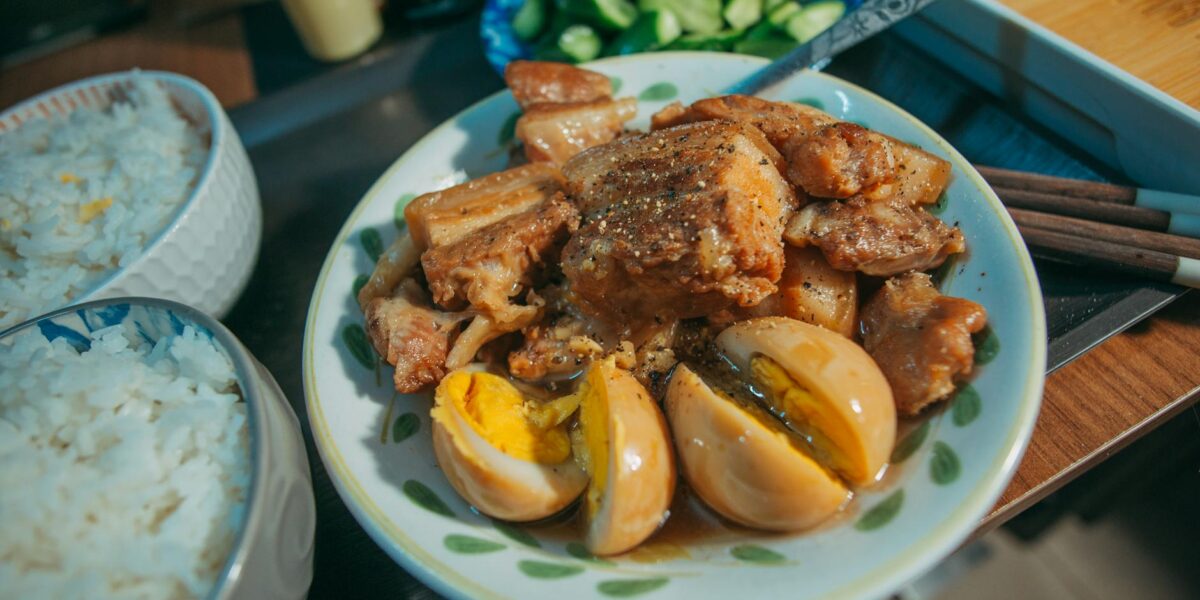
Adobo is the unofficial national dish and the single best entry point into Filipino cooking. Chicken, pork, or both are braised in a mixture of vinegar, soy sauce, garlic, bay leaves, and black peppercorns until the meat is tender and the sauce has reduced to a savory glaze. Every Filipino household has its own version — some prefer a saucier adobo, others cook it dry until the oil separates and the meat crisps. Try our chicken adobo recipe for a traditional version. There is no single ”authentic” recipe; the only constant is the vinegar-soy backbone.
2. Sinigang
Sinigang is a sour soup that many Filipinos consider their comfort food above all others. The souring agent is typically tamarind, though calamansi, guava, green mango, or kamias can also be used. The soup base features pork ribs, shrimp, or fish, along with a generous amount of vegetables — tomatoes, onions, radish, string beans, eggplant, water spinach (kangkong), and green chili peppers. The flavor profile is aggressively sour and savory, balanced by the natural sweetness of the vegetables and the richness of the protein.
3. Lechon
Lechon is a whole roasted pig and the centerpiece of every Filipino celebration. The pig is marinated or stuffed with aromatics — lemongrass, garlic, onions, and sometimes tamarind — then slowly spit-roasted over charcoal for several hours until the skin turns into a deep amber, impossibly crispy shell. Cebu-style lechon is the most celebrated, known for its herbal stuffing and the crunch of its skin. Lechon is served with a liver-based sauce (lechon sauce) or, in Cebu, simply with vinegar because the meat is considered flavorful enough on its own.
4. Sisig
Sisig is a sizzling plate of chopped pork face and ears, seasoned with calamansi, chili peppers, and onions, served on a cast-iron plate with a raw egg cracked on top that cooks from the residual heat. It was invented in Pampanga in the 1970s by Lucia Cunanan, who transformed what were considered throwaway parts of the pig into one of the most popular dishes in the country. Modern variations use pork belly, chicken, tuna, or tofu, but the classic version remains a textural masterpiece of crispy, chewy, and creamy.
5. Kare-Kare
Kare-kare is a thick, golden stew made with oxtail, tripe, and vegetables (eggplant, string beans, banana blossom) in a peanut-based sauce colored with annatto. It is always served with bagoong alamang (fermented shrimp paste) on the side, which provides the salty, funky counterpoint to the rich, mild sweetness of the peanut sauce. Kare-kare is a celebration dish that takes patience — the oxtail needs hours of braising — but the result is one of the most unique dishes in all of Asian cuisine.
6. Pancit (Filipino Noodles)
Pancit is the Filipino word for noodles, borrowed from the Hokkien Chinese word. There are dozens of regional pancit varieties across the Philippines. Pancit Canton uses wheat noodles stir-fried with vegetables and meat. Pancit Bihon uses thin rice noodles. Pancit Palabok is topped with a thick shrimp-annatto sauce, crushed pork rinds, and hard-boiled eggs. Pancit Malabon is a richer, seafood-heavy version. Noodles are served at every birthday celebration in the Philippines because they symbolize long life.
7. Lumpia
Lumpia are Filipino spring rolls that come in two main styles. Lumpiang Shanghai are thin, tightly rolled, and deep-fried until golden and crispy — filled with ground pork, carrots, water chestnuts, and onions. Lumpiang Sariwa (fresh lumpia) are wrapped in a thin crepe-like wrapper and filled with sauteed vegetables, then topped with a sweet garlic sauce. Both are essential party food, and Filipino households routinely make lumpia by the hundreds for gatherings.
8. Pinakbet
Pinakbet is a vegetable stew from the Ilocos region that showcases the flavors of bagoong (fermented shrimp paste) and bitter melon. The dish includes squash, eggplant, okra, string beans, tomatoes, and bitter melon (ampalaya), sauteed with shrimp paste and sometimes pork. It is one of the healthiest and most flavorful Filipino dishes — packed with fiber, vitamins, and the deep umami of fermented shrimp. Pinakbet is traditionally cooked in a clay pot and served alongside grilled fish or fried meat.
9. Chicken Inasal
Chicken inasal is Bacolod’s gift to Filipino cuisine. Chicken pieces are marinated in a mixture of calamansi juice, pepper, annatto oil, and vinegar, then grilled over charcoal while being basted with the annatto-infused oil. The result is juicy, slightly charred chicken with a distinctive orange-red color and a tangy, smoky flavor. It is served with garlic rice, a vinegar dipping sauce, and unlimited rice — which is a standard offering at inasal restaurants in the Philippines.
10. Halo-Halo
Halo-halo (meaning ”mix-mix”) is the quintessential Filipino dessert. A tall glass is layered with sweetened beans (kidney beans, chickpeas, white beans), jellies, sweet potato, jackfruit, coconut strips, nata de coco, ube (purple yam) jam, leche flan, and shaved ice, then topped with a scoop of ube ice cream and drizzled with evaporated milk. The diner mixes everything together before eating. It is a maximalist dessert that somehow works — the contrasting textures and flavors blend into something refreshing and satisfying.
11. Bistek Tagalog (Filipino Beef Steak)
Bistek Tagalog is thin slices of beef marinated in soy sauce and calamansi juice, pan-fried until browned, then topped with caramelized onion rings. Despite its name, it bears little resemblance to a Western steak — it is more of a braised, saucy dish served over steaming white rice. The calamansi provides a bright acidity that cuts through the richness of the soy-marinated beef. It is a weeknight staple in Filipino homes — quick to prepare and deeply satisfying.
12. Bibingka
Bibingka is a coconut milk rice cake traditionally baked in clay pots lined with banana leaves. It is especially popular during the Christmas season, when it is sold outside churches after the Simbang Gabi (dawn masses) held in the nine days before Christmas. The cake is soft and slightly chewy, with a lightly charred bottom from the banana leaf lining. It is typically topped with salted duck egg, grated coconut, and butter. Bibingka represents the intersection of Filipino food and faith — a sweet tradition tied to one of the country’s most important cultural rituals.
Filipino Cooking Techniques
Filipino cooking uses a set of techniques that are straightforward but require attention to build the layered flavors the cuisine is known for.
Adobo Method (Vinegar Braising)
The adobo technique involves braising protein in vinegar, soy sauce, and aromatics. The key principle: never stir the pot when the vinegar first comes to a boil. This allows the vinegar’s sharp acidity to mellow rather than turning bitter. Once the liquid reduces, the oil separates, and the meat can be crisped in its own rendered fat. This method is also used for paksiw (vinegar-braised pork or fish) and various vegetable dishes. If you are familiar with Asian cooking techniques, the adobo method is one of the most versatile in the Filipino repertoire.
Ginataan (Cooking in Coconut Milk)
Ginataan refers to any dish cooked in coconut milk. The technique requires starting with the coconut cream (the thick part) to build a rich base, then adding thinner coconut milk to adjust consistency. Common ginataan dishes include ginataang kalabasa (squash in coconut milk), ginataang hipon (shrimp in coconut milk), and the dessert version with sweet potato, banana, and tapioca pearls. The Bicol region uses this technique most extensively.
Inihaw (Grilling)
Inihaw is the Filipino tradition of grilling over charcoal. The distinctive element is the marinade — typically a combination of vinegar or calamansi, soy sauce, garlic, and sometimes annatto oil. Filipino grilling emphasizes basting during cooking to keep the meat moist and build layers of caramelized flavor. Street-food versions include isaw (grilled chicken intestines), betamax (grilled blood cubes), and adidas (grilled chicken feet).
Sawsawan (Dipping Sauce Culture)
Sawsawan is not a cooking technique per se but a fundamental aspect of Filipino eating. Every meal includes one or more dipping sauces — vinegar with garlic and chili (sukang may sili), soy sauce with calamansi (toyomansi), fish sauce with calamansi, or bagoong (shrimp paste). The sawsawan allows each diner to adjust the flavor of their food to personal preference, making Filipino dining inherently customizable.
Sangkutsa (Sauteing the Base)
Sangkutsa is the Filipino term for sauteing garlic, onions, and tomatoes in oil — the holy trinity of Filipino cooking. This aromatic base appears in the majority of Filipino savory dishes, from sinigang to pancit to menudo. The technique requires patience: the garlic is fried until golden, the onions until translucent, and the tomatoes until they break down into a jammy sauce. This base is what gives many Filipino dishes their characteristic savory-sweet foundation.
Filipino vs. Other Southeast Asian Cuisines
Filipino food shares ingredients with its Southeast Asian neighbors but has a distinct identity shaped by its unique colonial history. Here is how it compares.
| Feature | Filipino | Thai | Vietnamese | Indonesian/Malaysian |
|---|---|---|---|---|
| Primary souring agent | Vinegar, tamarind, calamansi | Lime juice, tamarind | Lime juice, tamarind | Tamarind, lime |
| Dominant flavor profile | Sour-savory, sweet-salty | Sweet-sour-spicy-salty (balanced) | Fresh, light, herbaceous | Sweet, spicy, rich |
| Heat level | Mild to moderate (except Bicol) | Medium to very hot | Mild to medium | Medium to very hot |
| Colonial influence | Spanish, American | None (never colonized) | French, Chinese | Dutch, Portuguese |
| Use of herbs | Minimal (garlic, bay leaf) | Extensive (basil, cilantro, lemongrass) | Extensive (mint, cilantro, perilla) | Moderate (lemongrass, pandan) |
| Fermented condiments | Bagoong, patis, sukang iloko | Fish sauce, shrimp paste | Fish sauce, mam tom | Kecap manis, sambal, terasi |
| Main protein | Pork (dominant), chicken, seafood | Chicken, pork, seafood | Pork, beef, seafood | Chicken, beef (halal influence) |
| Noodle tradition | Pancit (Chinese-influenced) | Pad Thai, boat noodles | Pho, bun | Mie goreng, laksa |
| Rice preparation | Steamed, garlic fried (sinangag) | Steamed, fried rice | Steamed, broken rice | Steamed, nasi lemak |
| Dessert style | Rich, sweet (ube, leche flan, halo-halo) | Coconut-based, fruit | Light (che, fruit) | Coconut-based, pandan |
The Silog Breakfast Culture
One of the most distinctive aspects of Filipino food culture is the silog breakfast. Silog refers to a meal formula: a protein + sinangag (garlic fried rice) + itlog (fried egg). The protein determines the name of the meal.
Tapsilog: Tapa (cured beef) + sinangag + itlog. The tapa is sweet-cured, thin-sliced beef that is fried until the edges caramelize.
Longsilog: Longganisa (Filipino sweet sausage) + sinangag + itlog. Each region has its own longganisa style — garlicky Vigan longganisa, sweet Lucban longganisa, or spicy Pampanga longganisa.
Tocilog: Tocino (sweet cured pork) + sinangag + itlog. The pork is marinated in sugar and anise, giving it a candy-like glaze when fried.
Bangsilog: Bangus (milkfish) + sinangag + itlog. The milkfish is marinated in vinegar and garlic, then pan-fried until crispy.
Spamsilog: Spam + sinangag + itlog. A testament to the American influence on Filipino cuisine, elevated to an art form.
Every silog meal is served with a sawsawan (dipping sauce), typically vinegar with garlic. This breakfast tradition is served at dedicated silogan — small, no-frills eateries that serve silog meals 24 hours a day.
Filipino Meal Planning Tips
Filipino meals are structured differently from Western meals. Understanding the structure will help you plan authentic Filipino menus at home.
Everyday Meal Structure
A standard Filipino meal consists of steamed rice, one main dish (usually meat or fish), one vegetable dish, and a soup. The soup is not a starter — it is consumed alongside the other dishes, and diners spoon the broth over their rice. A typical weeknight dinner might be: adobo + pinakbet + sinigang broth + steamed rice.
Building a Filipino Menu for Guests
For a Filipino dinner party, plan for abundance. Filipinos serve food family-style, and running out of food is considered a serious hosting failure. A good spread for 6-8 guests might include:
- 1 centerpiece protein: lechon belly, crispy pata, or chicken adobo
- 1 noodle dish: pancit canton or pancit bihon
- 1 soup: sinigang or nilaga (boiled beef soup)
- 1 vegetable dish: pinakbet or ensaladang talong (grilled eggplant salad)
- 1 appetizer or side: lumpiang Shanghai or tokwa’t baboy (fried tofu and pork)
- Steamed rice — cook at least 1.5 cups of raw rice per person
- Sawsawan: vinegar with garlic and chili, toyomansi, bagoong
- Dessert: halo-halo, leche flan, or ube halaya
Batch Cooking and Make-Ahead Dishes
Many Filipino dishes improve the next day as the flavors develop. Adobo is famously better on day two. Sinigang and kare-kare also reheat well. Lumpia wrappers can be filled and frozen before frying. Longganisa and tocino can be marinated and frozen in portions for quick silog breakfasts throughout the week. This makes Filipino food particularly well-suited to meal prep.
Where to Buy Filipino Ingredients
Most Filipino pantry staples are available at Asian grocery stores or online. Here is what to look for and where to find it.
Vinegar: Look for Datu Puti or Silver Swan brand cane vinegar (sukang maasim). Regular white vinegar is not a substitute — Filipino cane vinegar has a milder, slightly sweet flavor that is essential to authentic adobo.
Calamansi: Available frozen (whole or as juice) at most Asian supermarkets. In a pinch, substitute a 50/50 mix of lime and orange juice, but the flavor will not be identical.
Bagoong (shrimp paste): Barrio Fiesta and Kamayan are the most widely available brands. Choose between the sauteed (ginisang bagoong) and raw versions depending on your recipe.
Fish sauce (patis): Rufina and Datu Puti are Filipino brands, though Thai fish sauce works as a substitute.
Ube (purple yam): Available as frozen grated ube, ube halaya (jam), or ube extract from Filipino grocery stores. McCormick ube flavoring (the Philippine version) is the standard for baking.
Annatto seeds (atsuete): Inexpensive and widely available. Steep in oil to create annatto oil for kare-kare and chicken inasal.
More Asian cooking ingredients can be found in our complete guide.
Filipino Street Food You Should Know
Filipino street food is an adventure. It is inexpensive, flavorful, and often made from parts of the animal that would be discarded in Western kitchens. Here are the classics.
Isaw: Chicken or pork intestines, cleaned meticulously, skewered, and grilled over charcoal. Served with a spiced vinegar dip.
Kwek-kwek: Hard-boiled quail eggs coated in an orange-dyed batter and deep-fried. Served with sweet-spicy vinegar sauce.
Fish balls, squid balls, chicken balls: Deep-fried balls of minced seafood or poultry served on skewers with your choice of sweet, spicy, or vinegar sauce.
Balut: A fertilized duck egg with a developing embryo, boiled and eaten from the shell with salt and vinegar. It is the most famous (and most challenging for newcomers) Filipino street food.
Banana cue: Saba bananas coated in caramelized brown sugar and deep-fried on skewers. A popular afternoon snack.
Taho: Warm, silken tofu served with arnibal (brown sugar syrup) and sago (tapioca pearls). Sold by street vendors in the morning.
The Rise of Filipino Cuisine Globally
Filipino food is in the middle of a global moment that has been building for years. Filipino-American chefs like Tom Cunanan, whose restaurant Bad Saint in Washington D.C. earned national acclaim, have brought dishes like kare-kare and laing to fine-dining contexts without stripping away their identity.
The ube trend — which has turned Filipino purple yam into a global dessert flavor appearing in ice cream, doughnuts, and cakes — introduced millions of people to Filipino ingredients. Jollibee, the Filipino fast-food chain, now operates hundreds of locations across North America, Europe, and the Middle East, making Filipino fried chicken and spaghetti (sweet-style, with sliced hot dogs) accessible worldwide.
What makes Filipino cuisine’s rise different from the earlier waves of Thai, Japanese, and Korean food is the role of the diaspora. There are over 4 million Filipinos living in the United States alone, and their home cooking has been the primary vehicle for introducing friends, colleagues, and neighbors to Filipino food. This grassroots, home-kitchen-first approach means that Filipino food is entering the mainstream through authenticity rather than adaptation.
Frequently Asked Questions About Filipino Food
What is the most popular Filipino dish?
Adobo is the most widely recognized Filipino dish both within the Philippines and internationally. It is simple to make, uses pantry staples (vinegar, soy sauce, garlic), and has countless regional and family variations. Our chicken adobo recipe is an easy place to start.
Is Filipino food spicy?
Filipino food is generally mild to moderately spiced compared to Thai or Indian cuisine. The exception is the Bicol region, where dishes like Bicol Express use generous amounts of chili peppers. Most Filipino dishes rely on sourness and umami rather than heat for their intensity. Spice is typically added at the table through chili-vinegar dipping sauces rather than cooked into the dish.
What makes Filipino food different from other Asian cuisines?
The combination of Spanish colonial influence, a preference for sour flavors over spicy ones, and the heavy use of vinegar as both a cooking medium and preservative sets Filipino food apart. Filipino food also has a stronger tradition of pork-centric cooking and sweet-savory combinations than most of its Asian neighbors. The sawsawan (dipping sauce) culture allows personal customization at every meal.
What is the best Filipino dish for beginners to cook?
Adobo is the easiest entry point — it requires only a handful of ingredients, one pot, and about 45 minutes. Pancit is another beginner-friendly option, as it comes together in under 30 minutes and uses widely available ingredients.
Is Filipino food healthy?
Filipino cuisine includes both indulgent dishes (lechon, crispy pata) and very healthy options. Sinigang is rich in vegetables and uses a broth-based cooking method. Pinakbet is a nutrient-dense vegetable stew. Grilled dishes like chicken inasal are lean and protein-rich. As with any cuisine, the healthfulness depends on what you choose to eat and how frequently. The traditional Filipino diet, centered on rice, vegetables, fish, and soup, is well-balanced.
What is the difference between Filipino adobo and Spanish or Mexican adobo?
Despite sharing a name, they are quite different. Filipino adobo uses vinegar and soy sauce as its base and produces a braised dish. Spanish and Mexican adobo is a chili-based sauce or marinade. Filipino adobo likely predates the Spanish arrival — early Filipinos were already cooking meat in vinegar as a preservation method, and the Spanish simply applied the name ”adobo” (meaning ”marinade” or ”sauce”) to what they observed.
Can I make Filipino food without calamansi?
Yes. While calamansi provides a distinctive citrus flavor, you can substitute it with a mix of equal parts lime juice and orange juice. The result will not be identical, but it will be close enough for most recipes. For adobo and sinigang, vinegar and tamarind provide the acidity, so calamansi is not necessary for those dishes.
What rice do Filipinos use?
Filipinos typically eat medium-grain or long-grain white rice, steamed until fluffy. Jasmine rice is common but not exclusive — many Filipino households use whatever affordable white rice is available. For garlic fried rice (sinangag), day-old rice works best because the drier grains fry better. For sticky rice desserts like suman and biko, glutinous (malagkit) rice is used. Check our guide on the best rice for Asian cooking for detailed recommendations.
Start Cooking Filipino Food Today
Filipino cuisine rewards curiosity. Start with chicken adobo — it takes one pot, five ingredients, and less than an hour. Move on to sinigang for a sour soup experience unlike anything in Western cooking. Try sisig for something bold and textural. Make lumpia for your next party and watch them disappear.
The beauty of Filipino food is that it was built for home cooking. These are not restaurant-exclusive dishes requiring specialized equipment — they are family recipes passed down through generations, designed to feed a crowd with accessible ingredients and straightforward techniques. Your kitchen is ready. The Philippines is waiting.

Mei Lin Chen
Mei Lin Chen is an Asian food writer and recipe developer. Melbourne-raised and London-based, she has spent over a decade exploring the rice paddies, hawker stalls, and home kitchens of South-East and East Asia. Her recipes balance traditional technique with everyday practicality.