The best wok you can buy for home cooking is a 14-inch carbon steel wok with a flat bottom — and after testing dozens of dishes from Kung Pao chicken to pad see ew, we’re confident that this one tool transforms what’s achievable in a Western kitchen more than anything else on the counter.
Last Updated: March 2026
Key Takeaways
- Carbon steel is the best material for home cooks — lighter than cast iron, better heat response than non-stick, and it builds a natural non-stick surface over time.
- Flat-bottom woks are the right choice for most Western kitchens (gas, electric, and induction all work).
- 14 inches is the sweet spot for families; 12 inches works for one or two people.
- Season before first use — a carbon steel wok needs one seasoning session on the stovetop before it performs well.
- High heat is non-negotiable — the entire advantage of a wok disappears at low or medium heat.
Types of Woks: Which Material Actually Matters
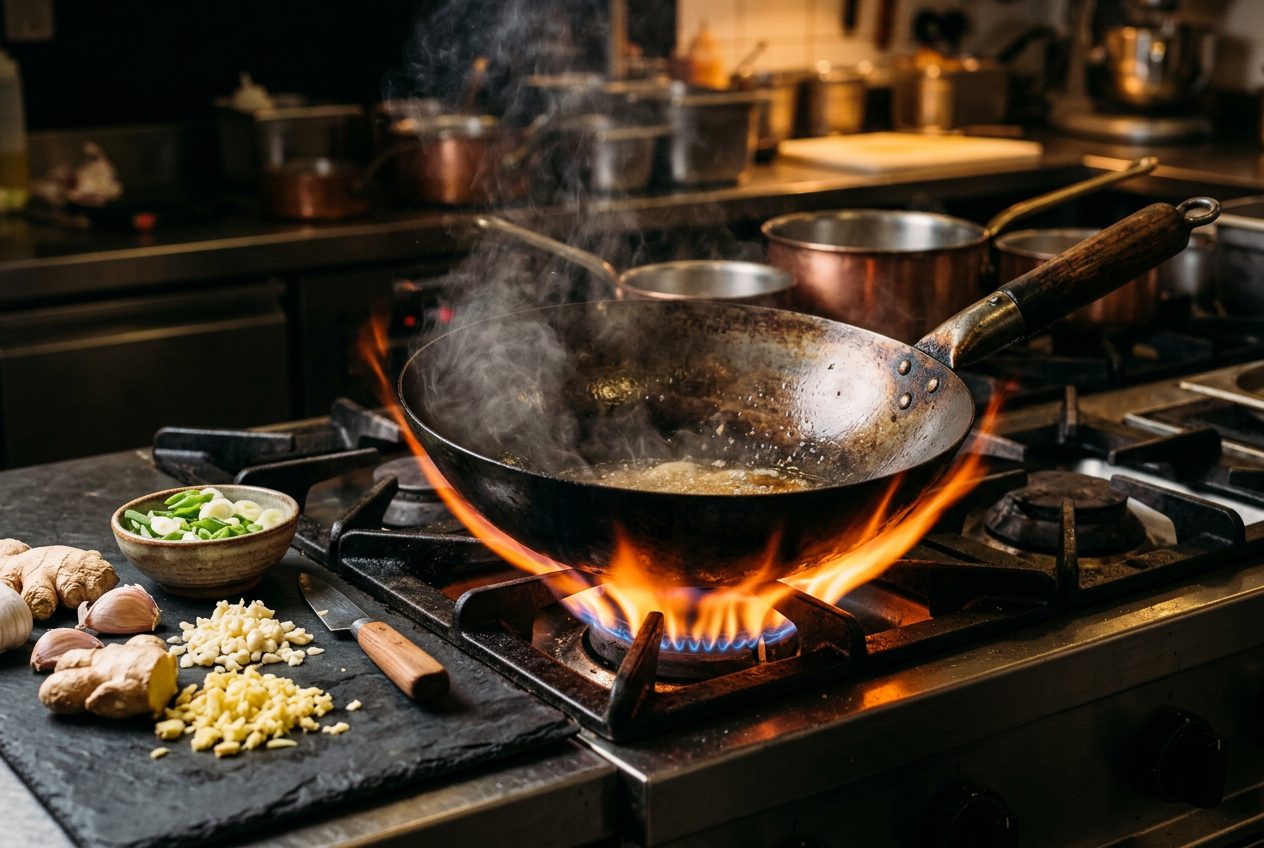
Walk into a professional Chinese kitchen and you’ll find one material in every wok station: carbon steel. Walk into a specialist cookware shop and you’ll be presented with four or five options, each with a confident pitch. Here’s the honest breakdown of what each material does — and which one most home cooks should choose.
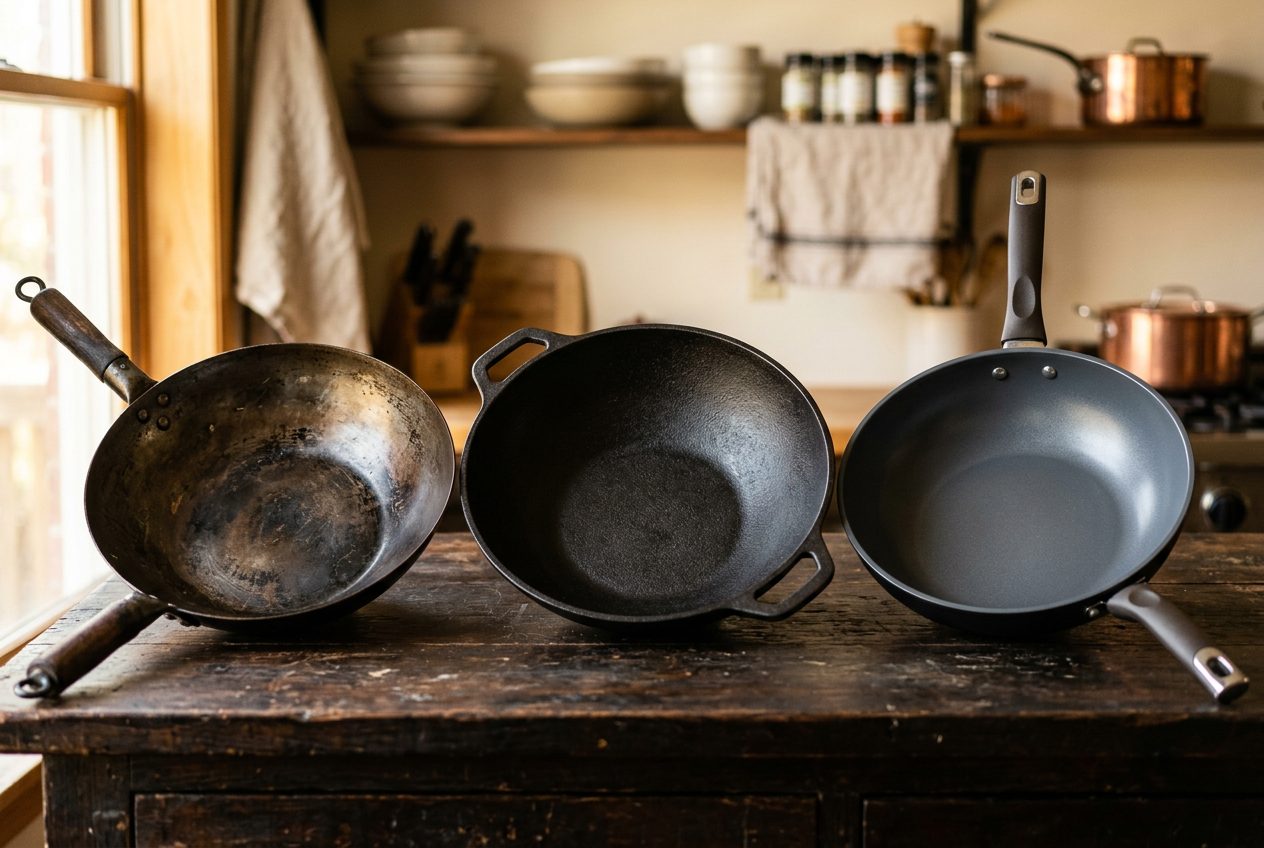
Carbon Steel: The Best Overall Choice
Carbon steel is roughly 99% iron and 1% carbon — which means it conducts heat fast, releases food well once seasoned, and weighs significantly less than cast iron. A standard 14-inch carbon steel wok runs between 4 and 5 pounds. That’s light enough to toss ingredients one-handed without straining your wrist, which matters when you’re stir-frying at high heat and need to keep everything moving.
The seasoning process — heating oil into the surface over a high flame — polymerizes the oil into a hard, slick coating that gets better with every cook. After ten or twelve uses, a well-maintained carbon steel wok becomes genuinely non-stick for eggs, fish, and delicate proteins. It also responds to heat changes instantly: turn the flame down and the wok cools; crank it back up and the temperature climbs in seconds. That responsiveness is exactly what stir-frying requires.
The one trade-off is upkeep. Carbon steel rusts if left wet, and acidic ingredients like tomatoes or vinegar can strip the seasoning if they sit in the wok for too long. Neither problem is serious — dry the wok after washing and avoid soaking it — but it does require a different relationship with your cookware than a dishwasher-safe stainless pan.
Cast Iron: Excellent Heat Retention, Demanding Weight
Cast iron woks hold heat better than any other material. Once a cast iron wok reaches temperature, it doesn’t drop when you add a cold batch of vegetables or protein — which is why professional restaurant wok stations use cast iron (though their burners output 10 to 15 times more BTUs than a home stove). The mass absorbs and stores thermal energy in a way carbon steel simply can’t match.
The problem at home is weight. A 14-inch cast iron wok can run 8 to 10 pounds, sometimes more. Tossing food becomes impractical. Moving the wok from burner to oven is a two-handed operation. For older adults or anyone with wrist or shoulder issues, it becomes genuinely uncomfortable to use for more than a few minutes. A 12-inch carbon steel pan by comparison weighs roughly 4.8 pounds — nearly half the mass of a cast iron equivalent, according to data from Misen’s cookware testing.
Cast iron is a legitimate choice if you cook in large batches, have a powerful gas range, and don’t plan to toss your food. For everyday Asian cooking — stir-fries, noodles, egg dishes — carbon steel gives you everything cast iron offers, without the arm workout.
Non-Stick: Easiest Care, Limited Performance
Non-stick woks are appealing for exactly one reason: nothing sticks and cleanup is effortless. That’s a real benefit, especially for new cooks who haven’t yet developed the instinct for heat management. For gentle applications — steaming, slow-braised dishes, cooking eggs — a non-stick wok performs fine.
The problem is temperature. Non-stick coatings degrade above 500°F (260°C), and authentic stir-frying requires heat well above that threshold to achieve wok hei — the slightly smoky, caramelized flavour that defines great Chinese cooking. Using a non-stick wok at high heat damages the coating over time, potentially releasing harmful compounds. Saveur’s testing found that non-stick woks ”contradict proper wok technique requiring high heat,” and that’s a verdict we agree with.
Non-stick woks are also incompatible with metal utensils, which restricts how you can cook. You can’t use a metal spatula to scrape the fond off the surface — and that fond is flavour. If easy cleanup is your priority, carbon steel seasoned properly is almost as forgiving, and it handles the heat that wok cooking demands.
Stainless Steel: No Seasoning Needed, but Mediocre Results
Stainless steel woks require no seasoning, tolerate acidic ingredients without reaction, and are dishwasher safe. For home cooks who cook Asian food occasionally and don’t want to commit to the upkeep of carbon steel, stainless is a practical option. It won’t rust, it won’t strip, and it won’t demand the same attention.
The performance ceiling, however, is lower. Stainless steel is a poor heat conductor on its own — most stainless woks use an aluminium core for better distribution, but this adds weight without the heat responsiveness of carbon steel. Food also sticks more readily on stainless, particularly proteins, which can make stir-frying frustrating if your technique isn’t solid. Seasoned carbon steel is genuinely more pleasant to cook on.
Stainless is the right call for cooks who want zero maintenance and cook Asian food less than once a week. For anyone serious about stir-frying, it’s a compromise that shows up in the food.
Round vs Flat Bottom: Match the Wok to Your Cooker
This decision is more important than most guides acknowledge. Getting it wrong means your wok wobbles, sits unevenly, or delivers inconsistent heat — none of which you want when you’re cooking at speed.
Gas Stovetops: Round or Flat Both Work
Gas burners surround the base with flame, which means a round-bottom wok can sit in a wok ring and receive heat across its curved surface. This is how traditional Chinese cooking has always been done — the round bottom concentrates heat directly beneath the food, with the curved walls acting as a resting zone. If you have a powerful gas range, a wok ring, and want the most authentic setup, round bottom is a valid choice.
In practice, most home gas burners aren’t powerful enough to take full advantage of a round bottom’s geometry. A flat-bottom wok sits directly on the grate without a ring, makes better contact with the flame, and is easier to handle. Many experienced home cooks — including those with strong gas ranges — use flat-bottom woks without any compromise in results. If you’re new to wok cooking, start flat.
The only scenario where round bottom is clearly superior is a commercial or semi-commercial wok burner producing 65,000+ BTUs, where the ring setup creates a perfectly centred flame contact across the full base. Home burners at 10,000–18,000 BTUs don’t justify the trade-off in stability.
Electric Coil and Ceramic Stovetops: Flat Bottom Only
On electric coil or ceramic stovetops, round-bottom woks are simply impractical. The coil needs contact to transfer heat, and a round base touching a flat element at a single point will never heat evenly or safely. A flat-bottom wok sits flush, draws heat properly, and behaves predictably. There is no benefit to a round bottom on electric — only downsides.
Electric stovetops are slower to respond to temperature changes than gas, which does create a challenge for stir-frying. The fix is to preheat the wok longer before adding food — typically 3 to 4 minutes on the highest setting — and to cook in smaller batches than you would on gas. This keeps the wok’s temperature from crashing when cold ingredients hit the surface.
Ceramic glass tops (also called smoothtop electric) work well with flat-bottom carbon steel woks, but be cautious with heavy cast iron — dragging a cast iron wok across a glass ceramic surface can scratch or crack it. Carbon steel, being lighter, is easier to lift cleanly.
Induction: Flat Bottom, Magnetic Material Required
Induction cooktops work by creating a magnetic field that heats the pan itself rather than the surface beneath it. This makes them faster and more energy-efficient than either gas or electric — but they only work with magnetic materials. Carbon steel is magnetic and works perfectly on induction. Most cast iron is also magnetic. Non-stick and stainless woks need to be specifically rated for induction, so check before buying.
Induction is increasingly common in modern Western kitchens, and it’s actually an excellent match for wok cooking when used with a flat-bottom carbon steel wok. The heat response is as fast as gas, and modern induction hobs can reach temperatures that rival home gas burners. The flat-bottom requirement is absolute — no exceptions on induction.
One note on induction-specific woks: some brands market woks as ”induction compatible” with a thicker magnetic base disc welded to the bottom. These work, but the welded disc can create uneven heating at the join. A naturally flat-bottom carbon steel wok — where the flat base is part of the original shape — performs more consistently on induction than a converted round-bottom design.
Wok Size Guide: How Big Do You Actually Need?
Size affects capacity, maneuverability, and how the wok handles heat. Too small and you’re crowding the food, which causes steaming instead of searing. Too large and you’re moving a lot of dead weight around — and home burners struggle to heat the full surface of a very large wok.
12-Inch Wok: Best for One or Two People
A 12-inch wok holds enough food for one generous serving or two moderate ones. It heats quickly, responds fast to temperature changes, and is easy to maneuver even with a long wooden handle. For solo cooks, couples, or anyone who meal-preps small batches, 12 inches is the right size.
On a standard home burner (10,000–15,000 BTUs on gas), a 12-inch wok gets evenly hot across its full surface — something that can’t be said about larger sizes on the same burner. If your cooking setup isn’t exceptionally powerful, downsizing to 12 inches often produces better results than going bigger.
The practical limit of a 12-inch wok is roughly 300–400 grams of protein plus a handful of vegetables. Beyond that, the food starts to pile up and the wok loses temperature quickly when you add ingredients. If you regularly cook for more than two people at a single sitting, step up to 14 inches.
14-Inch Wok: The Family Standard
Fourteen inches is the most popular size for home cooking globally, and it earns that position. It handles four to six servings without crowding, fits comfortably on most home ranges, and strikes the right balance between surface area and weight. At 4 to 5 pounds in carbon steel, a 14-inch wok is still manageable one-handed for most adults.
This is the size we use most often at UmamiCart for recipe testing. It handles a full batch of beef stir fry, a family portion of fried rice, or a generous helping of char kway teow in a single go. If you’re buying one wok for a household of three or more, start here.
The only time 14 inches becomes problematic is on very weak electric burners, where the outer edges of the wok stay noticeably cooler than the centre. If you have a powerful burner — gas or induction — 14 inches is the right call every time.
16-Inch and Above: For Large-Batch Cooking Only
Woks larger than 14 inches exist, and they’re useful for large-batch cooking — feeding eight or more people, catering, or batch-cooking for the week. But most home burners simply cannot heat a 16-inch wok evenly from edge to edge. The centre gets searing hot while the outer third of the cooking surface sits at a significantly lower temperature, creating uneven results.
Unless you have a professional-grade wok burner or cook for very large groups regularly, staying at 14 inches gives you better performance than going bigger. A 14-inch wok used in two batches will outperform a 16-inch wok used in one batch on a standard home range.
One practical note: larger woks are heavier, and the handles need to be longer to counterbalance the weight. This can make them awkward in kitchens with low overhead cabinets or limited storage. The 14-inch sweet spot exists for good reason.
Key Features to Look For Before You Buy
Two woks can share the same size, material, and shape and still perform very differently. These are the construction details that separate a wok you’ll use for twenty years from one that ends up at the back of a cupboard.
| Feature | What to Look For | Why It Matters |
|---|---|---|
| Gauge (thickness) | 1.5–2mm for carbon steel | Too thin = warps at high heat; too thick = slow to respond |
| Handle type | Long stick handle for stir-frying; helper handle optional | Long handle keeps hands away from flame and enables tossing |
| Base type | Flat for Western cooktops | Stability and even heat contact on gas/electric/induction |
| Pre-seasoned or unseasoned | Pre-seasoned for beginners; unseasoned if you want to season yourself | Pre-seasoned saves time; unseasoned lets you build your own patina |
| Lid included | Useful but not essential | Needed for braising, steaming, and one-pot dishes |
| Handle material | Wooden for comfort; steel for oven use | Wood stays cool; steel handles allow oven transfer |
Gauge and Thickness: 1.5–2mm Is the Target
Carbon steel wok gauge — the thickness of the steel — is measured in millimetres, and it matters more than most buyers realise. Woks below 1.5mm are too thin: they warp at sustained high heat, developing a bowl-like convex bottom that makes flat surfaces irrelevant. The food concentrates in the middle and burns before the outer food cooks.
Woks above 2.5mm edge toward cast iron territory: they’re slower to heat and slower to cool, which reduces the responsiveness that makes carbon steel excellent. The sweet spot for most home cooks is 1.5 to 2mm. Hand-hammered woks — which we cover in the top picks section — are typically 2mm and the hammering process adds structural rigidity that a flat-rolled 2mm wok doesn’t have.
Most product listings don’t advertise gauge prominently. When in doubt, check the weight: a 14-inch carbon steel wok should weigh between 3.5 and 5.5 pounds. Below 3 pounds suggests it’s too thin; above 6 pounds and you’re approaching cast iron weight ranges.
Handle Type: Long Stick vs. Two-Handle
The long stick handle — a single handle extending from one side of the rim — is the standard for stir-frying. It lets you grip the wok, toss food with a forward-and-up motion, and keep your hand well away from the flame. This handle type is non-negotiable if you plan to toss food during cooking, which is the foundation of proper stir-fry technique.
Two-handle woks — with a short loop handle on each side — are better suited for braising, steaming, and any dish where you need to carry a full wok from stovetop to table. Some woks include a long stick handle on one side and a short helper handle on the opposite side: this is our preferred configuration, because it gives you the tossing capability of a stick handle with the two-handed stability of a helper handle when the wok is full.
Wooden handles stay cool during cooking, which is practically useful but does limit oven use. Steel handles can go in the oven (useful for finishing dishes under a grill) but get very hot on the stovetop — always use a cloth or silicone grip. Some woks use a riveted steel handle with a wooden or silicone sleeve over it, which gives you the best of both.
Lid: When You Need It and When You Don’t
A lid is not necessary for stir-frying — you want the steam to escape, not concentrate. But for a broader range of Asian cooking, a lid opens up a second set of techniques: steaming, braising, one-pot rice dishes, and anything where you want to trap moisture and flavour. If you plan to use your wok for dishes beyond stir-fries, a lid is worth having.
Wok lids are typically domed, which allows condensation to collect at the edge rather than dripping back directly onto the food. The dome height matters: a flat lid will sit on a curved wok without a proper seal, and a very deep dome can add significant height to your storage problem. Look for a lid designed specifically for the wok you’re buying — many brands sell them separately, and a universal wok lid in the right diameter works fine.
Glass lids let you monitor cooking without lifting the lid and losing heat. Stainless lids are more durable and often cheaper. For most home applications, either works — prioritise the fit over the material.
Our Top Wok Picks by Category
We’ve cooked with all of these — across stir-fries, braised dishes, noodle recipes, and high-heat protein work. Here’s where each one earns its place.
Best Overall: Yosukata 14-Inch Carbon Steel Wok (Flat Bottom)
The Yosukata 14-inch flat-bottom carbon steel wok is the recommendation that keeps coming up across serious food publications — Serious Eats named it their top performer, AllRecipes rated it best overall — and after extensive use, we understand why. The 1.8mm gauge hits the sweet spot: responsive enough to change temperature quickly, thick enough to handle sustained high heat without warping. The uncoated surface builds seasoning naturally with use and after three or four cooks it starts to develop genuine non-stick properties.
The long wooden stick handle is comfortable to grip, well-balanced for the wok’s weight (approximately 4.5 lbs), and stays cool on the stovetop. The wok ships without pre-seasoning, which some buyers find off-putting — but it’s actually a benefit: you’re starting with a clean surface and building your own patina from scratch, rather than inheriting someone else’s factory seasoning that may be uneven.
The Yosukata typically retails around $65–$75 USD. That puts it at the mid-range of carbon steel wok pricing — not the cheapest, but a genuine lifetime tool if maintained properly. Compatible with gas, electric, and induction stovetops.
Best for Induction: BK Pre-Seasoned Carbon Steel Flat Bottom Wok (12-Inch)
BK’s pre-seasoned carbon steel wok is the first choice for induction cooktop users. The base is naturally flat — not welded — which means even heat distribution from the induction element without the cold-spot issue common to converted round-bottom designs. The pre-seasoned surface means it’s ready to use straight out of the box, which matters if you don’t want to go through a full seasoning session on an induction hob (induction seasoning works, but takes longer than gas).
Saveur rated the BK as their ”Best Overall” pick in their tested lineup, specifically noting the consistent heat performance and the quality of the pre-seasoning. The 12-inch size is more common for this model, which suits one-to-two-person households on induction. The steel handle (no wood) means it can go from stovetop to oven — useful for finishing braised dishes or keeping food warm.
Price sits around $50–$60 USD. If you’re cooking on induction and want to skip the first-seasoning process, the BK is the easiest entry point into carbon steel wok cooking.
Best Budget: Joyce Chen 14-Inch Carbon Steel Wok (Under $40)
Joyce Chen has been making woks for Western home cooks since the 1970s, and the 14-inch flat-bottom carbon steel model remains one of the most recommended entry-level options on the market. It’s not the thickest wok in this list — gauge is closer to 1.5mm — but at under $40, it delivers solid carbon steel performance at a price that removes all the hesitation from trying wok cooking for the first time.
The hollow steel handle with phenolic sleeve stays cool and is comfortable to grip. The wok ships unseasoned, which requires a first seasoning session, but that process takes about 20 minutes and is well worth doing. Saveur included Joyce Chen in their tested lineup as a ”Best Value” pick, noting the size-to-price ratio was genuinely excellent.
If you’re not sure whether you’ll use a wok regularly and don’t want to commit $70 to find out, the Joyce Chen is the right first wok. It won’t be your last — once you start cooking with it consistently, you’ll understand why carbon steel is addictive — but it’s a serious tool, not a throwaway purchase.
Best for Beginners: Yosukata Pre-Seasoned Carbon Steel Wok
Yosukata also produces a pre-seasoned version of their popular carbon steel wok, and it’s our top recommendation for cooks who want to skip the seasoning step entirely. The factory seasoning uses a high-heat oil process that creates a serviceable initial non-stick layer, though — as with all factory seasoning — it improves significantly with the first few home cooks.
The advantage for beginners isn’t just convenience. A pre-seasoned wok is visually reassuring: the dark surface looks ready to cook and behaves more forgivingly in the first few uses. First-time wok cooks often under-heat their pan (a common mistake), and a pre-seasoned surface provides some insurance against food sticking while technique is being developed.
The pre-seasoned Yosukata retails around $65–$80 USD and is available in 12-inch and 14-inch sizes. Pair it with a wooden wok spatula and a bottle of high-smoke-point oil (we use avocado oil or refined peanut oil for Asian cooking) and you have everything you need to start.
Best Splurge: OxenForge Hand-Hammered Carbon Steel Wok
Hand-hammered carbon steel woks represent the artisan end of the market. The hammering process — traditionally done by hand, though modern production uses controlled mechanical hammering — creates thousands of tiny depressions in the steel surface. Those depressions hold oil during cooking, which accelerates the seasoning process and creates a more textured cooking surface that many cooks find superior for keeping food moving during a stir-fry.
OxenForge’s hand-hammered 14-inch wok is one of the most discussed in wok-enthusiast circles, alongside ZSH. The construction is 2mm carbon steel — at the upper end of the responsive range — with a long wooden handle and a weight of approximately 4.8 lbs. After initial seasoning, the surface takes on a beautiful mottled dark patina that’s functional as well as visually striking.
These woks retail between $80 and $130 USD, depending on the finish and source. For everyday home cooking, the performance difference over a quality flat-rolled carbon steel wok is real but incremental. The hand-hammered surface seasons faster and holds seasoning better, which matters if you cook with your wok daily. For cooks who treat their tools as long-term investments, the splurge is justified.
How to Season a New Carbon Steel Wok
Seasoning a carbon steel wok is not complicated, but it requires patience and the right conditions. Do it once properly and you won’t need to do it again for years — only the occasional re-season if the wok develops rust spots or the patina strips in a section.
Step 1: Remove the Factory Coating
New carbon steel woks are coated with a thin layer of machine oil to prevent rust during storage and shipping. Before you season, this coating must come off. Wash the wok with hot water and dish soap — the only time you’ll ever use soap on a carbon steel wok — using a sponge or brush to scrub the full surface inside and out. Rinse thoroughly and dry completely with a clean towel.
If the factory coating is particularly heavy (some woks have a visible sheen), you can boil water in the wok for 5 minutes before washing. This helps lift the oil before scrubbing. Once clean, place the wok on the stovetop over medium heat to drive off any remaining moisture. You’ll see steam rising from the surface — that’s the last of the water evaporating. Once the steam stops, the wok is dry enough to proceed.
Some new woks develop light surface rust during shipping, particularly if they’ve sat in a humid warehouse. Scrub the rust off with fine steel wool before washing. This is cosmetic — the steel underneath is clean and unaffected.
Step 2: Heat and Oil in Thin Layers
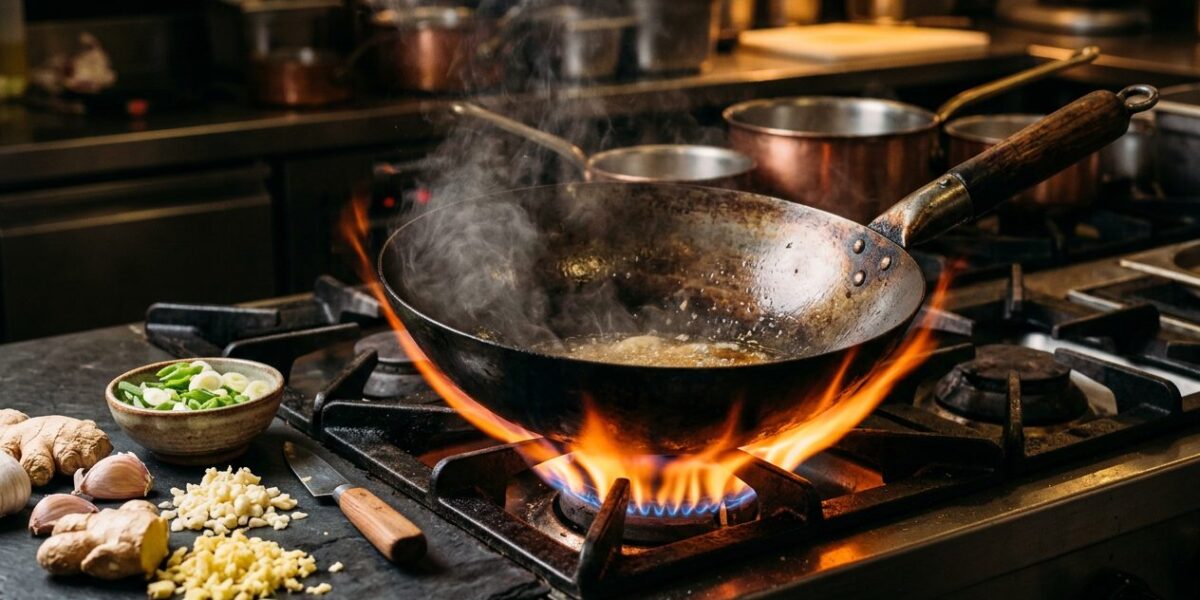
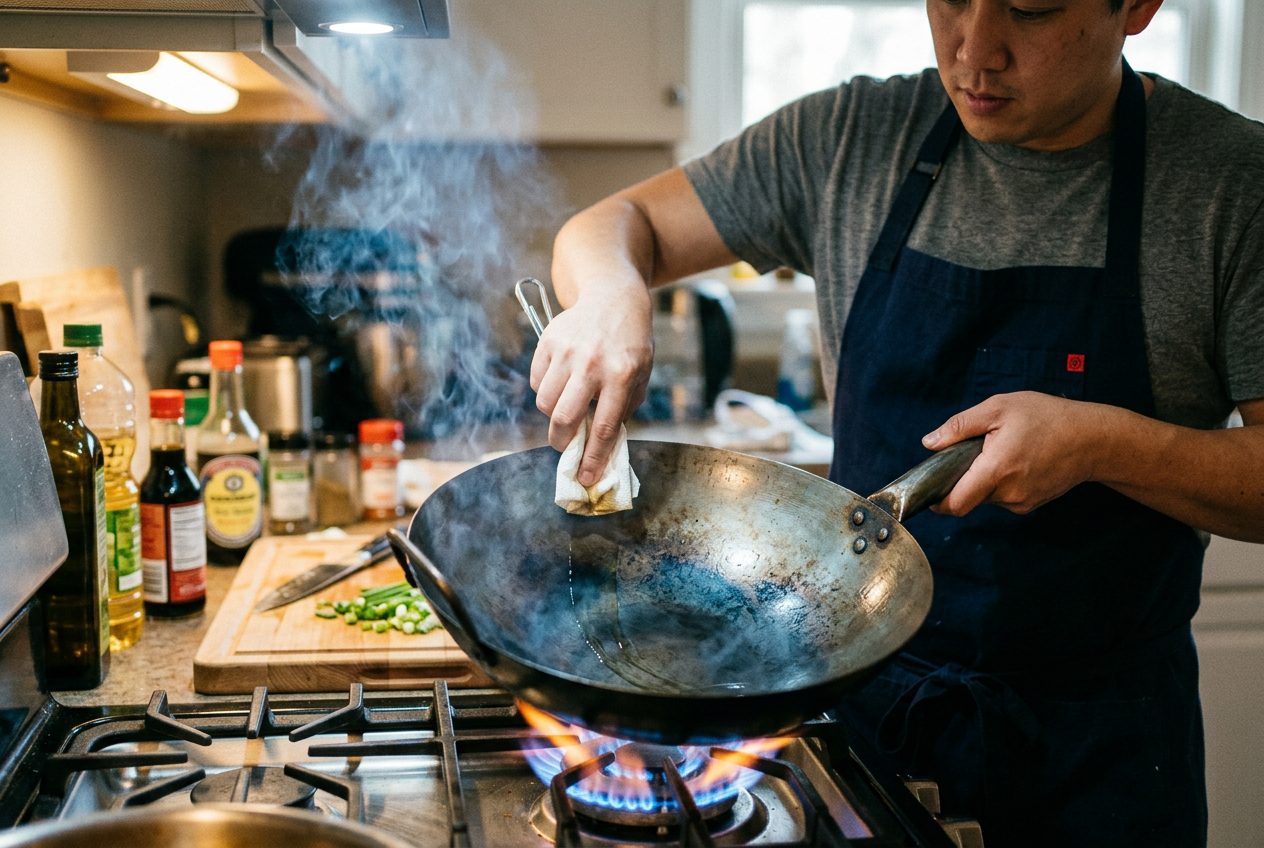
Place the dry wok over the highest heat your burner produces. Allow it to heat until the metal just starts to change colour — you’ll see slight blue or grey tones appearing on the surface, a sign the steel is hot enough to polymerize oil. This typically takes 2 to 4 minutes on a gas burner.
Add a very small amount of high-smoke-point oil — roughly half a teaspoon. Any more and the oil will pool rather than coat. Use a folded paper towel held with tongs to spread the oil across the entire inner surface of the wok: the base, the curved walls, and up toward the rim. The key word here is thin. A thick layer of oil will become sticky and gummy rather than polymerizing into a hard coating.
Allow the oil to smoke and burn off for 2 to 3 minutes. The wok surface will begin to darken. Wipe off any excess oil, add another small amount, and repeat the process 3 to 4 times. Each layer of polymerized oil builds the non-stick patina. By the end of the fourth or fifth pass, the wok’s interior should be visibly darker — somewhere between gold and dark brown — and feel dry and hard to the touch rather than oily.
Step 3: The First Cook — Use Aromatics
Chinese wok tradition calls for stir-frying a handful of aromatic vegetables — sliced ginger, spring onion, garlic — in a generous amount of oil as the first proper cook after seasoning. This ”xiāng guō” or aromatic wok seasoning step fills the remaining micro-pores in the steel surface and imparts a pleasant base note to all subsequent cooking. Use the aromatics until they’re dark and fragrant, then discard them.
After this first cook, rinse the wok with hot water — no soap — and dry it immediately and completely. Apply a very thin layer of oil to the interior with a paper towel before storing. The wok is now seasoned and ready for real cooking. From this point, every session with the wok adds another layer to the patina. After 10 to 15 cooks, you’ll have a surface that rivals any non-stick pan for eggs and delicate fish.
One common mistake: panicking when food sticks during the first few cooks. It will. The seasoning isn’t complete yet, and your technique is calibrating to the wok. Keep the heat high, use enough oil, and keep the food moving. Sticking during the first few sessions is normal and temporary.
Wok Care and Maintenance
A carbon steel wok that’s cared for correctly will outlast you. The maintenance routine is simple once it becomes habit — three rules cover 95% of what the wok needs.
Cleaning: Hot Water, No Soap
After cooking, rinse the wok with hot water while it’s still warm from the stove. Use a bamboo brush or a soft nylon brush — not steel wool, which strips seasoning — to scrub off any stuck food. For stubborn residue, add a small amount of coarse salt and scrub with a paper towel; the abrasive action lifts the debris without attacking the patina.
Never put a carbon steel wok in the dishwasher. The combination of harsh detergent and prolonged water exposure strips seasoning and promotes rust. The same applies to soaking: never leave a carbon steel wok sitting in water. If you’ve made a braise or any dish with liquid that sits in the wok for an extended period, the seasoning in that section may need refreshing.
After washing, place the wok back on the stovetop over low heat for 1 to 2 minutes to evaporate all remaining moisture. This single step prevents rust more effectively than any other part of the maintenance routine. Apply a very thin wipe of neutral oil with a paper towel before putting the wok away. The interior should feel almost dry to the touch — not visibly oily.
Storage: Dry and Protected
Store your wok in a dry environment. Hanging it from a hook by the handle is ideal — airflow around the entire surface prevents any moisture from concentrating at the base. If you stack it with other pans, place a paper towel inside to prevent scratching and absorb any ambient moisture.
Avoid storing a carbon steel wok in a damp environment: under the sink, in a garage, or near a dishwasher vent. Humidity builds rust even on a well-seasoned surface over time. A kitchen cabinet or a hanging rack in a dry kitchen is the right home for your wok.
If you’re storing the wok for an extended period — weeks or months without use — coat the interior with a thicker layer of oil before putting it away. This protects the surface during dormancy. When you take it out again, heat the wok to burn off the storage oil before cooking with it.
Re-Seasoning: When and How
Signs that your wok needs re-seasoning: surface rust (orange or brown spots), food sticking despite proper heat management, or a dull grey appearance where the dark patina has worn through. All of these are fixable. Re-seasoning is the same process as the initial seasoning, with one extra step at the start: scrub the affected area (or the entire wok if the damage is widespread) with fine steel wool to remove rust and strip the old patina back to clean steel.
Once you’ve scrubbed back to clean metal, wash with soap to remove any residue, dry completely over heat, and run through the same thin-oil-layers process described in the seasoning section above. A full re-season takes about 20 minutes. After the third or fourth use post-re-season, the patina will have rebuilt to its previous quality.
Prevention is simpler than re-seasoning: dry the wok after every wash, oil lightly before storage, and avoid acidic dishes sitting in the wok for extended periods. Follow those three rules and a re-season becomes an annual event at most, rather than a regular chore.
Frequently Asked Questions
Do I really need a wok, or can I use a regular pan?
A wok is not strictly necessary — a large, heavy skillet will cook most Asian dishes. But a wok’s curved shape creates cooking zones: the hottest point is the base, the curved walls are cooler and useful for resting cooked ingredients while you work on the next batch. This design makes high-heat stir-frying significantly more practical than any flat-bottomed pan allows. For anyone who cooks Asian food more than occasionally, a wok pays for itself in improved results within the first month of use.
Can I use a wok on an electric stovetop?
Yes, with a flat-bottom wok only. Round-bottom woks won’t sit stably on an electric coil. The bigger challenge with electric is heat response — electric elements are slower to change temperature than gas or induction, so you’ll need to preheat the wok for longer (3–4 minutes) and cook in smaller batches to prevent the temperature from crashing when you add cold ingredients. Electric can absolutely produce good stir-fries with a flat-bottom carbon steel wok; it just requires slightly more patience than gas.
How do I know when the wok is hot enough?
The water droplet test: flick a few drops of water into a preheated wok. If they sizzle and evaporate immediately, the wok is warm but not hot enough. If they form dancing, rolling balls (the Leidenfrost effect) and bounce around the surface before evaporating, the wok is at the right temperature for stir-frying. A properly heated wok should show a faint wisp of smoke when you add oil — not billowing clouds, just a thin shimmer. If oil smokes heavily before food hits the surface, the wok is too hot; reduce heat slightly before adding ingredients.
How do I clean a wok without ruining the seasoning?
Hot water and a bamboo brush immediately after cooking is the gold-standard method. For stuck-on food, add coarse salt and scrub with a paper towel — the salt acts as a gentle abrasive without stripping the patina. Avoid dish soap, steel wool, and the dishwasher. After cleaning, dry the wok over low heat on the stovetop for 1 to 2 minutes, then wipe the interior with a light coat of oil before storing. This routine takes under 5 minutes and keeps the wok in perfect condition.
What oil should I use to season and cook in a wok?
For seasoning, use any oil with a high smoke point: refined peanut oil, avocado oil, grapeseed oil, or vegetable shortening. Extra virgin olive oil is too low smoke point and will turn rancid in the wok rather than polymerizing. For everyday cooking, refined peanut oil is the traditional choice in Chinese cooking — it has a smoke point around 450°F (232°C) and a neutral flavour that doesn’t compete with other aromatics. Avocado oil (smoke point ~520°F / 271°C) is an excellent modern alternative and widely available in Western supermarkets. Dishes like Kung Pao chicken and shrimp stir fry benefit from a neutral oil that lets the aromatics and sauce carry the flavour.

Mei Lin Chen
Mei Lin Chen is an Asian food writer and recipe developer. Melbourne-raised and London-based, she has spent over a decade exploring the rice paddies, hawker stalls, and home kitchens of South-East and East Asia. Her recipes balance traditional technique with everyday practicality.