Last updated: March 19, 2026
Goan food is one of the most distinctive cuisines in all of Asia, a sun-soaked, sea-salted collision of Konkani roots, Hindu temple cooking, and four and a half centuries of Portuguese rule that produced a regional style unlike anything else in India. If you have only ever tried ”vindaloo” at a curry house in London or New York, you have barely scratched the surface. The real cuisine of Goa is a coastal kitchen built around fresh fish, fiery dried red chillies, kokum, coconut, tamarind, palm vinegar, and a deep love of pork, all stitched together by Catholic feast-day baking and Hindu festival sweets. This guide walks you through Goan food region by region, dish by dish, technique by technique, with shopping tips, a comparison table, and a complete FAQ at the end so you can cook it confidently at home.
Goa is India’s smallest state by area but punches far above its weight in flavor. Wedged on the Konkan coast between Maharashtra and Karnataka, with the Arabian Sea on one side and the Western Ghats on the other, it has been a crossroads for traders, missionaries, and migrants since long before the Portuguese arrived in 1510. What you eat in a Panaji kitchen today is the layered result of those centuries: rice and fish curry from the Konkani fisherfolk, sweet-sour tang from kokum and Portuguese palm vinegar, smoky heat from Kashmiri and bedgi chillies, and Iberian baking techniques absorbed into village ovens. If you want the broader sweep, our Indian food guide sets the stage; this article zooms in on Goa specifically.
A Brief History of Goan Cuisine
To understand Goan food, you have to understand three overlapping food cultures that have lived side by side for centuries. The first is the indigenous Konkani Hindu kitchen, which predates almost everything else and still defines what most Goans eat at home: simple rice, fish curry, dal, vegetables, and pickles, all built on locally grown rice, coconut, and sea fish. The second is the Catholic Goan kitchen that emerged after Portuguese colonization in 1510 and the introduction of pork, beef, vinegar-based curries, and European baking. The third is the Muslim mercantile influence that arrived even earlier with Arab and Persian traders along the Konkan coast, leaving behind aromatic spice blends and slow-cooked meat techniques that mingled with everything else.
The single most transformative event was the Portuguese arrival in 1510, when Afonso de Albuquerque captured the city of Goa from the Bijapur Sultanate. Within decades, the Portuguese had introduced chillies (originally from the Americas, traveling via Lisbon), tomatoes, potatoes, cashews, pineapples, papayas, and the bread-baking traditions that produced the famous Goan poi. They also brought the vinegar-pickling, sausage-curing, and pork-roasting techniques that gave us vindaloo, sorpotel, choriz, and bebinca. The cuisine that emerged is not Indian food with Portuguese garnishes, nor Portuguese food with Indian spices; it is genuinely its own thing, the way Mexican mole or Louisiana Creole are their own things.
Trade with East Africa, Macau, Malacca, and Brazil also left fingerprints. Cashews, now central to Goan cooking and to the feni distillery industry, arrived from Brazil via Portuguese ships in the 16th century. Piri-piri chilli traditions traveled in the opposite direction, with Goan cooks influencing Mozambican and Angolan food just as those colonies fed ingredients back into Goa. The result, by the 1700s, was a recognizably modern Goan kitchen: rice and fish curry on weekdays, slow-cooked pork on Sundays, sorpotel at Christmas, and bebinca for special occasions.
The Two Goas: Hindu and Catholic Cooking
The most useful mental model for navigating Goan food is to think of it as two parallel cuisines that share a pantry but diverge sharply in what they put on the plate. They are not isolated from each other — most home cooks borrow freely across the line — but the underlying logic of each tradition is genuinely different, and recognizing which one you are looking at makes everything easier to understand.
Hindu Goan cuisine (Saraswat and Konkani): Vegetarian by default for many families, with fish as the main protein for those who eat it. No pork, no beef. Souring is done with kokum (the dried purple-black skin of a coastal fruit related to mangosteen) rather than vinegar. Coconut, both fresh-grated and as milk, is everywhere. Tempering with mustard seeds, curry leaves, and asafoetida is the signature finishing move — a technique you can learn in depth from our guide to tadka. Jaggery sneaks into many dishes for balance. Classic Hindu Goan dishes include xacuti (when made vegetarian or with fish), khatkhate mixed-vegetable stew, sol kadhi pink coconut-kokum drink, and tonak (sprout curry).
Catholic Goan cuisine: Pork-heavy and unapologetically meaty. Vinegar (originally palm or coconut, later cane) replaces kokum as the main souring agent. Garlic is used far more aggressively. Dishes are often deeply spiced and slow-cooked, with vindaloo, sorpotel, choriz (Goan sausage), assado de leitao (roast suckling pig), and the elaborate sweet bebinca as flagship dishes. Catholic Goan cooks bake bread daily — the poi, undo, and katro of Goan bakeries — using techniques absorbed from Portuguese friars in the 16th century. Beef is also common, unusual in most of India.
The Muslim community in Goa, smaller but historically significant, contributes a third strand: dishes like xacuti are sometimes attributed to early Muslim-Hindu fusion, and the use of dried whole spices (cinnamon, cloves, star anise, mace) in many ”masala” preparations reflects long contact with Arab and Persian traders. The line between Hindu, Catholic, and Muslim Goan cooking is porous, but understanding the three streams will help you read any Goan menu intelligently.
North Goa vs South Goa: Regional Differences Inside the State
Within Goa itself, the food shifts as you move from north to south. North Goa, anchored by Panaji and stretching up to Pernem on the Maharashtra border, sees more Marathi and Konkani influence — slightly more austere fish curries, more use of kokum, drier ”sukhem” preparations, and more of the village-style cooking that resembles coastal Maharashtra. South Goa, from Margao to Canacona near the Karnataka line, leans richer and more Catholic, with thicker coconut-based gravies, more pork, more vinegar, and the heaviest concentration of bakeries producing poi, undo, and katro daily.
Old Goa, the colonial-era capital just inland from Panaji, was the heartland of the Portuguese culinary influence and remains a touchstone for the most ”Iberian” Goan dishes. The Salcete taluka in the south, with towns like Margao, Benaulim, and Loutolim, is where you will find the most refined Catholic home cooking — the multi-course Sunday lunches built around a roast or curry, served with rice, sannas (steamed rice cakes), and pickle. The interior taluka of Sanguem and Quepem, hugging the Western Ghats, lean more Hindu and forest-influenced, with more wild greens, bamboo shoots, and game traditions surviving in older households.
Bordering states leave their own marks. Northern Goa shares fish-curry-rice culture with the Konkan coast of Maharashtra, while southern Goa shows clear Mangalorean and coastal Karnataka influence — particularly in the use of byadgi chillies and the prominence of fish dishes like ambot tik that overlap with Mangalorean kitchens.
Essential Goan Ingredients
If you want to cook Goan food at home, the pantry comes first. Most of these are easy to source online or at a well-stocked South Asian grocer. The ones that are genuinely hard to substitute — kokum, palm vinegar, and dried Kashmiri or bedgi chillies — are worth tracking down because they define the flavor profile of the cuisine more than any single spice.
| Ingredient | What It Is | Role in Goan Cooking | Substitute |
|---|---|---|---|
| Kokum | Dried purple-black skin of Garcinia indica fruit | Souring agent in Hindu Goan fish curries, sol kadhi | Tamarind (different flavor but similar pH) — see our tamarind guide |
| Coconut (fresh, grated) | Mature coconut flesh, finely grated | Base of most curry masalas; ”vatan” paste | Frozen grated coconut; never dried |
| Coconut milk | Pressed liquid from grated coconut | Body and richness in curries — see our coconut milk guide | Canned full-fat coconut milk works |
| Palm vinegar (toddy vinegar) | Fermented coconut palm sap | Souring agent in Catholic Goan curries, vindaloo | Cane vinegar or white wine vinegar |
| Kashmiri chillies | Long, mild, deeply red dried chillies | Color and gentle heat in masalas | Paprika plus a dash of cayenne |
| Bedgi (byadgi) chillies | Wrinkled, very red, low-heat dried chillies | Color in seafood masalas | Kashmiri or Aleppo pepper |
| Recheado masala | Wet red paste of chillies, vinegar, garlic, spices | Stuffing for fish, marinade for prawns | Make from scratch; no real substitute |
| Goan choriz | Vinegar-cured spicy pork sausage | Pulao, pao stuffing, fried with onions | Spanish chorizo plus extra vinegar splash |
| Feni | Distilled spirit from cashew apple or coconut | Drink; occasionally a deglaze | Tequila for a rough analog |
| Jaggery (gud) | Unrefined cane or palm sugar | Balancing sourness in Hindu Goan dishes | Dark brown sugar or muscovado |
| Curry leaves | Aromatic fresh leaves of Murraya koenigii | Tempering, finishing — see our curry leaves guide | No real substitute; omit if unavailable |
| Turmeric | Ground dried rhizome | Base spice in nearly every curry — see our turmeric guide | Use fresh; no flavor substitute |
| Mustard seeds (black) | Tiny pungent seeds | Tempering oil at start or end | Brown mustard seeds |
| Goan red rice | Parboiled coarse short-grain rice (ukda chawal) | Daily rice with fish curry | Brown basmati or short-grain brown rice |
| Toddy / Palm sap | Fermented sap of palm trees | Leavening for sannas; bread-making | Yeast plus a pinch of sugar |
One ingredient deserves its own paragraph: recheado masala. This bright red, vinegar-laced wet paste is to Catholic Goan cooking what Thai green curry paste is to Thai cooking — the move that unlocks half the cuisine. You make it by soaking dried Kashmiri chillies in palm vinegar, then grinding them with garlic, ginger, cumin, peppercorns, cloves, cinnamon, and a touch of sugar until you have a thick, glossy paste. Slathered inside a butterflied mackerel and pan-fried, it becomes one of Goa’s most beloved dishes. Stirred into a prawn curry, it adds depth no individual spice can match.
Goa’s Spice and Masala Logic
Goan curries rarely use pre-mixed dry spice blends the way North Indian curries lean on garam masala. Instead, each dish has its own wet ”vatan” — a paste ground fresh on a grinding stone (or in a wet grinder) for that specific recipe. The pattern is consistent: dry-roast whole spices briefly, soak dried chillies, then grind everything with grated coconut, vinegar or tamarind water, garlic, and ginger into a smooth thick paste. The paste is then sizzled in oil and turned into the curry base.
This wet-masala logic is why Goan food has a different texture from most North Indian food. Where a Punjabi gravy gets its body from onions and tomatoes plus dry spices, a Goan curry gets it from a thick coconut-and-chilli paste. Where Bengali curries lean on mustard oil and panch phoron, Goan curries lean on coconut oil and freshly ground wet masala. The closest analog elsewhere in India is probably Mangalorean and Kerala coastal cooking — see our Kerala food guide for a related coastal style — though Goan food is more chilli-forward and more openly Portuguese-influenced than either.
A typical Goan spice-cabinet starter set, beyond what’s in the ingredients table, includes coriander seeds, cumin seeds, black peppercorns, cloves, cinnamon, green cardamom, star anise (used sparingly in xacuti and similar dishes), poppy seeds (in xacuti specifically), and nutmeg. Dry-roasting these before grinding is non-negotiable in serious Goan kitchens; it is the difference between a curry that tastes alive and one that tastes flat.
14 Must-Try Goan Dishes
If you only get to eat fourteen Goan dishes in your life, eat these. They cover both Hindu and Catholic traditions, span snacks to mains to sweets, and together give you an honest picture of what people in Goa actually eat — not just what gets put on tourist menus in Calangute.
1. Fish Curry Rice (Xitt Koddi)
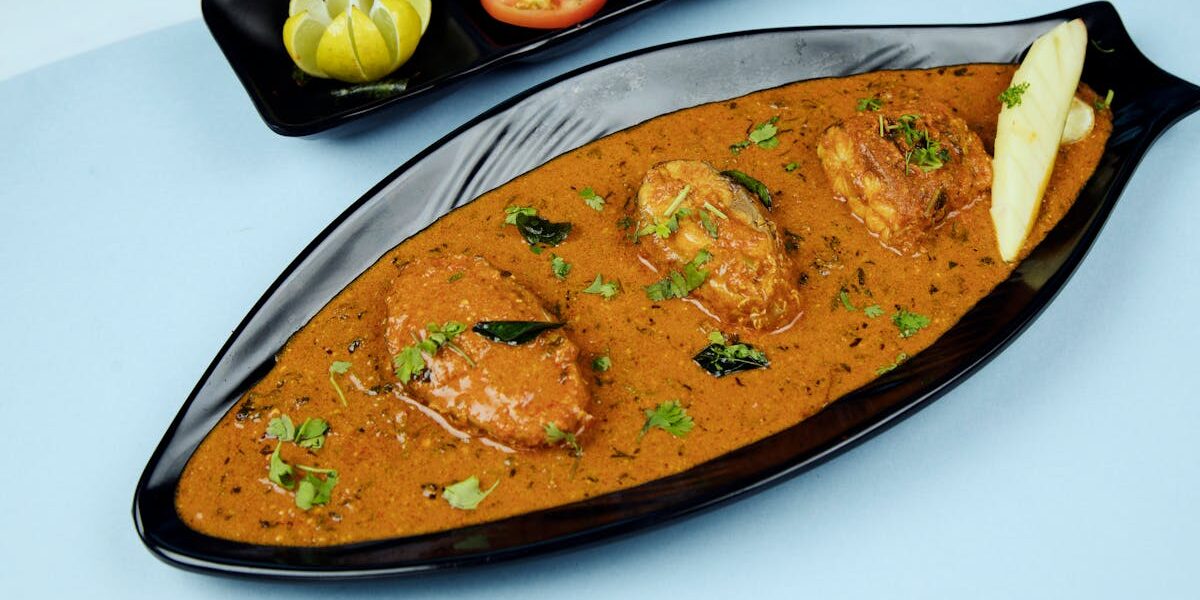
The everyday backbone of Goan eating, eaten by Hindu and Catholic households alike, usually for lunch. Boneless or bone-in pieces of pomfret, kingfish, or mackerel simmer in a thin, bright orange-red coconut curry sharpened with kokum or tamarind and tinted with Kashmiri chilli powder and turmeric. It is served over a generous mound of parboiled red rice (ukda chawal). The flavor profile is sour-spicy-savory, not sweet, and the curry should be loose enough to pool around the rice rather than coat it.
2. Pork Vindaloo
The real Goan vindaloo is a long way from the bright orange ”extra hot” curry-house version. Its name comes from the Portuguese ”carne de vinha d’alhos” — meat in wine and garlic — which the Portuguese brought to Goa as a ship-preservation technique. Goan cooks swapped wine for palm vinegar, added Kashmiri chillies, cumin, mustard seeds, cloves, cinnamon, and a generous amount of garlic, and slow-cooked pork (often with fat) for hours until the meat fell apart in a deep mahogany sauce. Real vindaloo is tart, garlicky, warmly spiced, and only moderately hot. The heat is supposed to bloom across the back of the palate, not punch you in the throat.
3. Sorpotel
The single most iconic dish of Catholic Goa, traditionally eaten at Christmas and at weddings. Pork (and traditionally pork blood and liver) is boiled, finely diced, and then simmered in a vinegar-heavy masala with Kashmiri chillies, ginger, garlic, and warm spices until the sauce reduces to a deep, glossy red-brown stew. Sorpotel improves dramatically over two to three days as the flavors marry; many Goan families make it a full week before Christmas and reheat it daily. It is eaten with sannas (steamed coconut rice cakes) or with poi (Goan bread).
4. Xacuti (Chicken or Lamb)
Pronounced ”shakuti,” this is one of the most spice-complex curries in all of India. The masala is built on dry-roasted poppy seeds, coconut, dried red chillies, coriander, cumin, fennel, peppercorns, cloves, cinnamon, mace, star anise, and nutmeg — sometimes more than fifteen spices in one paste. The result is a thick, dark, intensely fragrant curry that envelopes pieces of chicken (most common), lamb, or even crab. Xacuti is the dish to order if you want to taste the high end of Goan masala craft, and it is often a Sunday or special-occasion dish in Catholic homes.
5. Recheado-Stuffed Mackerel (Bangda Recheado)
A whole mackerel (bangda) is butterflied along the belly, slathered inside and out with bright red recheado masala, dusted with semolina or rice flour, and pan-fried in coconut oil until the skin crisps and the masala caramelizes. The result is a fish that is sweet-sour-spicy-garlicky all at once, with the oily flesh of mackerel standing up beautifully to the assertive paste. It is street-vendor and home-kitchen staple in equal measure, and one of the easiest Goan dishes to recreate abroad as long as you can find decent mackerel and make a small batch of recheado.
6. Prawn Balchao
A vinegar-cured prawn relish that sits halfway between curry and pickle. Small prawns are cooked down with onions, dried shrimp, Kashmiri chilli paste, garlic, ginger, and vinegar until the mixture turns thick, dark, and almost jam-like. It keeps for weeks in the fridge and is eaten in small spoonfuls alongside rice, with bread, or stuffed into pao for an absurdly good sandwich. The name traces back to the Portuguese-influenced trade route through Macau, where ”balichao” originally meant a fermented shrimp paste.
7. Sol Kadhi
Pink, frothy, and intensely refreshing, sol kadhi is the everyday Goan digestive drink and the standard accompaniment to fish curry rice. It is made by steeping kokum in warm water, mixing the resulting pink liquid with thin coconut milk, then seasoning it with crushed garlic, green chilli, cumin, and salt. Drink it cold at the end of a meal and feel an oily, spicy belly settle within minutes.
8. Sannas
Goan sannas are pillowy, slightly sweet steamed rice cakes, leavened traditionally with toddy (fresh palm sap) and now more often with yeast and a little sugar. The batter — soaked rice ground with coconut — is fermented overnight, ladled into small molds, and steamed. The finished sanna is white, spongy, faintly sweet, and the perfect counterweight to sorpotel or vindaloo. They are the Goan answer to the South Indian idli but richer, sweeter, and meatier in texture.
9. Cafreal Chicken
A bright green chicken dish that betrays Goa’s African connections — the name comes from ”cafre,” the Portuguese term for African (and the dish traveled to Goa via Mozambique). Chicken is marinated in a vivid green paste of coriander leaves, mint, green chillies, ginger, garlic, cumin, and vinegar, then pan-fried or grilled. It is herby, hot, and tangy, often served with a wedge of lime and onion rings. Cafreal is the Goan dish that bridges most easily into the broader piri-piri-chicken family eaten across Portugal, Angola, and Mozambique.
10. Choriz Pao
The Goan sausage sandwich. Goan choriz (chouriço) is a vinegar-cured, garlic-heavy, deep red pork sausage that has been hung to dry for days or weeks. To make choriz pao, the sausage meat is squeezed out of its casing, fried with onions and a splash of vinegar, then stuffed into split Goan pao (or any soft white roll). It is bar food, beach food, breakfast food — and a near-perfect representative of how Catholic Goan cooks have absorbed Portuguese charcuterie traditions and made them their own.
11. Ambot Tik
Literally ”sour and spicy,” ambot tik is a tangy red curry usually made with shark, kingfish, or catfish, although you can use any firm white fish. The masala leans heavily on Kashmiri chillies, garlic, cumin, peppercorns, and a generous slug of vinegar or tamarind. There is no coconut here, which makes ambot tik feel sharper and cleaner than the more typical Goan fish curries. It is a Catholic Goan classic and one of the simplest serious Goan dishes a home cook can attempt.
12. Khatkhate
A Hindu Goan mixed-vegetable stew that bridges religious and seasonal traditions. Five or seven vegetables — typically pumpkin, drumstick, sweet potato, raw banana, yam, ash gourd, and others — are simmered with toor dal, coconut, Kashmiri chillies, and a small amount of jaggery, then finished with a tempering of mustard seeds and curry leaves. The lucky-number convention (5 or 7 vegetables) ties khatkhate to festival cooking, and it is a fixture at Saraswat Brahmin Hindu feasts.
13. Bebinca
The ”Queen of Goan Desserts.” Bebinca is a sixteen-layer (or seven-layer in smaller home versions) baked pudding made from coconut milk, egg yolks, sugar, ghee, and a touch of flour. Each layer is poured over the previous and individually browned under heat until you have a striped, fudgy, intensely rich cake. A good bebinca takes the better part of an afternoon and dozens of egg yolks. It is the showpiece dessert at Christmas, weddings, and Easter, and arguably the most direct Portuguese inheritance in the Goan sweet repertoire — convent cooking, transplanted.
14. Dodol
A dark, fudgy coconut-and-jaggery sweet made by cooking thick coconut milk with palm jaggery and rice flour for hours until the mixture turns glossy and pulls away from the pan. Dodol is dense, chewy, and intensely sweet, almost like a dense Asian toffee, and is traditionally a Christmas sweet, although you will find it year-round at Mapusa market and the Margao kondari (sweet shops). Variations of dodol exist across the Portuguese diaspora — Sri Lanka, Malacca, Macau — but the Goan version is unmistakable.
Goan Breads: The Daily Loaves of Goa
One thing that sets Goa apart from almost every other Indian state is its bread culture. The Portuguese left behind not just recipes but an entire bakery infrastructure of village ovens (the ”fornel”) tended by the ”poder” — the bread-baker who cycles through Goan neighborhoods at dawn and dusk delivering fresh loaves, often signaling his arrival by squeezing a rubber horn on his bicycle. The poder is to Goa what the milkman was to mid-century England: an institution, and one that is still mostly intact in 2026.
The four main Goan breads are poi, a soft, slightly tangy whole-wheat round leavened traditionally with toddy and now mostly with yeast; pao, the soft white dinner-roll style bread that you’ll see used for choriz pao and other sandwiches; undo, a denser, smaller, harder-crusted roll that goes well with curry; and katro, a butterfly-shaped roll that splits down the middle and is excellent for sopping up gravy. All four are baked in wood-fired ovens at small village bakeries that still account for the bulk of bread production in Goa, even as supermarket bread has spread.
Goan breads are not garnish; they are part of the structural logic of the meal. A Catholic Goan home will eat bread with breakfast (often with butter and choriz), bread with the curry course (especially with sorpotel or vindaloo), and frequently bread with the evening drinks. Where rice anchors the Hindu Goan plate, bread anchors much of the Catholic one.
Cooking Techniques to Know
Goan cooking is technique-heavy more than gear-heavy. A few core methods, learned and repeated, will unlock most of the cuisine. Master these and you can attempt 90% of Goan recipes confidently.
1. Dry-roasting whole spices: Before grinding, whole spices are toasted in a dry pan over medium-low heat until fragrant — usually 60 to 120 seconds. This is non-optional. Skipping it produces a muddy-flavored masala. Watch carefully; spices burn quickly.
2. Soaking and grinding wet masala: Dried chillies are soaked in warm water or vinegar for 15 to 30 minutes to soften before grinding. The wet masala is then ground in a wet grinder or strong blender with grated coconut, garlic, ginger, and just enough liquid to keep the blades moving. The finished paste should be smooth and thick, not watery.
3. Bhuna (slow-frying the masala): The ground paste is sizzled in oil over medium heat for 5 to 15 minutes until it darkens, the oil separates around the edges, and the raw chilli smell disappears. This is the single most important step in any Goan curry. Underdone masala will taste sharp and raw. Properly bhuna-ed masala tastes deep and integrated.
4. Tempering (tadka / phodni): Hindu Goan dishes often finish with a tadka of hot oil bloomed with mustard seeds, curry leaves, and sometimes asafoetida or dried red chilli. The hot tempering is poured over the cooked dish at the end and stirred in. Our complete guide to tadka technique covers this in depth.
5. Vinegar-curing and slow-cooking pork: The vindaloo / sorpotel / sausage family all rely on extended contact between pork and acidic vinegar-based marinades. The meat is marinated overnight in palm vinegar and ground masala, then cooked low and slow for 1 to 3 hours until it falls apart. The combination of acid and time is what gives these dishes their signature tang and tender bite.
6. Pan-steaming sannas: Sannas batter is fermented overnight, ladled into greased small bowls or idli molds, and steamed. The fermentation gives them lift; the bowl shape gives them the distinctive flat-top, round-bottom Goan profile.
7. Layer-baking bebinca: Each thin layer of batter is poured into a greased pan and browned under heat — traditionally a metal sieve filled with coal placed over the pan, in modern kitchens the overhead broiler — until it sets. Then the next layer is poured on. Sixteen layers, sixteen brownings. Patience is non-optional.
Goan Food vs Other Indian Cuisines: A Comparison
Goa is technically part of India, but in many practical ways its food sits closer to the Portuguese-influenced cuisines of Mozambique, Macau, and Malacca than to North Indian food. The table below positions Goan food against four other Indian regional cuisines to make the differences concrete.
| Feature | Goan | Punjabi | Bengali | Kashmiri | Kerala |
|---|---|---|---|---|---|
| Main fat | Coconut oil | Ghee, mustard oil | Mustard oil | Mustard oil, ghee | Coconut oil |
| Main souring agent | Kokum, palm vinegar | Yogurt, tomato | Tamarind, lime | Yogurt, dried cockscomb flower | Tamarind, kokum |
| Main protein | Fish, pork | Chicken, lamb, paneer | Fish, lentils | Lamb, mutton | Fish, beef, chicken |
| Heat level | Moderate to high | Moderate | Low to moderate | Moderate | High |
| Defining spice | Kashmiri chilli, vinegar | Garam masala, kasuri methi | Panch phoron, mustard | Saffron, fennel, ratan jot | Curry leaves, coconut |
| Staple starch | Red parboiled rice, poi bread | Wheat (roti, naan) | Long-grain rice | Long-grain rice | Red rice, appam |
| Religious profile | Hindu + Catholic + Muslim | Sikh + Hindu + Muslim | Hindu + Muslim | Hindu + Muslim | Hindu + Muslim + Christian |
| Pork allowed? | Yes (Catholic) | Rare | Rare | No | Yes (Christian) |
| Bread tradition | Yes, daily (Portuguese) | Yes, daily (roti, naan) | Limited (luchi) | Limited (girda) | Limited (appam) |
The big takeaways from this table: Goan and Kerala food share more with each other than either does with North Indian cuisine, both being coconut-and-coastal-fish cultures. Goa is unique in its bread culture and its open use of pork and beef across the Catholic community. The use of vinegar as a souring agent is also nearly unique to Goa among Indian regions — most other Indian cuisines reach for yogurt, tamarind, lime, or unripe mango first.
Goan Drinks: Feni, Urak, and Beyond
Goa is one of the few Indian states with its own indigenous spirits tradition. Feni is the king — a clear, pungent distilled spirit made from either the fermented juice of cashew apples (caju feni) or from coconut palm toddy (coconut feni). Cashew feni has a distinctive fruity-funky aroma somewhere between rough tequila and a young grappa; coconut feni is softer and slightly sweeter. Both clock in at 40–45% ABV and are protected by a Geographical Indication tag from the Government of India, meaning only spirits made in Goa from these specific sources may legally be called feni.
Urak is the lighter, lower-strength (15–20% ABV) first-distillation cousin of cashew feni, only available during the cashew harvest from mid-March through May. Urak is much more delicate than feni, smelling strongly of cashew fruit, and is usually mixed with lime juice and sugar over ice to make an urak limbu pani — Goa’s version of a margarita.
Beyond spirits, sol kadhi (described above) is the everyday non-alcoholic Goan drink. Kokum sherbet — kokum syrup mixed with cold water, salt, and a pinch of cumin — is the summer cooler of choice. And the tradition of ”drinking” toddy fresh from the morning’s harvest, before it ferments much, is still alive in some villages, though declining. With food, a Goan meal might be paired with a cold local beer (Kingfisher being the obvious one), a glass of port (a clear Portuguese legacy), or a feni cocktail.
A Sample Goan Meal Plan: How to Eat for a Week
If you want to cook Goan at home for a full week, the rhythm below will give you variety, control your shopping list, and avoid having you make complicated dishes every night. It is loosely modeled on how a Catholic Goan household with vegetarian sympathies actually eats — keeping the slow-cooked specialties for weekend cooking.
| Day | Breakfast | Lunch | Dinner |
|---|---|---|---|
| Monday | Poi with butter, banana | Fish curry rice + sol kadhi | Khatkhate + rice |
| Tuesday | Sanna leftover + tea | Ambot tik + rice | Cafreal chicken + salad |
| Wednesday | Choriz pao | Veg xacuti + rice | Tonak (sprout curry) + poi |
| Thursday | Bread, butter, fruit | Recheado mackerel + rice | Daal + rice + pickle |
| Friday | Poi with butter | Prawn curry + rice | Bangda recheado + sol kadhi |
| Saturday | Choriz pao | Pork vindaloo + sannas | Chicken xacuti + poi |
| Sunday | Eggs + poi | Sorpotel + sannas + dodol | Light fish curry + rice |
A few practical tips: make your recheado masala and a base coconut-chilli vatan on Sunday for the week ahead, both keep for two weeks in the fridge. Buy your fish on the day you’ll cook it; freeze pork for vindaloo in single-meal portions. Vindaloo, sorpotel, and balchao all improve over 2–3 days, so cook a big batch on Saturday and re-eat them later in the week without quality loss. Pre-toast a week’s worth of whole spices for the xacuti masala and grind to order.
Festivals and Food: When and What Goans Eat
Goan food is built around festivals more visibly than most Indian cuisines, largely because the Catholic calendar dictates a clear annual rhythm. Christmas is the biggest food event of the year: sorpotel, vindaloo, choriz, roast pork, bebinca, dodol, and a dozen kinds of ”kuswar” — the assorted Christmas sweets like neureos (sweet pastry parcels filled with coconut and jaggery), kulkuls (little curl-shaped fried sweets), bolinhas (semolina-coconut cookies), and dose (coconut fudge). Many families spend the week leading up to Christmas baking and frying together; the Christmas kuswar tray is a serious social signal.
Easter brings roast lamb, sorpotel again, and special breads. The Feast of Saint Francis Xavier in December, centered on Old Goa, is another major food event. Weddings — particularly Catholic ones — feature multi-course meals built around pork roasts, sorpotel, prawn curry, chicken xacuti, sannas, and elaborate dessert spreads.
On the Hindu side, the festivals are equally food-centric. Ganesh Chaturthi in August or September brings modaks (sweet steamed dumplings filled with coconut and jaggery), patoleo (turmeric-leaf-wrapped sweet rice cakes), and a strictly vegetarian feast. Diwali brings sweets and fried snacks. The Shigmo festival in March is celebrated with sannas, vegetable curries, and a sweet rice porridge. And during the four-month Hindu Chaturmas period (roughly July to November), many Hindu Goan families observe vegetarianism, which is when the vegetable-forward Konkani dishes get their fullest expression.
Where to Eat Goan Food (and How to Spot the Real Stuff)
If you are eating in Goa itself, the best food is generally not on the beach. The shacks of Anjuna, Baga, and Calangute mostly cook for tourists, and the menus skew toward generic ”Indian restaurant” food with a few token Goan dishes that are often watered down. To find the real cuisine, head inland to family-run ”comedores” and old-school restaurants in Panaji, Margao, Mapusa, and Old Goa, or to riverside taverns away from the beach belt. Look for menus that name specific Goan preparations — recheado, ambot tik, xacuti, cafreal — rather than just ”fish curry” and ”prawn masala.”
Outside Goa, Goan food is rarer than you might expect. In Mumbai, look for old Catholic eateries in the Bandra and Fort areas. In Bangalore and Delhi, a handful of specialist restaurants do real Goan cooking. Internationally, the diaspora is concentrated in Lisbon, London, Toronto, and the Gulf, with the best Goan food usually at private supper clubs and Sunday-only family-run spots rather than full-time restaurants. The dishes that travel best are vindaloo, sorpotel, and chicken xacuti, since they all benefit from cooking in advance.
When you are scanning a menu, three red flags suggest a non-authentic kitchen: (1) vindaloo described as ”very hot” — real vindaloo is tart and warm, not punishingly hot; (2) sorpotel that is brown rather than deep red-mahogany, which suggests it has been under-spiced; and (3) bebinca that is fewer than seven layers, which means corners are being cut. None of these are death sentences, but they are signals to keep your expectations measured.
Frequently Asked Questions About Goan Food
Is Goan food the same as South Indian food?
No. Goa is geographically on the western coast of India, north of Karnataka, and culturally distinct from the dosa-and-idli South Indian cuisines of Tamil Nadu, Andhra Pradesh, and Kerala. It shares some coastal-cooking DNA with Kerala (coconut, fish, red rice) but is far more Portuguese-influenced. Goan menus do not typically feature dosa, idli, sambar, or rasam — the staples of true South Indian cuisine.
Why is Goan food so different from the rest of India?
Four and a half centuries of Portuguese rule (1510–1961) is the short answer. The Portuguese introduced ingredients (chillies, tomatoes, potatoes, cashews), techniques (vinegar pickling, sausage curing, layered baking), and an entire bread culture that did not exist in pre-colonial India. They also overlaid a Catholic religious identity on much of the population, which permitted pork and beef to enter everyday cooking in ways unusual elsewhere in India. The result is a cuisine that reads as half-Indian, half-Iberian.
What is the difference between Goan vindaloo and curry-house vindaloo?
British-Indian ”vindaloo” is a generic hot curry, typically with cubed potatoes, designed around the British curry-house heat ladder (korma, madras, vindaloo, phaal). Real Goan vindaloo contains no potatoes (despite a folk etymology — the name comes from Portuguese ”vinha d’alhos” meaning wine and garlic, not ”vin” + ”aloo”/potato), is made specifically with pork, and is defined by vinegar, garlic, and Kashmiri chilli rather than raw heat. Real vindaloo is warmly spicy, deeply tart, and slow-cooked. The curry-house version is fast, hot, and tomato-heavy.
Can Goan food be made vegetarian?
Yes — Hindu Goan cuisine, particularly the Saraswat Brahmin tradition, has a deep vegetarian repertoire. Khatkhate (mixed vegetable stew), tonak (sprout curry), bhaji (vegetable curry), patal bhaji (lentil-vegetable curry), and many fasting-day preparations are entirely vegetarian. Catholic Goan dishes are harder to convert because they often rely structurally on pork fat and pork blood, but vegetable xacuti, vegetable vindaloo, and prawn-substitute mushroom balchao are all reasonable adaptations. For broader Indian vegetarian context, see our Indian food guide.
What does ”Goan masala” mean on a menu?
It is usually shorthand for either recheado masala (the red vinegar-chilli paste used for stuffing fish) or for the broader category of wet, coconut-based curry masalas used in Goan cooking. There is no single ”Goan masala” the way there is ”garam masala.” If a menu lists ”fish in Goan masala” without further specification, it most often means the dish is in a coconut-Kashmiri-chilli curry.
What kind of rice is used in Goa?
Goan red rice (ukda chawal), a parboiled coarse-grain rice with a reddish hull intact, is the default. It is nuttier, chewier, and more nutrient-dense than basmati. The parboiling is done by soaking and steaming the unhusked rice before milling, which gelatinizes some of the starch and gives the cooked grain a firm, almost al-dente bite that holds up to thin coconut-based curries. Basmati is rarely used in everyday Goan cooking and is considered more of a ”company” rice. If you cannot find Goan red rice, short-grain brown rice is the best substitute.
How spicy is Goan food?
Moderate to high, but not punishing. The defining chilli is the Kashmiri or bedgi chilli, which is more about color and aroma than raw heat. Most Goan dishes have a clear, lingering warmth rather than the upfront throat-burning heat of, say, an Andhra curry or a Thai green curry. Recheado, vindaloo, and ambot tik can be made hotter on request. The Kashmiri-chilli base means you can scale heat up or down without changing the fundamental flavor profile.
Is Goan food healthy?
The Hindu Goan side is exceptionally healthy: coconut, fish, vegetables, lentils, red rice, fermented rice cakes, very little dairy, moderate use of oil. The Catholic Goan side is richer — pork, vinegar-cured sausages, coconut-cream-heavy gravies, layered egg-yolk desserts — but in normal home-cooking portions, it is still less indulgent than, say, a Punjabi or Mughlai feast. The overall cuisine is well-balanced when you eat across both traditions, with the high seafood and vegetable intake offsetting the richer pork dishes.
What’s the best Goan dish for a beginner to cook at home?
Chicken cafreal is the easiest entry point: it is essentially a green-marinade chicken pan-fry, very forgiving, and uses ingredients (coriander, mint, ginger, garlic, green chilli) that most people already have. A close second is recheado mackerel, which only requires you to make the recheado paste and pan-fry the fish — both quite manageable once you have your chillies and palm vinegar. Save vindaloo and sorpotel for your fourth or fifth Goan cook, when you have built up the spice cabinet and the muscle memory.
Where can I buy Goan ingredients in the US?
Kokum, Kashmiri chillies, jaggery, coconut milk, mustard seeds, curry leaves, and turmeric are all easily found at Indian grocers across the US and Canada, and online via specialty Asian food shops. Palm vinegar and feni are harder — many Goan cooks abroad substitute cane vinegar or apple-cider vinegar for palm, and skip feni entirely. Goan red rice, choriz, and bebinca are essentially unavailable commercially outside India; brown short-grain rice, Spanish chorizo with extra vinegar, and a homemade bebinca are the best workarounds. For more on related Asian pantries, see our Kerala food guide.
What sweets should I try besides bebinca?
Dodol (dark coconut-jaggery fudge), neureos (sweet pastry parcels filled with coconut and jaggery, especially at Christmas), bolinhas (semolina-coconut cookies), kulkuls (small curled fried sweets dredged in sugar), dose (coconut fudge), patoleo (turmeric-leaf-wrapped sweet rice cakes, Hindu Goan), and serradura (a Portuguese-influenced ”sawdust pudding” of crushed Marie biscuits and whipped cream) are all worth trying. Bebinca is the showpiece, but the Christmas kuswar tray is where you’ll find the cuisine’s full sweet vocabulary.
What’s the difference between Goan choriz and Spanish chorizo?
Both are pork sausages cured with paprika or chilli and garlic, but Goan choriz is far more vinegar-forward and uses Kashmiri rather than Spanish chillies, giving it a tangier, brighter flavor. The cure is also typically faster — days rather than weeks — and the texture inside the casing is coarser and looser. Goan choriz is rarely eaten as is; it is almost always crumbled out of the casing and fried with onions before serving, whereas Spanish chorizo is often eaten sliced and raw or barely cooked.
Is Goan food halal?
Catholic Goan food, with its heavy pork content, is not halal. Hindu Goan vegetarian dishes are. Many Goan Muslim families maintain their own variation of the cuisine that omits pork and emphasizes lamb, chicken, and seafood — chicken cafreal, chicken xacuti, prawn caldine, and lamb vindaloo (made with vinegar but using lamb instead of pork) are all eaten across the Muslim Goan community.
What is the national dish of Goa?
India does not officially designate state ”national dishes,” but if Goa had one by consensus it would be fish curry rice (xitt koddi). It is eaten across religious lines, every day, at lunch, by the great majority of Goans. Vindaloo gets the international fame, sorpotel gets the festival glamour, but fish curry rice is the cuisine’s true heart.
Final Thoughts on Cooking Goan at Home
Of all the regional Indian cuisines, Goan food rewards home cooking unusually well. The flavors are big and forgiving — a slightly-too-much-vinegar vindaloo still tastes great; a slightly-too-thick fish curry still works over rice — and the wet masala logic means most of your work is upfront in the grinder, after which the actual cooking is fast. You don’t need a tandoor, a wood-fired oven, or any specialist equipment. A heavy-bottomed pan, a good blender, and a willingness to dry-roast and grind your own spices will get you 95% of the way to a genuinely good Goan dinner.
Start with one wet masala — recheado is the easiest and most flexible — and learn to make it well. Build out from there to vindaloo, cafreal, ambot tik, and fish curry. Add a Hindu Goan dish or two (khatkhate, tonak, sol kadhi) so you have vegetarian options. Bake a small bebinca for a special occasion. Within a couple of months, you’ll have a Goan repertoire that genuinely belongs on your table, with flavors no other Indian cuisine produces.
And the most important Goan rule: cook a little extra and eat it the next day. Almost every signature Goan dish — vindaloo, sorpotel, balchao, xacuti, ambot tik — improves overnight as the vinegar mellows and the masala settles. The Catholic Goan habit of cooking a sorpotel on Sunday and reheating it through the week isn’t a workaround; it’s the way the dish is meant to be eaten. Goan food is, in its bones, a cuisine of patience, vinegar, and time.

Mei Lin Chen
Mei Lin Chen is an Asian food writer and recipe developer. Melbourne-raised and London-based, she has spent over a decade exploring the rice paddies, hawker stalls, and home kitchens of South-East and East Asia. Her recipes balance traditional technique with everyday practicality.